Making Wall Street make sense. Plain-English breakdowns of earnings, valuation and market moves. Free newsletter + earnings cheat sheet at the link below.
I've posted 12 money lessons so far, and they're scattered all over my timeline. So here they all are in one spot.
Each one is a single card, so start wherever you want. I'll keep adding to this as new ones go out.
Binance just confirmed the hack, and it's big. About $6.3B was taken, and about $3B has been frozen so far.
What they say happened: a DevOps engineer's laptop was compromised, which let the attacker push through unauthorized withdrawals. No wallet keys were leaked.
Binance says it will cover every loss from its emergency fund and its own money, and says user funds are safe. Deposits and withdrawals are paused for now.
If you keep crypto on any exchange, this is a good reminder to know where your coins actually sit.
Binance's initial investigation suggests that the security incident may involve a compromised DevOps engineer’s laptop, which allowed an attacker to gain access to a service container and submit unauthorized withdrawal transactions. We have found no evidence of any wallet private key leak. We will share a detailed technical post-mortem once the investigation is complete and the facts are fully verified.
The estimated total impact sits at around $6.3B. We have worked with blockchain partners to freeze affected assets, with ~$3 billion frozen on-chain so far.
Binance will cover all losses from the SAFU fund and the company’s funds. User funds are safe. We will also publish an updated Proof of Reserves once the remediation is complete.
As an immediate precaution, Binance has:
- temporarily suspended deposits and withdrawals while security checks are completed;
- revoked the affected address authorisation;
- engaged law enforcement and blockchain intelligence partners to trace and recover funds.
Our teams are working around the clock to resolve this issue safely and thoroughly. We are working closely with our law enforcement partners to confirm the identity of these criminals and bring them to justice.
Please rely only on official Binance channels for updates. Please feel free to contact Binance Customer Support if you have any further questions.
https://t.co/ywB2mKFy0p
CNN says $GOOGL just had its worst day on record, down more than 12%. Worse than any day in 2008 or Covid.
Here's what didn't fall: operating income up 30% to $40.6B, Cloud profit $11.1B vs $3.6B a year ago, and search growing at its fastest pace in 5 years.
The stock had a historic bad day. The business had a strong quarter. Those aren't the same thing.
I own $GOOGL.
Shares of Google's parent company tumbled more than 12% on Thursday, their worst day on record – a historic single-day decline bigger than any day during the Covid-19 pandemic or 2008 financial crisis. https://t.co/PB3xps2o09
Update: CZ says user funds are safe and, as a shareholder, he expects them to be fully covered. He notes he no longer runs Binance, so this isn't an official statement yet. Binance itself still hasn't commented. https://t.co/Jw6IKgKJpR
User funds are safe!
It does look like a hack on Binance. Appreciate the quick freeze from Tether (~$971m) and Circle (~$823m).
I don't manage Binance (.com) anymore, but as a shareholder, I expect all user funds will be fully covered.
Tether says it has frozen more than 1.567 billion USDT tied to a possible hack at Binance. Circle froze about $823 million of USDC too, according to Binance founder CZ.
Binance itself hasn't commented yet. CZ says user funds are safe and he expects them to be fully covered.
Two things worth knowing:
• Stablecoins like USDT and USDC can be frozen by the company that issues them. That helps in a hack, and it also means the issuer has control most holders never think about.
• Crypto you keep on an exchange is only as safe as that exchange.
More as it comes in.
BREAKING: Tether has frozen $971 million worth of USDT which has been linked to a suspected Binance hack.
This comes just minutes after Binance wallets saw a $2.8 billion outflow across five blockchains.
Binance has yet to comment on the situation.
Own $TSLA? You get a vote. Tesla's board is asking shareholders to re-elect Elon Musk, Robyn Denholm and JB Straubel at the annual meeting on Dec 3 at 4 PM ET.
A few numbers from the letter:
• 35,566% total shareholder return since the 2010 IPO (FactSet, through Oct 28)
• 1.74 million paid FSD (Supervised) customers
• More than 10 million vehicles delivered
Your proxy materials come with a control number. You can vote online, by phone, by QR code or by mail. Even a few shares count.
I own $TSLA.
Tesla’s Board of Directors has sent a new letter to shareholders:
“Dear Tesla Shareholders,
We have always set ambitious goals at Tesla. Achieving them requires the right team and the right leadership at both the management and Board levels. At our Annual Meeting on December 3, 2026, our three Class I Directors - Elon Musk, Robyn Denholm and JB Straubel - are up for re election.
We have all the building blocks necessary to propel us into our next phase of transformational growth, but we must keep the leadership that has proven key to Tesla's success. We are asking you to vote FOR ALL proposals on this year's ballot - most importantly, the re-election of our three Class I Directors.
Thank you for your continued support of Tesla.
Sincerely,
The Tesla Board of Directors”
More info:
$GOOGL fell about 13% today. Search ad revenue came in below estimates, and the cash going into AI ran deeper than expected.
The other side of the same report:
- Operating income up 30% to $40.6B. The core business made more money, not less.
- Google Cloud profit roughly tripled, to $11.1B from $3.6B a year ago.
- Search queries grew at the fastest pace in five years. People are using Google more. The open question is how fast AI search turns into ad dollars, and Google says early ad tests in AI Mode look promising.
- The Gemini app passed 1 billion users.
A 13% day tells you how people feel about a stock today. It doesn't tell you whether the reason you bought it still holds.
I own $GOOGL.
COINBASE EARNINGS: $COIN just reported $1.22B in revenue, right in line with Wall Street, even with crypto trading quiet.
• Revenue $1.22B vs Est. $1.21B
• Transaction revenue (trading fees) $590M, about flat from last quarter
• Subscription and services $570M, now 49% of net revenue
• Net income $719M, after losses the last 3 quarters
Why: trading volume fell again, but subscription and services revenue rose about 3% from last quarter. Prediction markets are now running at more than $200 million a year in revenue. Part of the profit was a $715M gain on crypto Coinbase holds as an investment.
Why it matters: revenue is still down 35% from $1.87B a year ago, when crypto was busier. The business is leaning less on trading than it used to.
Takeaway: Coinbase is building income that doesn't depend on people trading every day.
(Source: Coinbase Q3 shareholder letter; revenue estimate MarketBeat)
STRATEGY EARNINGS: $MSTR just reported 848,517 bitcoin on hand, and a $20.91B gain on that pile in Q3.
• Bitcoin held: 848,517 as of Oct 25, average cost about $75,446 each
• Revenue $125.4M vs Est. $128.0M (that's the old software business)
• EPS $44.75 vs $8.42 a year ago
• BTC Yield, their bitcoin-per-share measure: down 3.7% this year
Why the profit is so big: Strategy counts its bitcoin at market price every quarter. Bitcoin rose in Q3, so the gain shows up as profit. When bitcoin falls, the same rule turns it into a loss.
Why it matters: Strategy sold $5.41B of new stock in Q3 to keep the machine running. More shares means each share holds a little less bitcoin unless they buy enough to keep up, and this year they haven't.
Takeaway: for Strategy, the earnings line is mostly a bitcoin price report. Bitcoin per share is the number to watch.
(Source: Strategy Q3 release; revenue estimate MarketBeat)
INTEL EARNINGS: $INTC just beat on profit and still fell more than 15% after hours. Next quarter's forecast is what did it.
• Revenue $16.5B vs Est. $16.5B
• Adj. EPS $0.52 vs Est. $0.40
• Q4 sales outlook $15.0B to $16.0B vs Est. $17.1B
• Data center and AI sales $7.3B, up 78%
Why: PC chip sales fell 5%, and Intel's finance chief expects the PC slowdown to last at least through the first half of next year. Gross margin is guided down to 38% from 44.1% this quarter.
Why it matters: the data center side is booming, but PCs are still Intel's biggest business. When that side shrinks, the whole forecast shrinks with it.
Takeaway: a strong quarter can still sink a stock when the next one looks weaker.
(Source: Intel Q3 release; estimates Bloomberg, FactSet)
AMAZON EARNINGS: $AMZN just posted its best operating margin ever, 13.9%, and the stock still fell about 9% after hours.
• Revenue $201.9B vs Est. $202.3B
• EPS $1.89 vs Est. $1.96
• AWS (Amazon Web Services, its cloud business) $46.0B, up 39%, vs Est. $45.5B
• Q4 sales outlook $240B to $247B
Why EPS dipped: last year's Q3 included a $9.5B gain on Amazon's Anthropic stake. Operating income actually jumped to $28.1B from $17.4B.
Why it matters: Amazon is spending so much on AI data centers that free cash flow over the last 12 months was negative $42.4B. AWS alone brought in about $500 million a day this quarter, and investors want that spending to keep paying off.
Takeaway: the cloud business is booming, but the bill for building it is huge.
(Source: Amazon Q3 release; estimates LSEG via CNBC)
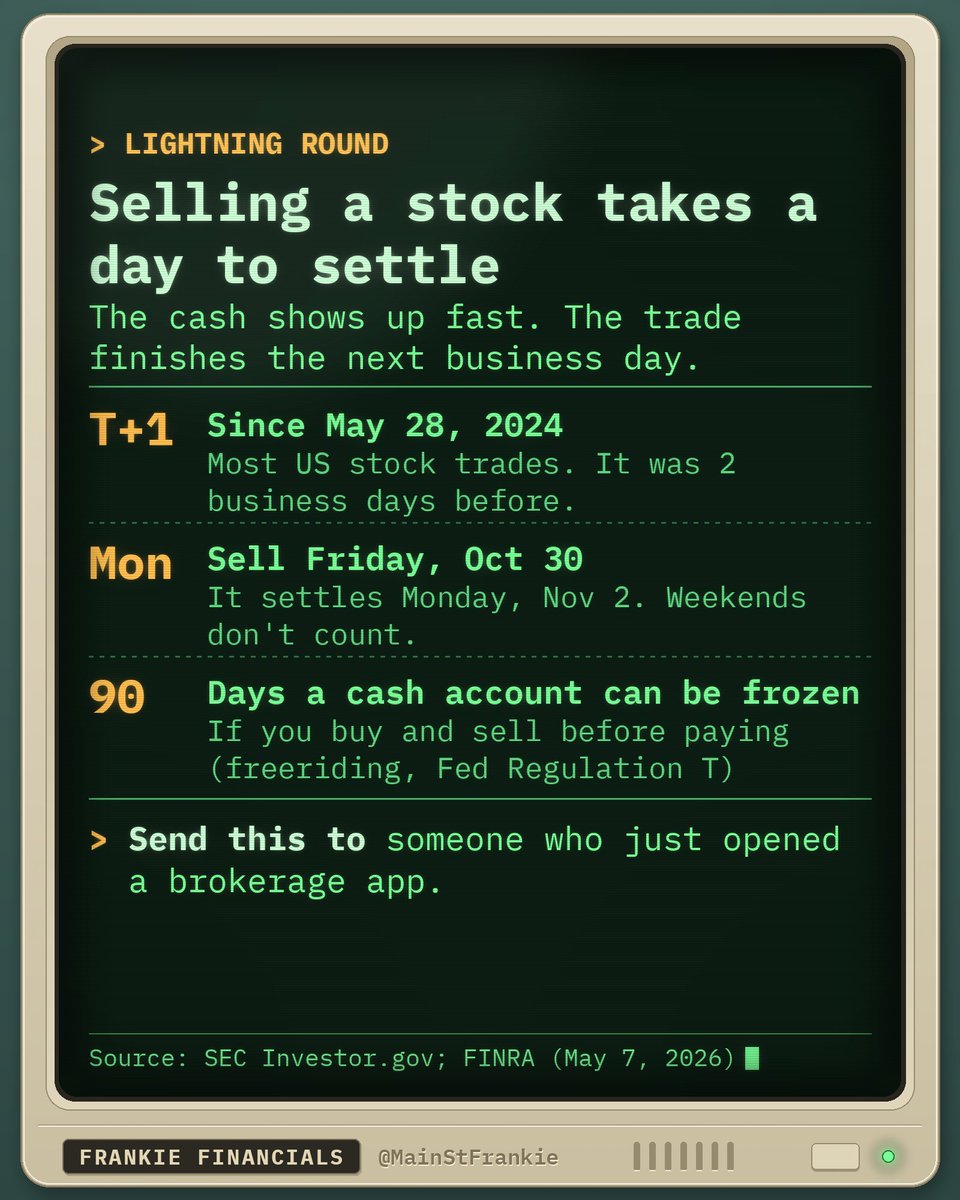
Sell a stock and the cash usually shows up in your app right away. Technically, though, the trade isn't finished until it settles.
Since May 28, 2024, most US stock trades settle one business day after the trade. That's what "T+1" means: trade date plus one day. Sell on a Tuesday and it settles Wednesday. Sell this Friday, Oct 30, and it settles Monday, Nov 2, because weekends don't count. It used to be T+3, then T+2 until 2024.
I remember those days. I use cash accounts, no margin, and when I'd buy and sell a stock, my cash sat tied up waiting to clear. I was always afraid of getting hit with the 90-day freeze.
That freeze is real. In a cash account, if you buy a stock and sell it before you've paid for the buy with settled cash, that's called freeriding. Under the Fed's Regulation T, your broker may have to freeze your account for 90 days. T+1 made it a lot easier to avoid.
Sources: SEC (https://t.co/20WxrwF4H3) and FINRA
I've posted 12 money lessons so far, and they're scattered all over my timeline. So here they all are in one spot.
Each one is a single card, so start wherever you want. I'll keep adding to this as new ones go out.
A 10% dividend yield looks like free money. Usually it's a warning light.
Yield is the yearly dividend divided by the share price. When the stock drops, the yield goes up on its own, even if nothing about the business got better.
A $50 stock paying $2 a year yields 4%. If it falls to $25 and still pays $2, that's 8%. If the company then cuts the dividend to $1, you're back to 4% on a stock worth half as much.
Do you look at the yield first or the payout history?