A weekly podcast where me, Phillip, and and a different guest go through a huge list of movies that Quentin Tarantino likes or recommends. I like all movies.
Mario Bava on the troubles he faced while making 'Planet of the Vampires' (1965):
"I wish that the audience and the critics knew the conditions under which I am forced to make movies. For 'Planet of the Vampires' (1965), I didn’t have anything to work with. There was only a studio, completely empty and squalid, because there was no money: I had to turn that into a [mysterious, alien] planet.
So what did I do? In the studio next door there were two big plastic rocks, a leftover prop from a sword-and-sandal movie or something. I took these two rocks and I put them in the middle of my studio, then I covered the floor with smoke and I darkened the white wall in the background.
I shot the whole movie by moving the two rocks around the studio. Can you believe it? And, while I was shooting, there was this American screenwriter who kept rewriting the script, changing scenes and dialogues… After a while, I stopped listening to him.
Do you remember that, at the end of the movie, the astronauts land on planet Earth at the beginning of its existence? Well, the screenwriter wanted the astronauts to get off the spaceship and meet Adam and Eve in the Garden of Eden, which was located in Missouri, USA. Naturally, I refused to shoot this kind of stuff."
(Mario Bava's interview with Luigi Cozzi, translated by Cinepugno, 1970)
Quentin Tarantino recounts seeing his first blaxploitation film with an all-Black audience at nine years old. The movie was Jim Brown’s “Black Gunn,” and the experience changed his life forever…
“During this time, my mother was dating a football player named Reggie. So in an effort to score points with her, Reggie asked to hang out with me. Being a football player, he asked her, "Does he like football?" She told him “No, he likes movies.”
Well, as luck would have it, so did Reggie. And apparently, he saw every blaxploitation flick that came out. So late one Saturday afternoon, Reggie, who I had never met before, dropped by the apartment, picked me up and took me to the movies.
He took me to a part of town I had never been before. I had been to the big movie theater districts in Hollywood and Westwood, but this place was different.
This theater row had huge cinemas on both sides of the street, which went down for about eight blocks. I realized when I got older, Reggie took me to the theater district in downtown Los Angeles, located on Broadway Boulevard.
All of them were blaxploitation films. Films I had never seen, the new movie on Broadway, having opened just last Wednesday, was Blaxploitation superstar Jim Brown's new motion picture, "Black Gunn."
I had seen the TV spots a lot that week, and it looked really exciting. I even remember the radio spot proclaiming, "Jim Brown was gonna get the mother who killed his brother."
Well, "Black Gunn" was definitely the movie Reggie wanted to see. One being the connoisseur that he apparently was, it was the only one of the movies playing he hadn't seen. Also, it was pretty fucking obvious he dugged Jim Brown.
This thing, the Saturday night showing of the brand new Jim Brown movie, the huge auditorium, I mean, it was probably 1400 seats, wasn't exactly packed, but it was definitely busy and buzzing with anticipation.
My little face was the only white one in the audience.
This was to be my first movie in a, except for me, all black movie theater in a black neighborhood. This was 1972.
Then, on a downtown Saturday night, Jim Brown's new movie, "Black Gun," began flickering through the film projector shutter gate for an extremely excited audience of about 850 black folks, 800 of them male.
And frankly, I've never been the same.
To one degree or another, I've spent my entire life since both attending movies and making them, trying to recreate the experience of watching a brand new Jim Brown film on a Saturday night in a black cinema in 1972. There was no comparison.
When Jim Brown sat behind his desk and Bruce Glover, Crispin’s father, and his other white gangster henchmen threatened him, and Gunn hits a button under the desk and a sawed off shotgun dropped in his lap (see below), the massive theater full of black males cheered in a way the nine-year-old me had never experienced in a movie theater before.
At the time, living with a single mother, it was probably the most masculine experience I'd ever been part of.
And when the movie ended with a freeze frame of Jim Brown as Gunn, the guy behind Reggie made me proclaimed out loud, "Now that's a movie about a bad motherfucker!"
Sadly, after that night, I never saw Reggie again, and to this day I have no idea what happened to him."
From Quentin Tarantino’s book Cinema Speculation
Moonraker (1979) goes completely off the rails and that’s the appeal. Roger Moore leaning into the absurd, a lineup of memorable villains, glossy visuals, and set pieces that just want to entertain. It’s Bond at his most ridiculous and it works.
Madonna explains why she got mad & cried because of Al Pacino's method acting in "Dick Tracy" (1990):
"Interviewer: Describe the relationship between the two characters, Breathless and Big Boy.
Madonna: I had nothing but contempt for Big Boy. And he would treat me like a bad little girl. He was always slapping me and spanking me. And in terms of being on the set, whenever Al Pacino put his prosthetics on, his suit, he was a gross pig. And he’s not that way in real life—he’s very gracious, and well-mannered, and gentlemanly, and sweet... .
As Big Boy, he would tell me the dirtiest jokes and suck on his cigar like it was some sort of weird phallic symbol, and just be a pig. He was always smacking my butt and my face. I hated him, I loathed him, I was disgusted with him. And so what happened off-camera was that I’d always try to be moving away from him, and he’d always grab me and go “Get over here!” which is exactly what happened in the movie. Every time I expressed my distaste for him, he would smack me, which is also what happened in the movie. I got mad. He made me cry sometimes.
There was a scene where he kept smacking me in the stomach, and it would sting, and what made me cry was not so much the hit, but the fact that Warren Beatty wouldn't stop. He would just keep going, and I was humiliated. So it worked, because that’s what’s happening to Breathless—she’s totally humiliated by Big Boy.
Interviewer: Did you always stay in character off-camera?
Madonna: Yes. I always do, in all my movies."
("Dick Tracy: The Making of the Movie", Mike Bonifer, 1990)
The Trailer to a super Documentary on one of Cinema’s greatest poster artists & illustrators — DREW STRUZAN.
DREW: THE MAN BEHIND THE POSTER (2013)
Saluting historian Kevin Brownlow, who turns 88 today! If you've never seen the 1980 series, Hollywood: A Celebration of the American Silent Film, written and directed by Brownlow and David Gill, you can pop over to YouTube and treat yourself! It's amazing.
Zombi 3 turns 38 today. Two directors, a stolen bioweapon, and a zombie bird that should not work but absolutely does. Fulci walked off set. Mattei finished it. The result is chaotic, messy, and impossible to look away from
Joan Crawford in her iconic role as bitchy Crystal Allen in "The Women" (1939). Here, getting her comeuppance as she tosses out a classic way around a word prohibited by the film code at that time...
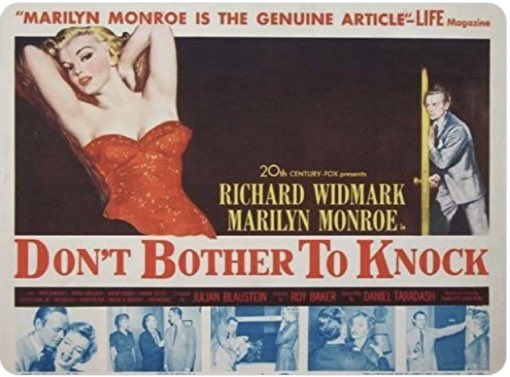
Few babysitters could be so heartily disrecommended as Nell Forbes (Marilyn Monroe) in "Don't Bother to Knock" (1952). An unsuspecting couple leaves her in charge of their little darling on elevator operator Eddie Forbes's (Elisha Cook Jr.) suggestion. Bad move. #filmnoir
Disclosure Day is masterful. It’s Spielberg at his absolute best in years. It’s emotional, poignant, paranoid, intriguing, striking, and everything else that makes movies so damn magic as an art form. Empathy really is our specialty as humans. A truly special film. #DisclosureDay
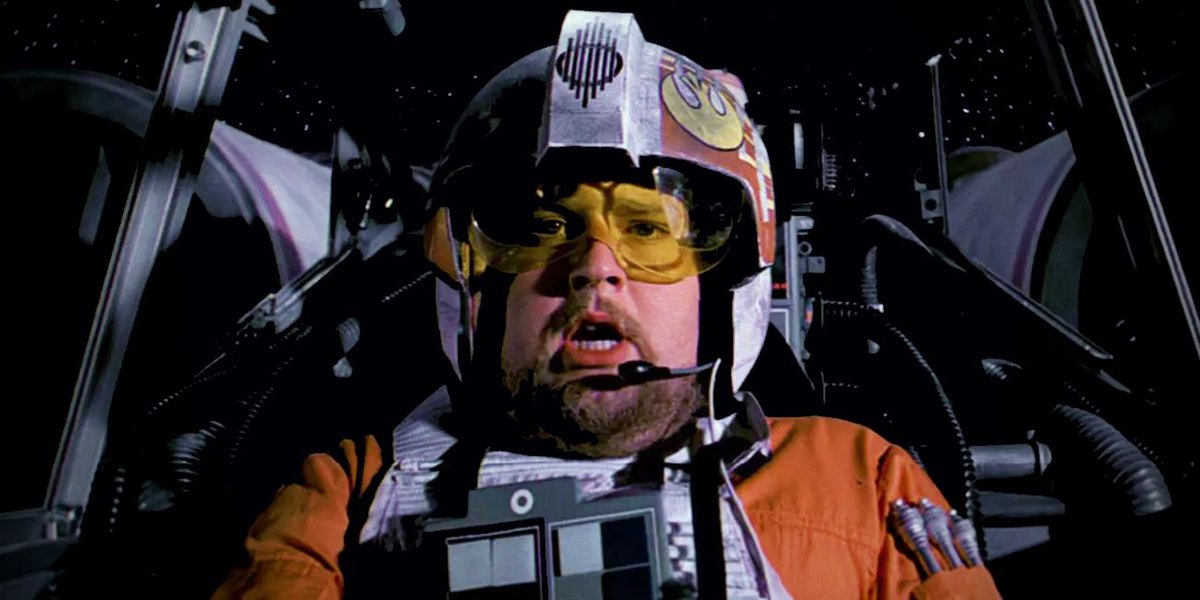
Right before Porkins is shot down, Biggs yells "Eject!" at him as if they aren't all wearing open helmets and wouldn't just die anyway in the vacuum of space