We’re happy to announce that our EDR Internals & Development training is now in its final stages of development.
Over the past several months, an enormous amount of work has gone into building this highly technical & detailed training. The course covers the internals of modern EDR from both user-mode and kernel-mode perspectives, including techniques like syscall hooking, filesystem minifilters, ETW telemetry, memory scanning, kernel callbacks, process instrumentation callbacks, call stack tracing, and anti-tampering mechanisms.
The course concludes with building a limited yet functional custom EDR agent and we test it against several malware techniques to gain practical experience with detection engineering and EDR internals.
This huge undertaking would not have been possible without @GigelV41464 who dedicated countless hours to analyzing different EDR products, building custom implementations, analyzing internal mechanisms, and documenting the techniques with excellent depth and clarity.
The official launch date is scheduled for June 15, 2026 but starting today, we're opening access to an early bird discount of 20% for a limited time.
EDR Internals & Development: https://t.co/oN6qcMjLr2
Today we released WhisperLoader, a stealthy loader that combines Thread Name-Calling for payload delivery with a TP_DIRECT.Callback hijack for execution on the victim's own pool worker thread.
The loader injects the shellcode into the target remote process using thread descriptions via APC queues, skipping PROCESS_VM_WRITE access on the process handle and skipping NtWriteVirtualMemory. If the target process already exposes a PAGE_EXECUTE_READWRITE memory region, the loader reuses it skipping both NtAllocateVirtualMemory and NtProtectVirtualMemory calls.
The shellcode is executed by hijacking a TP_DIRECT.Callback pointer inside an existing thread pool object (TP_IO / TP_ALPC / TP_JOB), then posting a single completion packet so the victim's own worker dispatches into it.
https://t.co/epouhr8B0K
Great news for our students!
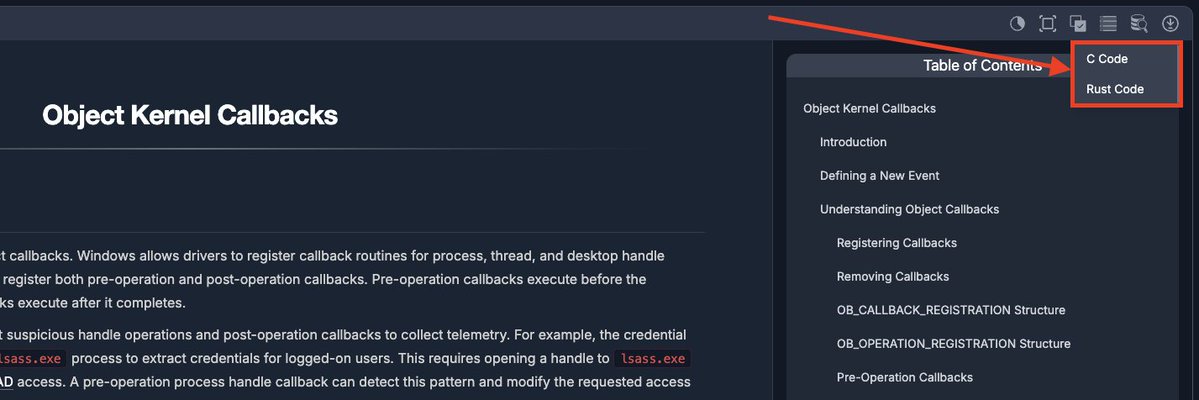
The entirety of our EDR Internals & Development course has been updated to include Rust implementations.
Students can now download the code in either C or Rust for all supported modules at no extra cost.
EDR Internals & Development: https://t.co/LeGYIWO09h
Released TpDirectCallbackHijack, a process injection PoC where you overwrite one function pointer inside an existing thread pool object (TP_IO / TP_ALPC / TP_JOB), post a single completion packet, and the victim's own worker thread dispatches your shellcode. Restore stub puts the pointer back on the way through, so the thread pool keeps working.
No remote thread, no Get/SetThreadContext. Pool Party adjacent. Based on @_0xDeku's research.
https://t.co/MzpJaCeFdh
Today we released WhisperHijack, a stealthy process injection PoC that uses thread descriptions to inject payloads into remote processes, then patches a waiting thread's return address for execution.
Every memory op happens in-target via Queue APCs, with zero NtWriteVirtualMemory or NtSetContextThread calls.
Based on @hasherezade TNC + WTH research.
https://t.co/lyUQciKEbx
Great news for students enrolled in our EDR Internals & Development course!
We're planning to provide Rust implementations of all the course's code, giving students the opportunity to explore EDR internals and develop EDR solutions using Rust.
This update will bring the course in line with our other courses, which already feature implementations in both C/C++ and Rust.
EDR Internals & Development Course: https://t.co/LeGYIWO09h
We’d have to respectfully disagree on this point.
Understanding EDRs internal working is directly relevant to offensive security. Knowing how/when EDRs collect telemetry, analyze behavior, and detect threats provides valuable insight into how defensive mechanisms operate, which can directly aid the development of evasion techniques.
Publishing the "ApiHashing" repository based on the latest V2 update of the malware development course.
The library replaces GetModuleHandleA/W, GetProcAddress, and GetModuleFileNameW and supports EAF bypass through ROP-style gadgets, forwarded functions, ordinal exports and API set DLLs versions 2 through 6.
https://t.co/VTUkR99nrJ
The third batch of updated modules for the Malware Development Course 2.0 is nearly ready, with around (20) rewritten modules & code.
This batch of updates provides significant changes and includes two new modules specifically dedicated to improving the custom GetProcAddress implementation, extending it to handle API set DLLs, forwarded functions, and ordinal exports.
The update also includes an enhanced implementation of compile-time API hashing.
Syllabus: https://t.co/67X8yAD3Dq
Malware Development database updated for the month of September with new snippets.
End of summer sale is still active using SUMMER15 code.
Database: https://t.co/Bg8zuxfaAW
Our end of summer sale is now active!
For a limited time, get 15% off all Maldev Academy offerings with the code SUMMER15. The discount applies across our full training catalog.
Available trainings: https://t.co/my9ln7X58d
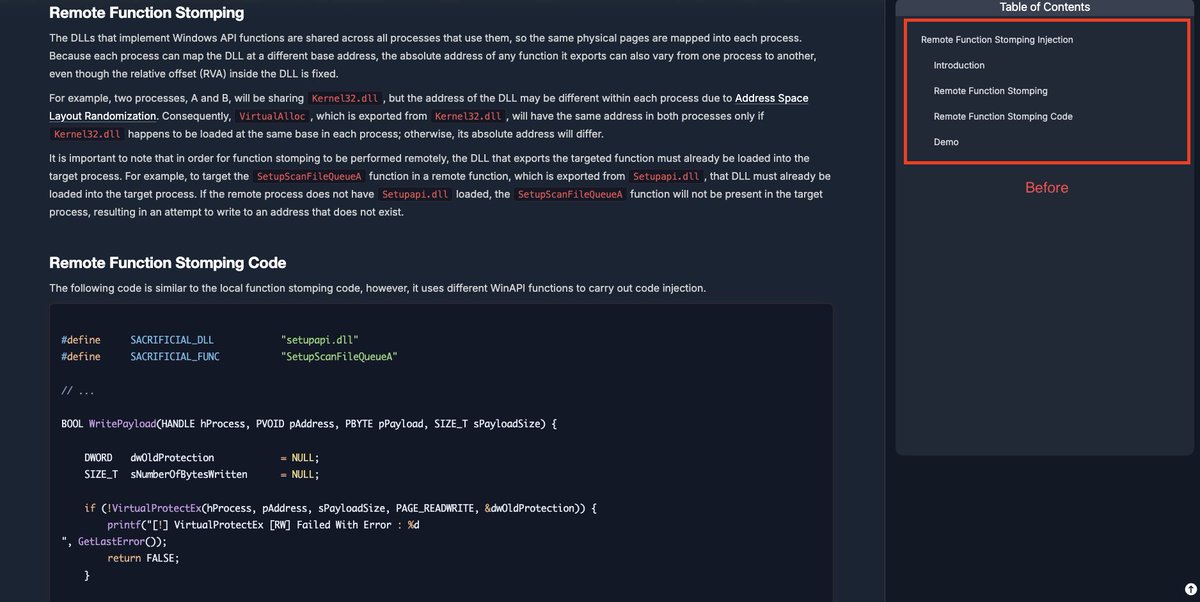
Last week, updates for the Malware Development Course 2.0 continued with the release of the second batch of module and code updates. To give you an idea of how extensive these updates are, below is a before-and-after comparison of the Remote Function Stomping Injection module.
As usual, these updates are available to all users enrolled in the Malware Development Course at no extra cost.
Full syllabus: https://t.co/67X8yAD3Dq
The next batch of refreshed modules for the Malware Development Course 2.0 is out. 20 modules updated along with content and code.
Updated syllabus: https://t.co/P6qCbpbTa0
The team is working hard, and the second batch for the Malware Development Course 2.0 is already on the way for next week.
Another 20 modules will be released with updated content and code.
Syllabus: https://t.co/P6qCbpbTa0
The team is working hard, and the second batch for the Malware Development Course 2.0 is already on the way for next week.
Another 20 modules will be released with updated content and code.
Syllabus: https://t.co/P6qCbpbTa0
Honestly, I bought all the courses from @MalDevAcademy, following my own pace to cover them. It is like an ocean of knowledge embedded in these courses.
Understanding EDR internals is just as valuable for attackers as it is for defenders.
In our EDR Internals & Development course, students learn and implement ETW Threat Intelligence (ETW-TI), a powerful Windows telemetry source capable of exposing security-relevant activity such as cross-process memory writes, memory protection changes, APC operations, and thread manipulation.
Understanding how an EDR observes an operation changes how you think about offensive tradecraft. Instead of looking at a technique only from the attacker's perspective, you can understand the telemetry it generates, which behaviors are visible to security products, and why certain techniques are easier to detect than others.
EDR Internals & Development Course: https://t.co/LeGYIWO09h
Our Malware Development course is being upgraded to version 2.0, with updates rolling out gradually in phases. The first phase will modernize the first 25 modules and is expected to launch by early next week.
All currently enrolled students will receive the the updated course at no additional cost.
Malware Development Course: https://t.co/wXXC0YH1dL