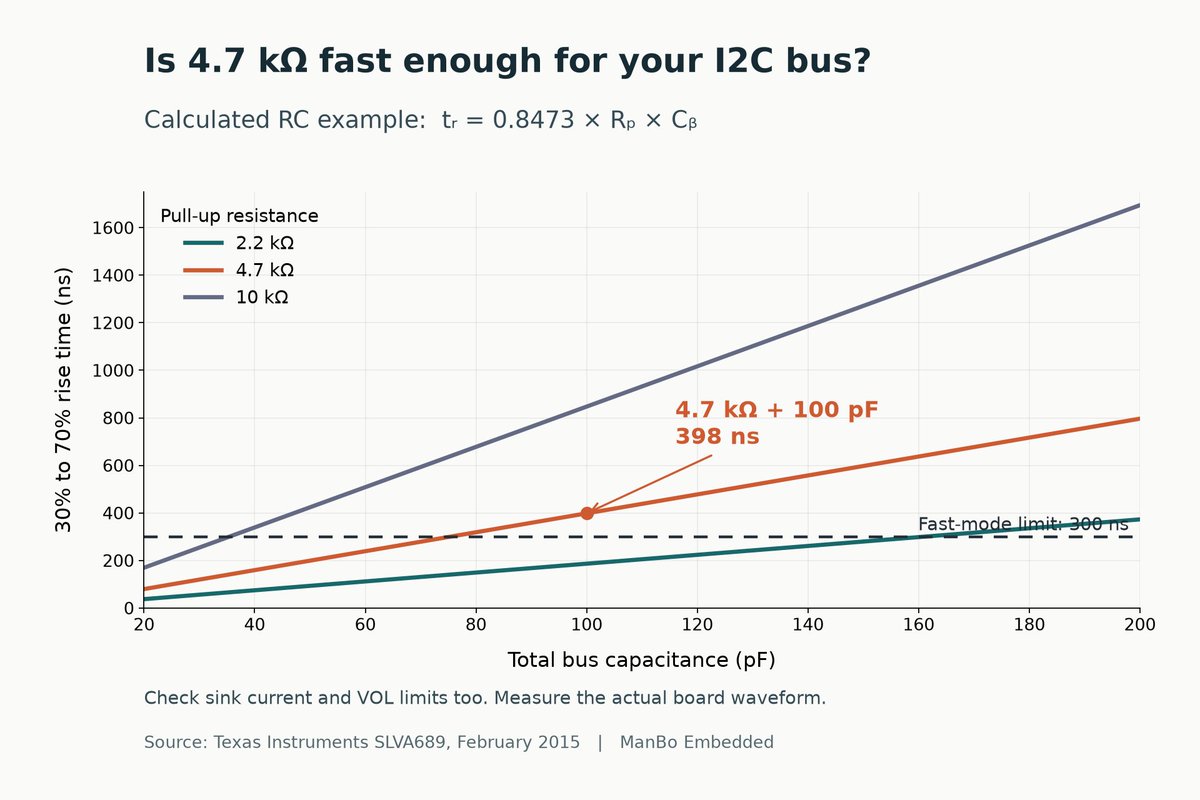
4.7 kΩ + 100 pF gives a calculated I2C rise time of 398 ns. Fast-mode (400 kHz) allows 300 ns.
Check both rise time and sink current before choosing pull-ups.
TI: https://t.co/DCyJyOCKQb
@hackaday The author reports video/OSD freezes during repeated C6 ownership changes. Factory mode avoided them on the tested firmware; begin() doesn't enter it. Check this board-specific note before sustained I2C updates:
https://t.co/RiOd2xAATO
@john_newall PCM peak is the largest sample magnitude. For signed 16-bit audio, a peak of 1,000 is about 3% of full scale (32,768). Inspect decoded samples after software volume adjustment, before I2S.write(). That helps separate a quiet digital signal from the amplifier side.
@_streetdogg If load faults are in scope, compare the same faulting load with rd=x1 and rd=x0. Discarding the result mustn't suppress its exception or applicable side effects. RV32I §1.1.6:
https://t.co/Szsu10Jc9M
@kurogedelic For a Cardputer port, I'd compare peak refill time with the display idle and during redraws, using all four tracks. Log voice shedding alongside it to distinguish timing changes from a drop in voice load.
@ATaylorFPGA Thanks for clarifying. I read the README's sender-side throughput label as the definition of those plots. Your measurements are from the board, so that interpretation was off.
@pimoroni For North American projects, check the carrier's LTE bands first. The A7683E here supports B1/3/5/7/8/20/28; Pimoroni notes coverage may be limited there.
https://t.co/7C7GIoiiSd
@Jk1Fyu Is 2.4 V at the ACC pin or the regulator output? Compare unloaded ACC with the LDO input under load, using the same ground. If the input stays near 13.8 V, focus on the LDO/load; if it collapses too, trace upstream.
@shapoco For this RP2350 port, check clk_peri in the startup log after changing clk_sys. The README notes the SDK can move clk_peri to the 48 MHz USB PLL; the demo sets it to 125 MHz for 62.5 MHz panel SPI.
https://t.co/mYgY8SBEav
@Alacritic_Super Check a node's last-heard time before treating a map pin as a live link. OrcMesh's map includes locally saved history. RSSI/SNR in its inspector describe the last RF hop.
https://t.co/rDKksw7onY
@Light21687270@AstraKernel Check the exact chip when setting up Rust: ESP32/S2/S3 need the Xtensa compiler fork; C3/C6 use RISC-V. Espressif's guide separates those toolchains:
https://t.co/DIOlBtLFLX
@kuran_kuran For DIN MIDI, try a raw UART RX log at 31,250 baud before parsing. If no bytes arrive, check the Pico's UART pin mux and the signal after the optocoupler. If bytes arrive, inspect the parser next.
@Alacritic_Super The router's USB port supplies power; DNS traffic goes over Wi-Fi. Clients still need the C3's IP as their DNS server. The README lists automatic DHCP setup as unfinished.
https://t.co/RafzFDRJUU
@hackaday The ESP32-C3 in this build has no on-chip DAC. The article's built-in-DAC suggestion needs a different chip. Milen's C3 design uses a PCM5102A over I2S.
https://t.co/0imkPHLWia
STM32F411 USART2, PCLK1=16 MHz, OVER8=0, BRR=0x008B: the calculated rate is 115,108 baud, about -0.08% from 115,200.
Read back BRR and check PCLK1. This is divider error only; oscillator error is extra.
ST RM0383 Rev 4 §19.3.4: https://t.co/vrFTOOcIXg
@scribblerlive The README reports 28.9M stored parameters on ESP32-S3 with 8 MB PSRAM and 16 MB flash. That's different from the article's NXP/289M description. The README doesn't document the STM32 diffusion demo.
@mikerankin The RAM note could use an update: the current code has HOR_LEN=8 and ST7789_WIDTH=280, so disp_buf uses 4,480 bytes. The 48-line example would need 26,880 bytes.
https://t.co/jmmQYEyOHj
@HatoGnss On C3, the current docs list 256-bin FFT over native USB for continuous capture. The 2048-bin mode uses snapshots. Continuous capture still analyzes selected windows, so it can miss short bursts.
https://t.co/beVCbOig3n