2025 taught me that in crypto, the quiet infrastructure plays often deliver the loudest wins by year-end.
As someone who's watched data layers evolve, here's my personal prediction on how @pyth_network is building momentum and set to close 2026 in absolute grand style. 🧵🧵
For years, financial data felt like a private members club.
The best information moved through closed terminals, expensive relationships, and systems designed to keep most people outside the room.
🧵🧵🧵 With @PythNetwork
looking at @dreamworkhq differently.
Instead of leaving you with generic career tips, it adapts your resume to each opening and handles the application process across company career pages.
. @dreamworkhq autopilot handles strong job matches automatically, tailoring your resume and cover letter for each application.
Less time filling out forms, more time preparing for the interviews that actually matter.
Introducing Dreamwork, the last tool you'll ever need to find your dream job.
With just a resume we match you to millions of jobs, tailor each resume and submit them for you - all with just a click.
But it's more nuanced than that ⤵
Checking my @PlayOnMint rank from the Telegram Mini App, then opening https://t.co/VdDdCuDT5B just to double-check it.
That small detail actually matters.
Your XP, rank and leaderboard position now carry across both surfaces, so the progress you make on your phone is still part of the same Season 1 board.
And with the $125K $MNTD pool tied to Season 1, that consistency becomes more important.
No separate progress bar.
No different ranking depending on where you play.
Just one account, one progression system, and the same leaderboard wherever you check it.
I have lost track of progress before simply because different platforms showed different numbers.
Having the Mini App and website point to the same board removes some of that friction.
Now I’m curious how quickly everyone’s ranks are syncing.
Has yours been matching perfectly across both yet?
CRYPTO WENT GLOBAL. SPENDING IT STILL FEELS LOCAL.
I was looking into @WebitPay and the concept is pretty straightforward.
The problem they're addressing is something crypto users have probably experienced:
You have USDC.
You can move it anywhere.
But using it for a normal purchase can still involve unnecessary steps.
It's a new day and happy Sunday.
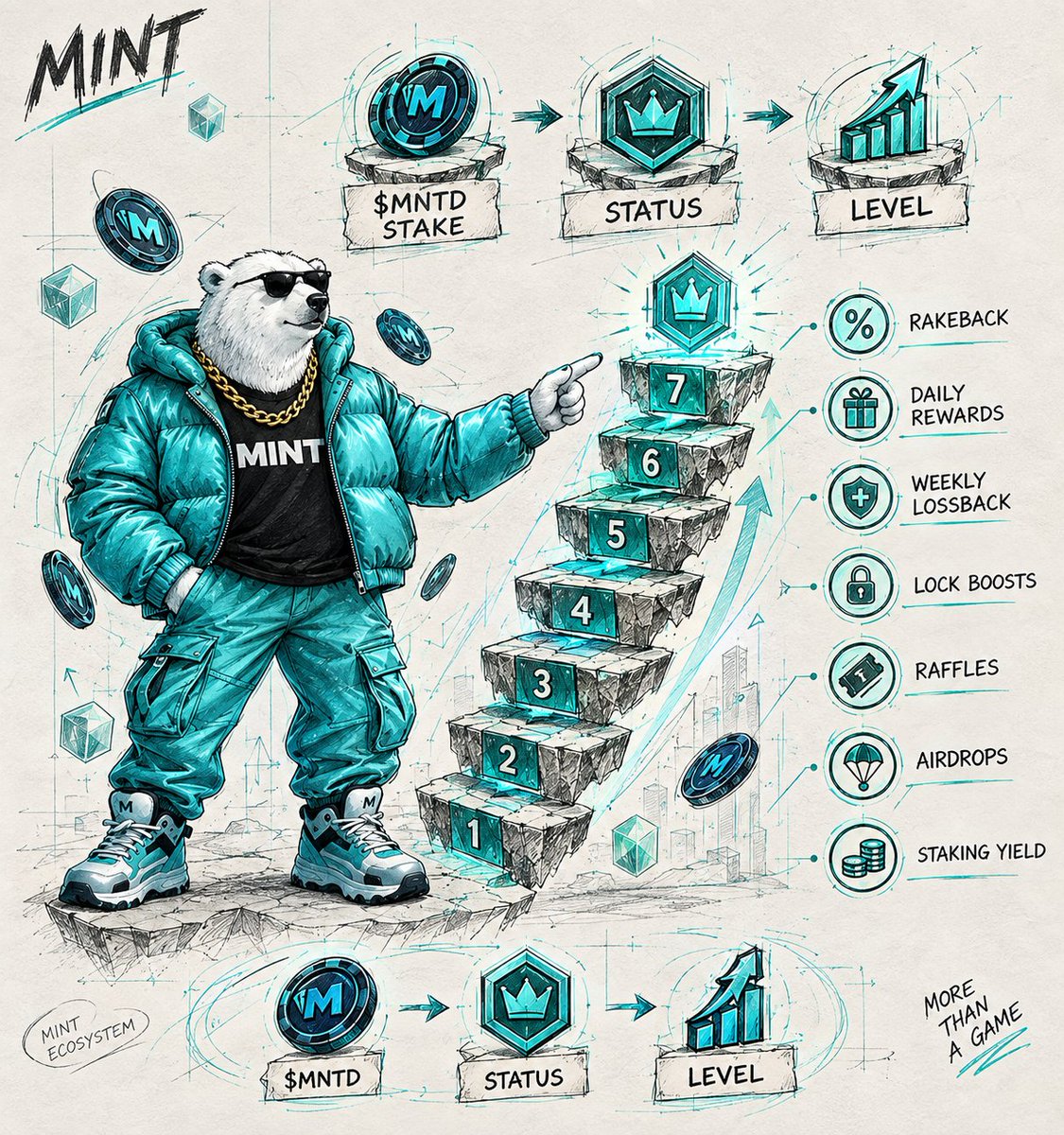
Here’s a different narrative that explains Status as a progression system rather than just a list of benefits:
I think of MINT Status less like a VIP badge and more like an account progression system.
@PlayOnMint has seven Status levels, and staking $MNTD is what moves you through them.
You are not unlocking completely different games as you climb.
You are improving the rates attached to the activities you already use.
As the Status level increases, the account can access stronger rates across things like rakeback, daily rewards, weekly lossback, lock boosts, raffles, airdrops and staking yield.
The structure is straightforward:
Stake $MNTD → reach a Status level → unlock the rates attached to that level.
There is no need to treat the seven levels as separate products. They are different points on the same progression ladder.
So when thinking about MINT Status, keep the roles clear.
$MNTD is what you stake.
Status is the rank you build.
The seven levels are simply the progression between them.
A mapping van can cover a road.
But what happens when the place you need is inside the building?
That is where @vangrid_io gets interesting.
Warehouses, loading bays, workshops, stairwells and other hard-to-map spaces are not places a mapping fleet can constantly visit.
But people with smartphones are already there.
Vangrid turns those phones into distributed capture nodes. Someone can visit a specific location, record the environment, and send the footage back to be reconstructed into usable 3D spatial data.
The important part is the distribution.
You do not need to deploy a dedicated sensor at every location or send a mapping vehicle everywhere.
The hardware is already in people’s pockets.
And with privacy processing handled on-device, identifiable details such as faces and license plates can be filtered before the data leaves the phone.
The idea is not that a phone replaces professional surveying equipment.
It is that billions of phones can reach places those systems cannot reach economically.
That changes what an on-demand spatial data network can look like.
Not a fleet waiting for the world to come to it.
A network of people already inside the world.