Hanna Hattab was not drunk - I hope we don't continue to tarnish his reputation without proven facts.
Thank you to @issasaid232 for clarifying, and @Eri1806 for his integrity.
This just makes me think
We should do what the Saudi Pro League is doing (at least the proposed intention) and increase foreigner limit so that the homegrown players are motivated to move abroad for gametime
Everyone with inflated wages. UNDESERVED
Facts About @IndianFootball 1/10
Football in British India began much earlier than the establishment of FIFA. The Indian Football Association (IFA), West Bengal, was established in Kolkata in 1893, FIFA was founded in Paris in 1904, the All India Football Federation (AIFF) was established in Shimla in 1937, and the Asian Football Confederation (AFC) was founded in Manila in 1954.
This historical timeline reflects India's early association with organised football. It is reasonable to believe that India was among the early football-playing nations when the international game was still developing.
Independent India participated in the Olympic Games in 1948, 1952, 1956 and 1960. In the Asian Games, India won the football gold medal twice, in 1951 and 1962, when six and eight countries respectively participated in the football competition.
However, after these achievements, India gradually lost its position and has not been able to make a significant impact in the Olympic Games or at the highest levels of Asian football. Today, the Asian football landscape has expanded considerably, with 47 member associations competing within the AFC framework.
1. How World Football Has Changed Over the Last 40 Years (1986–2026)
In 1986, the football world witnessed the extraordinary brilliance of Diego Maradona at the FIFA World Cup in Mexico. At that time, 24 countries participated in 52 matches. FIFA's revenues during that period were approximately US$100 million. Forty years later, Mexico has once again co-hosted the FIFA World Cup, alongside the USA and Canada.
-The 2026 edition features 48 participating countries and 104 matches, while FIFA's revenues have grown to approximately US$15 billion. The transformation of international football over these four decades has been remarkable, not only technically and tactically but also commercially.
2. Where Was India Then, and Where Are We Today?
India suffered a 10–1 defeat against Yugoslavia at the 1952 Helsinki Olympic Games and later lost 9–1 to Kuwait in 2010.
What were our results in Asia Cup, when we played teams other than SAFF region?
-in 2023, we lost all three matches against Australia, Syria, Uzbekistan.
-In 2019, we finished at bottom of the table, lost to UAE and Bahrain.
-In 2015, we dropped lowest 173rd in FIFA ranking.
- In 2012, we lost to North Korea, Philippines and Tajikistan
-In 2011, we lost to Australia, South Korea and Bahrain.
-In 2010, we lost to Kyrgyzstan, Turkmenistan, North Korea.
-In 2007, we lost 6 out of 6 matches, Japan, Yemen, Saudi Arabia, conceding 24 goals.
-In 2004, lost to North Korea
- In 2000, we lost to Bahrain, Uzbekistan
-In 1996, we lost to Indonesia, Malaysia
In qualifiers of World Cup? From 1998, only 7 wins in 35 matches, 19 defeats. Of those 6 wins were against SAFF region.
FIFA introduced its world ranking system in 1992. India was ranked 143rd at that time. Our highest-ever ranking was 94th in 1996, while our lowest was 173rd in 2015. In 2026, India is ranked 141st.
Does this ranking adequately reflect our aspirations? Or do we need to move beyond our comfort zone and regularly challenge ourselves against the top 50 footballing nations?
Over the last 30 years, India has won 10 out of 11 SAFF Championship editions in which it participated. However, our FIFA friendly matches have often been arranged against relatively weaker opponents.
During these four decades, Indian football has also witnessed considerable changes in its domestic structure, with competitions such as the Santosh Trophy, Durand Cup, DCM Trophy, Rovers Cup, Scissors Cup, IFA Shield, National Football League, I-League and Indian Super League.
These competitions have contributed significantly to domestic football and club-level fan engagement.
Nevertheless, we must also evaluate the competitive standard of our domestic leagues by examining the performance of Indian clubs in continental competitions and comparing our achievements in AFC.
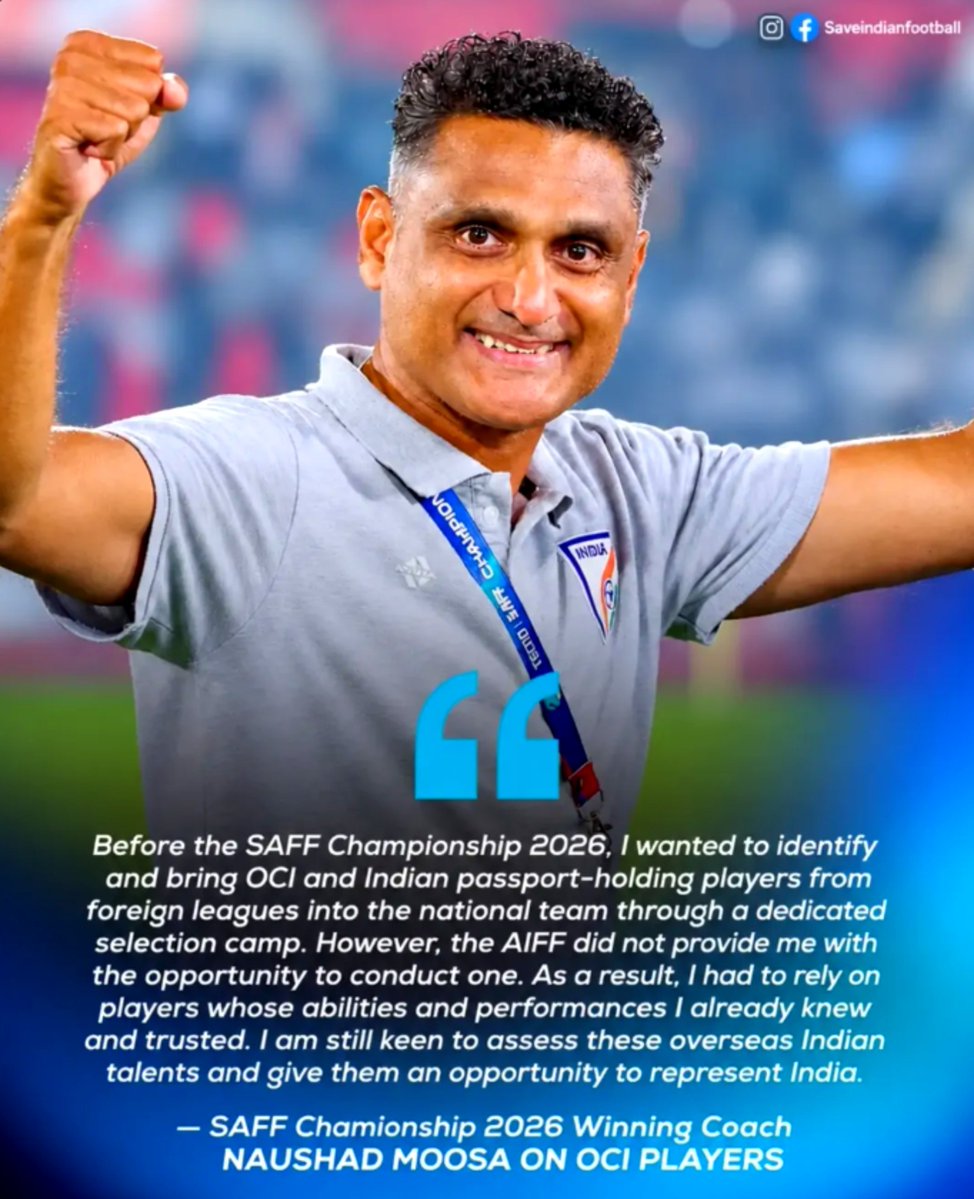
🚨 | BIG: Naushad Moosa indicates that he is actively looking to add OCI and Foreign-based Indian players to the NT Squad 🌎 🇮🇳
The B-Team Head Coach wanted to conduct a special camp to select such overseas talents before SAFF Championship 2026, but AIFF refused! #IndianFootball
Indian football lacks the financial muscle of cricket but it has a soul, for now. Unlike cricketers, most of whom are influenced by the politics of BCCI, footballers know the difference between an enemy and an opponent. Hope those in power don't corrupt their minds