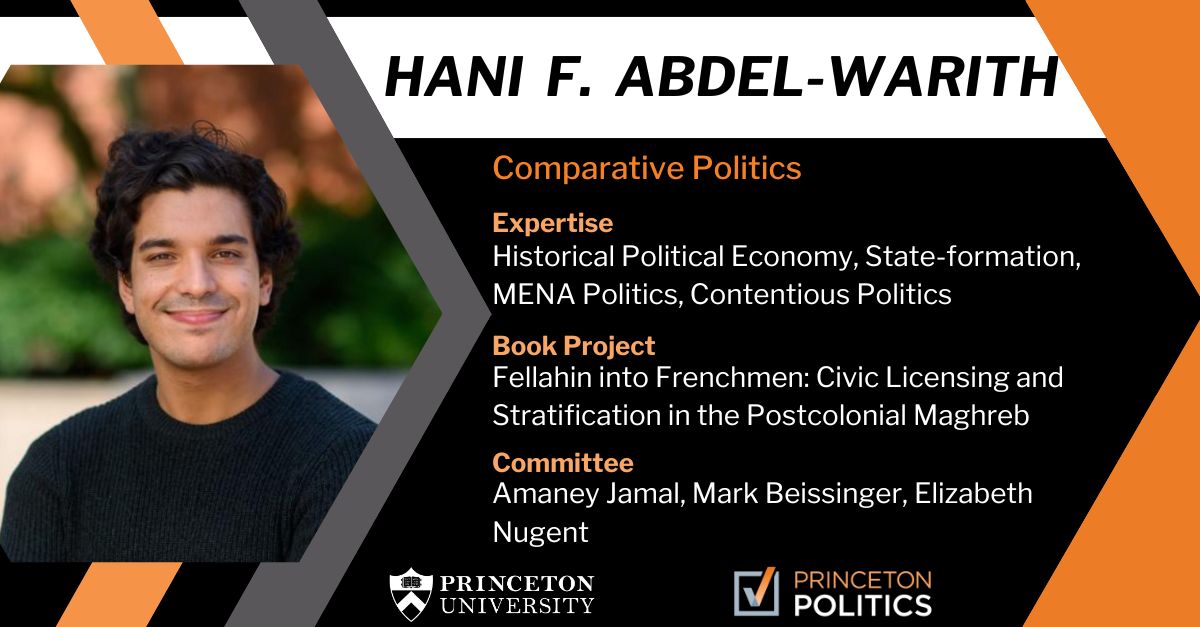
In his dissertation book project, Hani F. Abdel-Warith demonstrates that autocrats in the Middle East and North Africa punish their opponents by withholding schools from restive regions. Ironically, these policies of control become opportunity structures for activists who mobilize in these punished places to win elections, to instigate protests and even to foment revolutions.
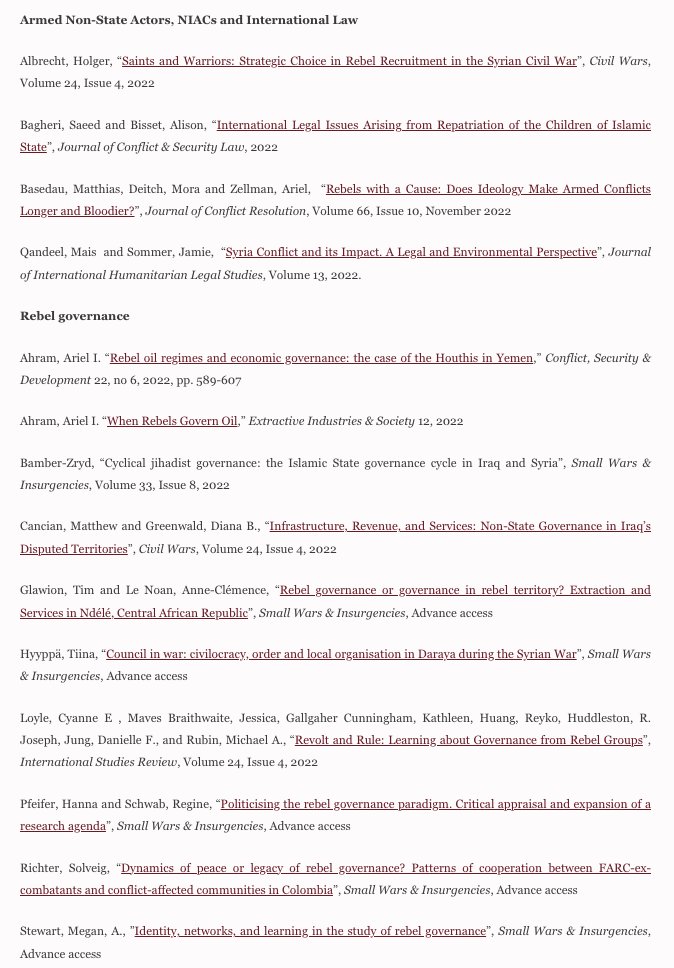
In her dissertation, Manasi @ManasiBose examines international responses to rebel governance and uses the case study of HTS in Syria to address the question of why groups with no expectation of legitimacy or legal recognition engage in costly political institutionalization. She finds that the establishment of constituent-focused political institutions by rebel groups insulates them from the worst forms of negative intervention and increases the likelihood that they will receive international support.
In his book project, @emreceyhun1 examines how elite access to new communication technologies re-shapes internal power dynamics within ruling parties in competitive authoritarian regimes — creating new forms of intra-party challenge to autocratic leadership.
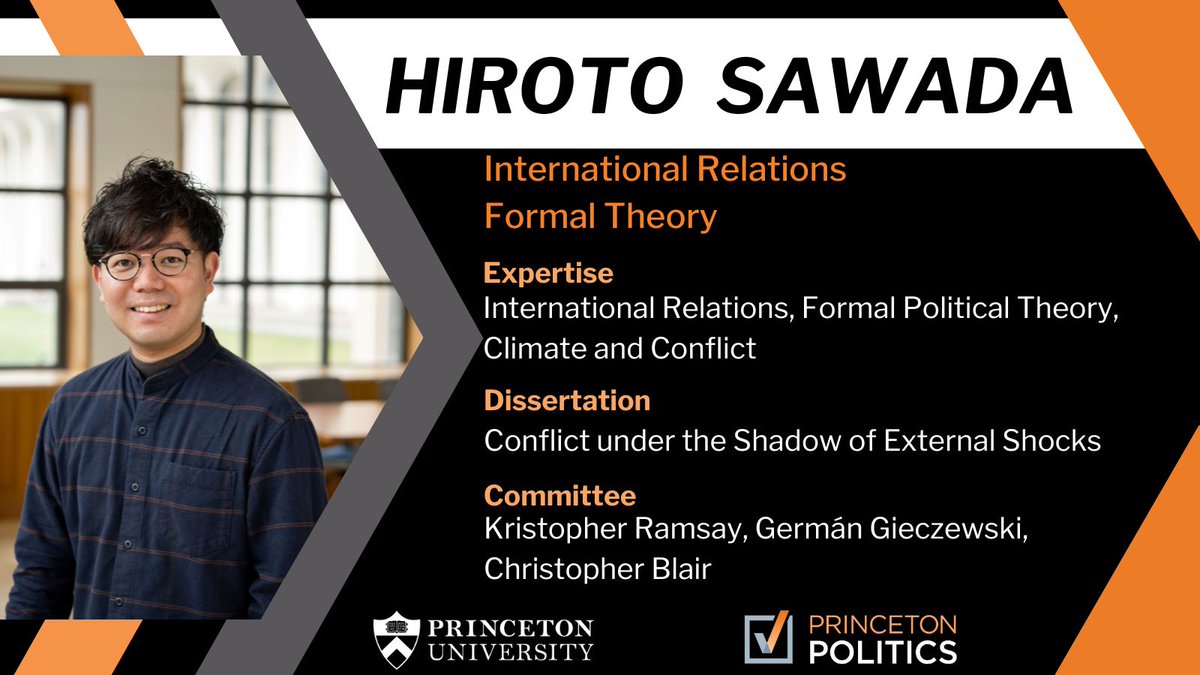
In his job market paper, @sawada_hiroto presents a formal model to explain (i) when a climate disaster triggers armed conflict and (ii) why empirical evidence on climate and conflict seems mixed. His research can be found at https://t.co/oNC6C0bZei
A recipient of the 2024 APSA Kenneth Sherrill Prize, @NancyYunTang studies how authoritarian regimes and LGBTQ movements interact through the lens of "law". Nancy's job market paper, "Jurisgenerative Reproductive Justice Under the Pro-natalist Turn", explores how feminist and queer advocates advance non-heteronormative reproduction as the Chinese party-state seeks to boost birth rates.
Not only did their strategy make for scalable governance models as they moved south, it also insulated them from negative engagement at the local and foreign level while they did so.
Check out my new article at @WarOnTheRocks: “The Patient Efforts Behind Hayat Tahrir al-Sham’s Success In Aleppo” https://t.co/OHAeQ2j6Fk You’ll want to keep this one bookmarked!
Grateful for the chance to present coauthored work with Viivi Järvi at @CRS_INFO. Special thanks to @DrGydaSindre for the very helpful discussant comments and to @GiuliaPiccolino and @afghanopoly for convening the panel on rebel governance and post-conflict order.
Excited that my @CambridgeUP book with @dustintingley, Uncertain Futures, is now shipping.
We explain why the climate impasse is hard to break. Credibility challenges stand in the way, but we identify solutions to unlock support.
More ⬇️ Please RT!
https://t.co/Tpf35MeJc4
Very glad to have been able to attend @ESoConflict Bogotá and connect with people doing interdisciplinary work on conflict and intervention across the world.
Article I wrote with @ManasiBose recapping a very motivating conference in Bogotá, Colombia with @ESoConflict. Such a wonderful community of scholars doing empirical and formal work on conflicts across the world.
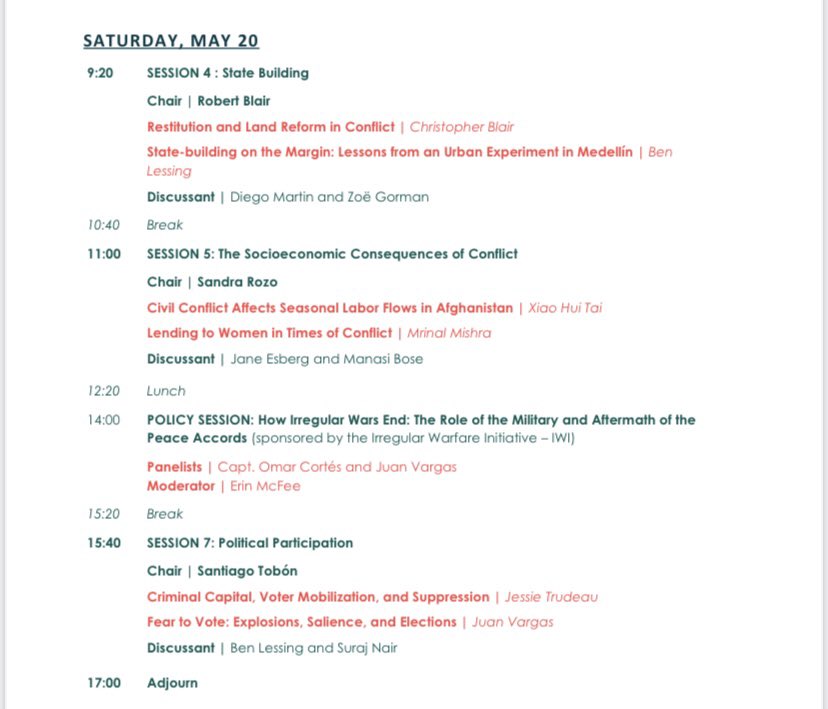
Day 2 will start with a session on state building with papers by @Chris_W_Blair and @BigBigBLessing (and guest discussants @DiegoMartin979 and Z.Gorman), followed by on on consequences of conflict featuring @xiaohuitai and M.Mishra (and guest discussant @ManasiBose) 👇🏽
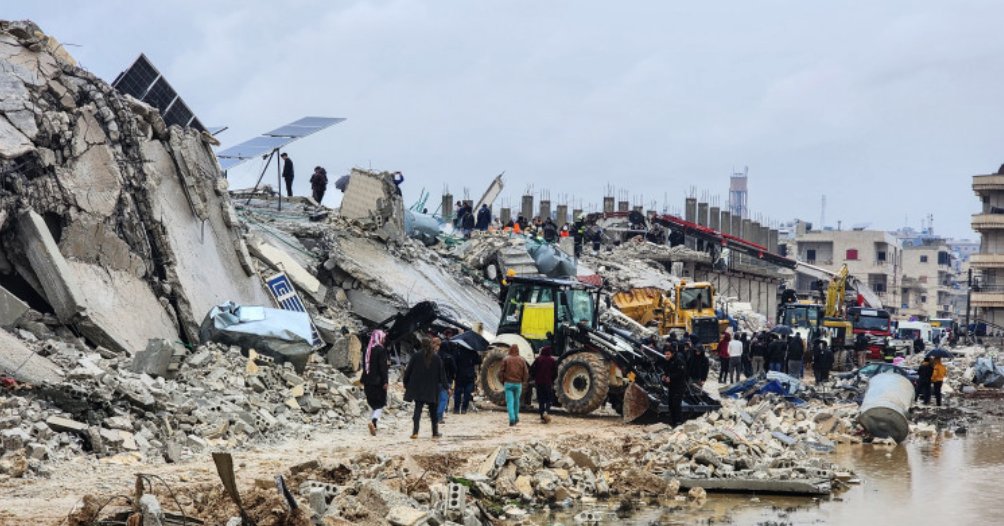
39% of those killed in the earthquake in Syria resided in regime-held areas yet 100% of the earthquake relief aid provided by the @UN went to these areas. Rebel-held NW Syria, home to millions displaced by Assad, is yet to receive any UN earthquake relief aid.
For now, the disaster response is left to heroic volunteers. Please consider donating:
@molhamteam - https://t.co/fzZtwHKDpi
@sams_usa - https://t.co/AKnUuMgJDs
@SyriaRandD - https://t.co/f5mYqhBxWx
@SyriaCivilDefe - https://t.co/lyFRvzDmTJ
Honestly, every dollar counts.