Presenting your work at a conference is NOT about reporting your results.
It's about controlling the flow of logic and excitement through the minds of the audience.
At each conference, I see a lot of mistakes that make #research presentations hard to follow. Wrong visuals, wrong language, wrong style and information flow.
Communication skills are vital for your career. Conferences are an excellent playground for their development.
Below, I put a brief list of what NOT to do during presentation.
Your slides:
1. Don’t put too much on one slide!
- Too many figures on one slide make it confusing. Don’t put more than 3-4 figures. Ideally, 1-2.
2. Don't rush through slides.
- If you show a slide only briefly, you don't let the audience absorb it. Speak slower or give more details.
3. Don’t assume that every detail you say must be supported by a figure.
- This is NOT necessary. You can just tell the audience about facts and findings without providing a visual "proof" for every detail discussed. Speak, not show!
4. Stop putting logos on each slide… They clutter the space and distract.
- If you really need them, put those logos on the front and last slides.
5. Don’t put titles on each slide when they are long and useless.
- People don’t read titles that often. Titles attract attention (by defocusing the audience from other parts of the slide), so use them wisely! Obsessive titling distracts from the core data.
6. DON’T use small fonts and small figures!
- Even if others are blessed with eagle vision, small fonts/figs require don’t get into memory as easily. Also, it often annoys the audience - some rooms are big, most people don’t have perfect vision, and when you don’t see what the person is speaking about, you get upset.
7. Don’t end your presentation with the slide “Thank you!” or “Questions?” or “Acknowledgements”.
- The last slide is your most valuable one. It stays on the screen while you’re answering questions, and your audience keeps looking at it for quite some time! So, you can put your acknowledgements beforehand, but not on the last slide.
Use the last slide for (1) your most important message(s) and (2) list of your papers relevant to the talk. Encourage the audience to take a photo of it.
Your speech:
8. Don’t speak too fast. Don’t speak monotonously. Make pauses! Use excitement in your voice!
- It’s hard to analyze your slides when your speech is very fast. Plus, it’s really hard to follow for non-native speakers at international conferences. Advanced speakers also introduce emotions into their talks (surprise, curiosity, etc.).
9. Don’t speak too quietly.
- Yes, a lot of people make this mistake without realizing it! Make sure your speech can be easily heard from the back of the room. Even if you use a microphone, it doesn’t mean you are loud enough.
10. Don’t weave your laser pointer too much.
- A pointer guides the attention. But when it keeps jumping up and down on a slide, the audience is getting tired. Use it only briefly one or twice on each slide. Or better stop using it at all and introduce cool animations into your presentation.
Finally, when watching others presenting, analyze their style and how audience perceives it. Identify weaknesses and possible improvements. It will help you see your own presentations differently.
#AcademicTwitter #phdchat
Request to those writing or about to start writing PhD thesis: Please take time & write a comprehensive 'Introduction' chapter that reviews literature to set up the context of your own thesis. This chapter should be an essential reference for those starting research in the field.
@keerthana6174 Google is basically restricting you from overusing their resources. You can try with TPUs, but I think they also have restrictions. The free and reliable solution would be to use your own pc if it has a GPU. If you don't have a GPU use the cpu-only versions of the library needed.
@BSen1716 If its a very old subject then there will be tons of good textbooks. Whereas if it is a fairly new subject you can look at review papers. If your problem is numerical even better. Read, try to write a code to solve numerically. Rinse and repeat.
At @IiserMohali, I have accumulated six courses with B grades because I was short by precisely two marks for the A cut-off. Is it reasonable to give a 20% lower grade for a 2% difference?
We updated our student projects section 😎🤓 (internship/master etc).
No matter if you’re a cleanroom fan, like to build complicated setups or more the coding type, there is something for you!
🤓💪🏼 check them out and reach out :)
https://t.co/SFCBjpnlwJ
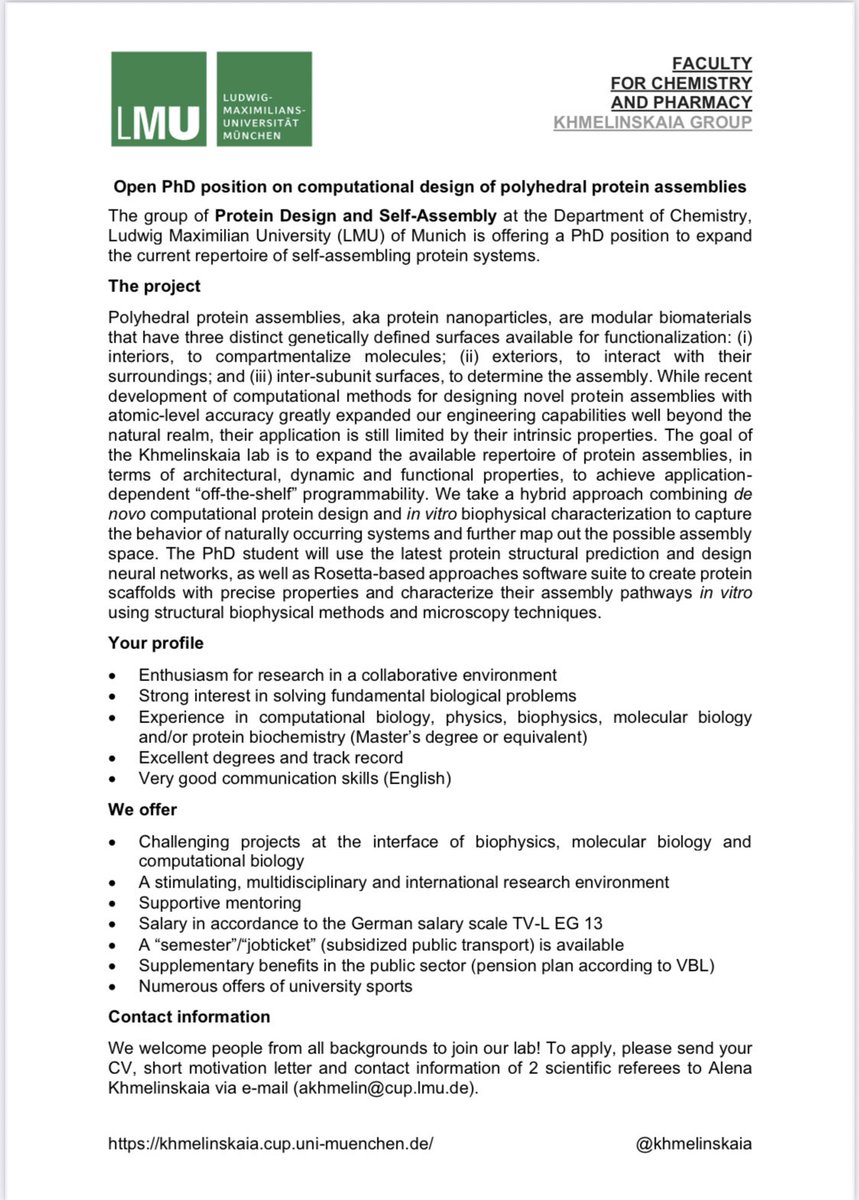
**!! We are hiring !!**
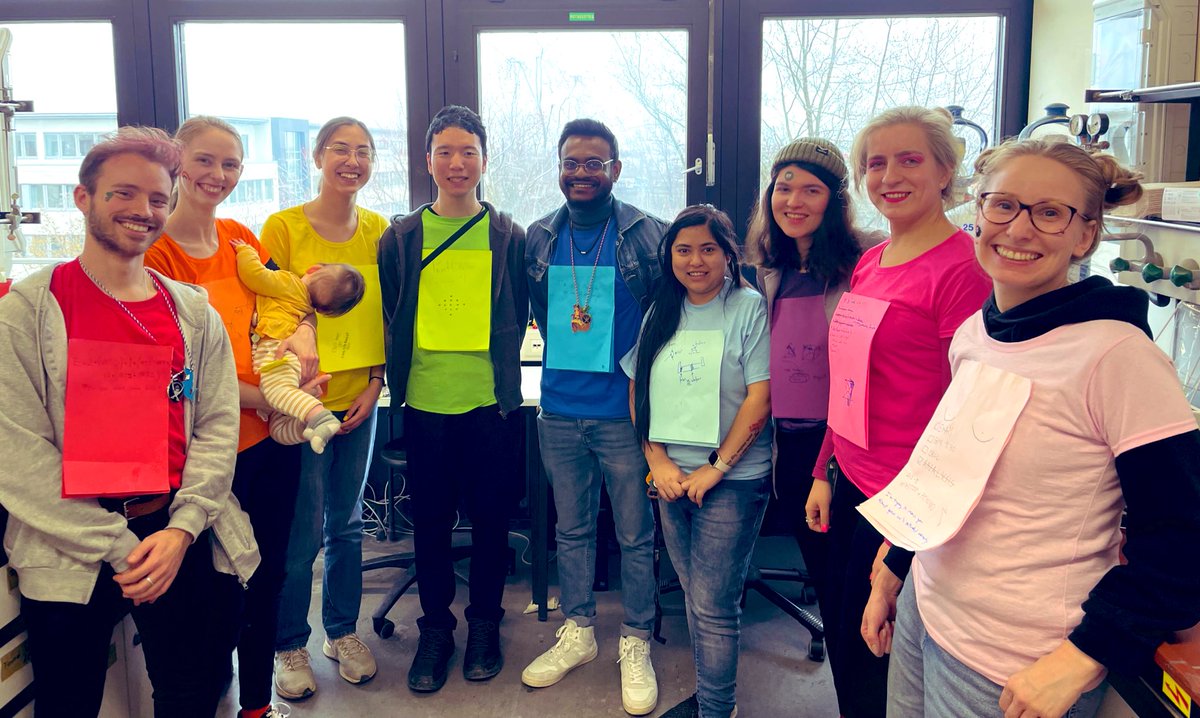
With the move to the @LMU_Muenchen we are looking for an exceptionally motivated and curious PhD student to join our team @akhmelinlab in exploring the exciting protein self-assembly space through _de novo_ protein design (:
I am happy to share that I will join the University of Cambridge as an Associate Professor this summer!
I have PhD and postdoc positions available. Candidates with a strong background in Theoretical Computer Science and Quantum Computing are welcome to email me.
Check out our new paper from first author and recent PhD graduate @LauraBocaM.
See how interkinetic nuclear movements give rise to tissue fluidisation in an epithelium.
https://t.co/2GFjhHxX25
(1/n)
"As a community, we have made progress not by ignoring the complexity of life’s mechanisms, but by taming it, revealing underlying physics problems."
An extremely interesting article.
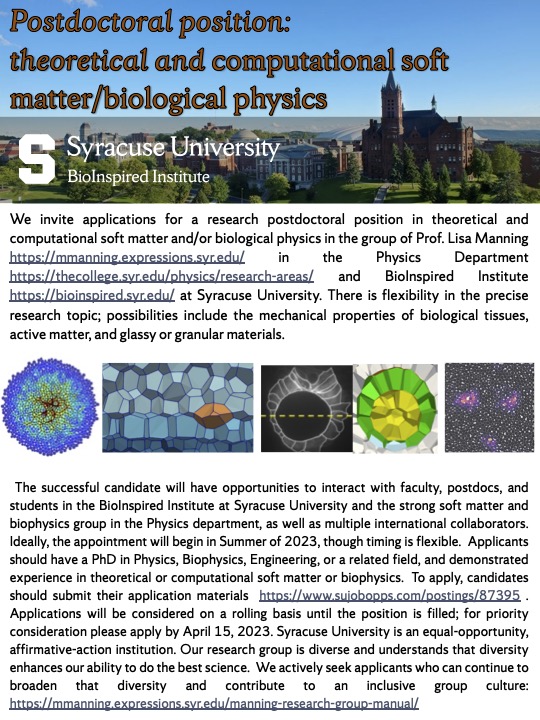
Announcing a new soft matter/biophysics postdoctoral position available in my group: https://t.co/DIeIZbxWqg , please apply or forward. Priority consideration for applications is April 15 2023 (date is wrong on the link, unfortunately). Happy to chat about it!
I am a little bemused by the Nobel hype. It is as if we are waiting for this one committee to confer prestige and public attention on someone(s), for work whose value is already well established. idk
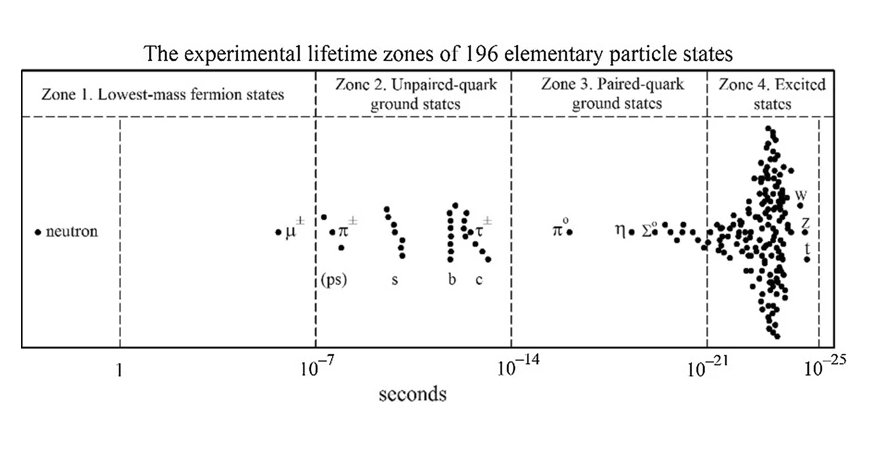
The most precise atomic clock in the world measures with an astounding uncertainty of 10^-18 s.
Yet we have *measured* the lifetimes of particles that decay over a million times faster than that.
How is that even possible? 🧵1/10