Spent months (or years) studying Chinese but still freeze when someone asks "你叫什么名字?" (nǐ jiào shénme míngzi? - What's your name?)... You're not alone.
Here's why: Most learners get trapped memorizing isolated words like 天气 (tiānqì - weather) instead of natural phrases like 今天天气很好 (jīntiān tiānqì hěn hǎo - Today's weather is nice). Your brain craves patterns and context, not random vocabulary lists.
You don't consciously analyze English grammar when speaking. So why torture yourself memorizing Chinese grammar rules?
The path to genuine fluency requires:
Learning in complete sentences
Letting grammar become automatic by doing lots of listening and reading
Using memory techniques to learn characters & words
Actually doing speaking practice exercises (not just consuming content)
What's the longest Chinese conversation you've had recently? When was the last time you practiced speaking out loud?
Ready to break free from beginner-level purgatory? Join our live webinar to discover how to speak Chinese naturally and confidently. We'll share the exact system that's helped thousands of students move beyond basic phrases. Save your spot → https://t.co/aQXtWMqgFS
You are likely making this WAY harder than it needs to be. That textbook exercises and grammar memorization? It's actually slowing you down.
I discovered this the hard way - real Chinese fluency comes from immersing yourself in actual, usable sentences. Think about it: did you learn your first language by memorizing grammar rules?
Let me share three phrases that'll instantly make your Chinese sound more natural:
真的假的? (zhēn de jiǎ de) - When your friend shares surprising news
可以啊 (kě yǐ a) - A casual "sure" that natives actually use
太好了 (tài hǎo le) - Perfect for showing genuine excitement
Your brain is wired to learn through patterns and real usage, not abstract rules. Every time you use these phrases in context, you're building natural speaking habits. 💡
What's the most natural-sounding Chinese phrase you know?
Which textbook phrase would you like a more natural alternative for?
Ready to transform your Chinese learning approach? Join Luke or Phil live this week to discover how to speak natural Chinese up to 5x faster, plus get your questions answered in real-time. Save your spot: https://t.co/aQXtWMqgFS
Here's something nobody tells you: most of my friendships in China and Taiwan didn't start with strangers on the street. They started at work. Same as anywhere else. The difference is knowing which phrases move a coworker from "person I nod at" to "person I grab lunch with."
你好 is fine for day one. But it doesn't build anything. What actually moves things forward is showing genuine curiosity:
你是哪里人?(nǐ shì nǎlǐ rén? "Where are you from?") This is huge in Chinese culture. People are proud of where they're from and it immediately opens up conversation about food, dialect, hometown culture.
你平常喜欢做什么?(nǐ píngcháng xǐhuan zuò shénme? "What do you usually like to do?") Find the overlap. When you hit something in common, that's when you say 真的吗?我也是!(zhēn de ma? wǒ yě shì! "Really? Me too!")
Then close with the most important phrase for social life in the Chinese-speaking world: 我们加一下吧 (wǒmen jiā yíxià ba, "Let's add each other"). In China that means WeChat. In Taiwan it's LINE. Either way, that one line is the equivalent of exchanging numbers. Once you're connected there, voice messages, shared posts, lunch invitations, it all flows from that.
The connection you're looking for isn't blocked by grammar. It's blocked by not knowing which phrases actually matter in building relationships.
What situation are you most hoping to use Chinese in socially? Work, travel, daily life?
Want to stop fumbling through small talk and start building real relationships in Chinese? Our free on-demand training shows you exactly how we'd approach it. Watch it here → https://t.co/aQXtWMqgFS
日 (rì) = sun ☀️
月 (yuè) = moon 🌙
Put the two brightest things in the sky together and you get 明 (míng) — bright, clear, obvious.
That's not a coincidence. It’s a system. 💡
Here's why it matters beyond just one example:
If you already know 日 and 月, you’ll learn 明 in about five seconds.
No rote repetition. No grinding.
Just logic clicking into place.
But it goes further:
日 shows up in 早 (zǎo, early), 时 (shí, time), 晚 (wǎn, evening).
月 shows up in 朋 (péng, friend), 有 (yǒu, have).
Learning one component doesn't just teach you one character — it pre-loads a dozen more.
This is exactly why we teach components before characters. Every component you lock in makes the next wave of characters almost effortless.
💭 问大家:
Which components have you learned that suddenly made a cluster of characters make sense?
Are you actively studying components first, or still learning characters in isolation?
Curious to see the full system behind this kind of accelerated learning?
Our free on-demand training walks you through how we structure it from the ground up. You can watch it here → https://t.co/aQXtWMqgFS
⭐ New video alert! ⭐
Ever notice one Chinese character popping up EVERYWHERE? 🤯
Same character… different meanings… total confusion.
In this video, I break it down so it finally makes sense.
Don’t skip this 👇
https://t.co/EU8VXO7wnD
– Luke
⭐ New video alert! ⭐
If your Chinese study feels slow, confusing, or all over the place…
You’re going to want to see this. 👀
Learn the exact approach efficient learners use to progress faster, with less effort.
Don’t miss this 👇
https://t.co/l6LNrUrU4m
– Luke
⭐ New video alert! ⭐
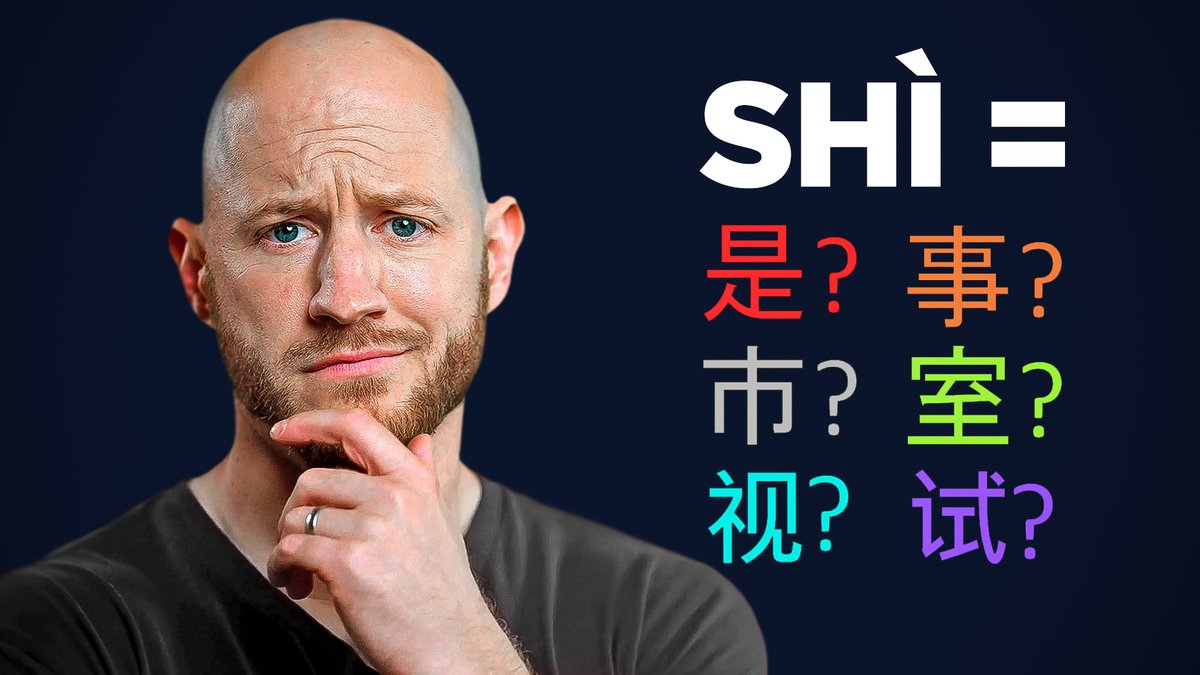
Why does Chinese sound like… the SAME word over and over?! 🤯
If you’ve ever thought “shi, shi, shi… WHAT is going on?” you’re not alone.
This video breaks down exactly why it sounds that way (and how to finally hear the difference).
This might be the aha moment your Chinese needs 👇
https://t.co/6SlvyazZpz
– Phil
⭐ New video alert! ⭐
Your Chinese doesn’t suck… it just needs better phrases. 😏
These 70 must-know phrases will instantly make you sound smoother, clearer, and more natural.
If you haven’t seen this yet, this is your sign. 👀
👉 https://t.co/FhhwPmu2zA
– Luke
Y'all wouldn't build a house starting with the roof, right? Yet that's exactly what most of us do when learning Chinese - jumping straight into grammar patterns before understanding the building blocks.
Here's why that backfires: You might memorize "我想去..." (wǒ xiǎng qù...) for "I want to go," but then freeze when you see 想 (xiǎng) in a different context. The character feels like a random symbol instead of a meaningful piece of language.
Let's flip the script. First, learn to recognize characters by their components. Take 想 (xiǎng) - it's made up of 相 (xiāng) on top and 心 (xīn) below, and even 相 is made up of 木 mù (wood) and 目 mù (yes, same pronunciation) meaning (eye).
Once you understand these building blocks, you'll start seeing patterns everywhere. Now when you encounter words like 理想 (lǐxiǎng - ideal) or 想法 (xiǎngfǎ - idea), they'll actually make sense.
What character components have you noticed repeating? When was the last time you had that satisfying "aha!" moment in your studies?
Ready to build a rock-solid foundation in Mandarin? Join our webinar to discover proven strategies that work. Save your spot → https://t.co/aQXtWMqgFS
I have been learning Chinese for many years and I will share my honest opinion: I've seen people pass HSK 5 and 6 and still freeze completely in real conversations. They optimized for the test, got the certificate, then realized they couldn't actually use Chinese. The exam became a participation trophy, not proof of listening, reading and speaking skills.
So should you bother with HSK at all? Only if one of these applies:
You need it for university admission in China — some programs require HSK 4, 5, or 6
You need it for a job that requires formal proof of proficiency
You need external accountability — a test date forces consistency that pure self-study sometimes lacks
That's it. If none of those fit your situation, skip it entirely and put that energy into actual fluency.
Real conversations. Real listening practice. Real characters in context. That's what builds the ability to use Chinese — not test prep cycles that teach you to pass questions, not communicate.
The certificate is not the goal. Being understood is the goal.
Are you planning on taking HSK exam? Do you see it as a goal, or just a milestone? Or are you focusing on actually using Chinese in real life instead?
Want to focus your time on what actually moves the needle toward fluency? Watch our free on-demand training and learn from the mistakes we made chasing the wrong targets → https://t.co/aQXtWMqgFS
I finally understood 把 in a movie theater in 2014. I was living in China and went to see Interstellar, an American movie in English to give my brain a break from immersion. Little did I know, my friend had bought tickets for the Chinese-dubbed version with Chinese and English subtitles. I wasn’t able to follow the entire plot, but by the end, something clicked.
Despite having two full years of Chinese classes under my belt, I had never been able to wrap my head around using the 把 structure correctly. But seeing so many examples used in context throughout the movie finally made it make sense!
Almost every learner struggles with 把. Textbooks hand you rules: “Use 把 when the verb has a complement,” “Use it when the result is definite.” You nod, think you get it, and then freeze the second you try to speak.
Native speakers don’t follow rules. They just know when 把 sounds right. And you can get there too!
把 does one core thing: it puts the object center stage, before what happens to it.
我把苹果吃掉了 (wǒ bǎ píngguǒ chī diào le) isn't just "I ate the apple." It's: the apple — here's what I did to it.
That feeling doesn’t come from grammar charts. It comes from exposure to the right sentences at the right level, consistently over time, and cultivating your 语言感 — your intuition for how Chinese feels.
💭 问大家:
How many sentences using the 把 structure are you actually encountering each week? Are you building a real feel for Chinese, or just memorizing rules you’ll forget under pressure?
Want to develop natural instincts for Chinese faster? Watch our free on-demand training here → https://t.co/aQXtWMqgFS
I’ve learned both simplified and traditional characters from day one, and I’ve been living in Taiwan for a couple of years now - so I can share my honest perspective.
For most learners, simplified is the right choice. There are more resources available, and it’s easier to learn from scratch-especially when it comes to handwriting. The number of strokes in traditional characters can feel overwhelming, particularly at the beginning of your journey.
Once you learn simplified, moving on to traditional isn’t like learning a completely new language. It’s more of a natural extension. The meaning stays the same, it’s just the form that changes.
The one exception is if your goal is specifically Taiwan, Hong Kong, or classical Chinese literature. In that case, start with traditional from the beginning. Otherwise, go with simplified first and expand later, if needed.
About 70% of characters are the same anyway, so the overlap is huge. Don’t worry too much about the choice. The worst version of this decision is spending three weeks researching it instead of just starting.
Which are you learning, and what made you choose that? And if you haven’t started yet, what’s actually holding you back?
Tired of decision fatigue around Chinese learning? Our free on-demand training cuts through the noise and gives you a clear roadmap from day one. Watch it here → https://t.co/aQXtWMqgFS
Ever notice how you can study Chinese for years but still struggle to have a real conversation? I see this ALL the time, and there's actually a scientific explanation for it.
Here's the thing - most Chinese teachers and textbooks have it completely backwards. They bombard you with grammar rules and vocabulary lists before you've even mastered the basic sounds of the language.
Think about how babies learn their first language. They don't start with textbooks (obviously 😄). They begin with sounds, then words, then simple phrases they can actually use.
This is exactly why we developed our approach at Mandarin Blueprint. We start by nailing down pinyin and pronunciation fundamentals. Without this foundation, everything else is like building a house on sand.
Then we use memory techniques that actually work. Take the word 杯子 (bēizi - cup) for example. Instead of mindlessly repeating it 100 times, we create memorable associations: imagine a baby (bei) falling asleep (zzzz) while holding a cup. Your brain loves these kinds of connections!
From there, it's all about listening and repeating real, useful Chinese phrases. No more memorizing random sentences about your uncle's pet giraffe that you'll never use in real life.
Learn characters, learn words, listen and repeat a lot, and try to speak Chinese sentences each day. Do these things and you won’t be a beginner for long.
What's been your biggest struggle with speaking basic Chinese? Has traditional teaching helped or held you back?
Ready to break through your Chinese plateau? Join Luke or Phil LIVE this week to discover scientifically-proven methods for reaching conversational fluency, plus get your questions answered in real-time. Save your spot → https://t.co/aQXtWMqgFS
⭐ New video alert! ⭐
Some Chinese advice sounds super smart… 🤓
But it could be quietly slowing your progress down.
Don’t fall for the trap - here’s what actually works. 👀
👉 https://t.co/SQRsWrpJBB
– Phil
Most learners see a measure word chart and immediately panic. Dozens of categories, seemingly random rules, no obvious logic. But here's what nobody points out:
English has measure words too.
A piece of paper. A cup of coffee. A slice of pizza. You never drilled those. You picked them up through exposure — thousands of repetitions in context — and now they're completely automatic.
Chinese works exactly the same way. The anxiety comes from treating this as a memorization problem. It's not. It's an exposure problem.
So while you're building that exposure, start with one word: 个 (gè). It's the universal measure word.
One person — 一个人 (yī gè rén).
One apple — 一个苹果 (yī gè píngguǒ).
Even something abstract like good news — 我有一个好消息 (Wǒ yǒu yī gè hǎo xiāoxi).
个 covers a huge range, and the good thing is: you'll be understood every single time you use it!
The specific ones — 本 (běn) for books, 只 (zhī) for small animals, 杯 (bēi) for drinks — start clicking naturally as your exposure grows. Don't force them - they will arrive.
Are you currently treating measure words as something to drill, or something to absorb? And how much Chinese reading and listening are you doing each day to build that exposure?
Want a structured path that builds this kind of intuition from the start? Watch our free on-demand training and learn how we'd approach it differently → https://t.co/aQXtWMqgFS
I had a revelation while coaching a student the other day that I need to share with you all.
She told me she studies Chinese "all the time" - listening to podcasts while cooking, watching dramas while scrolling Instagram, doing flashcards during work breaks.
But after 2 years of "studying," she still struggles with basic conversations.
Here's a truth that most teachers don’t tell you: Your brain doesn't learn language through osmosis. Every time you split your attention, you're essentially cutting your learning potential in half.
Ten minutes of focused practice is probably worth more than two hours of passive listening.
After teaching thousands of students, I've noticed something fascinating - the ones who progress fastest aren't studying the longest. They're the ones giving their full attention for shorter periods.
Here's my simple approach that gets results:
Set a timer for just 20 minutes. During that time, do ONE thing:
Watching shows? Pause and note new words for later flashcards
Listening to audio? Actually repeat after the speaker (multiple times if necessary)
Reading? Say new phrases aloud and save them as flashcards.
Think about it - would you rather spend a year pretending to learn, or three months actually making progress? 🤔
Tell me honestly - how much of your "study time" is actually focused learning vs background noise?
Ready to transform your learning approach and speak Chinese up to 5x faster? Join our live webinar where I'll share more game-changing focus techniques and answer your questions personally. Save your spot here → https://t.co/aQXtWMqgFS
Hundreds of hours of Chinese dramas, podcasts, native content. All of it. And the conclusion? Immersion is overrated.
Not worthless — the cultural exposure was real. But for the time invested, the language gains were genuinely disappointing compared to structured, active study.
Here's why passive watching underdelivers: your brain needs to understand at least 70–80% of what it's hearing for language acquisition to actually happen. Below that threshold, it just treats the audio as noise. Interesting noise — but noise. Most learners bingeing native TV aren't anywhere near that threshold.
The fix isn't to stop watching. It's to stop watching passively.
Active watching means: pause and look up words. Read Chinese subtitles — not English ones — and actually process them. Shadow lines out loud. Mine sentences for your flashcard deck. Any one of these turns consumption into skill-building.
And the ratio that actually works: TV as a supplement — roughly 20% of study time. The other 80%? Structured input at your level, where comprehension is high enough for real progress.
The learners in our community who improve fastest aren't the ones watching the most Chinese TV. They're the ones doing the least passive watching.
Passive watching feels productive. That feeling is the problem. Are you watching Chinese TV actively or passively right now — and what's one thing you could do differently this week?
Ready to build a structured approach that actually gets you to comprehension? Watch our free on-demand training here → https://t.co/aQXtWMqgFS
You know hundreds (maybe thousands) of Chinese words, yet when it's time to speak, your mind goes blank. It’s frustrating, and we’ve all been there!
Here’s the thing: native speakers only use about 1,500 words in daily conversation, far fewer than they actually know. So why do we sometimes have trouble recalling the words we’ve already learned?
It’s because recognizing a word like 认识 (rènshi) when you see it is a COMPLETELY different skill from pulling it out of your brain to say “I know him” (我认识他) in conversation.
One of the most effective (and very simple) ways to bridge that gap is to learn new words in the context of a sentence, rather than in isolation.
For example, with 认识, you could learn it using the sentence:
我认识他很多年了 (wǒ rènshi tā hěn duō nián le) –
“I’ve known him for many years.”
Once you’ve created your sentence, here’s a simple way to practice it:
Shadow it (repeat while listening)
Read along with native audio
Practice active recall from English
Learning words in context is a small change that can make a big difference in how easily you are able to actually use them when speaking!
💭 问大家:
What words are you having trouble remembering?
In what real-life situations could you use these words?
How could you practice them in the context of a sentence?
Where do you have a few extra minutes in your day to practice your sentences?
If you want more practical techniques to turn your knowledge into actual speaking ability, check out our free webinar → https://t.co/aQXtWMqgFS
Here's the idea. Take whatever character keeps slipping — the one you review, forget, review again, and still can't hold. Set it as your lock screen: character, pinyin, meaning. Every unlock becomes a passive reinforcement. Swap it every two to three days.
One of our members was stuck in a loop with 尴尬 (gāngà — awkward). Reviews weren't making it stick. She put it on her lock screen. Three days and about 200 unlocks later, it came up in her flashcards — instant recall. No extra study time. She just saw it while living her life.
This works because it mirrors the logic behind spaced repetition — frequent, brief exposures spread across time. Your brain reinforces what it sees repeatedly whether you're consciously trying or not. Your lock screen just makes that happen passively.
You're not replacing your study sessions. You're multiplying them.
Which character would you put on your lock screen right now? And what other small moments in your day are you already using — or could you be using — for passive exposure?
Want to know the right characters to prioritize for maximum impact? Our free on-demand training maps out the full strategy. Watch it here → https://t.co/aQXtWMqgFS
⭐ New video alert! ⭐
Some people learn Chinese way faster than others… 🤯
So what’s their secret?
Here’s what our fastest learners all have in common and how you can copy it. 👀
👉 https://t.co/fbwujklLXI
– Luke