Feeling lost or unsure about faith? Don't hesitate to ask questions. Exploring God's Word together can bring clarity and connection. Find a Bible-preaching church, or join us Sundays at 9:00 AM at Marana Middle School. #FaithJourney#AskQuestions#Church
A devotion on clever parables and repentance: 2 Samuel 12:1-25
Nathan’s little parable in our reading from 2 Samuel this morning is obviously of great benefit to King David because it brings him to repentance over his sins. But these words are also a great blessing to preachers.
Nathan most certainly understands that you can’t necessarily walk up to someone cold, and call him an adulterer and a murderer. In the case of the king, he might have you put to death, but in the case of regular folks, they’ll just close their ears to the important words of condemnation you have to speak. Rather, what Nathan recognizes is that, if you stoke a man’s outrage at someone else’s sin, it’s too late for him to bottle that anger back up when you reveal that the someone else is actually him. He either has to defend the indefensible in himselfor acknowledge that the evil he was just screaming about three seconds earlier is, in fact, still evil when it’s born from his own heart.
And so, my advice for preachers is to avail yourself of the Nathan trick. Stoke your people’s anger about the evil in the world, and then show them how that same evil has been bursting out of their own hearts. Get them cheering as you condemn the persecution of Christians throughout the world, then show them the ways they persecute the faithful with their own sins. Win their applause by condemning the licentiousness and mammon-worship of the world, then show them how their hearts are brimming with the same lust and greed. Let the people know that they’re right to be repulsed by the sins of others, but once they proudly announce themselves as Team Repulsed, show them how they must now be repulsed by their own manifestations of those transgressions.
Do that and then you can show them God’s beautiful answer to our hideous iniquities. Just as David was spared death as his innocent son died in his place, so we too are spared from death from another Son of David, the greater Son, the Son born not of adultery, but of a virgin, the Son born to bear not just the sins of David, but our sins as well. The blood of Jesus has washed you clean and given you the right to live forever. May we always hate the repulsive sins of the world. May we always hate the repulsive sins in our hearts. And may we always rejoice to receive the beautiful love of Jesus Christ that has made us pure.
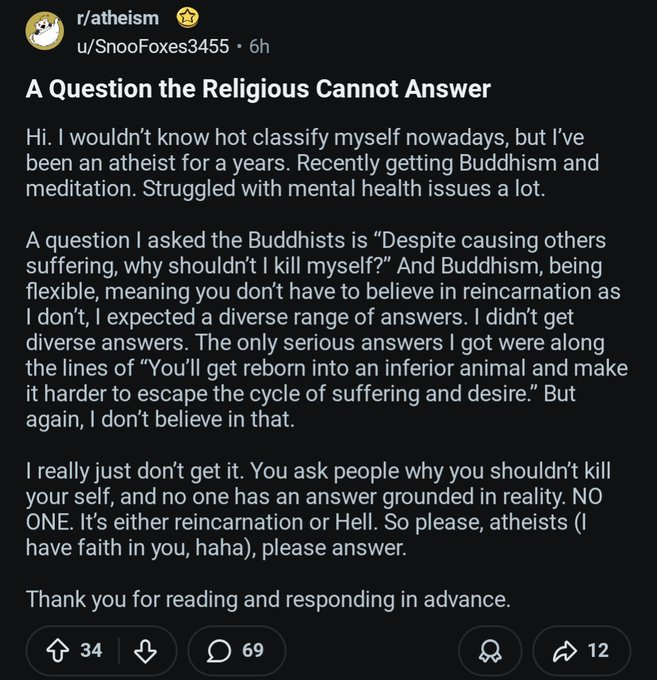
This is actually really REALLY sad. This atheist is at least honest about his struggle. The end of atheism can only either be hedonism or nihilism. Either the only thing that matters is the enjoyment you can claw out of this temporary life, or nothing matters at all, and then you die.
If there is no higher power, there is no higher purpose. You were not made in the image of anything immortal, you will have nothing to look forward to, in anticipation or fear, you just are, and then one day you aren't. So why do you keep on being?
Christianity has answers to this, even beyond "hell is real". The reason you should not kill yourself is because you have value, you are loved, and you life has worth and meaning. You should not destroy something meaningful, and instead find peace in the reality that someone loved you so much that they would die for you. That as lonely as you feel, there are countless others who are willing to call you "brother" and mean it. That as miserable or hurt as you are, there is a solution where you will no longer suffer anymore. That as worthless as your life seems, there is a reality where you can finally see how much you mean.
Why You Should Thank Martin Luther For The 4th Of July, Even Though He'd Probably Hate It
(WARNING: this is both not nearly comprehensive enough, and already too long for social media, so apologies in advance for both of those things. Continue reading at your own risk.)
Prior to the Declaration of Independence, people had 3 ways of dealing with tyranny: revolt, submission, and the Lesser Magistrate.
Revolt is people with no power rising up and taking power by force. While its reasons are often justified, it typically ends in either chaos or a worse tyranny than it replaced. Or it fails.
Submission is just that. You just live with it. Sometimes it gets better. Usually it gets worse.
There has to be a better way!
The Lesser Magistrate doctrine was developed by Martin Luther and Protestant princes and theologians in 16th century Germany. Facing forced submission to the Pope from the Holy Roman Emperor, they had to figure out how to preserve and defend their Christian faith and practice.
Revolt was never an option to them. There is no Biblical account of mob-driven uprisings, and Romans 13 explicitly tells us to submit to the governing authorities. We are only authorized to disobey when forced to do what God forbids, and even then, the Bible shows God's people doing so as martyrs, willing to suffer the punishment for it.
But there ARE Biblical instances of lower officials resisting or overthrowing tyrants. Jehoiada the Priest overthrowing Queen Athaliah (2 Chronicles 23). Commander Jehu’s coup against King Joram (2 Kings 9). Jeroboam and the tribal leaders seceding from King Rehoboam's Israel (1 Kings 12).
The Emperor (the Greater Magistrate) had taken an oath to uphold the laws of the Empire, and the local princes were sworn to protect their specific territories.
Luther, who was very hesitant to support violent resistance of any kind, conceded that if the Emperor broke his own constitutional contract, the local princes (the Lesser Magistrates) had legal permission to resist him to protect their citizens. This paved the way for the formation of the Schmalkaldic League, a defensive military alliance of Lutheran princes.
And so the Lesser Magistrates doctrine was born.
This is a Christian doctrine, so repentance and reconciliation is the preferred resolution. But if the tyranny persists from the Greater Magistrate, then the Lesser Magistrate is Biblically permitted to defend the citizens.
Over time, this doctrine was further expanded upon by John Calvin, John Knox, Theodore Beza, Samuel Rutherford, John Locke, and many others.
Under their development, the law itself was the true ruling authority, and no ruler was above it. The Lesser Magistrate was not just permitted, but OBLIGATED, to defend the citizens against tyranny. Authority was conditional on treatment of the citizens.
Luther would have likely disagreed with much of this. He was hesitant to even resist active religious persecution by a tyrant. But ultimately, the Reformers were taking his Biblically-sound doctrine to its logical conclusion.
These ideas were revolutionary.
But the Declaration of Independence took it to its ultimate conclusion.
Prior to it, here was the hierarchy of authority according to the Lesser Magistrate Doctrine:
God
Greater Magistrate (King, emperor)
Lesser Magistrate (Princes, elected officials)
Citizens
All authority comes from God, and is granted to the King. The King delegates that authority further to the Lesser Magistrates, who govern the citizens. If the King is a tyrant, the Lesser Magistrate can and should rein him in.
In the case of the United States, after many years of trying to reconcile with the Crown, the Lesser Magistrates were declaring independence.
And their Declaration changed everything.
"We hold these truths to be self-evident, that all men are created equal, that they are endowed by their Creator with certain unalienable Rights"
The Lesser Magistrates declared all of us equal. This is inherently Christian, as all people are equal bearers of God's image, and all Christians are equal heirs of God's Kingdom. But now, it was being applied to temporal political power.
"That to secure these rights, Governments are instituted among Men, deriving their just powers from the consent of the governed"
The Lesser Magistrates declared that their power would be derived from the consent of CITIZENS, not divine right of rule.
"That whenever any Form of Government becomes destructive of these ends, it is the Right of the People to alter or to abolish it, and to institute new Government"
The Lesser Magistrates even declared that the citizens not only granted authority through our consent, but that we had every right to CHANGE that government if necessary.
Under the Declaration of Independence, here is the hierarchy:
God
Citizens
Lesser Magistrate (elected officials)
The Declaration of Independence is a Declaration that We, the People, are the Greater Magistrate!
If only we would remember that, and treat our right and responsibility accordingly. But that's for another time.
AGAIN, Martin Luther was born in the end of the Middle Ages, and was highly averse to any form of resistance against temporal authority. He would probably be aghast at the thought of the commoners being in charge.
But the Biblically-based doctrine he helped develop led directly to a government ruled by the people.
So we'll get to tease him about that in Heaven.
Happy Independence Day, everyone!
God Bless you, and God Bless America.
Yesterday's devotion on obesity, blindness, and the righteousness of God: John 9:24–41
If you have any sort of bodily affliction or abnormality or even just a minor difference of the body, one of the harsh realities of life is that you’re always just one outburst of anger away from someone using that against you. So Woman A is overweight and often laments this to her friend, Woman B. But Woman B tells her, throughout the years, “stop it, you’re beautiful. You’re amazing. Don’t ever say that about yourself.” But then Woman B decides to leave her husband for another man, and Woman A tells her that she’s turning away from God and harming her family. So how does Woman B respond? Something along the lines of, “just because you’re fat and can’t do any better than your husband doesn’t mean I should stay in my bad marriage.” So it is if you have an unpleasant birthmark, if you’re paralyzed, whatever it may be. The very afflictions people would tell you they’re praying about, they’ll use those against you the moment they believe you’re standing in between them and the righteousness they want to have.
We see this in our reading from John this morning. Everyone knows that this man was born blind, and they know his parents, which means they have a good amount of familiarity with him. So surely the Pharisees have prayed for a man like this, a man bearing a terrible burden from birth. Surely they’ve made big displays showing how much compassion they have for men like this. But when he laughs at their unbelief and ultimately scorns them for refusing to believe in the Savior who showed His divinity by performing this miracle on him, the Pharisees lose all that compassion. If this man is going to insist that they believe in Jesus, then his blindness is fair game. And why should they listen to some disgusting sinner whose blindness-from-birth reveals what a worthless soul he is?
But this is not how Jesus sees you in your afflictions. When He sees the brokenness of your flesh, the afflictions of your body, and when He sees the sins in your heart, He does not quietly make a record of them so He can shove them in your face the moment you get in His way. In fact, when you stood in His way, when you opposed Him with your transgressions, He went to the cross to destroy those sins forever. He eradicated them with His blood. So He will never shove your vile words and thoughts and deeds into your face because He Himself has erased them from His own memory.
Likewise, in His resurrection, He has sworn to give you a glorified body, flesh that will never be corrupted by the effects of your own sin or simply by the fallenness of this world. The Lamb of God who was without blemish laid down His life and picked it back up again so that you could receive a body without blemish, without affliction, without shame. The Lord who chose to see us all as His beautiful brothers and sisters, He will grant you that perfect, glorified body on the Last Day and you will never feel the fallenness of sin in your flesh again. And He will do this all because Jesus didn’t see you as someone who stood between Him and the righteousness of God. He saw you as someone who needed the righteousness of God. And so He stood between you and the Father so He could take His Father’s kingdom of righteousness and place it into your hands.
Does baptism save? 💦🤔
What does Scripture actually teach about baptism and the forgiveness of sins? 📖
TONIGHT @ 6:00pm EST, @GerhardsGhost and I will be responding to @needGod_net's critique of Lutheran baptismal theology in a live roundtable discussion.