If “show more” feels like an assault… flee to shorts 😏 and rot your brain freely. Reserved for rare souls who read full paragraphs without emergency dopamine.
“The limits of my language mean the limits of my world.”
— Ludwig Wittgenstein
Do you ever find yourself wondering what we’re actually talking about anymore? It feels as if the words we use are slowly ceasing to describe reality and starting to obscure it instead.
The world around us is growing less sharp, while language and political correctness try to impose one preferred way of speaking. Words are banned, stretched, mixed together and stripped of their edge. They lose their precision and take on phantom forms — forms that are, quite simply, semantically broken.
Yet when the meaning of words is altered, when the boundaries between concepts that stand at opposite poles are blurred, or when those words are used interchangeably, people are deliberately led into confusion. Two completely different attitudes, behaviours or phenomena end up being treated as one and the same.
When we lose linguistic precision, we lose the ability to distinguish. And once we can no longer distinguish, we become easy to manipulate.
When everyone — a biological woman, a man in a dress, a man after sex-reassignment surgery — is called a “woman,” a fundamental biological and ontological difference is erased.
When criticism of Islamic ideology (its doctrine, sharia law, the treatment of women, or the simple citing of historical facts) is labelled Islamophobia, ordinary intellectual analysis is equated with hatred of people.
When racism (the belief in the biological inferiority of races) is stretched to include noticing cultural differences or a preference for one’s own cultural group, any attempt to name reality becomes “racism.”
When criticism of the Israeli government’s policies is automatically equated with antisemitism — hatred of Jews as such — the line between legitimate political criticism and classical, hateful Judeophobia disappears.
The same thing happens with words like “hate speech,” “fascism” or “xenophobia.” Stretched to the point of absurdity, they lose any power to name things with precision.
I see this mechanism not only in the media and in international or globalist politics, but also in the small, everyday spaces around me — at work, in the bakery, at the bus stop. You become afraid to open your mouth. You have to weigh every word carefully — and listen even more carefully — to understand who you’re really dealing with and what idea you’re actually facing.
As a result, language, instead of helping us describe reality with precision, has become a tool for obscuring it. People lose the ability to notice subtle differences, and public debate turns into a series of labels and moral judgements rather than a genuine conversation.
That is why it matters so much that we guard the precision of our language. Every time we refuse to accept a change in the meaning of a word, we defend our world from shrinking.
The greatest barrier to resolving social and political conflicts rationally — and at the same time the main source of deepening divisions — is the loss of linguistic precision.
Let us not allow others to blur the boundaries for us. By defending the meaning of words, we defend the ability to think clearly. And by defending that, we defend reality itself and our freedom to perceive it.
The limits of our language really are the limits of our world. Let us not surrender them without a fight.
When something becomes unimaginable or non-existent to us, we bring it into our world by naming it — a healthy expansion of vocabulary. But loading countless meanings onto one word turns it into a chaotic mix of approximations.
The richer is our languagethe more nuances of reality we can notice, understand and process. A person with a limited vocabulary literally lives in a smaller world.
Preserving the precise meaning of words is not, in my view, a matter of semantic purism. It is not pedantry. It is an act of defending our ability to see reality as it is — the last line of defence against someone else beginning to think for us.
He would like more than a word…
He is right that concepts freeze becoming, and I am not claiming language is innocent. All the more, though, he would not cheer for what I described — the stretching of concepts, wrapping in fog the contours that are already barely visible. In the world of the Last Man, certain compromises have to be made: it is not possible to speak only from that height. Before anyone reaches it, it is not worth putting out the light below.
I understand the question perfectly. This kind of literature doesn’t make anyone comfortable.
As for the man who writes it: I don’t think you have to be mad to tell stories about madness. It may be the other way around. You need a sane mind to see the horror in the first place, and then the nerve and the talent to put it into words.
The Greeks didn’t invent their brutal myths because they wanted to live inside them. They used them as a kind of laboratory for the psyche: extreme feeling, destructive pride, and how helpless a person is against fate.
Atreus serves Thyestes his own sons at a feast. Medea kills her children. Oedipus kills his father and sleeps with his mother. Orestes kills his mother. Those stories were a path from blood revenge to law and civilization.
The same Greeks who told stories about children being eaten, incest, and a son murdering his mother also gave us the big questions: what is truth, what is measure, what is justice, what is a human being.
Plato didn’t grow up beside those stories by accident. He came out of a culture that could look straight at the worst of it and still think, still make things, still grow — maybe even because of that.
King is in the same line. The darkness is material. Horror, like tragedy, puts fear on the table. It looks at it, twists it, blows it up. What it doesn’t do is turn it into an empty picture of the world where nothing means anything and nothing follows from it.
I think stories of every kind — even the ones full of hate, pain, and a horrible world — can be a foundation and a mirror of the way the world actually works.
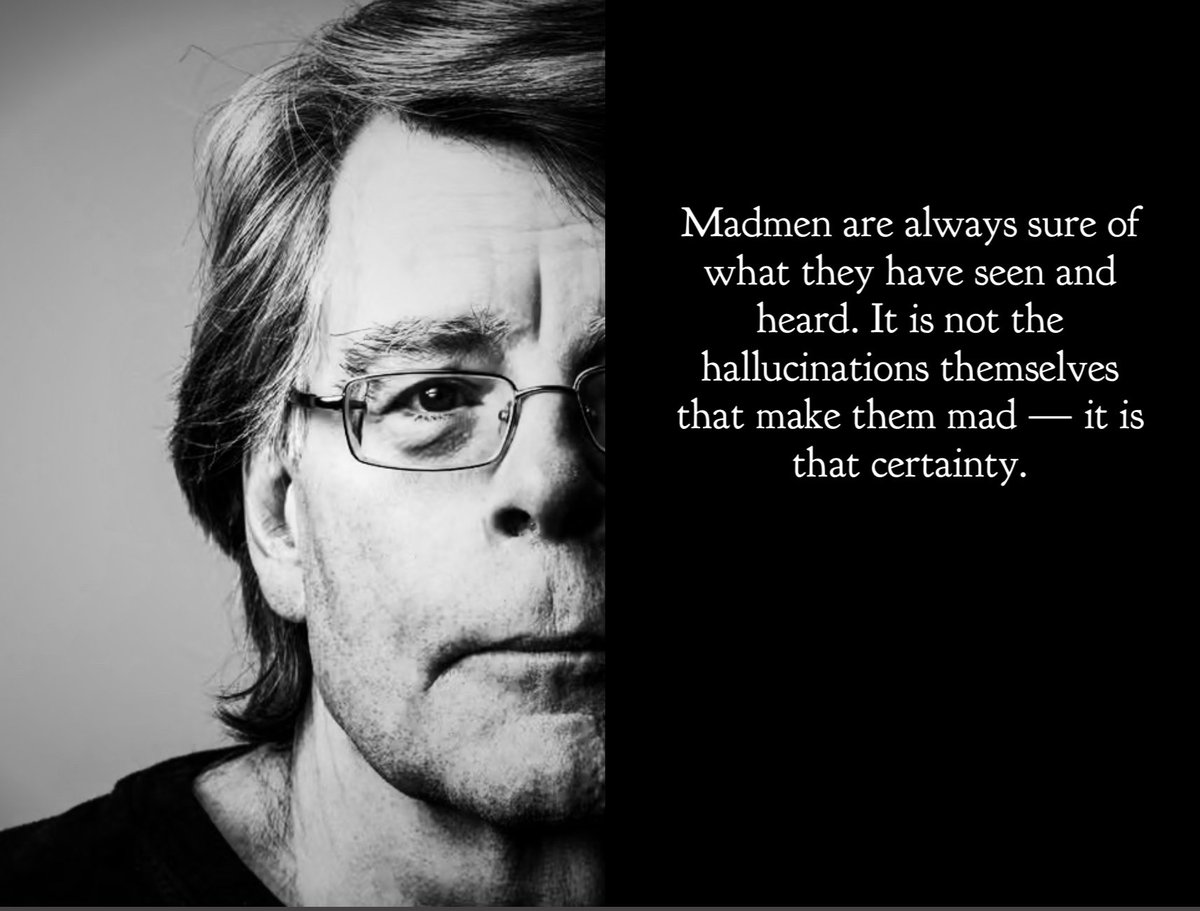
“Madmen are always sure of what they have seen and heard. It is not the hallucinations themselves that make them mad — it is that certainty.” — Stephen King, Insomnia
Not every private experience is a delusional opinion. The danger begins only when experience is turned into a verdict on the world.
The certainty King describes is not the force of a conviction. It is a mind shut against doubt and against the search for truth. A madman is not mad because he sees, hears, or feels something other people do not. He is mad because he no longer allows for error, and treats what he perceives as a final truth that cannot be touched.
To treat every opinion as equal is an absurdity. It seals anyone who forms a view inside a private, sealed-off world. Families — the smallest cells of social life — communities and civilizations endure and grow around shared beliefs, convictions, truths, and values, and around a direction chosen in common.
When the world becomes a set of parallel realities pulling in opposite ways, whose claims cannot be challenged or overturned, and whose course no one is allowed to influence, community, society, and civilization begin to come apart.
Yes. Exactly that. The unraveling starts with equality — and with unchallengeable certainty about what that equality rests on.
An opinion, by itself, does not blow a shared world apart. What does is the belief that it must not be touched. The same is true of an ordinary mistake, an ideology, or a powerful feeling. Certainty with no room for confrontation, no chance of being shown wrong, and no path to correction is dangerous for the person who holds it, because it locks them inside their own picture of things; and dangerous for everyone else, because the common ground of judgment disappears. That hard certainty is expensive. It makes learning harder. It makes relationships harder to repair. And it blurs the line between what happened and how it was read.
Contemporary culture goes further. It does not leave this certainty alone. It manufactures it and then protects it. It protects the bubble in which a person can remain planted in their own vision of the world even when that vision is error, falsehood, or an emotional reading of events. Information bubbles, and the faith that every opinion “counts,” are no longer tolerance. They are a shield: the more tightly someone is fixed in their own picture, the more inviolable that picture is supposed to be.
A community does not require everyone to feel the same thing. It requires ground on which a claim can be tested, an error demonstrated, and a direction chosen. When every perspective becomes equally important and equally immovable, that ground vanishes. The protection of private certainty stops being a door left ajar. It becomes a force that shatters shared judgment and shared action.
And present culture, too often, rewards with attention, empathy, and protection the person who ends the matter with a feeling. The wish to check, to confront, to criticize, or to show that something is wrong is frequently taken as an assault, as political incorrectness, as an offense.
The side effect is a fading border between opinion and fact. A shared, testable reality loses first place, because every perception is supposed to matter equally. The right to a perspective turns into the demand that this perspective be treated as equal — and as beyond challenge.
Culture often skips the condition without which the rest makes no sense: that reality exists also outside what someone feels. When that condition disappears, what remains is a contest of perspectives, and the only measure of importance becomes how fiercely someone is sure of what they believe.
I used the quotation (trans. from the Polish edition) as a pretext and followed it further — I hope not too far. But seen more deeply, those two sentences of King’s say what many of today’s debates no longer want to hear.
“Live attentively, because all around you are so many people whose lives and sense of meaning depend on the steps you take. And this applies to every one of us, for these paths, these places, these people, these destinies are always crossing, everywhere. Whether we are aware of it or not. For me, this is what it means to live responsibly, to live attentively, to live carefully — to look closely at those around us, and above all to look closely at ourselves…”
Krzysztof Kieślowski
This is a compelling way of seeing the world, and one that deeply resonates with my own feelings about life and its tangled paths. In the times we live in, we more and more often become either opponents or indifferent strangers to one another. Shut inside our information bubbles and sunk in egocentrism, we lose not only our connection with other people, but a significant part of our own humanity. Along with it goes our sense of agency, our motivation, our feeling of purpose, and that quiet inner drive that once carried us forward.
Instead of observing and contemplating the complicated, difficult and unique relationships between people, we prefer to play gods — all-knowing little deities who neither watch nor understand, but only judge and assign others their place in our lives and in the world. Completely cut off from our own shared and so deeply human flaws and limitations.
As Kieślowski once said: “I am afraid of those who know everything.”
For it is precisely the other person — the bond with people, the sense of community, the attentive gaze — that allows humanity to grow. Isolation and excessive independence, which we so often mistake for freedom today, in truth cut us off not only from others, but from something greater: from our own humanity and from what is divine within us.
And it is precisely in this way that every decline of civilization begins.
Krzysztof Kieślowski (1941–1996) was a Polish director, screenwriter and documentary filmmaker, one of the most important figures in European cinema of the second half of the twentieth century, a man who left a lasting mark on the world. “Every person wants to change the world when they begin to do anything. I don’t think I ever expected to change the world in the literal sense. I thought it might be possible simply to describe it.”
He made many documentary and feature films and eventually became a leading voice of the movement known as the cinema of moral anxiety.
In his work we find, above all, a deep sensitivity to the human being, a keen eye for observation, and a steady attention to an essential moral order — one that stands independent of politics or religious dogma. We also see his fascination with the mysteries of existence and with the subtle connections between people, observed in the difficult Polish reality of his early career. In that reality, for all its brutality and everyday harshness, Kieślowski perceived not only the tangle of events, people and times, but also silent, metaphysical forces that reason alone cannot explain.
“I believe in good and evil, even though in the times we live in it is hard to speak of pure black and pure white. Still, I believe one is clearly better than the other, and I believe people want to choose what is good — they simply are not always able to do so.”
He achieved worldwide recognition above all with the television series Dekalog (1988–1989), The Double Life of Véronique (1991), and the Three Colours trilogy: Blue, White and Red (1993–1994).
Here they come – the defenseless women with children who need our help,
together with the students, valuable engineers, doctors and other highly skilled specialists who will strengthen Europe and boost our economy and culture.
“Nobody has the right to go through life being protected from being offended, insulted or having their feelings hurt. […] It is absolutely right that we should allow people, no matter how profoundly we disagree with them – I hate to utter clichés in this august debating hall, but I am going to utter one – that no matter how much we may disagree with somebody, we should defend to the hilt their right to say it.
And that is something that I have believed all my life.
You succeed by defeating your opponent, not by wishing him away. You get nowhere by trying not to hear what is being said.
Today you may feel morally superior by refusing to listen to other people’s words, but tomorrow someone else may feel equally morally superior by refusing to listen to what you have to say.
Free speech is for all, not just for the privileged few.”
The entire incredible speech can be watched here:
https://t.co/DwPZ2QSx8f
@ballaratiandrea Prohibiting the event, blocked citizens with petitions,and put up barbed wire — the EU’s true tyrannical face is being revealed. We need more such gatherings!
https://t.co/8tucdaKPQp
@JonaLionDE@MartinSellner_@SaveEuropeAct Prohibiting the event, blocked citizens with petitions,and put up barbed wire — the EU’s true tyrannical face is being revealed. We need more such gatherings!
https://t.co/8tucdaKPQp
Fromm – Heretic of Marxism. Love and Freedom Beyond Ideology
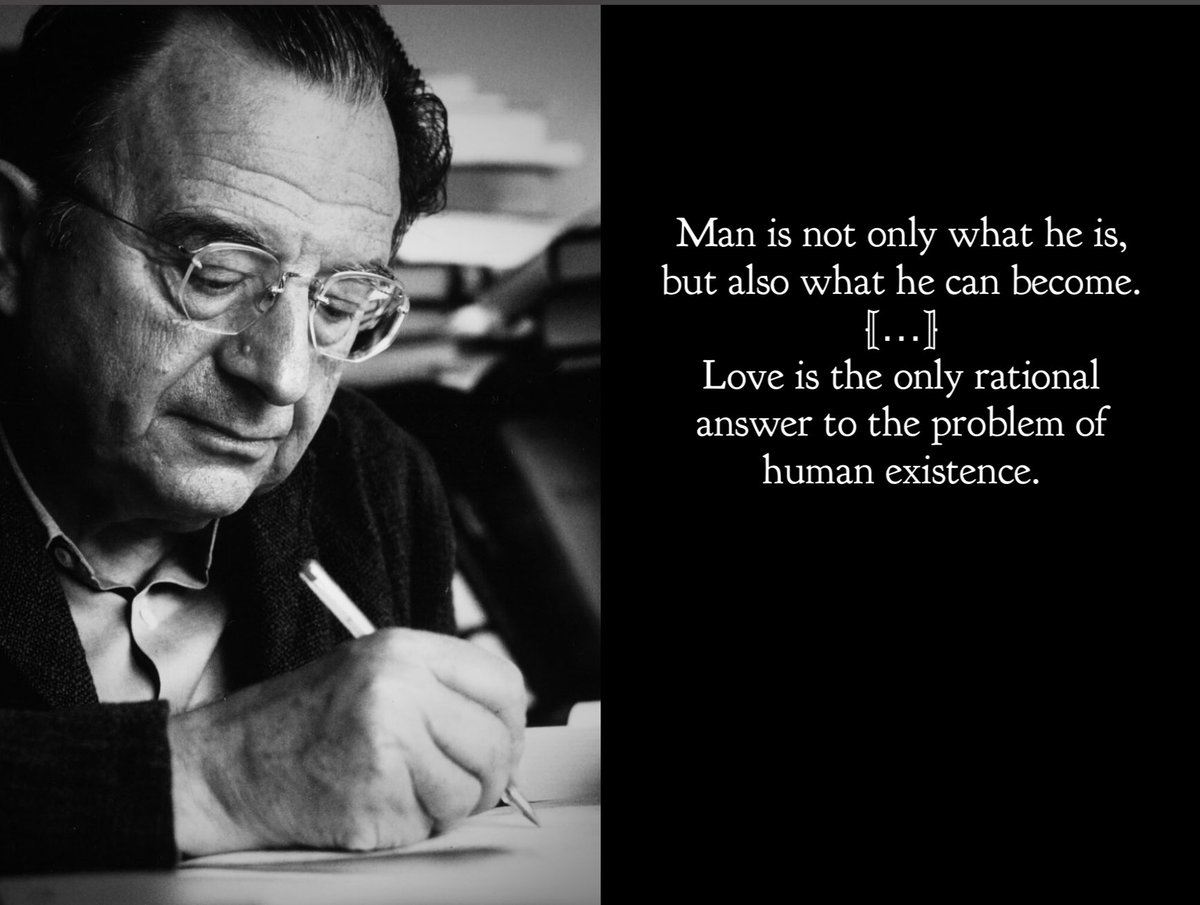
“Man is not only what he is, but also what he can become.”
“Love is the only rational answer to the problem of human existence.”
Erich Fromm (1900–1980) was a German-born American sociologist, psychologist, and philosopher. In 1933 he fled Nazi Germany for the United States, later living in Mexico and Switzerland. His experiences of war, exile, and totalitarianism deeply shaped his thought.
Fromm created a distinctive approach called social psychoanalysis, which highlighted the decisive influence of social and cultural forces on human personality. He rejected both Freud’s extreme biological determinism and Marx’s economic determinism, insisting that a true understanding of man must integrate biology, psychology, and socio-cultural context.
He was a fierce critic of both consumer capitalism and totalitarian regimes. In his book The Sane Society, he warned of a “pathological society” marked by alienation, loneliness, and meaninglessness.
He championed love, responsible freedom, rootedness, and an identity based on being rather than having. At the heart of his philosophy lay a profound respect for human dignity and an enduring belief in our capacity for growth.
In his later years, Fromm moved away from orthodox Marxism toward what he called “humanistic socialism”. Still, many critics — especially conservatives — accused him of utopianism, excessive optimism about human nature, and a naive faith in the possibility of radically reshaping society through conscious social engineering.
His central aim was to help people reclaim their full humanity in a world that, whether through capitalist consumerism or totalitarian control, constantly fosters alienation. Unlike many 20th-century thinkers, Fromm did not see freedom merely as the absence of restrictions. For him, true freedom demanded responsibility, discipline, and the ability to love.
Several of his ideas remain strikingly relevant today:
♥️Love as an art, not merely a feeling. It requires effort, knowledge, and practice. As Fromm wrote: “Love is not primarily a relationship to a specific person; it is an attitude, an orientation of character, which determines the relatedness of a person to the world as a whole, not to one ‘object’ of love.”
This remains one of the most powerfully anti-consumerist messages in modern psychology.
♥️Being versus having — his sharp critique of defining our worth through possessions, status, and consumption. Fromm argued that consumerism does not fulfill us but only deepens our existential emptiness.
♥️The escape from freedom — a tendency still very much alive: many prefer to surrender responsibility for their lives to authorities, ideologies, or algorithms rather than face the uncertainty that comes with genuine freedom.
♥️The need for rootedness and meaning — a fundamental human requirement that modern societies often fail to satisfy.
Fromm offered no easy formulas or revolutionary slogans. Instead, he called for patient, demanding work on oneself and the gradual cultivation of the capacity for authentic living. In our world of consumption, superficiality, and deepening polarization, his diagnoses still resonate — even if some of his broader social proposals appear utopian.
Fromm’s understanding of love stands as one of the deepest and most influential analyses of the 20th century. Its greatest strength lies in weaving together philosophical insight, psychological depth, social criticism, and an ethical call to self-development.
In today’s landscape of dating apps, narcissistic culture, fleeting relationships, and eroding trust, Fromm’s message feels more timely than ever.
Perhaps the most valuable element of his thought is the conviction that love is not primarily about finding the right person, but about developing our own capacity to give, to respect, and to take responsibility — regardless of whether we fully accept his social diagnosis.
Barbed Wire for Citizens: The EU’s Soft Tyranny Exposed
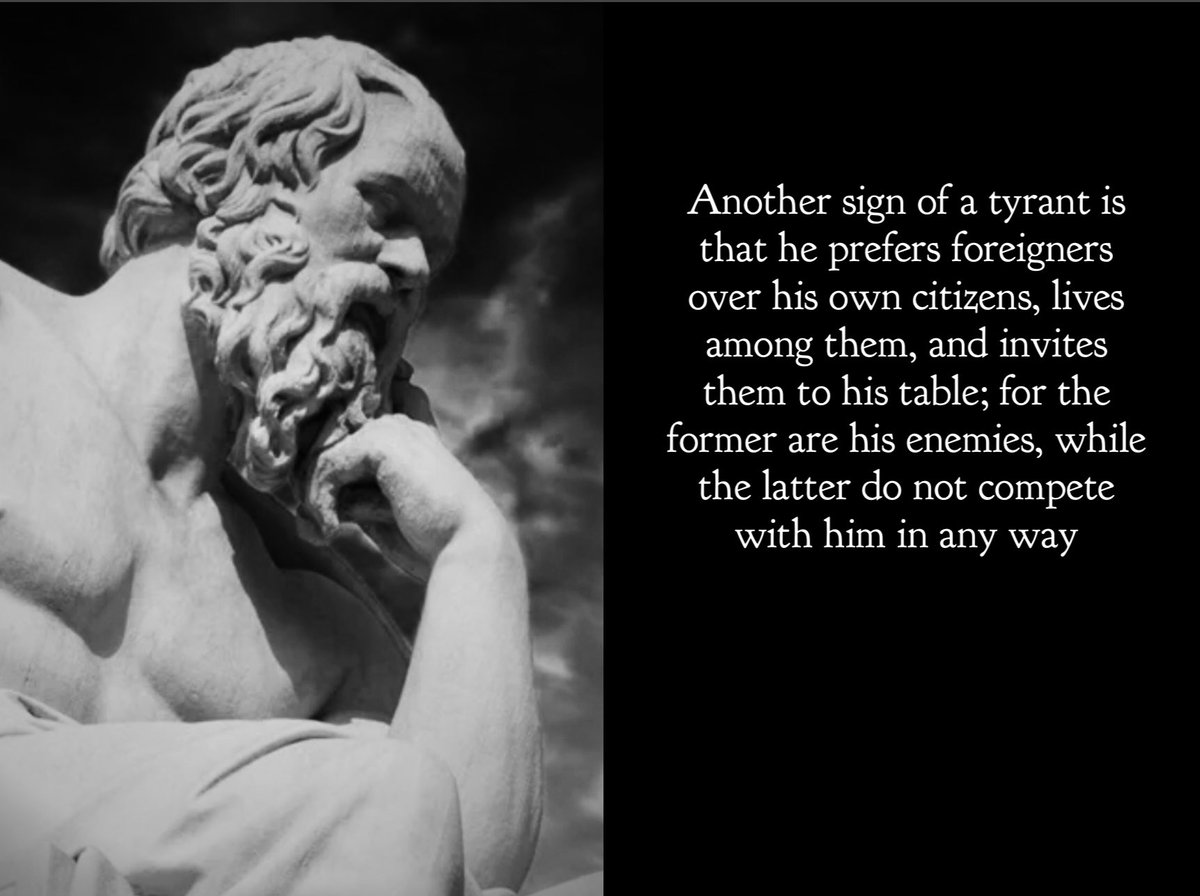
“Another sign of a tyrant is that he prefers foreigners over his own citizens, lives among them, and invites them to his table; for the former are his enemies, while the latter do not compete with him in any way.” — Aristotle
Yesterday we saw tyranny in action with our own eyes.
European citizens tried to deliver more than 530,000 signatures for the “Save Europe” remigration initiative. Instead of open dialogue at the headquarters of what is supposed to be “democracy in action” — an institution that should protect citizens, ensure their security, sovereignty, and freedom of speech — they were greeted with barbed wire fences and police cordons.
This is the same system that for years has claimed “we cannot close the borders,” yet it managed to do so within hours — when the goal was to protect itself from its own people.
Why? Because citizens have rights, expectations, and the potential power to resist. They can question those in power and demand justice. To the EU’s tyranny, they are the “enemy” because they represent a real threat.
Foreigners, on the other hand, are dependent on the authorities’ goodwill. They do not resist injustice — in fact, they often support it, since they live off the same resources: taxes and rights extracted from working citizens. They are grateful for their place “at the table” and willingly serve as bodyguards, advisors, or tools of repression. A tyrant surrounds himself with those who do not challenge his dominance.
Modern tyranny is not a single person or family, but a sprawling network of institutions, oligarchs, and political elites who maintain power through lobbying, algorithmic manipulation, censorship, mass surveillance, financial dependency, lawfare, and cultural authoritarianism — including cancel culture, mandatory gender ideology in schools and workplaces, climate alarmism used as a control mechanism, and engineered mass migration.
All of this serves to shield their power from their own people. This system now dominates much of the Western world and key supranational institutions (the EU, UN, Big Tech, and global financial bodies).
Understanding what is truly happening helps us recognize threats to freedom in any era.
The philosophical study of tyranny shows us that it is not about uniforms or titles. It is about the relationship between those in power and the citizens: whether the state and its institutions serve the common good, or whether they exist primarily to maintain and expand their own dominance.
When authorities begin to treat their own people as the enemy — blocking petitions with barbed wire and silencing dissenting voices — we are witnessing classical tyranny, only in a modern, “soft” form.
It is time for citizens to remind the elites who is really in charge in Europe.
Barbed Wire for Citizens: The EU’s Soft Tyranny Exposed
“Another sign of a tyrant is that he prefers foreigners over his own citizens, lives among them, and invites them to his table; for the former are his enemies, while the latter do not compete with him in any way.” — Aristotle
Yesterday we saw tyranny in action with our own eyes.
European citizens tried to deliver more than 530,000 signatures for the “Save Europe” remigration initiative. Instead of open dialogue at the headquarters of what is supposed to be “democracy in action” — an institution that should protect citizens, ensure their security, sovereignty, and freedom of speech — they were greeted with barbed wire fences and police cordons.
This is the same system that for years has claimed “we cannot close the borders,” yet it managed to do so within hours — when the goal was to protect itself from its own people.
Why? Because citizens have rights, expectations, and the potential power to resist. They can question those in power and demand justice. To the EU’s tyranny, they are the “enemy” because they represent a real threat.
Foreigners, on the other hand, are dependent on the authorities’ goodwill. They do not resist injustice — in fact, they often support it, since they live off the same resources: taxes and rights extracted from working citizens. They are grateful for their place “at the table” and willingly serve as bodyguards, advisors, or tools of repression. A tyrant surrounds himself with those who do not challenge his dominance.
Modern tyranny is not a single person or family, but a sprawling network of institutions, oligarchs, and political elites who maintain power through lobbying, algorithmic manipulation, censorship, mass surveillance, financial dependency, lawfare, and cultural authoritarianism — including cancel culture, mandatory gender ideology in schools and workplaces, climate alarmism used as a control mechanism, and engineered mass migration.
All of this serves to shield their power from their own people. This system now dominates much of the Western world and key supranational institutions (the EU, UN, Big Tech, and global financial bodies).
Understanding what is truly happening helps us recognize threats to freedom in any era.
The philosophical study of tyranny shows us that it is not about uniforms or titles. It is about the relationship between those in power and the citizens: whether the state and its institutions serve the common good, or whether they exist primarily to maintain and expand their own dominance.
When authorities begin to treat their own people as the enemy — blocking petitions with barbed wire and silencing dissenting voices — we are witnessing classical tyranny, only in a modern, “soft” form.
It is time for citizens to remind the elites who is really in charge in Europe.
The Sweet Lie of War
“War is sweet to those who have not experienced it. But the experienced man trembles in his heart at its approach.”
Pindar
Contemporary man doesn’t even have to get off the couch to feel the “sweet taste” of war. It’s enough to open X or any other portal. People eagerly take sides in conflicts as if it were a football game or the new series. Without compassion, they churn out memes, crack jokes about the tragedies of millions, and turn human suffering into viral content.
War has become a backdrop for moral and intellectual performance — people quote Heraclitus (“war is the mother of all things”), Nietzsche, or other theories about nations being forged and progress through conflict. All from a safe distance: from apartments with electricity, running water, and a full stomach.
Wars are the oldest and common part of human history - ever since agriculture emerged, along with property, food reserves, inequalities, and larger, permanent communities. All of this dramatically increased both the reasons and the opportunities to wage war.
From Neolithic settlements, through ancient empires, colonizations, Crusades, world wars, to today’s conflicts. No major civilization or state has survived without wars. War was a tool of expansion, defense, resource acquisition, settling succession disputes, and ideological struggles.
But why now?
John Mueller, who is no naive pacifist, says: “Major war between rich states has become so stupid and unprofitable that it is increasingly heading to the dustbin of history — just like duels or slavery. But conflicts will still arise in places where the cost-benefit calculation looks different.” And let us hope his prediction comes true.
Meanwhile, for many elites, oligarchs, and representatives of the military-industrial complex, war remains the most reliable way to multiply wealth and power. Arms deals, reconstruction contracts, control of resources, new markets — all of this generates enormous, predictable profits.
Big money is made on war — not on peace. As long as real power and decision-making in the world remain in the hands of groups for whom conflict is good business, wars will keep breaking out or being prolonged.
Every one of us who today has electricity, bread, and is not standing on the barricades is a winner in history’s lottery. This luck carries an obligation — at least the obligation not to turn someone else’s hell into cheap, tasteless entertainment.
And to seriously ask ourselves whether we would be capable of looking another human being in the eyes and pulling the trigger. And this is not a matter of feminine “sensitivity” or instinct.
All people possess an innate, powerful, evolutionary mechanism that inhibits the killing of our own kind. A resistance so strong that in many circumstances soldiers on the battlefield would rather die than overcome it.
Dave Grossman, in his book On Killing, shows in detail how armies had to develop special methods of psychological conditioning to break this barrier — and what enormous psychological cost (PTSD, depression, suicide, guilt) those who cross it must bear.
And people think that posting a funny meme turns them into impressive tough guys, intelligent commentators, armchair strategists, and heroes in civilian life?
Perhaps instead of a philosophical, witty, or “most righteous” comment, it is simply time to shut up out of respect for those who have been forced to commit inhuman acts. Who for months cross the boundary of their own humanity — they have no choice. You do.
This is not a game. This is not a film. This is not a meme. This is a confrontation with the deepest moral and emotional side of a human being!
And until you yourself start killing, do not jokes on subjects you know only from history books or even the most credible Hollywood films — they have nothing in common with the real tragedy that unfolds between people wearing two different colored uniforms when they meet on the battlefield.’
Barbed Wire for Citizens: The EU’s Soft Tyranny Exposed
“Another sign of a tyrant is that he prefers foreigners over his own citizens, lives among them, and invites them to his table; for the former are his enemies, while the latter do not compete with him in any way.” — Aristotle
Yesterday we saw tyranny in action with our own eyes.
European citizens tried to deliver more than 530,000 signatures for the “Save Europe” remigration initiative. Instead of open dialogue at the headquarters of what is supposed to be “democracy in action” — an institution that should protect citizens, ensure their security, sovereignty, and freedom of speech — they were greeted with barbed wire fences and police cordons.
This is the same system that for years has claimed “we cannot close the borders,” yet it managed to do so within hours — when the goal was to protect itself from its own people.
Why? Because citizens have rights, expectations, and the potential power to resist. They can question those in power and demand justice. To the EU’s tyranny, they are the “enemy” because they represent a real threat.
Foreigners, on the other hand, are dependent on the authorities’ goodwill. They do not resist injustice — in fact, they often support it, since they live off the same resources: taxes and rights extracted from working citizens. They are grateful for their place “at the table” and willingly serve as bodyguards, advisors, or tools of repression. A tyrant surrounds himself with those who do not challenge his dominance.
Modern tyranny is not a single person or family, but a sprawling network of institutions, oligarchs, and political elites who maintain power through lobbying, algorithmic manipulation, censorship, mass surveillance, financial dependency, lawfare, and cultural authoritarianism — including cancel culture, mandatory gender ideology in schools and workplaces, climate alarmism used as a control mechanism, and engineered mass migration.
All of this serves to shield their power from their own people. This system now dominates much of the Western world and key supranational institutions (the EU, UN, Big Tech, and global financial bodies).
Understanding what is truly happening helps us recognize threats to freedom in any era.
The philosophical study of tyranny shows us that it is not about uniforms or titles. It is about the relationship between those in power and the citizens: whether the state and its institutions serve the common good, or whether they exist primarily to maintain and expand their own dominance.
When authorities begin to treat their own people as the enemy — blocking petitions with barbed wire and silencing dissenting voices — we are witnessing classical tyranny, only in a modern, “soft” form.
It is time for citizens to remind the elites who is really in charge in Europe.
Barbed Wire for Citizens: The EU’s Soft Tyranny Exposed
“Another sign of a tyrant is that he prefers foreigners over his own citizens, lives among them, and invites them to his table; for the former are his enemies, while the latter do not compete with him in any way.” — Aristotle
Yesterday we saw tyranny in action with our own eyes.
European citizens tried to deliver more than 530,000 signatures for the “Save Europe” remigration initiative. Instead of open dialogue at the headquarters of what is supposed to be “democracy in action” — an institution that should protect citizens, ensure their security, sovereignty, and freedom of speech — they were greeted with barbed wire fences and police cordons.
This is the same system that for years has claimed “we cannot close the borders,” yet it managed to do so within hours — when the goal was to protect itself from its own people.
Why? Because citizens have rights, expectations, and the potential power to resist. They can question those in power and demand justice. To the EU’s tyranny, they are the “enemy” because they represent a real threat.
Foreigners, on the other hand, are dependent on the authorities’ goodwill. They do not resist injustice — in fact, they often support it, since they live off the same resources: taxes and rights extracted from working citizens. They are grateful for their place “at the table” and willingly serve as bodyguards, advisors, or tools of repression. A tyrant surrounds himself with those who do not challenge his dominance.
Modern tyranny is not a single person or family, but a sprawling network of institutions, oligarchs, and political elites who maintain power through lobbying, algorithmic manipulation, censorship, mass surveillance, financial dependency, lawfare, and cultural authoritarianism — including cancel culture, mandatory gender ideology in schools and workplaces, climate alarmism used as a control mechanism, and engineered mass migration.
All of this serves to shield their power from their own people. This system now dominates much of the Western world and key supranational institutions (the EU, UN, Big Tech, and global financial bodies).
Understanding what is truly happening helps us recognize threats to freedom in any era.
The philosophical study of tyranny shows us that it is not about uniforms or titles. It is about the relationship between those in power and the citizens: whether the state and its institutions serve the common good, or whether they exist primarily to maintain and expand their own dominance.
When authorities begin to treat their own people as the enemy — blocking petitions with barbed wire and silencing dissenting voices — we are witnessing classical tyranny, only in a modern, “soft” form.
It is time for citizens to remind the elites who is really in charge in Europe.
@KoronaWarszawa Police officers on standby and barbed wire — this is exactly what democracy in action looks like!
And they certainly didn’t look ashamed of themselves.