To safeguard yourself against the impending collapse of the traditional financial system, learn all about the concept of the petrodollar and why it won't work anymore.
Prepare yourself accordingly.
Avoid being a blind sheep, you fool.
Strait of Hormuz transit and risk monitor
Transit activity in the Strait of Hormuz strengthened over the weekend, with crossings reaching 10 on Saturday and 11 on Sunday, according to #MarineTraffic data. Sanctioned vessels accounted for almost half of Sunday’s movements, highlighting a shift in traffic composition alongside rising volumes. No verified physical attacks or incidents during this period, despite elevated geopolitical rhetoric. While this suggests near term operational stability, evolving political developments may still shape vessel behaviour and risk exposure in the days ahead. Read the latest analysis by Dimitris Ampatzidis, Kpler Senior Risk & Compliance Analyst: https://t.co/ENluSMTU1f
Here’s a playback of vessel activity in the Strait of Hormuz over the past two days.
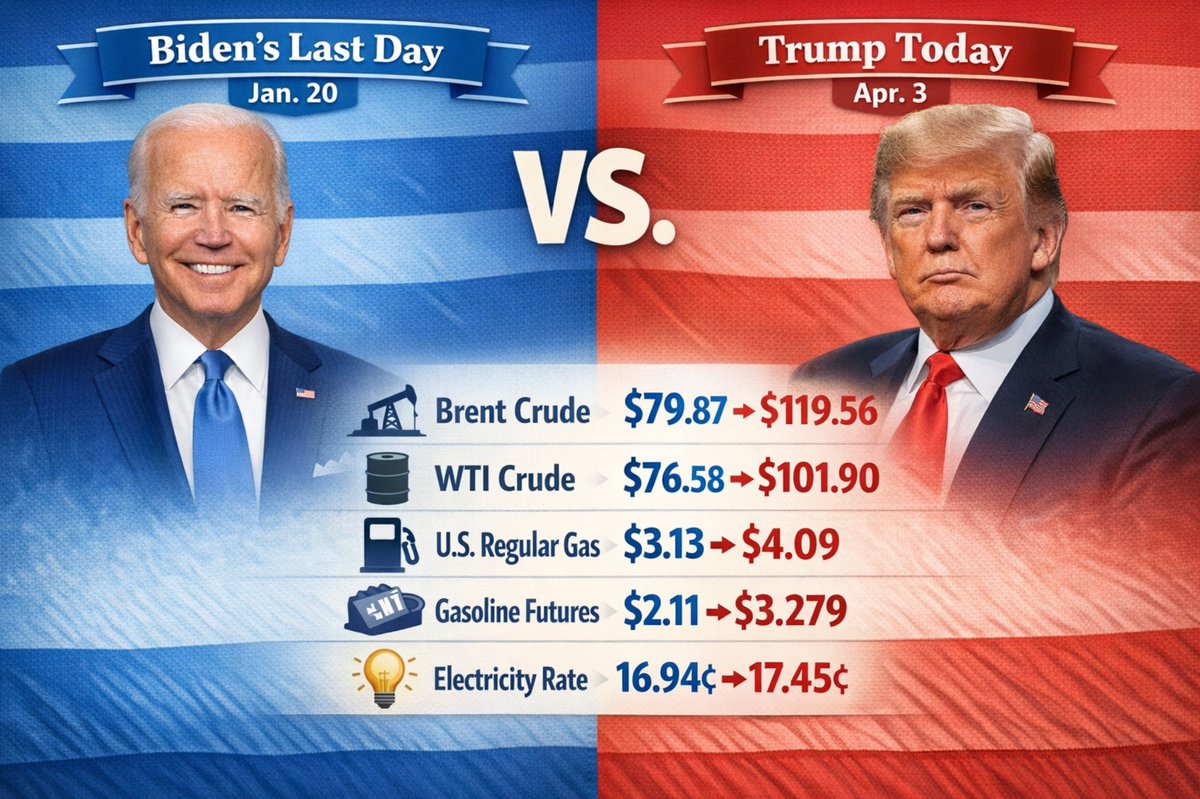
U.S. Energy Prices on Joe Biden's last day in office compared to Donald Trump's America today:
- Brent crude $79.87 → $119.56
- WTI crude $76.58 → $101.90
- U.S. regular gas $3.13 → $4.09
- Gasoline futures $2.11 → $3.279
- Residential electricity 16.94¢ → 17.45¢
Is this what MAGA considers "WINNING"?
Grayscale just updated its filing for a $TAO (Bittensor) trust with the SEC. That's a clear sign institutions are starting to look at TAO seriously. If this moves forward, it could make TAO more accessible to big investors and that usually brings attention and liquidity.
Here's a video of a NASA rocket launch, filmed from a window in a passing airplane.
According to NASA, the reason why every one of their rocket launches arc in this rainbow-shaped trajectory is because they "need to accelerate to 17,500 MPH, then enter Earth's orbit horizontally".
Conspiracy theorists are calling bullshit, saying the rockets never get anywhere near that speed, and instead are just going up a little ways, then coming back down into the ocean. (As explained in the QRT'd post below, if this WERE the case, the area all of these rockets would be crash-landing would be right in the Bermuda Triangle 🤔)
What do you think?
Personally, I'd like to see more videos from this perspective that last another minute or two for a more comprehensive view of the full launch (I dug pretty hard across the web but couldn't find any; if you know of any please LMK)
...But from what I can see in this short clip, it's obvious the rocket is nowhere near 17,500 MPH (that's 10x the speed of a speeding sniper bullet for reference), and it sure appears to be tapering off of its thrust in the upper atmosphere, NOT continuing to accelerate, as it would need to in order to reach the blinding horizontal orbit speed of 17,500 MPH that NASA claims.
Let me know what you think in the comments! 👇
Most systems ask you to trust the approval. $SIGN changes that by turning approvals into verifiable evidence.
Not who said it, but whether it can be proven.
~@Sign#SignDigitalSovereignInfra
$SIGN isn't introducing new data, it’s reorganizing how trust is carried, so the same verification can hold value across different systems.
@Sign#SignDigitalSovereignInfra $SIGN
With Sign Protocol, processes don't just run, they leave behind proof you can verify anytime, instead of relying on blind trust.
@Sign#SignDigitalSovereignInfra $SIGN
$SIGN turns trust into something verifiable, making token distribution fairer and harder to game. Still early, but the direction feels real. >@Sign#SignDigitalSovereignInfra
$SIGN lets one proof carry across chains, so you don’t repeat the same verification again. The process finally feels seamless.
#SignDigitalSovereignInfra@Sign
In my opinion, Sign Protocol reframes claims as attestations that carry their own verifiability.
And then trust becomes secondary, verification becomes primary...
@Sign#SignDigitalSovereignInfra $SIGN