Our planet is sending us a clear signal.
From climate change to deforestation and land-use change, the pressures on our planet are growing.
On #EarthDay and every day, the world must accelerate its shift to a sustainable economy, one that works for both people and the planet.
Tiger Global just valued a bagel shop at $300 million. And the math actually makes sense if you stare at it long enough.
PopUp Bagels started in 2020 out of a kitchen in Westport, Connecticut. Adam Goldberg was baking bagels for neighbors during the pandemic. Five years later, Tiger Global closed a deal in late March that values the company at 5x what it was worth five months ago.
The unit economics are what caught Tiger's attention. Average transaction over $24. Five bagel varieties. Three schmears. 55 total SKUs while competitors run 200-300. Stores are 1,000-1,200 square feet. Each location hires 10-15 employees instead of the 50-60 a typical QSR needs. No ice machines. No soda fountains. No fryers.
They don't sell individual bagels. You buy packs of three, six, or twelve. You grip, rip, and dip. That constraint does two things simultaneously: it raises average order value above the threshold where a small-format store prints money, and it creates a ritual that photographs well. Every customer becomes a content creator.
The franchise math: $330K-$810K to open, $35K franchise fee, 6% royalty. They've signed 300 franchise units with fewer than 15 operators. That's roughly 20 stores per operator. Experienced multi-unit franchisees running large territories, not first-timers buying a single shop. About 30 locations open now, targeting 100 by end of 2027.
Celebrity investors include Paul Rudd, JJ Watt, Michael Phelps, Michael Strahan. Stripes bought a majority stake in 2023 and brought in a real CEO, Tory Bartlett, in late 2024. Adam Sandler has a dedicated phone at one of the New York shops to call in orders. They literally call it "the Sandler Phone."
Here's what Tiger Global sees. The same firm that backed Meta, invested in OpenAI and Waymo, has been exiting 85+ companies from its most recent fund to concentrate on fewer, higher-conviction bets. They looked at a bagel company and decided it belonged in that concentrated portfolio.
The $300 million number only works if you believe 300 franchise locations actually open and hit the projected unit economics. At an estimated $6M revenue per location and 18% margins, 100 operating stores would generate roughly $108M in systemwide profit. At 300, you're approaching the kind of numbers that make $300M look cheap.
The real question is whether the hype survives national scale. PopUp Bagels built its brand on scarcity, long lines, and social media energy. Every franchise system in history has faced the tension between exclusivity and expansion. Levain Bakery, funded by the same firm Stripes, is the closest comparable, and it stayed small.
Tiger's betting the ritual travels. That the 1,100 square foot format, the five-SKU simplicity, and the $24 average ticket create something that works in Tampa the same way it works in Greenwich Village.
If they're right, this is the most capital-efficient restaurant concept of the decade. If they're wrong, it's a $300 million lesson in the difference between a brand and a business.
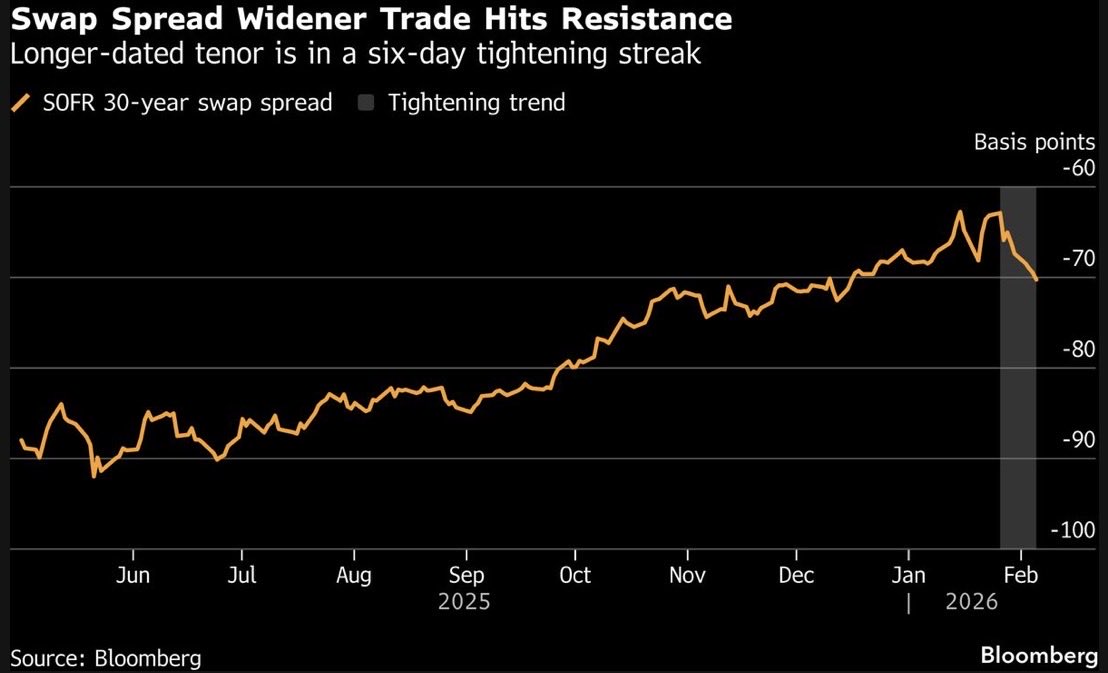
Dollar swap spread widener has been a staple trade since the April blowout
Cracks appearing now though and early signs of deleveraging underway. Balance sheet uncertainty and expected vol uptick playing into unwinds…
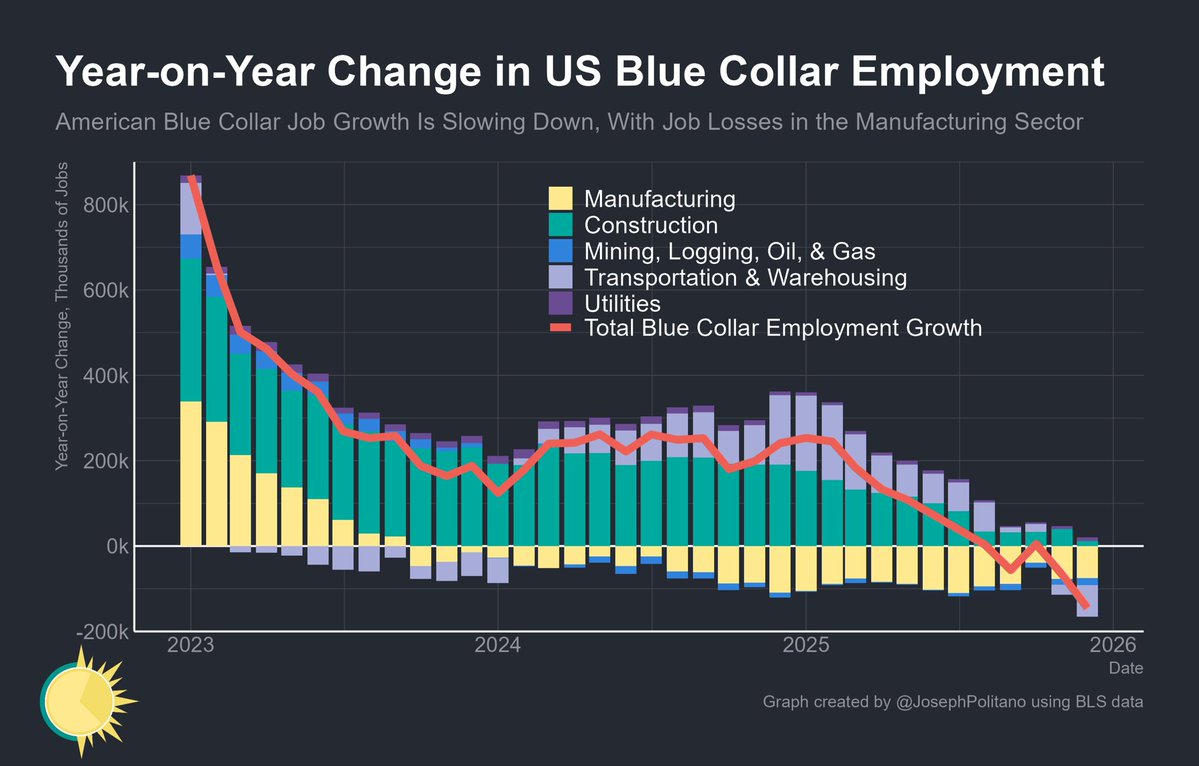
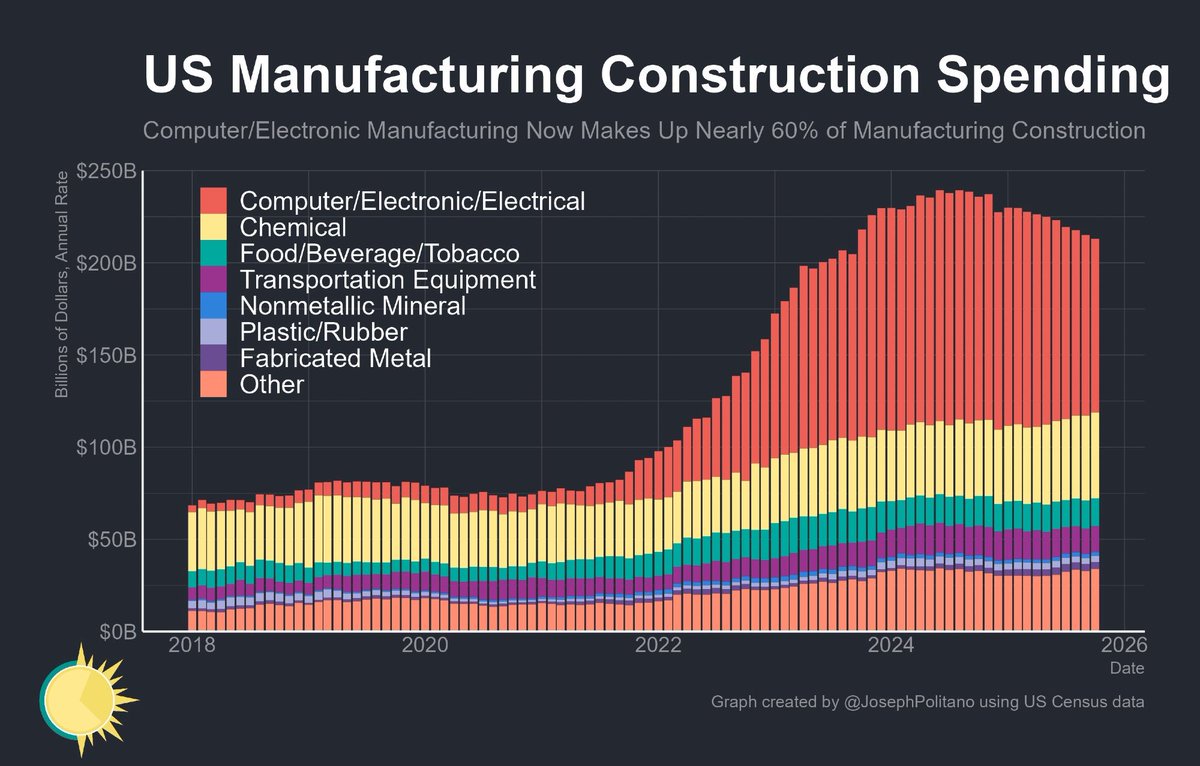
Bessent is wrong here—not only is America losing manufacturing jobs amidst the tariffs, but there’s no “burst in construction jobs” & we don’t have a “record number of factories being built”
The US construction job growth has zeroed out & factory construction is actually falling
“When we protect the most vulnerable,
when we refuse to look away,
when we speak up for the institutions that speak up for us,
we keep human rights alive.”
— @antonioguterres on Wednesday’s #HumanRightsDay.
https://t.co/JGN0GN57RH
So much of capitalism’s bad press comes from this confusion. People blame free markets for problems caused by political favoritism, where political pull distorts competition, props up incumbents, and punishes innovation.
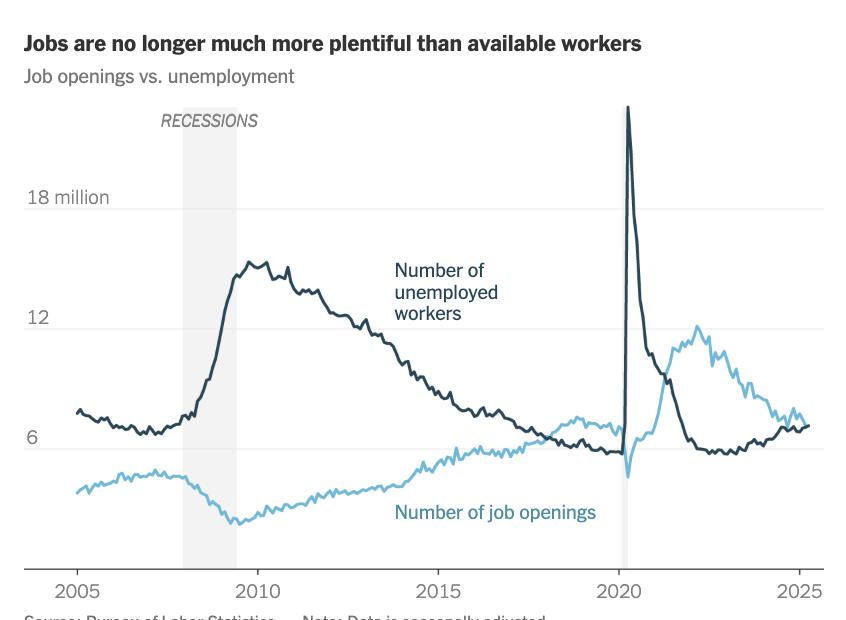
ECON NEWS: Labor Market Mirage?
Jobs are rising—but the cracks are showing:
• Labor force participation is 📉
• More people working 2+ jobs📈
• Payrolls up, but not from new workers
• Same people hustling harder to stay afloat
More to come later in our report.
Why the Atlanta Fed’s 4.6% Q2 Estimate May Be a Distorted Signal, Not a Growth Story
The Atlanta Fed’s GDPNow model made headlines after jumping to 4.6% for Q2 2025 up from 3.8% just days prior. If confirmed in the final print, this would be the strongest U.S. GDP figure since 2021. But before interpreting this as proof of economic strength or resilience, we need to step back and understand what’s really driving the surge.
The headline figure is not being propelled by a boom in consumption, business investment, or productivity. It’s being driven by a sharp contraction in imports a mechanical boost to GDP via the net exports channel. In other words, the economy looks stronger on paper because it bought fewer goods from abroad.
⸻
1. Why a Decline in Imports Raises GDP
This isn’t a trick it’s just accounting. GDP is calculated as: GDP = Consumption + Investment + Government Spending + (Exports – Imports)
So, when imports fall, the GDP formula automatically shows a boost. In this case, the net exports contribution jumped to +1.36 percentage points, adding substantial lift to the topline estimate. But here’s the problem: falling imports can signal weaker consumer demand, tighter credit, or disrupted global supply chains none of which are bullish for the real economy.
⸻
2. Internal Composition: What’s Actually Driving Growth?
Looking beyond net exports, the internals are mixed:
•Services consumption remains the strongest contributor at +1.51 percentage points, showing steady post-pandemic demand.
•Goods consumption added +1.26 points, reflecting some resilience in durable and nondurable purchases.
•Fixed investment (+0.79) and government spending (+0.42) are contributing modestly.
•But private inventories fell by -0.70 points, suggesting businesses are not rebuilding stock often a warning of softer forward demand.
So while the total print looks high, the engine driving it is not broad-based acceleration it’s a statistical lift from trade dynamics, not internal strength.
⸻
3. Historical Parallels: When Strong GDP Misleads
This setup is not new. We’ve seen similar situations before:
•Q4 2008: GDP was temporarily buoyed by collapsing imports while the U.S. was entering the worst recession since the Depression.
•2011 and 2020: Short-term GDP spikes from trade and inventory quirks masked deeper structural fragility.
In each case, the data appeared strong because of mechanical boosts, but the real economy was weakening beneath the surface. That dynamic may be playing out again.
⸻
4. Why Markets Should Be Cautious
This data has significant implications:
•Bond markets may misinterpret this as inflationary heat, pushing yields higher.
•The Fed, if overly focused on backward-looking strength, may delay needed easing.
•Equity markets could overprice resilience and underprice risk, especially in consumer cyclicals and industrials.
But the more important signal is this: inventory liquidation combined with a collapse in imports usually signals a late-cycle transition or pre-recession phase. Businesses pulling back on inventory and global trade slowing are not hallmarks of healthy expansion.
⸻
5. Bottom Line
A 4.6% GDP print looks strong, but context matters. This is a GDP illusion an artifact of declining imports, not organic demand. Policymakers, investors, and analysts would be wise to treat this not as confirmation of resilience but as a potential signpost of fragility.
GDP can rise while the economy deteriorates underneath. That’s the danger of treating headline numbers as reality instead of asking what’s driving them. This print is not an all clear it’s a yellow light flashing against a distorted backdrop.
What just happened?
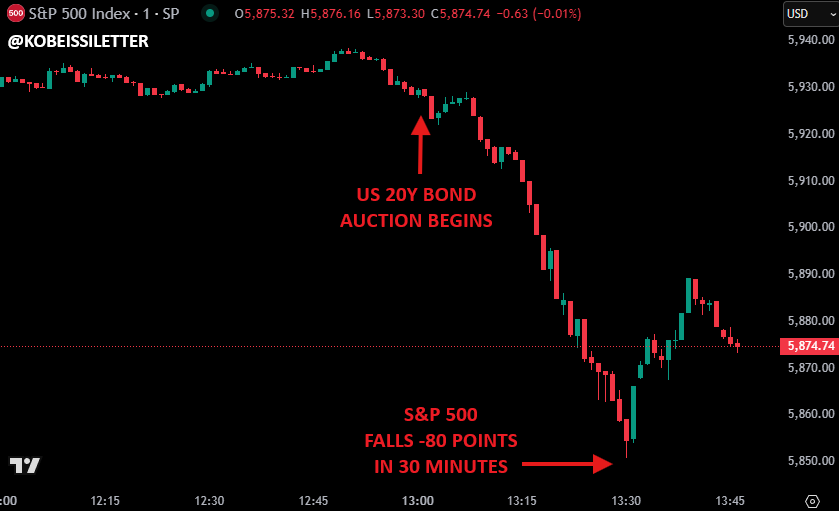
At 1:00 PM ET, the S&P 500 fell nearly -80 points in 30 minutes without any major "news."
What actually happened was a weak 20Y Bond Auction which sent US Treasury Yields soaring.
Investors MUST watch yields here. Let us explain.
(a thread)