Ephesians 3:20 ESV
[20] Now to him who is able to do far more abundantly than all that we ask or think, according to the power at work within us,
https://t.co/UpBxPqPbdo
The G-to-G framework which was introduced about three years ago for fuel imports lacks transparency and has not secured competitive prices.
When importing oil, there is an item called premium; it is where the competition is. Under the G-to-G framework, which was not fully disclosed to this House for interrogation, the premium was fixed at $100 per tonne. The global average for premium has been $60 per tonne, meaning Kenya is paying over $40 more. ~
BREAKING: As I promised you yesterday, today we reveal how Kenyans may have been misled on the REAL cost of Talanta Stadium.
You were told:
“KSh44.5 billion.”
But the latest Auditor-General report now suggests the long-term liability could exceed KSh97.5 BILLION once interest and the 15-year financing structure are included.
That is more than DOUBLE.
And it gets worse.
The Auditor-General says key guarantee documents linked to the deal were NOT provided for audit verification.
Meaning:
Kenyans could be carrying massive hidden costs without full transparency.
Now ask yourself:
How does a 60,000-seat stadium end up costing Kenya more than some of the biggest stadiums in Africa?
📍 Morocco:
Hassan II Stadium - 115,000 seats — approx KSh24.5B
📍 Morocco:
Ibn Battouta Stadium - 60,000 seats — approx KSh13.9B
📍 DRC:
Stade des Martyrs - 80,000 seats — approx KSh5.9B
Meanwhile, Kenyan taxpayers may end up paying over KSh97 BILLION for ONE stadium.
This matters because:
It is YOUR taxes,
YOUR fuel levies,
YOUR future debt burden.
At that cost exposure, Kenya could theoretically build multiple world-class stadiums.
Instead, ordinary Kenyans may be left paying for decades.
Source: Auditor-General report on the Sports Fund.
I have attached a snippet of the report in the image above
And there is more coming, an even bigger exposee, so follow me - Sholla Ard . Adiós! 👋
Philemon 1:4-5 ESV
[4] I thank my God always when I remember you in my prayers, [5] because I hear of your love and of the faith that you have toward the Lord Jesus and for all the saints,
https://t.co/5wOpK2RWIa
Matatu operators in Nairobi have announced a 50% fare hike nationwide after fuel prices went up by EPRA.
They also say all PSVs will go on strike from Monday over rising fuel costs affecting operations.
Mchezo wa taon. Members of Parliament have proposed relocating Nakuru State House to a different location away from the busy Nakuru–Nairobi highway. They cited security concerns, noting that a multi-storey hotel directly overlooks the presidential residence. Members of Parliament have flagged it as a serious breach of presidential security and zoning protocols.
But here’s the gist: The Encore Hotel is owned by Sam Mburu, who allegedly acts as a proxy for Kasongo. The hotel was constructed last year. In fact, before Kasongo took office, no one was allowed to construct even a two-storey building near State House. But somehow, the government allowed Susan Kihika and her husband to put up a hotel with over ten floors. Statehouse Nakuru is now on sale.
Kenyans are being told that the government cannot afford to lose Ksh 35 billion by granting tax relief to low-income earners, and that statement alone reveals the direction of the country’s economic philosophy.
At a time when fuel prices are surging, food costs are becoming unbearable, electricity bills keep rising, and salaries remain largely stagnant, the burden of sustaining government revenue is increasingly being shifted onto ordinary citizens. What makes this more frustrating is the contrast in urgency: relief for struggling families is treated as a dangerous “revenue loss,” yet billions lost through corruption, wastage, inflated procurement, and failed public projects rarely trigger the same alarm.
An economy cannot sustainably grow by continuously weakening the purchasing power of its lowest earners because those are the very people who drive consumption, small businesses, and local demand.
I’ve signed a petition calling for accountability over the humiliation of a Grade 10 student in the Kenyan Senate. No child should ever be degraded in public institutions. Join me in demanding action and stronger protections for children’s dignity: https://t.co/K7a8q1BgOf
EPRA UNCONVINCING EXCUSES ON HIGH PRICES AND GLARING CONTRADICTIONS
The Exchange Rate Alibi Collapses Instantly — the USD/KShs exchange rate has been virtually flat for 12 straight months: ranging narrowly between Sh129.27 and Sh130.08. The shilling is not the culprit. EPRA cannot hide behind forex volatility — it simply does not exist
The Diesel Spike is Extraordinary and Unexplained — Diesel landed cost jumped from US$1,073.82 to US$1,291.98 per cubic metre — a 20.32% increase in one month. This is an outlier of seismic proportions. EPRA offers zero explanation for why diesel specifically spiked so dramatically when global oil markets have not moved correspondingly
Super Petrol Landed Cost Up 10% in One Month — From US$823.87 to US$906.23 per cubic metre. Again, no contextual explanation tying this to specific international market events, supply disruptions, or geopolitical triggers that would justify a single-month double-digit jump
The Mohammed Jaffer’s MT Paloma Contaminated Cargo Shadow — EPRA’s press release is conspicuously and deliberately silent on whether the contaminated MT Paloma consignment has been factored into pricing. Are consumers now being charged premium prices for contaminated product?
The SICPA Bromide Question — EPRA equally says nothing about the halogenated brominated compound contamination alleged in COFEK’s High Court Petition No. E241 of 2026. How much of the expanded contract to @sicpa impacting the prices?
💰 THE SUBSIDY NARRATIVE DOESN’T ADD UP
EPRA claims the government will cushion consumers through the Petroleum Development Levy (PDL) Fund using approximately Sh5B to subsidize Diesel and Kerosene
Yet Diesel prices still rise by a punishing Sh46.29/litre — begging the question: what would the price be without the subsidy?
If Sh5B is being deployed and Diesel still jumps Sh46 in one cycle, the subsidy mechanism is either grossly inadequate, misapplied, or being siphoned
EPRA provides no breakdown of how the Sh5B is distributed, who receives it, or how it translates to per-litre relief
📊 THE INTERNATIONAL PRICE TREND TABLE TELLS A DIFFERENT STORY
Super Petrol international price: US$642.73/MT in January 2026 — by April 2026 it had surged to US$1,060.01/MT
Diesel: US$580.65/MT in January 2026 — rocketing to US$1,393.50/MT by April 2026
These are extraordinary movements demanding detailed explanation — which EPRA does not provide
Were these price surges linked to the G2G procurement scandal? To the MT Paloma off-spec cargo? To market manipulation by procurement cartels? EPRA is silent
IN A NUTSHELL …
EPRA��s press release is a numbers exercise dressed up as accountability. It explains the mechanics of price computation but studiously avoids the elephant in the room: that Kenya’s fuel procurement, quality assurance, and regulatory framework are under simultaneous criminal investigation, constitutional litigation, and public scandal
Kenyans are being asked to pay record fuel prices for fuel of questionable quality, regulated by an authority of compromised integrity.
New electricity tariffs are now loading for July too. Kenyans are being squeezed from every direction ; expensive fuel, expensive electricity, expensive transport and rising food prices while salaries remain stagnant and unemployment keeps rising.
Every EPRA adjustment eventually cascades through the economy because higher fuel prices increase transport costs, electricity raises production costs, and businesses transfer all those burdens directly to ordinary citizens.
Matthew 11:12 ESV
[12] From the days of John the Baptist until now the kingdom of heaven has suffered violence, and the violent take it by force.
https://t.co/sY8cpbmWJh
Matthew 11:12 ESV
[12] From the days of John the Baptist until now the kingdom of heaven has suffered violence, and the violent take it by force.
https://t.co/sY8cpbmWJh
The finance bill 2026 will affect us negatively as follows;
1. Rental income tax has been raised from 7.5% to 10%.(Brace yourself for increased rent)
2. Mitumba traders, brace yourselves.
Import a bale at Ksh1M → Pay Ksh50K tax upfront.
3. They’re removing VAT exemptions on mobile money and digital payments.This will increase the cost of sending money.
4. KRA can now decide 60% of your company’s retained earnings are “dividends” and tax you anyway.
5. An introduction 25% excise duty on phones.
6. Banks won’t absorb new compliance costs. Let’s be serious.
You will.
7. They’ve moved tax return deadlines from June to APRIL.
Tough times ahead.
@moneyacademyKE One could argue that revenue from park entry fee went up despite the fewer numbers. However, fewer visitors mean few vehicles, fewer drivers, lower room nights, lower food consumed & basically you kill an entire value chain to pursue higher park entry fees. Our advisors are crap.
Maasai Mara visitors dropped by almost 50% from 420,000 in 2023 to 213,000 in 2025.
The decline is linked to increased higher entry fees, with tourists shifting to cheaper parks like Amboseli and Tanzania’s Serengeti.
Good afternoon patriots. Here is your Lunchtime dose of anger. This should make you angry enough to avoid any nice looking thing near you.
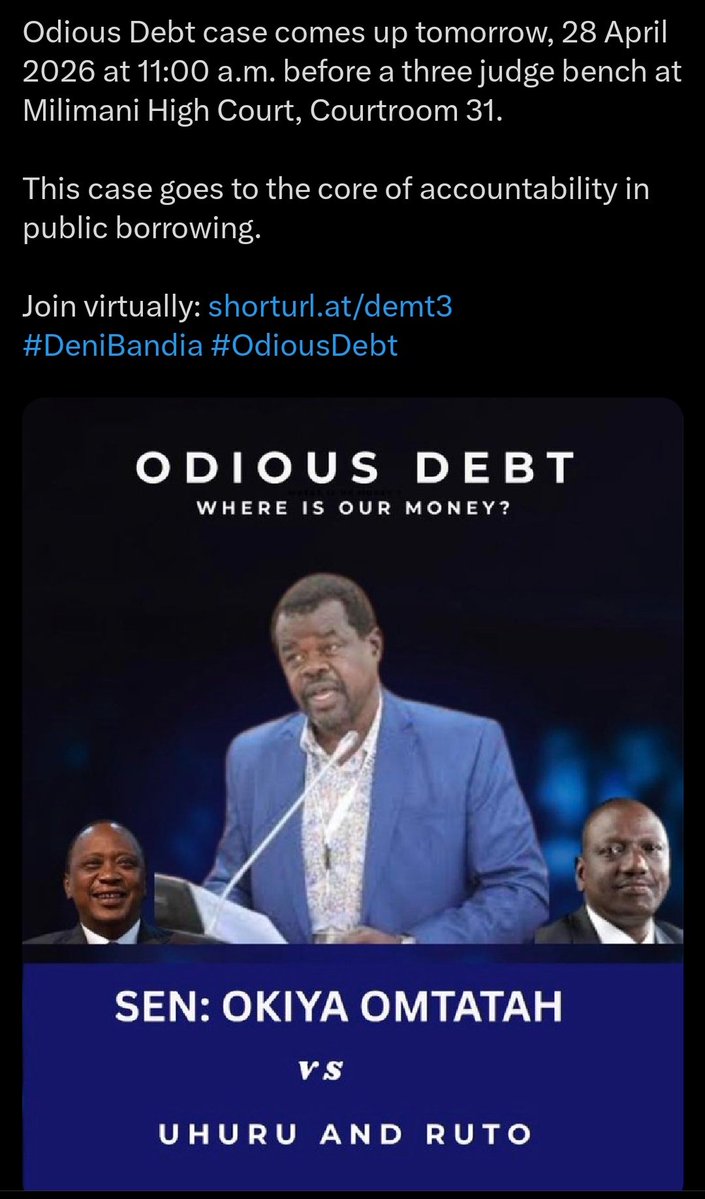
Today at Milimani High Court.
Courtroom 31.
One man is challenging KSh 7 trillion of debt.
Borrowed in your name.
Without your approval.
Routed to offshore accounts instead of the Consolidated Fund.
KSh 12.4 trillion total.
And only 28.6% had proper legal backing.
The rest was just borrowed.
Quietly.
On your behalf.
While you were sleeping.
The political class is silent.
The media is silent.
The same media that covered Ruto's misquoting in real time.
Silent.
The same politicians who scream about the people on rally podiums.
Silent.
Because this case does not just challenge the debt.
It challenges everyone who borrowed it.
Past presidents.
Current presidents.
Treasury officials.
The IMF.
All named as respondents.
Now here is the question nobody is asking.
If Omtatah wins.
Who pays?
You.
The same Kenyan who did not borrow the money.
Did not approve the money.
Did not see the money.
Will pay back the money.
With SHA deductions.
And housing levy.
And dirty fuel taxes.
This is the most important court case in Kenya's history.
And it is trending below Ruto's English lessons.
Stand with Omtatah Kenya.
He is doing what the whole Parliament should be doing.
For free on your behalf.
Again. Make it trend as they do not want you to know about #DeniBandia
Dismas wa Tabu. Dreaming in installments. Billed in full.
KRA is not playing with Naivas.
You know Naivas. Hii tu moja.
It was a fully family owned supermarket giant.
When the time came to cash out, the owners weighed their options.
If they sold the supermarket from Kenya, they would pay insane taxes.
So they went shopping for low tax countries. And Mauritius presented itself. It was irresistible.
- 0% tax on sale of the company.
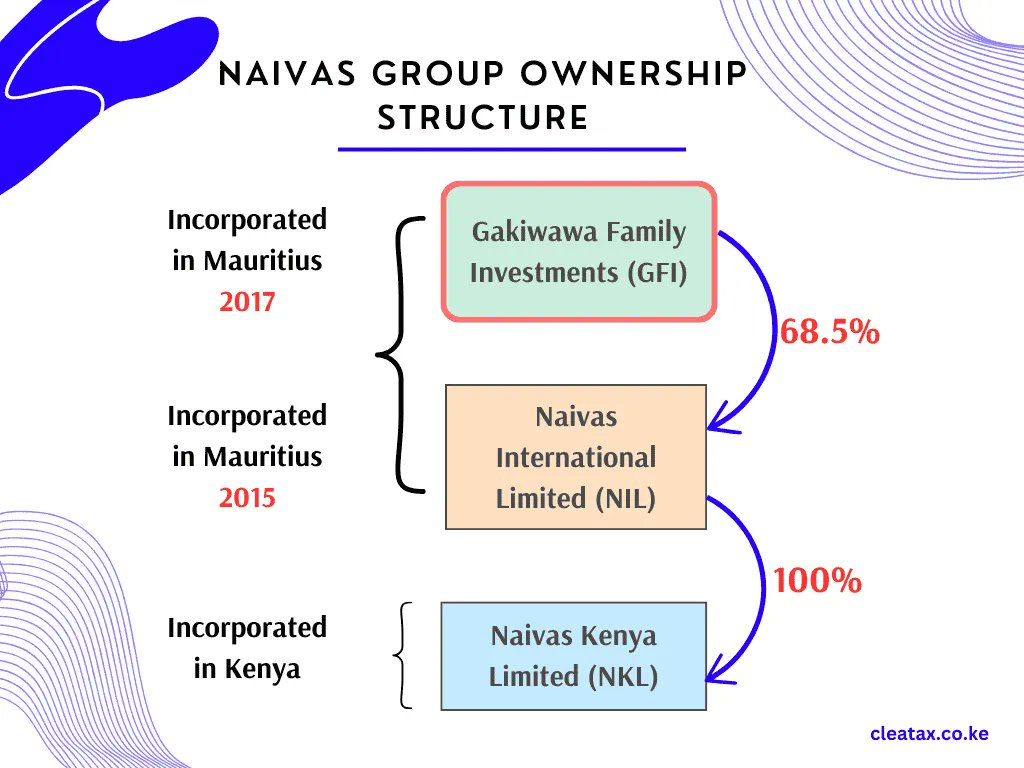
In 2015, the family registered a shell company in Mauritius. Called it NIL.
Then transferred all their shares to this company.
So Naivas was now 100% owned by a Mauritian company.
To make it even tighter, they added another layer.
They set up a second shell company. Called it GFI.
And transferred all NIL shares to GFI.
So now:
• GFI owns NIL
• NIL owns Naivas Kenya
Proper entanglement. Achana na hiyo yako.
As all this is happening, they are unaware of one dangerous sentence sitting quietly in Kenyan tax law.
It reads:
• Any company managed and controlled from Kenya is a Kenyan resident company.
Then the family went looking for a buyer.
In 2020:
• They sold 30% of the supermarket for 5.2B
• By selling 30% of NIL shares
So:
- Naivas is still owned by NIL
- But NIL now has a new shareholder
And everything happened in Mauritius quietly.
Nothing has changed hands in Kenya trigger anything.
• Deal is closed. 0 tax.
Bahati mbaya, KRA caught wind that Naivas is gone.
Immediately, KRA embarked on a fault finding mission.
In 2022, KRA discovered that:
- The family has always lived in Kenya. Not Mauritius.
- They managed and controlled every single operation of the shell companies from Kenya
They invoked the one dangerous sentence.
You remember it?
• Any company managed and controlled from Kenya, is a Kenyan resident company.
KRA said:
• These Mauritius shell companies are Kenyan
• They must pay tax in Kenya
Tax demanded: 30% of 5.2B. Plus penalties
• Total Bill: 1.8B
Naivas ran to court.
The court looked at it, and sided with KRA.
Family wakaabiwa walipe tax.
Case closed!
Lesson.
• Structure your offshore company properly.
• Or KRA will structure it for you.



![Manwa's tweet photo. Ephesians 3:20 ESV
[20] Now to him who is able to do far more abundantly than all that we ask or think, according to the power at work within us,
https://t.co/UpBxPqPbdo https://t.co/0qTxrevL3o](https://pbs.twimg.com/media/HKZY5AOX0AAPgbs.jpg)

![Manwa's tweet photo. Philemon 1:4-5 ESV
[4] I thank my God always when I remember you in my prayers, [5] because I hear of your love and of the faith that you have toward the Lord Jesus and for all the saints,
https://t.co/5wOpK2RWIa https://t.co/cXma2IwPcu](https://pbs.twimg.com/media/HIovGxKXMAAscL7.jpg)


![Manwa's tweet photo. Matthew 11:12 ESV
[12] From the days of John the Baptist until now the kingdom of heaven has suffered violence, and the violent take it by force.
https://t.co/sY8cpbmWJh https://t.co/AU3YRuBpk7](https://pbs.twimg.com/media/HIEgvFRWIAAO34d.jpg)