💌 El profesor e investigador coreano Sanghwan Lee se volvió tendencia tras escribir un ensayo sobre la decisión de BTS de no presentar su música a los Grammy 2027.
📝 Compartimos la traducción de uno de los fragmentos más comentados del texto.
Ha llegado el momento de hacernos otra pregunta.
¿BTS solo es grande si los Grammy le entregan un premio?
¿La música que amamos solo adquiere verdadero valor cuando el mundo decide reconocerla?
Lo que BTS dejó de lado esta vez no fue únicamente un trofeo.
Tal vez también nos esté diciendo que nosotros mismos debemos abandonar esa necesidad de buscar constantemente la aprobación de los demás.
De pronto me vino a la mente una frase muy conocida en Corea:
"¿Y qué si no tenemos dinero? ¿Acaso no tenemos dignidad?"
Quisiera darle una nueva forma.
"¿Y qué si nuestro territorio es pequeño? ¿Acaso el cielo también lo es?"
Corea no es un país grande.
Durante mucho tiempo tampoco fue el centro de la industria musical mundial.
Y el idioma coreano, por supuesto, no es una lengua que pueda entenderse en cualquier rincón del planeta como ocurre con el inglés.
Pero haber nacido en una tierra pequeña no significa que debamos mirar solo un cielo pequeño.
BTS cantó en coreano y cruzó el océano Pacífico y el Atlántico.
Personas que hablan idiomas completamente distintos terminaron cantando esas mismas canciones.
Algunos encontraron en ellas consuelo para soportar la soledad.
Otros aprendieron, gracias a ellas, a quererse a sí mismos.
Y otros recuperaron las fuerzas para seguir viviendo cuando atravesaban momentos de desesperación.
Si algún día los Grammy les entregan un trofeo, nos alegraremos junto a ellos.
Pero, aunque nunca se lo den, el mundo que BTS ha construido no se hará más pequeño.
Ninguna etiqueta podrá reducir el cielo por el que vuela su música.
Los premios descansan en las manos de los artistas.
Pero las canciones permanecen en el corazón de las personas.
Las estanterías donde se exhiben los trofeos tienen un límite.
El cielo por el que viajan las canciones no lo tiene.
Nuestro cielo no termina sobre la península de Corea.
Cruza el océano Pacífico.
Cruza el Atlántico.
Va más allá de cualquier ceremonia de premios.
Y atraviesa todas las fronteras que otros han trazado basándose en regiones o idiomas.
Ese cielo continúa hasta el universo.
Y las canciones de BTS llenarán ese universo.
¿La conclusión?
¿Y qué si nuestro territorio es pequeño? ¿Acaso el cielo también lo es?
Los Grammy no evaluaron a BTS.
Fue BTS quien evaluó a los Grammy.
---
Koreli bir vatandaşın grammy ve BTS hakkında yazdıkları gündem olmuş, benim de okurken tüylerim diken diken oldu diye paylaşmak istedim:
başlık: ülke toprağımız küçük olabilir, peki ya gökyüzümüz de mi küçük?
“Kore büyük bir ülke değil, global müzik sektörünün merkezinde hiçbir zaman yer almadı. korece de, ingilizcenin aksine, her gidilen yerde konuşulan ve anlaşılan bir dil de değil. ama küçük bir toprak parçasında doğduk diye bakış açımızı küçük bir gökyüzüyle sınırlayacak değiliz.
BTS, korece şarkılar söyleyerek Pasifik okyanusunu ve Atlas okyanusunu aştı. farklı dilleri konuşan insanlar onların şarkılarını hep bir ağızdan söyledi. kimileri yalnızlığına yoldaş buldu, kimileri kendini sevmeyi öğrendi, kimileri ise çaresizliğin ortasında yeniden yaşama tutunacak o gücü buldu.
eğer grammy onlara bir ödül verirse bunu onlarla birlikte sevinçle kutlarız ama vermezseler de BTS'in yarattığı bu dünya küçülüp gitmeyecek. hiçbir unvan veya etiket, BTS'in müziğinin yankılandığı gökyüzünü daraltamaz.
bir ödül, müzisyenin ellerindedir ancak bir şarkı ise insanın kalbindedir.
bir ödül rafının sınırları vardır ancak bir şarkının uçabileceği gökyüzünün ise asla sınırları yoktur.
bizim gökyüzümüz, Kore Yarımadasıyla sınırlı değil. Pasifik ve Atlas okyanusunu aşarak, ülkelerin ödül salonlarının ya da bölge ve dile göre ayrılmış sınırlarının ötesine geçiyor.
ve işte o gökyüzü, tüm evrene ulaşıyor. BTS'in müziği de o evreni doldurmaya her zaman devam edecek.”
My Reaction to BTS Not Playing the Grammys' Game, and the Korean Music Critic Who Criticized Their Decision
For the past ten days, I traveled along Korea's west coast and then spent time with my former students on Jebudo, an island where you can witness the miracle of Moses every single day, as the 2.3-kilometer road connecting the island to the mainland disappears beneath the sea as the tide comes in, only to emerge again when the water recedes. We spent a few days together at a pension (a Korean vacation rental), playing sports, talking late into the night over drinks, and laughing about old memories. Then I headed to one of the most remote temples in Korea for a temple stay, a place I often visit whenever I need to clear my mind and spirit.
I finally made it back to Seoul late tonight, and as soon as I got home, I opened my iPad to catch up on the day's news. The very first thing I saw was that all seven BTS members had agreed not to submit any music for Grammy consideration next year. I have to admit, I was really proud of them.
The moment the Recording Academy announced that new Asian music category last month, my immediate reaction was, "I know exactly what this is." It felt like a way of keeping BTS away from the major categories. A polite way of saying, "You may be the biggest music group on the planet, but you still don't belong here." I've said this to my friends ever since that category was announced that BTS should simply stop playing the Grammys' game. I know ARMYs around the world have felt exactly the same way.
So when I learned that BTS wouldn't just skip the Grammys but wouldn't even submit their music for consideration because they believed the category was essentially segregating Asian music, I clapped and said out loud to myself, "That's the BTS I know and love."
They've never played by other people's rules. They've always made their own. That's what they did with the Korean media, and that's exactly what they're doing now.
I know the Grammys' defense. They'll point to categories like Best African Music Performance or Latin music awards and say, "See? We have regional categories for everyone." But Asian music has always existed; why wasn't there an Asian category before? Why now?
The timing is just a little too convenient, isn't it? Even after taking a long break for mandatory military service, BTS's first album after their return became the best-selling album, songs like "SWIM" conquered the Billboard charts, and their worldwide tour is already breaking records. And now, all of a sudden, the Grammys create a brand-new category for Asian music? Come on, Grammys, nobody's buying it. We all know this isn't about recognizing Asian music. It's about keeping BTS in its own lane.
As a longtime ARMY, I know how much these seven men have dreamed, worked, and sacrificed over the years. So I definitely know that this decision did not come easily. That's what makes it so meaningful.
Then, of course, a Korean music critic had to pour cold water on BTS's brave decision and make me sigh… Just like the Korean music critic who suddenly argued that the American Music Awards had somehow "lost their influence" the moment BTS won Artist of the Year, one of Korea's best-known music critics, Yim Hee-yoon, criticized BTS's decision in an interview with Yonhap News, which, for those outside Korea, is essentially our version of the Associated Press.
He said:
BTS는 비교적 본상 또는 본상 후보 근처에 가장 근접한 한국 또는 아시아의 아티스트이기 때문에 이런 목소리를 낼 수가 있는 거라고 생각하거든요. 다른 면에서 바라보면 많은 아시아 아티스트들의 희망을 꺾는 일일 수도 있어요.
Which can be translated like this:
"I believe BTS can make this kind of statement because they are the Korean or Asian artist that has come closest to receiving one of the Grammys' main awards, or even becoming a serious contender for one. Seen from another angle, however, this could end up crushing the hopes of many Asian artists."
I read that sentence twice. Crushing the hopes of other Asian artists? So, according to this critic, BTS is supposed to gratefully accept a segregated category, smile, say thank you, and keep submitting their music because otherwise they might discourage other artists? Really? Hasn't BTS already done enough for Asian artists?
Let's be honest about what they've accomplished. They're the group that kicked open doors that many people thought could never be opened. They entered markets that had long been considered impenetrable for Korean artists and, in doing so, changed the way people around the world looked at K-pop. How long are they expected to keep carrying that responsibility?
What I don't think this critic understands is that BTS is making this decision precisely because they care about the future of Asian artists. They're willingly giving up possible Grammy nominations, and perhaps even Grammy awards, because they refuse to let Asian music be reduced to a regional category.
Think about that for a moment. If another Korean group, or a Japanese artist, or an artist from India, Thailand, Indonesia, or anywhere else in Asia creates a massive hit, should that artist automatically be placed in an "Asian Music" category simply because of where they come from? Or should they compete alongside everyone else?
BTS has answered that question with this decision.
And then I found myself thinking of someone I miss very, very much. Kim Young-dae. After he passed away, this music critic who criticized BTS's decision today, along with two other so-called music critics, took his place on Kim Ou-joon's program (remember the guy with the long bushy hair and messy beard?) to talk about K-pop. I've spoken with K-ARMYs about them, and we've all come away with the same feeling: unlike Kim Young-dae, they simply don't understand BTS.
Just a few weeks ago, Kim Ou-joon asked them a question, "Don't you think Korean media is always downgrading BTS? That it never really shows just how much influence they actually have around the world?" The critics replied, "No. Korean media supports BTS tremendously. The media is always reporting on their accomplishments, their concerts, and their success."
Kim Ou-joon immediately stopped him. "No," he said, "That's not what I'm talking about. I know the media reports those things. Everyone knows BTS sells out stadiums. Everyone knows they top charts. Everyone knows they've won awards. But they rarely try to explain why BTS became so popular. And they don't truly respect BTS as artists."
The room went quiet. No one really answered him. Instead, the conversation slowly drifted toward younger, up-and-coming K-pop groups. The moment that happened, I noticed something. Their eyes lit up. It felt as though they couldn't wait to stop talking about BTS.
They’re just like other Korean music critics and the Korean media, who are very good at reporting BTS's achievements but do not try to understand why millions upon millions of people around the world fell in love with seven young men from Korea.
They do not try to understand why people admire Namjoon's writing so much.
Why Yoongi's production is so respected.
Why Hobi's performances electrify audiences.
Why Jimin's voice moves people to tears.
Why Taehyung's artistic sensibility captivates so many people.
Why Jungkook is so beloved for his versatility.
Why Jin's expressive singing resonates with people around the world.
I've always believed that BTS never chased recognition for recognition's sake. They wanted people to hear their music, understand their message, and perhaps see the world a little differently because of it. If that meant refusing to play by someone else's rules, they've never been afraid to do it. That's one of the reasons I admire them so much.
Some people will probably say they're overreacting. Others will say they should have accepted the category and simply been grateful. I couldn't disagree more. Real change almost always begins because someone is willing to say, "No." Even when everyone else thinks it's safer to say yes.
Whether the Recording Academy changes course or not, I don't know. Whether this decision will make any difference five or ten years from now, I don't know either. But I do know this. Years from now, if another Asian artist is nominated for Album of the Year, Record of the Year, or Song of the Year without first being placed into a separate regional category, I hope people will remember that seven young men from Korea once decided to stand up and say something wasn't right. History has a funny way of revealing the importance of certain moments only after they've passed.
It's quarter past three here in Korea. Outside, it's so quiet that not even the distant barking of a dog can be heard. But before I call it a night, I'm going to pour myself a glass of Cabernet Sauvignon, a toast to BTS for their brave decision, and to Kim Young-dae.
"But by walking away, BTS has effectively taken one for the team. [...] BTS has unequivocally drawn a line in the sand, forcing the industry to confront its own structural biases regarding fairness and equality."
BTS are—and will remain—the only ones with the courage to make such a decision. After years of the Grammys benefiting from their global impact, responding by creating a separate category only highlights the treatment they have received. Their decision not to submit what many consider their best album speaks to principles, dignity, and a refusal to settle for half-hearted recognition.
#WeStandWithBTS
"BTS are unicorns. They're like 7 unicorns hopping along the world, blessing everyone with their talent & magic. They have fairy wings, they're just floating & dropping fairy dust on everyone. They're genuine. Awesome happy dudes. Very human." — Steve Aoki
The craziest part is that BTS became the first act ever to reject a racist award show, and it will forever go down as one of their most historic moments.
I don't think people fully understand the magnitude of this decision.
Some of the music industry's most respected producers, writers, engineers, and creatives worked on ARIRANG. A project built to the highest artistic standard. One producer even spoke publicly about hoping the album would receive Grammy recognition.
Then the Recording Academy introduced a category specifically for Asian pop.
And BTS chose not to submit.
Think about that. The biggest musical project of the year. One of the strongest commercial and artistic contenders. A project that could have competed across multiple major categories. It simply won't be in the race because the artists chose principle over prestige.
Moves like this don't happen often. When artists at BTS' level willingly walk away from the biggest stage in music, the conversation shifts because of what they refused to endorse.
[INFO] Many critics of the South Korean industry support #BTS's decision! 🇰🇷🔥
Im Jin-mo, a popular music critic assessed BTS's decision not to submit to the Grammys as "a declaration of musical independence that breaks the chains of Western-centric authority, and a restoration of subjectivity."
Critic Lim Jin-mo, who has consistently served as a commentator for the Grammy Awards, pointed, "While the Grammys put forward the justification of diversity for the newly established 'APMP' category, it is essentially a defensive and somewhat racist attempt to isolate K-pop into a peripheral category in order to protect the vested interests of mainstream music."
Lee Kyu-tak, a professor at George Mason University Korea and Director of the Global K-Center, pointed out that for BTS, who have achieved various accomplishments musically, commercially, and culturally, the Grammys tended to be regarded as "the ultimate goal they had to achieve." He noted, "It is true that whenever the Grammys came around, discussions about whether they would win consistently circulated among the media and fans, and there was a belief that they would only be 'truly' recognized in the United States if they won a Grammy."
However, the analysis noted, "The Grammys' creation of a separate 'APMP' award was tantamount to a declaration that Asian music (including K-pop and non-Western/non-English music) would be treated separately from the Grammys' 'main stage.' This implies that BTS, who are already established as musicians not only in Korea and the U.S. but globally, do not necessarily need to obsess over the Grammys." It continued, "Given that there would undoubtedly be debate among the media and fans regarding whether they accept the award or not under these circumstances, their voluntary refusal is significant in that it allows them to distance themselves from various controversies while clearly expressing their opposition to the Grammys treating non-Western/non-English music as a form of segregation."
Critic Im Jin-mo interprets BTS's recent decision as a resistance chosen instead of compromise in the face of the Grammys' conservatism, which prioritizes ratings and buzz while withholding fair evaluation. He viewed the decision not to submit as "a complete 'declaration of independence' from Grammy authority, signifying that they will no longer force K-pop's identity to conform to American standards."
Critic Lim also highlighted the potential impact that BTS's decision is expected to create. He pointed out, "Just as The Weeknd's past declaration of a Grammy boycott stirred up public opinion in the local music industry, the fact that a single Asian artist has rebelled against a massive awards ceremony and opened a forum for public discourse demanding change demonstrates immense influence in itself."
#WeStandWithBTS
The most powerful part of this decision is that they are no longer asking to be accepted by the industry. They already know their worth as artists and understand that they deserve nothing less than everything they have built and earned throughout the years. 👏💜🔥
#WeStandWithBTS
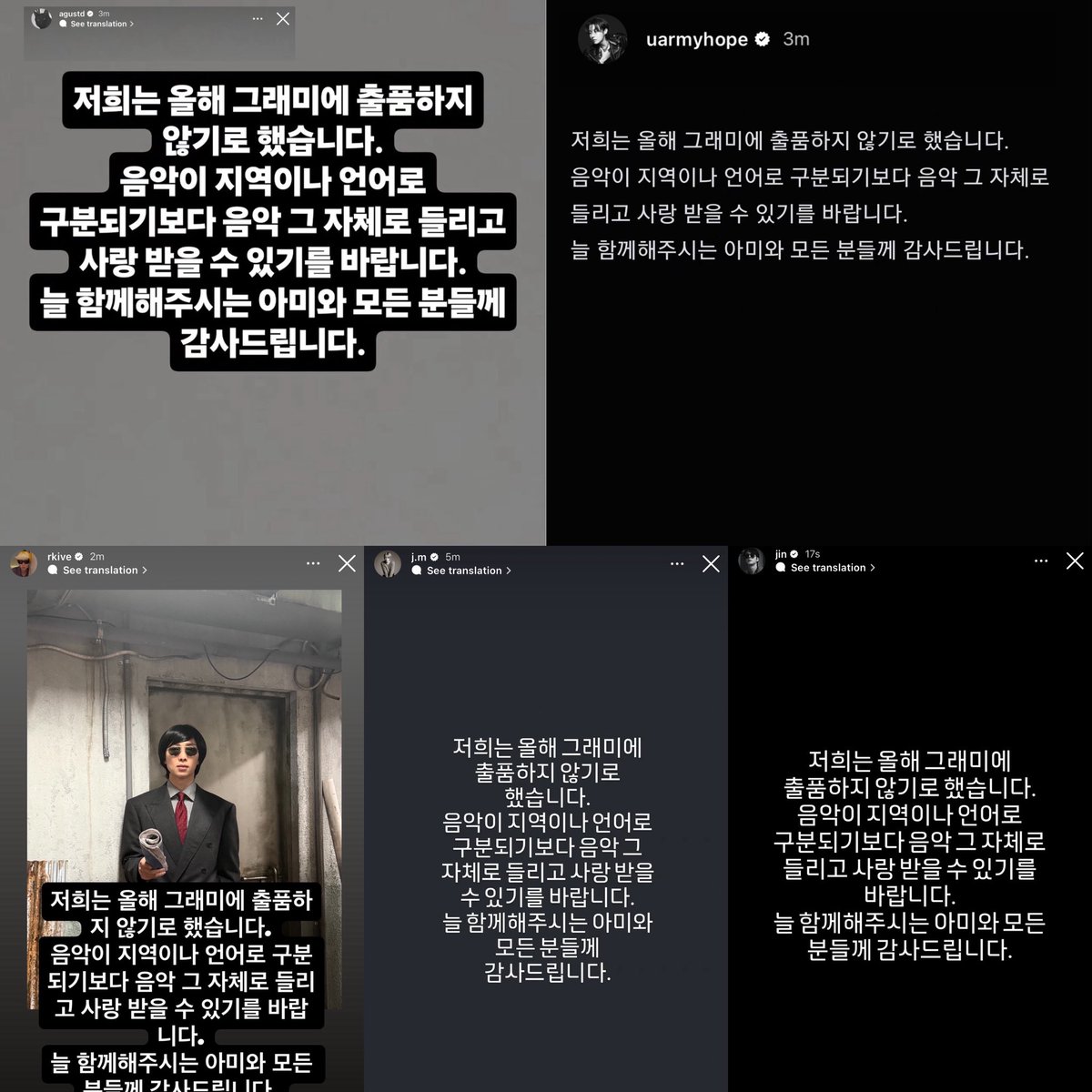
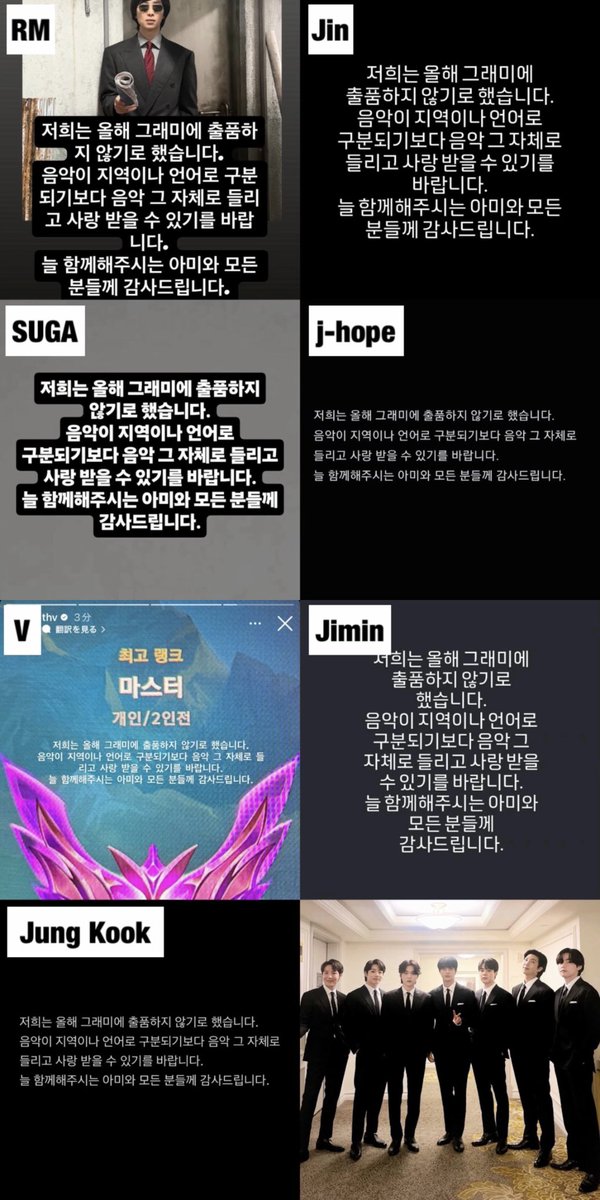
BTS Announces They Won’t Submit to the Grammys This Year.❌
"We’ve decided not to submit our work for this year’s Grammy Awards. We hope music will be recognized and loved for what it is, rather than being divided by region or language. Thank you, as always, to ARMY and everyone who supports us." ✊
BREAKING: NBC News is reporting that Trump FAILED to secure an indictment against six brave Democratic lawmakers who filmed a video reminding service members to not follow unlawful orders. This is a major victory for free speech and the rule of law.
They were going to be the helpers that Mister Rogers said to look for. In early January, Natalie Ehret brought her sons to the Henry Whipple Federal Building -- the nerve center of ICE's months-long operation in Minneapolis -- to hand out cookies and hand warmers to the protesters keeping watch across the street. She didn't know people were being released from detention there in the frigid Minnesota winter.
Then one of her sons called her over. He'd found two young women who had just been released. They were freezing with no phone, no ID, and no ride. He'd already brought them to the family's car, given them food and water, and handed them a phone to call home.
Within days, the Army veteran and mom of two sons had founded Haven Watch -- a round-the-clock volunteer operation stationed at the gate of the Whipple building. Because what her son stumbled into that afternoon wasn't an anomaly. It was happening every single day. "From his act of kindness," Natalie later told MPR News, "that's what we do every day."
Like most Minnesotans, Natalie had no idea that federal agents were simply releasing people into the dead of a Minnesota winter with nothing.
But the pattern, once she saw it, was unmistakable. And appalling.
Detainees were being turned loose from Whipple at all hours -- day and night -- almost always stripped of their phones and identification during detention. No phone call before release. No one waiting for them outside. They walked out in whatever they'd been wearing when they were grabbed. Often without a coat. Into temperatures that regularly plunged into the single digits.
One volunteer, Kim Gerdes, described the moment it clicked for her: "They released someone in front of the Whipple Building in no winter clothes. It was freezing cold. She was just out in the cold." Gerdes gave the shivering woman everything she had on her -- her gloves, everything. "That's when I realized there was this immense need."
Another time, a mother and two children, ages 2 and 6, walked out of Whipple without coats. They had been detained in a facility in Texas holding thousands of people before being returned to Minnesota and released with nothing. "These kids are traumatized," Gerdes said. "They're out in the cold. They're shaking, crying. They just went through something so horrible."
The stories of who was being swept up and dumped back outside defied belief.
Natalie estimated that 60 to 70 percent of the people she met at the gate were American citizens. Detained for nothing more than observing ICE operations. Blowing a whistle at an agent. Being the wrong color in the wrong place. Stories like these have poured out of Minneapolis for months -- citizens tackled on sidewalks, dragged from cars, detained for hours, and nearly always released without charges or explanation.
Mubashir Khalif Hussen, a Somali American born in the United States, described a masked agent sprinting at him at full speed, tackling him, and dragging him handcuffed through the snow. "I told him, 'I'm a U.S. citizen.' He didn't seem to care."
Hussen was taken to Whipple and eventually released -- told to walk the seven miles in the freezing cold back to where he'd been grabbed.
Others -- legal refugees, immigrants with valid documentation -- were pulled from cars on the way to work, showed their IDs, and still dragged to Whipple. "To say that they're not criminals is a total understatement," Natalie said. "They're business owners and kids."
Gage Garcia, a U.S. citizen, was shackled and held for hours after blowing a whistle in an agent's face. He could see immigrant detainees through one-way windows -- "crying, curled up in a ball, distraught."
Inside Whipple, the conditions were horrendous. A Star Tribune investigation -- based on interviews with 30 detainees and nearly 200 court records -- documented a facility designed for 12-hour holds that had devolved into something far worse. Cells meant for 20 crammed with 100 people. Barely any food. Bleeding and injured people denied medical care. A young Muslim woman was shackled at the ankles and locked in a bathroom with three men for 24 hours.
Many people are held overnight or even multiple days in a facility with no beds, forcing people to sleep on concrete floors in freezing conditions with no blankets. Natalie described how she's had several teenagers in her car after being released "crying and shaking, telling me how cold they were."
"After some of these I just go cry in the parking lot because it's so devastating," Natalie reflects. "I just don't know how we got so lost that we can traumatize these people that are our community members."
For its part, DHS issued the same statement it always does -- that detainees receive "proper meals, medical treatment, and opportunities to communicate" -- but in a court hearing last week over its own failures to comply with release orders, a Department of Justice attorney admitted what everyone already knew: the system "sucks."
And for those that were released -- many of them hungry, sick, or injured -- they were walking into a Minnesota winter where exposed skin can develop frostbite in under ten minutes. Where being released outside without a coat isn't just cruel -- it's potentially lethal.
But as they have again and again over these past few months, ordinary Minnesotans stepped up when they saw their neighbors suffering. Here, they did it again -- with Haven Watch.
Volunteers in orange vests now station themselves outside the Whipple building around the clock. They never know when someone will walk out -- but someone always does and the need has only grown. Natalie told MPR News this week that "if anything, we're seeing more people coming through."
So the volunteers wait with warm cars idling -- all day and all night. Piles of donated coats in the backseats. Burner phones charged and ready. Snacks and water on hand. When the gate opens, they cross the street, bring the person to a car, hand them a phone, and stay with them until a ride arrives or drive them home themselves.
"So many of us were sitting at home doom-scrolling, watching it on the news wanting to make a difference," said volunteer Sarah Haraldson. "This was a way to do that."
But the work is devastating. The day-to-day vigils -- hours spent waiting in their cars, never knowing when someone will walk out -- are physically taxing. And the emotional toll of meeting person after person who has been traumatized, abused, or injured by their own government is relentless.
"Most people are upset, no matter how long they were in there and why they were taken in," Haraldson said. "I have had more grown men cry in my car in the last week than anyone should see."
For Haraldson, it's personal. She has a 20-year-old son, adopted from Ethiopia as a baby, who is a naturalized U.S. citizen. "It scares me every day when he is out that they could pick him up and put him in that building based on the color of his skin and nothing else."
The message Haven Watch carries to every person who walks out of that gate is simple.
"We want people to know as they come out of that building that we love them, and they are our friends, they are neighbors, they are family, and people love them and want to support them."
The story of what Haven Watch was doing spread quickly, and with it came a wave of support that stunned even its founders.
A GoFundMe campaign launched on January 17 has raised more than $700,000 from over 9,800 donors -- and support keeps growing. What started with phone calls and car rides has grown into something much larger. Haven Watch now operates a full website and has expanded into a broader community resource: legal and immigration questions, healthcare referrals, lost wages, rental assistance for families whose breadwinners are too afraid to leave home.
Countless Minnesotans have stepped up as volunteers, embracing the group's motto: "No One Walks Alone."
The need is not going away. Even with a drawdown of 700 agents from the area, there are still over 2,000 federal agents in the Twin Cities area. This is a massive number. It is still one of the largest occupations of an American city by the federal government in history.
People are still being grabbed. Still being held. Still being released with nothing into the bitter cold.
For many of them, the first kind face they see belongs to a Haven Watch volunteer in an orange vest.
"After I've seen who comes through that gate, I just can't be at home thinking we're missing someone," Natalie reflects. "Emotionally it feels unsustainable. But that's being human. I shouldn't pick my son up from soccer and pretend I didn't just hear a story that's so painful that it changed me."
The toll is immense. But so is the resolve. "We won't stop," she says. "But we are tired."
The simple act of waiting at a gate with a warm car and a charged phone is not a small kindness. It is the thing standing between a stranger and the cold. And right now, thanks to Natalie and the volunteers of Haven Watch, no one walks out alone.
Michael Garrett - NC Senate's Viral Statement on the Bad Bunny Halftime Show
“I watched #BadBunny deliver the most American halftime show I have ever seen. Then I came home and watched it again. And I am not okay. In the best possible way.
He sang every single word in Spanish. Every. Single. Word. He danced through sugarcane fields built on a football field in California while the President of the United States sat somewhere calling it “disgusting.” Lady Gaga came out and did the salsa. Ricky Martin lit up the night. A couple got married on the field. He handed his Grammy, the one he won eight days ago for Album of the Year, to a little boy who looked up at him the way every child looks up when they dare to believe the world has a place for them.
And then this man, this son of a truck driver and a schoolteacher from Vega Baja, Puerto Rico, stood on the biggest stage on the planet and said “God bless America.”
And then he started naming them.
Chile. Argentina. Uruguay. Paraguay. Bolivia. Peru. Ecuador. Brazil. Colombia. Venezuela. Panama. Costa Rica. Nicaragua. Honduras. El Salvador. Guatemala. Mexico. Cuba. Dominican Republic. Jamaica. The United States. Canada. And then, his voice breaking with everything he carries, “Mi patria, Puerto Rico. Seguimos aquí.” My homeland, Puerto Rico. We are still here.
The flags came. Every single one of them. Carried across that field by dancers and musicians while the jumbotron lit up with the only words that mattered: “THE ONLY THING MORE POWERFUL THAN HATE IS LOVE.”
I teared up. I’m not ashamed to say it. I sat on my couch and I wept because THAT is the America I believe in. That is the American story, not the sanitized, gated, English-only version that small and frightened people try to sell us. The REAL one. The messy, beautiful, multilingual, multicolored, courageous one. The one that has always been built by hands that speak every language and pray in every tongue and come from every corner of this hemisphere.
That is the America I want Jack and Charlotte to know. That when the moment came, when the whole world was watching, a Puerto Rican kid who grew up to become the most-streamed artist on Earth stood in front of 100 million people, sang in his mother’s language, blessed every nation in the Americas, and spiked a football that read “Together, we are America” into the ground. Not with anger. With joy. With love so big it made hate look exactly as small as it is.
And what did the President do? He called it “absolutely terrible.” He said “nobody understands a word this guy is saying.” He called it “a slap in the face to our Country.” The leader of the free world watched a celebration of love, culture, and everything this hemisphere has given to the world, and all he could see was something foreign. Something threatening. Something disgusting.
Let that sink into your bones.
The man who is supposed to represent all of us looked at the flags of our neighbors, heard the language of 500 million #Americans across this hemisphere, and felt attacked. That’s not strength. That’s not patriotism. That is poverty of the soul.
Here’s what I want to say to everyone who posted about that show tonight, who shared it proudly, who turned away from Bad Bunny’s celebration because it was in Spanish and the flags weren’t only red, white, and blue:
Your children will see those posts. Your grandchildren will find them. The internet doesn’t forget. And one day, when the history of this moment is written, when our kids and their kids look back at 2026 the way we look back at the people who stood on the wrong side of every bridge and every march and every moment that mattered, they will know exactly where you stood. They will see who chose Kid Rock over a hemisphere of flags. They will see who called love “disgusting.” And they will carry that knowledge the way all of us carry the knowledge of what our ancestors did when they were tested.
The only thing more powerful than hate is love”





![btschartsxdaily's tweet photo. [INFO] Many critics of the South Korean industry support #BTS's decision! 🇰🇷🔥
Im Jin-mo, a popular music critic assessed BTS's decision not to submit to the Grammys as "a declaration of musical independence that breaks the chains of Western-centric authority, and a restoration of subjectivity."
Critic Lim Jin-mo, who has consistently served as a commentator for the Grammy Awards, pointed, "While the Grammys put forward the justification of diversity for the newly established 'APMP' category, it is essentially a defensive and somewhat racist attempt to isolate K-pop into a peripheral category in order to protect the vested interests of mainstream music."
Lee Kyu-tak, a professor at George Mason University Korea and Director of the Global K-Center, pointed out that for BTS, who have achieved various accomplishments musically, commercially, and culturally, the Grammys tended to be regarded as "the ultimate goal they had to achieve." He noted, "It is true that whenever the Grammys came around, discussions about whether they would win consistently circulated among the media and fans, and there was a belief that they would only be 'truly' recognized in the United States if they won a Grammy."
However, the analysis noted, "The Grammys' creation of a separate 'APMP' award was tantamount to a declaration that Asian music (including K-pop and non-Western/non-English music) would be treated separately from the Grammys' 'main stage.' This implies that BTS, who are already established as musicians not only in Korea and the U.S. but globally, do not necessarily need to obsess over the Grammys." It continued, "Given that there would undoubtedly be debate among the media and fans regarding whether they accept the award or not under these circumstances, their voluntary refusal is significant in that it allows them to distance themselves from various controversies while clearly expressing their opposition to the Grammys treating non-Western/non-English music as a form of segregation."
Critic Im Jin-mo interprets BTS's recent decision as a resistance chosen instead of compromise in the face of the Grammys' conservatism, which prioritizes ratings and buzz while withholding fair evaluation. He viewed the decision not to submit as "a complete 'declaration of independence' from Grammy authority, signifying that they will no longer force K-pop's identity to conform to American standards."
Critic Lim also highlighted the potential impact that BTS's decision is expected to create. He pointed out, "Just as The Weeknd's past declaration of a Grammy boycott stirred up public opinion in the local music industry, the fact that a single Asian artist has rebelled against a massive awards ceremony and opened a forum for public discourse demanding change demonstrates immense influence in itself."
#WeStandWithBTS](https://pbs.twimg.com/media/HOYeTnEW8AE816Y.jpg)


![cypherluscious's tweet photo. "But by walking away, BTS has effectively taken one for the team. [...] BTS has unequivocally drawn a line in the sand, forcing the industry to confront its own structural biases regarding fairness and equality." https://t.co/64HPSEvdMR](https://pbs.twimg.com/media/HOZr68kWwAEzRWF.jpg)


![btschartsxdaily's tweet photo. [INFO] Many critics of the South Korean industry support #BTS's decision! 🇰🇷🔥
Im Jin-mo, a popular music critic assessed BTS's decision not to submit to the Grammys as "a declaration of musical independence that breaks the chains of Western-centric authority, and a restoration of subjectivity."
Critic Lim Jin-mo, who has consistently served as a commentator for the Grammy Awards, pointed, "While the Grammys put forward the justification of diversity for the newly established 'APMP' category, it is essentially a defensive and somewhat racist attempt to isolate K-pop into a peripheral category in order to protect the vested interests of mainstream music."
Lee Kyu-tak, a professor at George Mason University Korea and Director of the Global K-Center, pointed out that for BTS, who have achieved various accomplishments musically, commercially, and culturally, the Grammys tended to be regarded as "the ultimate goal they had to achieve." He noted, "It is true that whenever the Grammys came around, discussions about whether they would win consistently circulated among the media and fans, and there was a belief that they would only be 'truly' recognized in the United States if they won a Grammy."
However, the analysis noted, "The Grammys' creation of a separate 'APMP' award was tantamount to a declaration that Asian music (including K-pop and non-Western/non-English music) would be treated separately from the Grammys' 'main stage.' This implies that BTS, who are already established as musicians not only in Korea and the U.S. but globally, do not necessarily need to obsess over the Grammys." It continued, "Given that there would undoubtedly be debate among the media and fans regarding whether they accept the award or not under these circumstances, their voluntary refusal is significant in that it allows them to distance themselves from various controversies while clearly expressing their opposition to the Grammys treating non-Western/non-English music as a form of segregation."
Critic Im Jin-mo interprets BTS's recent decision as a resistance chosen instead of compromise in the face of the Grammys' conservatism, which prioritizes ratings and buzz while withholding fair evaluation. He viewed the decision not to submit as "a complete 'declaration of independence' from Grammy authority, signifying that they will no longer force K-pop's identity to conform to American standards."
Critic Lim also highlighted the potential impact that BTS's decision is expected to create. He pointed out, "Just as The Weeknd's past declaration of a Grammy boycott stirred up public opinion in the local music industry, the fact that a single Asian artist has rebelled against a massive awards ceremony and opened a forum for public discourse demanding change demonstrates immense influence in itself."
#WeStandWithBTS](https://pbs.twimg.com/media/HOYeTnFXYAAjzXT.jpg)