If You Are Interested In Investing Your Money to Change the World, You Have The Door Open.
Manyvip Launches 5% Of Its Human Company Model In Five Participations Of $ 100 Million.
Manyvip Has The Exclusive Global Intellectual Property To Eliminate All These Global Problems...
The Kentucky Attorney General’s Office Said it will ask for up to $40 Billion from Meta Platforms Inc. in a Sweeping Lawsuit Brought by a Coalition of State AGs Alleging the Social Media Company has Addicted and Harmed Children.
Sam Altman's OpenAI Secretly Embedded Meta’s Facebook Pixel and Google Analytics into ChatGPT, Turning Your Most Private Conversations About Health, Finances, Legal Issues, and Confidential Company Data into Ad-targeting Data Sent Straight to Meta and Google Without Consent.
Exclusive: US tech giant Meta has repeatedly failed to stop illegal ads for high-risk financial products running on its platforms in Britain, despite committing to block them, according to a review by the country's financial regulator. More here: https://t.co/jQXATTbMFf
I was on @RealTimers, where Bill Maher gave me the chance to explain why the social media execs are worse than the Tobacco execs in the 1990s: They all lied by claiming that their products were not addictive. But the tobacco execs never had to watch children suffer.
https://t.co/EbVaHr0jPk
At the trial last week in Los Angeles, Adam Mosseri claimed that Instagram is not addictive. He said a kid compulsively watching 16 hours of Reels a day is no different than when he watches too much Netflix and stays up a bit too late.
But he knows that gambling is a DSM addiction, he knows that slot machines are addictive, and he knows that his product was designed using behaviorist principles that were perfected on slot machines and that are not relevant to watching movies.
Also, he and his researchers have used the word "addiction" in many internal memos and studies. My team has organized the evidence on 31 studies carried out by Meta, and culled from internal documents that have come out in the many lawsuits against Meta. See for yourself:
https://t.co/dmDGPbmaH7
See study 3.1, which found that “the majority of clinicians believe that social media can be addictive,” with fully 85% of U.S. clinicians endorsing this proposition.
Or see this quote from a Meta senior data scientist with a PhD in neuroscience who once taught a university course on addiction:
“It seems clear from what’s presented here that some of our users are addicted to our products. And I worry that driving sessions incentivizes us to make our product more addictive, without providing much more value. How to keep someone returning over and over to the same behavior each day? Intermittent rewards are most effective (think slot machines) reinforcing behaviors that become especially hard to extinguish—even when they provide little reward, or cease providing reward at all.”
So, they know. To quote Sean Parker, discussing how social media apps were designed to give users "a little dopamine hit every once in a while" to hook them:
"The inventors, creators — it's me, it's Mark, it's Kevin Systrom on Instagram, it's all of these people — understood this consciously. And we did it anyway."
https://t.co/14KZQ4EowN
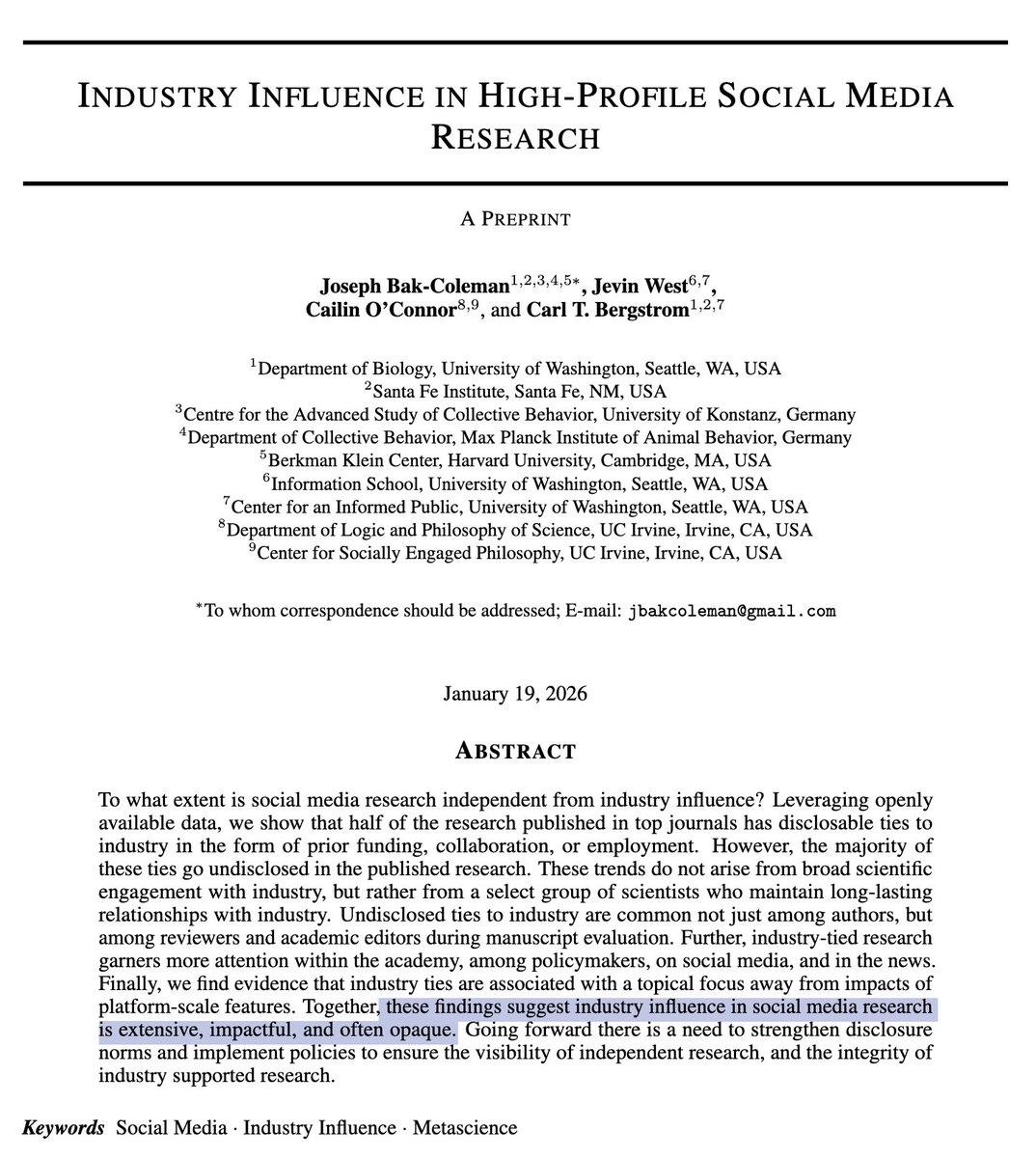
Social media research has a major conflict of interest problem:
“half of the research published in top journals has disclosable ties to industry in the form of prior funding, collaboration, or employment. However, the majority of these ties go undisclosed in the published research...these findings suggest industry influence in social media research is extensive, impactful, and often opaque”
https://t.co/MO648329e9
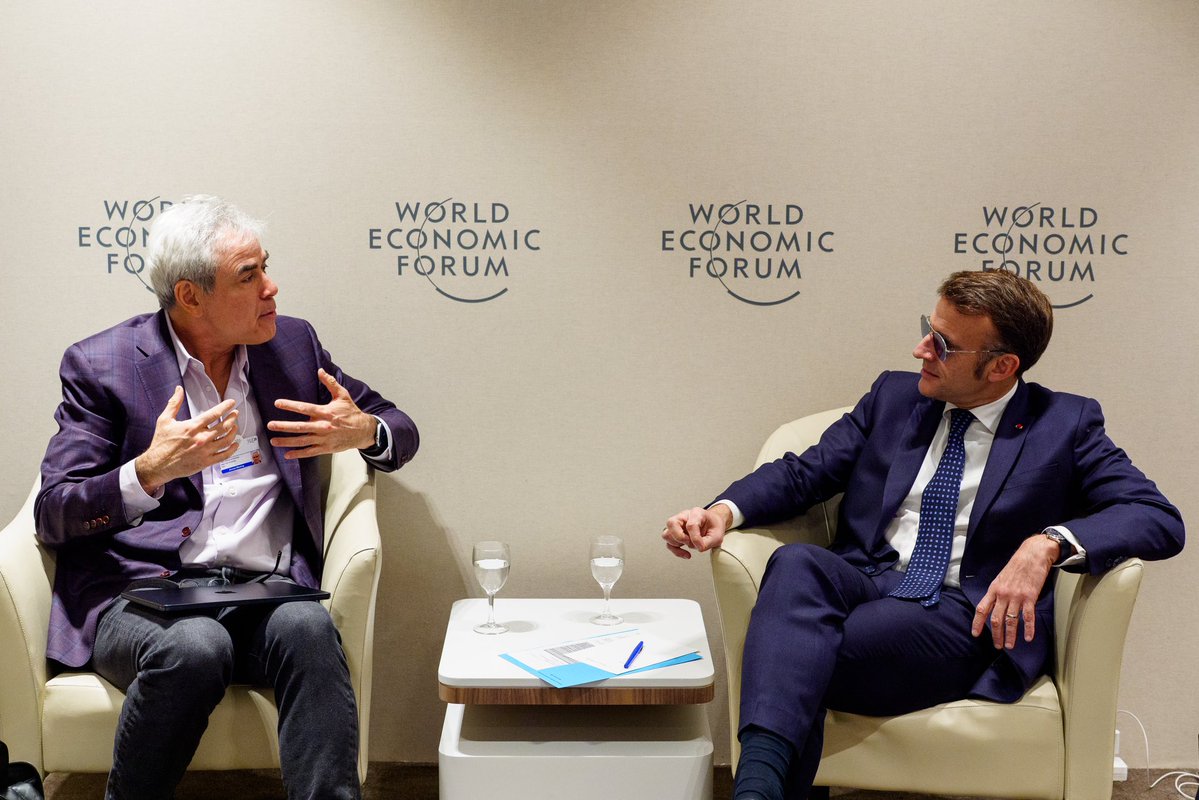
Échange essentiel avec @JonHaidt, scientifique et lanceur d’alerte, figure de référence de l’encadrement des réseaux sociaux, auteur de « Génération anxieuse ».
Ensemble, nous menons un combat décisif : reprendre le contrôle face aux réseaux sociaux, aux algorithmes et aux plateformes, protéger nos enfants et nos adolescents.
Je m’y suis engagé : la France sera pionnière en la matière.
On the latest Hard Fork podcast I talked with @CaseyNewton and @kevinroose about two major research projects I just posted, with @ZachMRausch:
https://t.co/rqUGZLzUgY
We organize multiple lines of evidence showing that social media is causing many harms to millions of children and teens. The data is not "just correlational."
Project #1: A review paper that will be published in March as part of the World Happiness Report 2026. We organize the research into 15 exhibits, grouped into 7 distinct lines of evidence. (See list below).
All converge on the conclusion that social media causes many harms to young people, including depression. The academic debate has focused on mental illness, but there are also many direct harms happening at vast scale, including sleep deprivation, sexual harassment, and sextortion. These are not correlations. And there are longitudinal studies, RCTs and natural experiments.
Here's a link to the pre-print:
https://t.co/iUJKbSPFsD
Project #2: A new website:
https://t.co/Nv14Y2n2kH
at which we present all the publicly available information on 31 studies carried out by Meta since 2018 as it studied the effects of its products on its users.
We organize the studies into roughly the same seven lines. They match. Meta's own researchers, with access to far better data (user log data), found evidence of harm that corroborates that of the outside researchers. On several occasions the researchers themselves say that the evidence shows causality, not just correlation. Check it out, read their internal presentations and communications.
Here are the 15 exhibits of evidence in our review paper, so that you can see the many kinds of evidence we gather in one place:
------
EVIDENCE LINE ONE: WHAT THE VICTIMS SAY
Exhibit A. Surveys of young people show harm and regret
Exhibit B: Internal surveys from social media companies show that Gen Z perceives high levels of harm
EVIDENCE LINE TWO: WHAT THE WITNESSES SAY
Exhibit C: Parents fear social media and perceive harm
Exhibit D: Educators perceive harms to education and mental health
Exhibit E: Clinicians perceive harm to mental health (according to Meta)
EVIDENCE LINE THREE: WHAT COMPANY DOCUMENTS AND INSIDERS REVEAL
Exhibit F: TikTok knows or believes that it is harming children at an industrial scale
Exhibit G: Snap Inc. knows or believes that it is harming children at an industrial scale
Exhibit H: Meta knows or believes that it is harming children at an industrial scale
EVIDENCE LINE FOUR: CROSS-SECTIONAL STUDIES
Exhibit I: Cross-sectional studies show that heavy users have elevated risk of depression
Exhibit J: Studies that report null findings actually yield significant associations when examining adolescent girls, heavy social media use, and internalizing disorders
EVIDENCE LINE FIVE: LONGITUDINAL STUDIES
Exhibit K: Social media use at time 1 predicts depression at time 2
EVIDENCE LINE SIX: RANDOMIZED CONTROLLED TRIALS OF TIME REDUCTION
Exhibit L: Experiments show that social-media reduction leads to reduced depression
Exhibit M: Studies that report no improvement from social-media reduction actually do reveal benefits to depression when unblended
Exhibit N: Meta’s own RCT shows that social-media reduction leads to multiple mental-health benefits
EVIDENCE LINE SEVEN: NATURAL EXPERIMENTS
Exhibit O: The evidence from natural experiments points to harm
-----
The strong preponderance of the evidence shows that social media is a dangerous consumer product for children and adolescents. What other industry harms such a large percentage of its young users, yet is completely unregulated?
I hope that other researchers will challenge our 15 exhibits, and our quotations from Meta's researchers. Let's pressure test the evidence. But if you find someone who still believes in 2026 that the evidence of harm is "just correlational" please send them the link to the review paper.
https://t.co/e2ifxADjd9
Or send them the link to the Hard Fork Interview:
https://t.co/rqUGZLzUgY
A Mathematical Model Inspired by the Physics of Complex Systems Demonstrates that Western Societies Maintain Diversity of Opinion Without Major Divisions as Long as the Number of Contacts is Low. Zucker-Madoff is the World's Number One Enemy.
https://t.co/mn2Wlj4gKY
Aside From Being a Serial Fraudster Who Delivers False Metrics to Advertisers, Zucker-Madoff Doesn't Care About Raking in Billions at The Expense of His Own Users' Suffering and Financial Loss.
https://t.co/NOxpNAlxad
TikTok's Short Videos Reduce Users' Mental Capacity. They Weaken Fundamental Functions Such as Sustained Attention, Self-Control, and Concentration. The Platform's Success Is Always Linked to Extreme Damage to the Biological Intelligence of Civilization.
According to the brief, Meta was aware that millions of adult strangers were contacting minors on its sites; that its products exacerbated mental health issues in teens; and that content related to eating disorders, suicide, and child sexual abuse was frequently detected, yet rarely removed. https://t.co/pmmMFkswIB
Zucker-Madoff Has Been Taking Money From Scammers Around the World for Many Years and Defrauding Brands and Advertisers With False Metrics. Most Marketing Departments are Bought by Zucker-Madoff to Burn Money Without Results or Return.
https://t.co/At1lLboaj6
Zucker-Madoff's Terrorist Platforms Are Digital Questionnaires Where Users Are Manipulated Toward Hypervigilance, Espionage, Addiction, and the Surrender of Personal Data in Exchange for Contacting Their Peers. This Has Never Happened Before in the History of Human Communications
Several internal documents displayed for the first time in open court Tuesday show social media companies discussing negative links between their platforms and users’ mental health. https://t.co/kLe3odhivA
Meta Platforms Inc. CEO Mark Zuckerberg must testify in California state court in January during the first trial of thousands of cases accusing tech companies of intentionally designing online platforms to addict children. https://t.co/VkY6IURREl
Zucker-Madoff Does Not Give Away Free Technology to Connect People in Exchange for Corporate Surveillance and Personal Data. It Camouflages Persuasive Technology Designed by its Behavioral Scientists With Addictive Software to Keep Humans Physically Disconnected.
Section 230 Protects Platforms From Liability for Content Hosted by Users. But With New AI-Powered Generation Systems, This Protection May Disappear Because Platforms Own The Response Systems.
While Section 230 has historically protected tech companies from liability for third-party content, legal experts say its applicability to AI-generated content is unclear and in some cases, unlikely. https://t.co/RK0RF3CuFu
A Biological Mind in the World Projects Humanity to 2050. Inexhaustible Sources of Electricity. New Fuels. Human Habitability. Continental Moisture Capture. 100% Clean Oxygen. Hybrid Technologies. Global Changes in Human Behavior. Internet Two. Secure Human Platforms.
Social Terrorist Zucker-Madoff (The Pedophile) Allowed His AI Chatbots to Sexually Flirt with Children. Anything Goes to Capture the Attention of the Most Powerless. Meta AI Director Yann LeCun Received Spain's Princess of Asturias Award. The Biggest Terrorists and Scammers.