TOP 5 European Stock ETFs in 2026
Europe is heating up: banks, Italy, Netherlands and Spain are leading the charge while broad indices sit around +11-12% YTD.
Here are the standout performers (data as of late July 2026):
1. EXV1 / SX7E — iShares STOXX Europe 600 Banks UCITS ETF → +19.7% to +22.8%
European banks (the strongest sector this year)
2. EWI — iShares MSCI Italy ETF (or FTSE MIB trackers) → +15.7% to +19.3%
Milan keeps outperforming the big markets
3. EWN — iShares MSCI Netherlands ETF (AEX trackers) → +15.3% to +17.6%
Dutch tech + financials powering ahead
4. EWP — iShares MSCI Spain ETF (IBEX trackers) → +12.4% to +16.9%
Spanish banks & utilities in full rally mode
5. EUFN — iShares MSCI Europe Financials ETF → +20%
Broad exposure to the best-performing sector on the continent
YTD figures (EUR/USD depending on listing).
Nvidia gets all the hype.
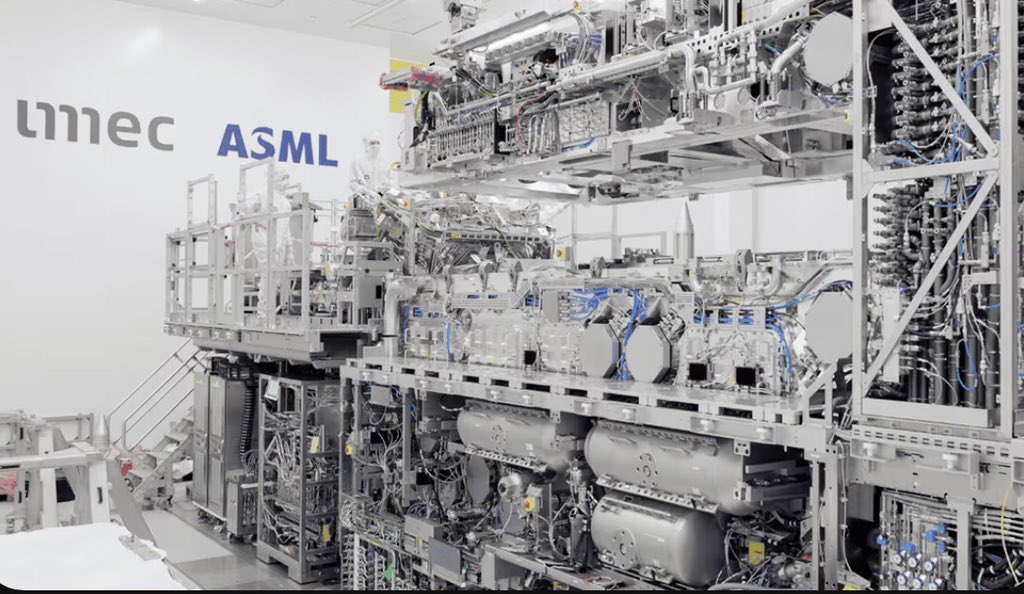
ASML is the real power: the ONLY company that builds the $400M machines needed for advanced AI chips.
No ASML = no next-gen Nvidia GPUs.
Europe is full of these ignored monopolies at big discounts.
Still only looking at Wall Street?
Today’s reports on Situational Awareness transferring its entire public equity book after significant drawdowns in AI-related names underscore how quickly concentrated, leveraged positions can face margin pressure in a risk-off environment.
https://t.co/gF3pLya9Dm
For my first post, I’m sharing a letter @NVIDIA signed on why open models matter.
AI will transform every industry, power every company, and be built by every country.
Open models strengthen safety and cybersecurity, accelerate innovation and diffusion, and enable sovereignty.
The world needs both frontier closed models and frontier open models.
https://t.co/AUKzoQ5Ikb
Kimi K3 has received far more love than we expected, and our GPUs are feeling it.
Over the past 48 hours, demand has pushed close to the limits of our current capacity. To protect the experience of existing subscribers, we're temporarily pausing new subscriptions and prioritizing compute for current members. Existing subscribed users are not affected.
We're adding capacity as fast as we can and will reopen new subscription spots in batches.
Going forward, we'll also split membership into two more focused plans: Kimi Membership for Kimi Web, App, and Work; and Kimi Code Membership for coding workflows. This will help us match compute more precisely and keep the experience stable.
Thank you for your patience and understanding!
When a theme already has three dedicated ETFs and features on lists of “20 small caps for 2030,” the discovery engine has already been partially exhausted for the most visible names.
That doesn’t invalidate the themes; it tells you where to look within them.
Weekly Note — Tech & AI: week of Jul 13–17 and setup for Jul 20–24
Bottom line: Last week was a positioning flush, not a thesis break. The market has shifted from paying for growth to demanding proof of ROI, and next week (Alphabet + Tesla on Wednesday, Intel on Thursday) is the first real test. The tactical risk/reward in semis is starting to look interesting, but there's no clean re-entry catalyst until a hyperscaler comments on capex.
What happened (a P&L read, not a headlines read)
The Nasdaq fell -2.9% on the week, the S&P -1.55% to 7,457, and the VIX surged 24% to 18.77. The SOX closed 20.2% below its June 22 high — an official bear market in semis. There were three distinct pressure vectors, and it's worth separating them because they carry different implications.
1. The "Kimi moment." China's Moonshot AI launched Kimi K3, an open-source model the company claims closes much of the gap with frontier models — reviving the DeepSeek ghost. Taiwan fell more than 6% on Friday; Japan dropped 4%. My read: the market itself is already walking back the narrative. What looked at the open like a broad tech negative is now being viewed through a more nuanced lens. This is a positioning washout with a convenient excuse, not a fundamental shift. DeepSeek in 2025 ultimately proved bullish for inference and aggregate compute (Jevons). I assign ~70% probability that Kimi K3 follows the same script.
2. Memory: this is where a new thesis worth watching is forming. This is the week's most important development and the least discussed. SK Hynix suffered its largest single-day decline on record (-15.4%) after broker profit warnings on HBM4, and confirmation that Apple is evaluating model compression technology (up to 15x less memory) hit Micron (-10%) and SanDisk (-24%). The bearish thesis: compression pulls forward the end of the memory bottleneck, and with it the pricing cycle. It's a timing thesis, not a demand thesis — but memory cycles trade on the second derivative of price, so the market shoots first. I wouldn't buy the dip in memory yet; the asymmetry has deteriorated.
3. Structural rotation underway. Tech has been underperforming not just this week but since early June, while cyclicals and defensives have held up. And keep an eye on oil: the crude rally threatens to undercut the positive inflation prints from last week — crude at ~$82 (+4.5%) is a quiet headwind for long-duration multiples.
A contrarian data point that supports the bull case: ASML raised its full-year revenue guidance for the second time in 2026, citing accelerating capacity expansion plans from customers driven by demand for advanced Logic and Memory chips. Upstream equipment is not seeing the slowdown that stock prices are discounting.
What's priced in
With the Nasdaq down 6% from highs and semis in a bear market, the market is pricing: (a) memory ASP deceleration, (b) competitive margin compression from China in AI models, and (c) skepticism over capex ROI. What is NOT priced in: a strong cloud/capex guide from Alphabet. That's where the trade is.
Next week: the calendar is in charge
Alphabet and Tesla report Wednesday the 22nd after the close — the most important night of the month — and Intel on Thursday the 23rd, where the street expects its first GAAP-profitable quarter after six consecutive quarters of losses. Friday brings flash July PMIs.
GOOGL is the event. Cloud has accelerated for five consecutive quarters, reaching $20B with operating margin expanding from 17.8% to 32.9%, and a backlog of $462B that nearly doubled in a single quarter. The key items to watch: cloud above $21–22B, and data on CTR in AI Overviews that either confirms the Search monetization story or reopens the cannibalization debate. Scenarios: Bull (40%) — Cloud >$22B + capex reiterated/raised → the market re-reads capex as a demand signal, semis rally 5–8%, last week's shorts get squeezed. Base (40%) — in-line beat, no capex surprise → tech trades sideways, rotation continues. Bear (20%) — any soft Search/CTR print → -8–10% in GOOGL and contagion across the AI-ad complex.
TSLA: the print is secondary; the driver is the robotics/autonomy narrative. Implied volatility is elevated — I prefer not to play it directionally. If anything, structures that sell the event vol.
INTC: the bar is extremely high after a $20 to $110 rally over twelve months. Asymmetric downside risk on the print unless management guides aggressively. Don't be long into the event.
A risk nobody is watching: oil. If crude continues toward $85–90, the "inflation under control + Fed on pause" narrative that cushioned the tech selloff breaks down — and then the multiple de-rating stops being just an AI story.
DISCLAIMER: This analysis is purely informational and does not constitute investment advice. The views and probabilities expressed reflect an independent analytical exercise under our framework.
On today's market:
Today's selloff shares the same anatomy as those of the past two weeks — with one new wrinkle. Chips are down another 3%, dragging the Nasdaq 100 to −1%, as the market questions whether massive AI spending can justify current valuations. TSMC beat earnings with 23% growth and got nothing for it: the company lifted its 2026 capex guidance 14.8% to $62B while free cash flow dropped 17.5%, and the stock fell 2.9%. That is the current regime in a nutshell — the market now only rewards cash conversion; capex without FCF gets punished, no matter whose name is on it. Add oil pushing yields higher on continued geopolitical escalation, and you have today's cocktail.
The new wrinkle: the purge of crowded trades has rotated sectors. Two weeks ago it was semis momentum getting flushed; last week, memory; today it's the strategic complex's turn — LEU (−6.8%) and MP (−6.8%) are falling alongside the rest of the "national strategic hype" trade. And yet, on the very same day, S&P breadth is positive and healthcare is ripping: Abbott +12%, UnitedHealth +5.6%. Yesterday, investors made an explicit rotation out of semis and into Big Tech, with Microsoft up 3% and Apple hitting all-time highs.
On tomorrow's CPI:
June's CPI print captures June itself: the month of the ceasefire. Oil sold off throughout the month following the June 15th agreement, bottoming near $72 (the lowest since March, with OPEC+ ramping output), and the labor market was already showing cracks. The crude spike triggered by the ceasefire breakdown didn't happen until July 8th, that shock feeds into the July CPI, which won't print until August.
In other words, the market is de-risking today over an energy scare that, when you actually look at the data, points squarely to a benign number tomorrow.