🚨 Incredibly excited to share that I'm starting my research group focusing on AI safety and alignment at the ELLIS Institute Tübingen and Max Planck Institute for Intelligent Systems in September 2025! 🚨
Hiring. I'm looking for multiple PhD students: both those able to start in Fall 2025 (i.e., as soon as possible) and through centralized programs like CLS, IMPRS, and ELLIS (the deadlines are in November) to start in Spring–Fall 2026. I'm also searching for postdocs, master's thesis students, and research interns. Fill the Google form below if you're interested!
Research group. We will focus on developing algorithmic solutions to reduce harms from advanced general-purpose AI models. We're particularly interested in alignment of autonomous LLM agents, which are becoming increasingly capable and pose a variety of emerging risks. We're also interested in rigorous AI evaluations and informing the public about the risks and capabilities of frontier AI models. Additionally, we aim to advance our understanding of how AI models generalize, which is crucial for ensuring their steerability and reducing associated risks. For more information about research topics relevant to our group, please check the following documents:
- International AI Safety Report,
- An Approach to Technical AGI Safety and Security by DeepMind,
- Open Philanthropy’s 2025 RFP for Technical AI Safety Research.
Research style. We are not necessarily interested in getting X papers accepted at NeurIPS/ICML/ICLR. We are interested in making an impact: this can be papers (and NeurIPS/ICML/ICLR are great venues), but also open-source repositories, benchmarks, blog posts, even social media posts—literally anything that can be genuinely useful for other researchers and the general public.
Broader vision. Current machine learning methods are fundamentally different from what they used to be pre-2022. The Bitter Lesson summarized and predicted this shift very well back in 2019: "general methods that leverage computation are ultimately the most effective". Taking this into account, we are only interested in studying methods that are general and scale with intelligence and compute. Everything that helps to advance their safety and alignment with societal values is relevant to us. We believe getting this—some may call it "AGI"—right is one of the most important challenges of our time.
Join us on this journey!
EurIPS is coming! 📣 Mark your calendar for Dec. 2-7, 2025 in Copenhagen 📅
EurIPS is a community-organized conference where you can present accepted NeurIPS 2025 papers, endorsed by @NeurIPSConf and #NordicAIR and is co-developed by @ELLISforEurope
https://t.co/RSAvf9lcZm
NeurIPS is pleased to officially endorse EurIPS, an independently-organized meeting taking place in Copenhagen this year, which will offer researchers an opportunity to additionally present their accepted NeurIPS work in Europe, concurrently with NeurIPS.
Read more in our blog post and on the EurIPS website:
https://t.co/WKkdiKHZuw
https://t.co/bp51jR9eDH
🚨Excited to release OS-Harm! 🚨
The safety of computer use agents has been largely overlooked.
We created a new safety benchmark based on OSWorld for measuring 3 broad categories of harm:
1. deliberate user misuse,
2. prompt injections,
3. model misbehavior.
#phdlife
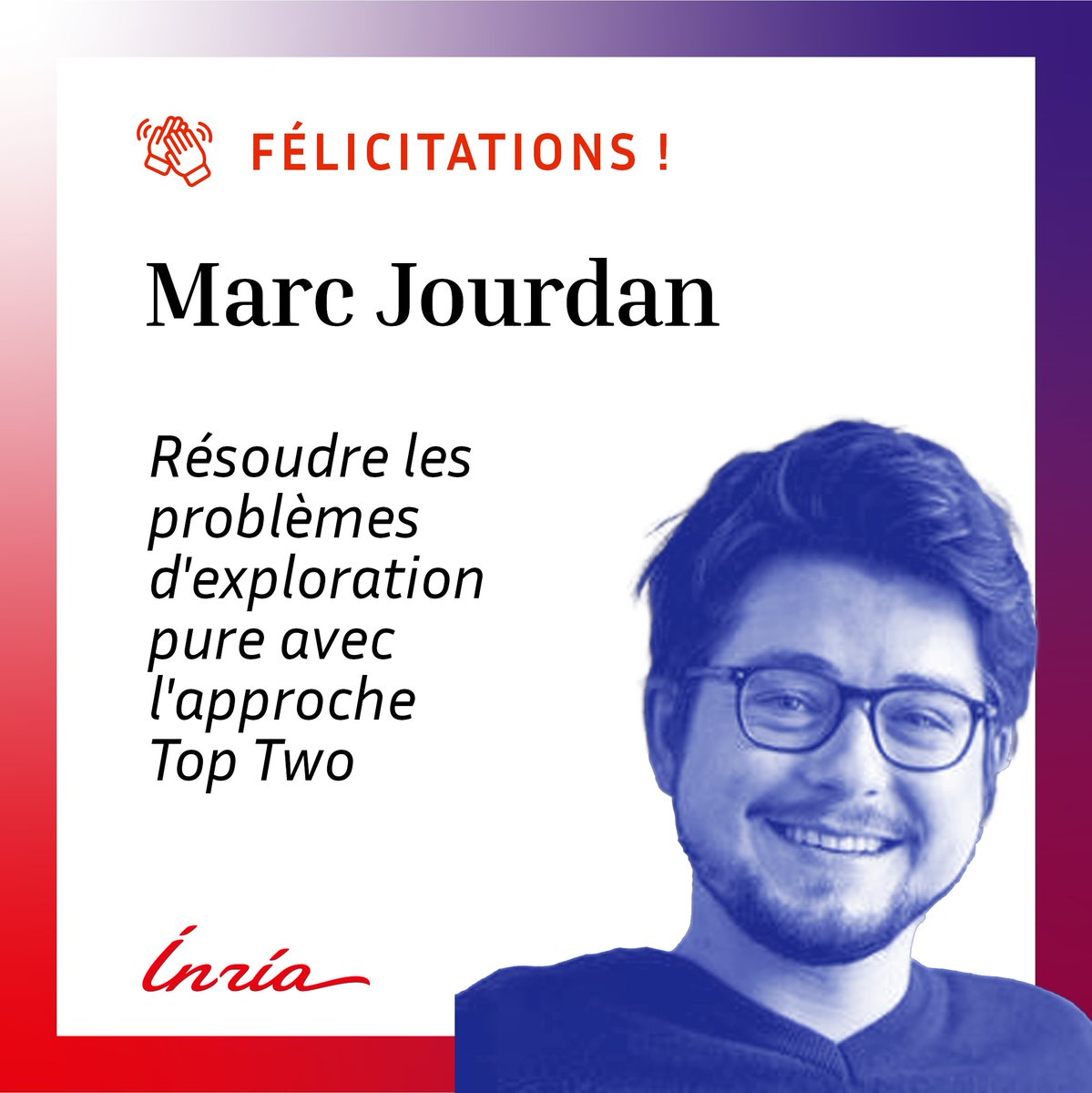
✌️Dans les algorithmes Top Two, un choix considéré "leader" est opposé à un "challenger" pour choisir la meilleure option.
📃Dans sa #thèse, @MarcJourdan5 de l’équipe @InriaScool en fait une méthode offrant garanties théoriques et excellentes performances empiriques.
(Big) life update 😊:
With @vict0rsch & @m_galtier, we are co-founding @Entalpic_ai, an AI startup for chemistry and materials discovery. Our mission is to develop science and its applications for a fair and ecological transition.
In stealth but hiring
https://t.co/idCEredN8B
Experiment design, Bayesian optimization or Active learning -- all under one umbrella. The advent of self-driving labs is here. We need strategies to implement automatic information gathering! ML models are only as informed as the data they are trained on.
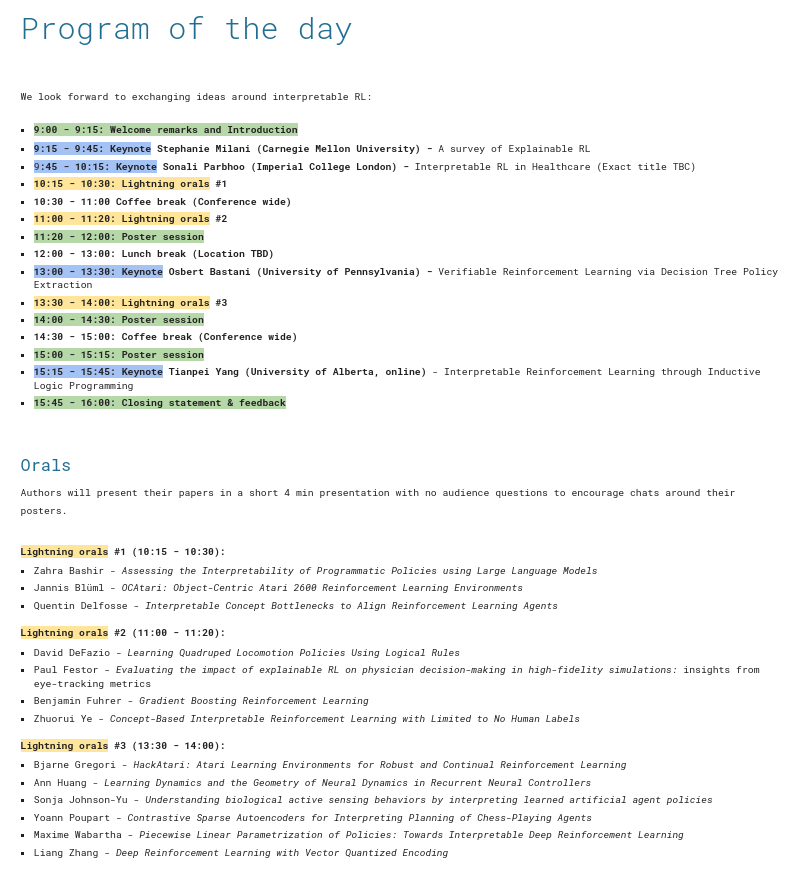
The workshop on Interpretable Policies in Reinforcement Learning (InterpPol) has been accepted
@RL_Conference: "Good diversity. Good list of organizers. Good line up of speakers. Good topic."! Stay tuned for the upcoming twitter account, website, and call for papers.
There will be a proposal for a workshop on interpretable RL @RL_Conference :) Get your papers ready if you work on: how to learn interpretable policies (trees, programs, ...), what to do with interpretable policies ( e.g. put them in hospitals), how to quantify interpretability.
Excited to announce 2 papers on performance-driven diversity for RL and combinatorial optimization to be presented at Neurips today 📢
Some problems are simply too difficult to be solved with a single shot. But if you have several shots, how to make the most of them?
🧵1/7
What's the metric your BAI algo achieve? Can we have it all?
Today at 5PM @NeurIPSConf, @MarcJourdan5 & Rémy will present EB-TCε algorithm that has fixed-confidence ε-BAI, anytime and uniform error probability, and simple regret guarantees at the same time. #Neurips23#bandits
2/2 today at 5:15PM at #NeurIPS23, @MarcJourdan5 & Remy present the first non-asymptotic upper bound on the expected sample complexity of a Top Two algorithm, which holds for any confidence level ✅and any instance having a unique best arm ✅✅.
@NeurIPSConf, @InriaScool members are going to present 6 papers on #RL, #bandits, and #privacy 🎓We invite the attendees of #NeurIPS2023 to visit & enrich us with your questions! Also, contact Scoolmates at NOLA if you want to know more about works & opportunities in Scool🙏
An ε-Best-Arm Identification Algorithm for Fixed-Confidence and Beyond
w/ R. Degenne & E. Kaufmann
Paper: https://t.co/bjpn5tingl
Poster: Wed 13 Dec 5 p.m - 7 pm CST (#1818)
4/4
I will be attending #NeurIPS2023 in New Orleans next week (Dec 9-16) to present 3 posters including 1 spotlight. DM me if you’d like to meet up !
I am graduating next year, so if you are hiring let's get in touch!
Check out details 🧵 1/4
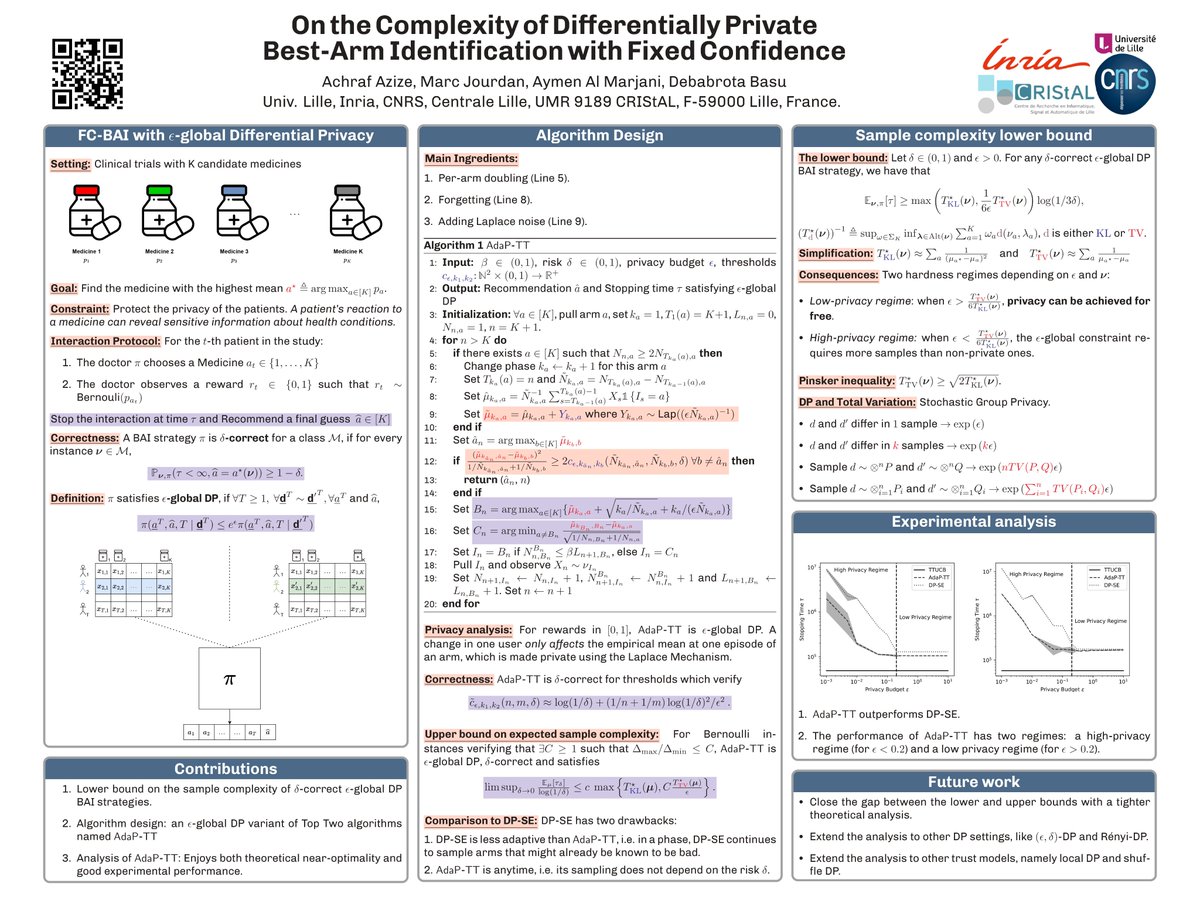
On the Complexity of Differentially Private Best-Arm Identification with Fixed Confidence
w/ A. Azize, @aymen_marjani & @BasuDebabrota
Paper: https://t.co/eGhwSJyXcF
Poster: Wed 13 Dec 10:45 a.m - 12:45 pm CST (#1604)
3/4