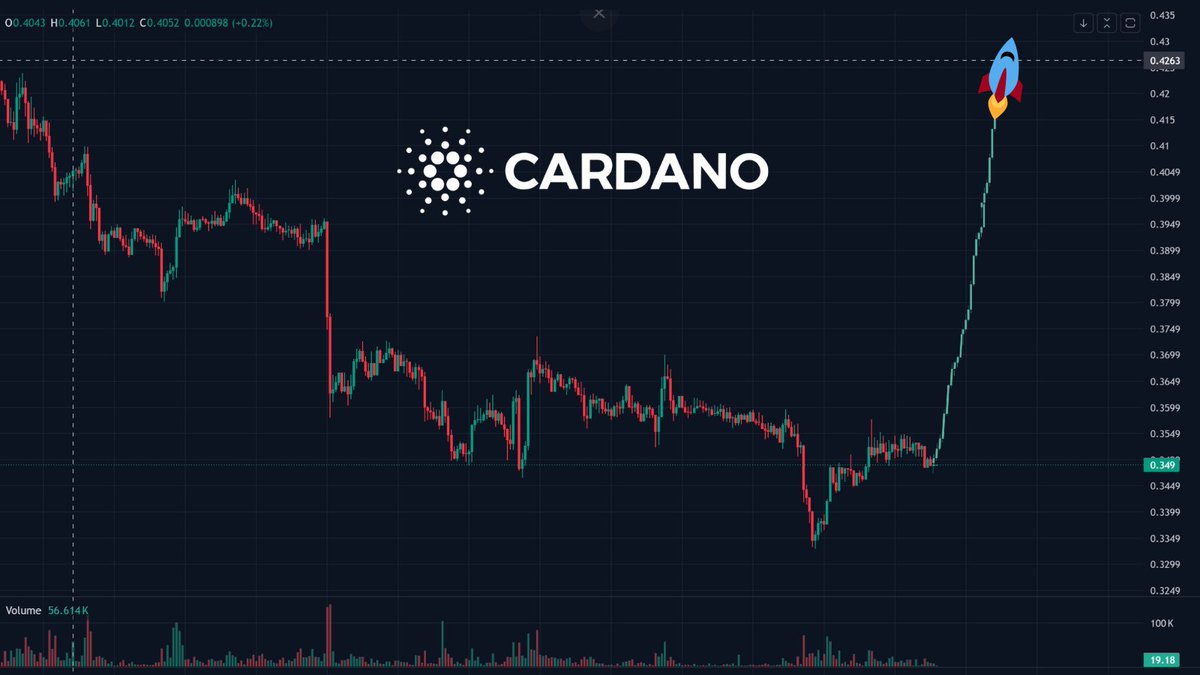
$ADA has been classified as a digital commodity by the SEC and CFTC.
A meaningful development for the Cardano ecosystem and for the broader digital asset industry.
🇺🇸 PRESIDENT TRUMP SAYS THE EXISTING FINANCIAL SYSTEM HAS REACHED ITS LIMITS, AND A CRYPTO-DRIVEN ERA IS COMING NEXT.
HE STATES THAT FINANCE IS SHIFTING FULLY ON-CHAIN, WITH BLOCKCHAIN AT ITS CORE.
THIS IS MASSIVELY BULLISH FOR BITCOIN 🚀
Midnight is going Mainstream!🕛
$NIGHT just got Listed on one of the Biggest exchanges on Earth as a Cardano Native asset!
Midnight mainnet is Launching this month Unlocking Privacy features that will bring Trillions of value on Chain!
All eyes are on $ADA & $NIGHT 🟡
$ADA 👑
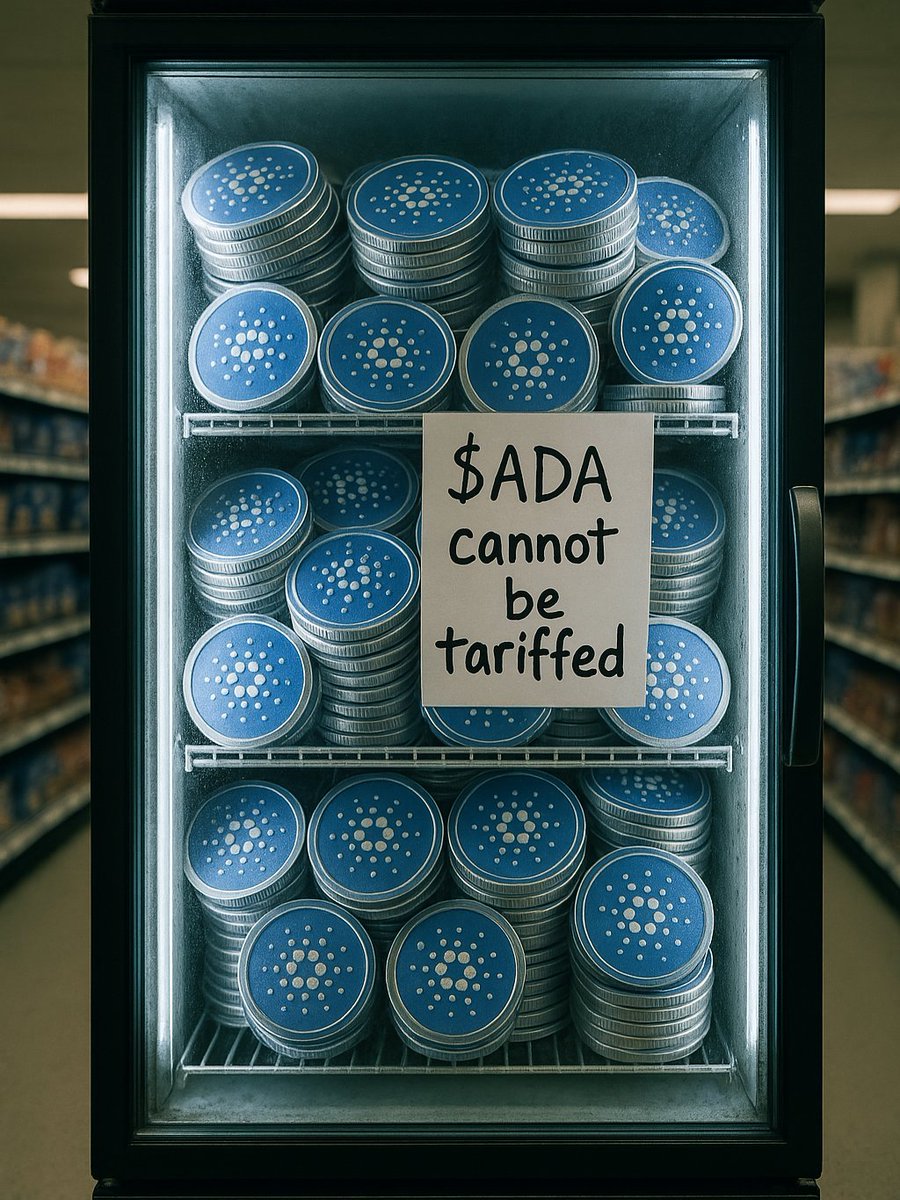
BREAKING: CARDANO'S $ADA TOKEN NOW ACCEPTED AT SPAR SUPERMARKETS IN SWITZERLAND
Swiss Spar stores now enable brick-and-mortar retail payments using $ADA through Cardano blockchain integration with @DFXswiss, marking major crypto adoption milestone in European retail.
JUST IN: #Cardano $ADA's Ouroboros Leios saw 147 updates in the past week. Leios will uplift the Layer-1 from 10 TPS to 500 TPS in the first release, a 50x improvement, with a public testnet set for the end of Q2. IOG aims to release Leios in the Dijkstra hard fork this year.
Netherlands approved 36% tax on unrealized gains (pending Senate)
Here's the scam:
Your portfolio pumps €100k → Pay €36k in taxes
Next year it crashes to zero → You can offset FUTURE gains but you already paid €36k on money that vanished
You can carry losses forward forever but NOT backward
Translation: Government gets paid on your wins immediately but you eat the full loss alone
Starts 2028
In what universe is this even fair?
The more I study Ouroboros Leios, the clearer it becomes that most people still haven’t realized what’s actually happening. Cardano is solving a problem the entire crypto industry keeps repeating as if it were a universal truth. The famous “blockchain trilemma” isn’t a law of physics… it’s a limitation of poor design. Leios proves it.
The key insight is so simple, yet almost nobody explains it. Most transactions on a blockchain don’t conflict with each other. They don’t touch the same state. They don’t modify the same part of the ledger. On Cardano —thanks to eUTxO— almost everything is naturally concurrent. That changes everything.
Leios takes that reality and turns it into architecture. The protocol assumes transactions can be processed in parallel, at massive scale, without stepping on each other. And when something does conflict, nothing breaks. Nothing becomes insecure. The system simply falls back into “Praos mode”—a safe, sequential path. Fast when it can be… conservative when it has to be.
And here’s the part many don’t want to hear: account-based chains simply can’t do this. Ethereum can’t. Solana can’t. Any network that relies on a single global mutable state will always hit a ceiling. Cardano can bypass that ceiling because its entire design was built for this kind of scalability from day one.
That’s why Leios matters so much. For the first time, a blockchain can scale without giving up security, without relying on centralized sequencers, without introducing single points of failure, and without collapsing under its own design constraints. This isn’t hype. It’s mathematics.
And I’ll be honest with you: once you truly understand how Leios works, you realize many blockchains aren’t competing with Cardano at all… they’re competing with the illusion that they scale. Cardano isn’t in that category. Cardano is building what everyone else said was “impossible.”
Those who understand this early already know how the story ends.
USDC might be better for Cardano than USDCx, but it’s certainly a good start.
USDC is a fiat-backed stablecoin that is widely recognized, liquid, and supported across wallets, exchanges, and protocols.
It’s natively issued on over 30 blockchains (mostly EVM chains) with a supply of $70B.
USDCx is a derivative/wrapper of USDC.
USDCx is a Circle-issued, 1:1 USDC-backed variant that enables USDC functionality on chains where canonical USDC is not yet available, such as Cardano.
USDCx incorporates ZK proofs for banking-level privacy in transactions, shielding details while remaining compliant.
Standard USDC lacks this built-in privacy.
USDC is globally understood and adopted. It is the second most widely used stablecoin after USDT (with a supply of $185B).
USDCx will require extra explanation to users and extra steps for integration. It may be more difficult to bootstrap liquidity.
USDCx does not require third-party bridges for deployment on Cardano.
It's directly backed 1:1 by USDC reserves held in Circle's xReserve smart contracts. xReserve is a protocol deployed and managed by Circle.
USDCx will be a Cardano Native Token but functions as a 1:1 representation of USDC.
The great thing is that, unlike some USDC implementations, USDCx cannot be frozen by Circle, aligning with Cardano's principles.
USDCx isn't widely listed on CEXs yet, so direct deposits and withdrawals might be limited. Moreover, support for CNTs is also limited.
However, it will be possible to hold USDCx on Cardano and deposit USDC on CEXs through a web application (or perhaps wallet integration) that will convert USDCx to USDC in the background. It will work in one click.
If I understand correctly, minting will be done by users depositing USDC into the xReserve contract on the source chain. This triggers minting of an equivalent amount of USDCx on Cardano via Circle's attestation service.
Burning and redemption will be done analogously. First, USDCx is burned on Cardano. Then xReserve releases the backing USDC on the source chain after verification.
For the record, the supply overview of Cardano stablecoins:
- USDM: 14.4M
- USDA: 11.7M
The success of the USDCx integration will depend primarily on liquidity.
The active proposal requesting 50M ADA to inject stablecoins into Cardano DeFi should consider USDCx.
The team should probably ask the community and DReps which stablecoin they want to support.
Given the current low price of ADA, it is necessary to think about how many stablecoins to support.
I estimate that currently, only about $10M worth of stablecoins could be minted. Market conditions may change. This is a challenge.
I am glad that Pentad delivered.
The specific terms of the agreement have not been disclosed, so I do not know whether native USDC could have been delivered or whether USDCx represents the most feasible option.
Congratulations to the Pentad team on this deal.