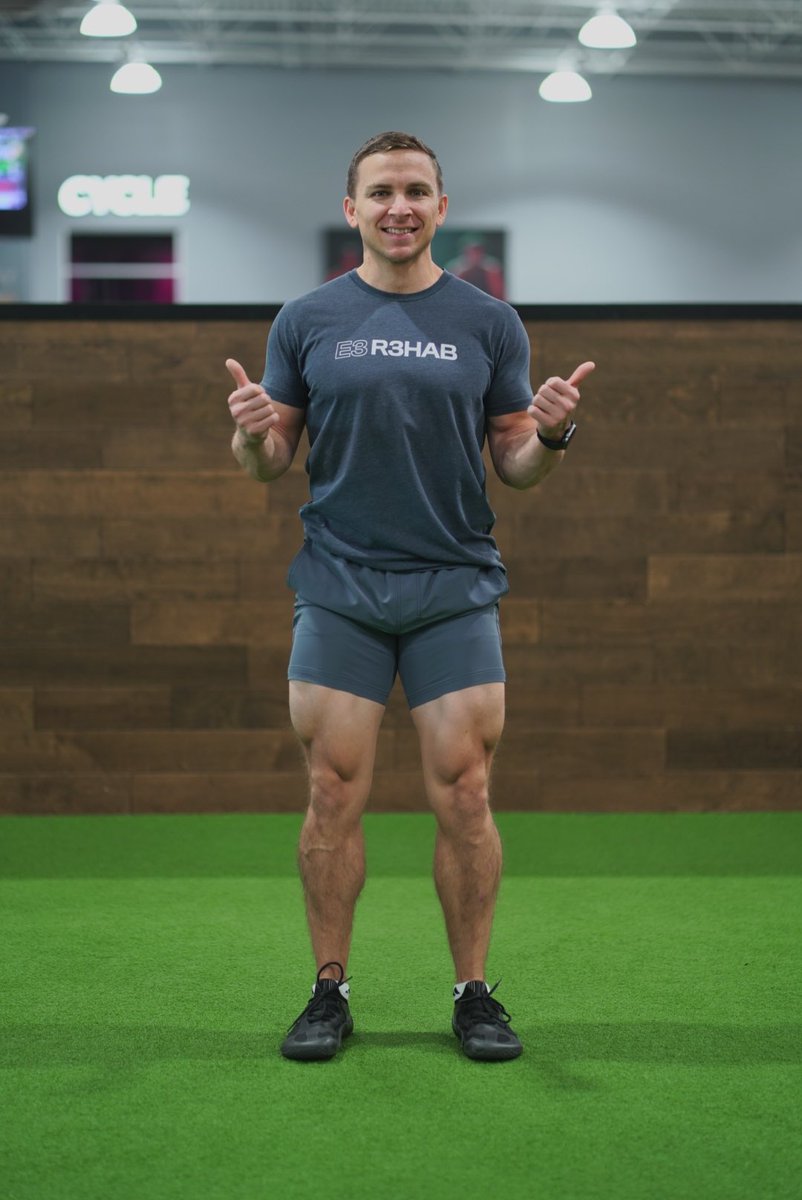
Despite having a total hip replacement when he was just 19 years old, @MarcSurdyka is still going strong 16 years later!
Check out our latest YouTube to learn more!
https://t.co/JOnKhtQ49m
Are you experiencing new, persistent, or recurring lower back pain that’s stopping you from doing the things you enjoy or just keeping you from feeling like yourself?
In our latest YouTube video, @MarcSurdyka discusses how to manage lower back pain. https://t.co/mmvRPsNDtH
In our latest podcast episode, @ChrisHughen sat down with @MarcSurdyka to discuss all things tendon rehab.
We dive into the evolution of tendon pain terminology, the role of inflammation, loading protocols, clinical applications, and much more.
https://t.co/yaI4jDRkCM
Hip Replacement 15+ Years Later!
In 2008, I was diagnosed with Avascular Necrosis of both hips (right worse than left) following high doses of corticosteroids from 2004-2007. This medication was part of my treatment for Acute Lymphoblastic Leukemia (cancer).
In the summer of 2009 at age 19, I had surgery for my right hip. This means I’ve had a right total hip replacement for over 15 years! It’s metal-on-metal (believed to be the best at the time) and the surgeon used a posterior approach.
I had a follow-up appointment this summer to see how everything’s looking and here’s what I learned:
- X-Rays look good!
- Blood work is fine (necessary to check for metal-on-metal implants).
- The new orthopedic surgeon I saw asked how my left hip is doing since he noticed avascular necrosis of the hip (I didn’t bring it up). I’ve never had the same range of motion and comfort of my left hip since before the corticosteroids, but it’s crazy to me that my hip has remained stable for so long!
What’s my secret?
I do my best to live a healthy-ish lifestyle and recommend people who find themselves in a similar situation to try the same.
Will both hips make it another 15 years? I hope so!
In our latest podcast episode, @ChrisHughen sat down with @MarcSurdyka and @NSurdykaPhysio to discuss all things ACL Rehab.
We dive into commonly held beliefs related to ACL surgery, average rates of return to sport, potential risk factors associated with a second injury, strategies to reduce the likelihood of a second tear, and much more!
https://t.co/3bfg4Doc7l
Can’t imagine being this miserable.
“Old” research is shared to inform those unaware of its existence, such as students, new grads, or individuals who don’t spend their days on an app.
I hope @E3Rehab can create a learning platform at <1/100 of the cost over the course of years, accessible to all, and without the nonsense and fluff included in most programs.
Faculty and staff need to have earnest conversations with applicants about the potential implications:
1. Inability to afford a home
2. Question their ability to have and raise kids
3. Retirement on back burner
4. Financial stress that is a central component of arguments with SO
Here’s a slide from my talk at @footballmed titled “Force Plates and RTP after ACLR: Tasks and Metrics”.
This slide shows that the “what” depends largely on the “why” and “when”.
Force plates are a great tool, but you need to identify the purpose of your assessments.
So excited to start up the Elite Soccer Rehab Conference with @erikMeira this August 3-4 in Portland!
If you currently or hope to work in elite soccer rehab/performance, this conference is for you!
https://t.co/CX3cBGty9W
This is a pretty good discussion of Stuart McGill’s episode of @PeterAttiaMD ‘s. The Drive. I probably sit a bit more on Stu’s side of the fence? In any case it’ll make 3 good listens. ( there are two episodes w/ Stu also)
https://t.co/vx7YRnHiPl
@MarcSurdyka
In our latest podcast episode, Chris and Marc sat down with Stu McGill for part two.
Stu adds more context to a host of topics that were discussed during his podcast recording with Peter Attia. Stu also addresses our disagreements with some of his statements made within that specific episode. We dive into a variety of topics including: Epidemiology, the McGill Big 3, nonspecific low back pain, and much more.
https://t.co/WeNa4fM4Wh
Do you have shoulder pain when sleeping on your side or while reaching out, overhead, or behind your back?
In our latest YouTube video, @MarcSurdyka teaches you how to manage this issue.
https://t.co/MPTQTmAdz4
In our latest podcast episode, @ChrisHughen sat down with Stuart McGill and @MarcSurdyka.
Stu provided more context surrounding his previous podcast interview with Peter Attia in addition to our recent episode discussing some of Stu’s claims during his conversation with Peter.
We dove into a variety of topics including: deadlifting in older adults, promoting resilience, disc bulges, adapting exercises for specific needs, lumbar flexion, and much more.
Watch the full episode: https://t.co/diJ1dnOODP
In our latest podcast episode, @ChrisHughen sat down with @MarcSurdyka to discuss Stu McGill’s most recent podcast episode with Peter Attia.
We dive into a variety of Stu’s claims throughout that podcast including: deadlifting in older adults, the McGill Big 3, vacuuming disc bulges, non-specific low back pain, and much more.
https://t.co/Q7uhdau4lC
Do you have pain associated with your sacroiliac joint?
In our latest YouTube video, @MarcSurdyka discusses sacroiliac joint pain, dispels the most common myths about the sacroiliac joint, and teaches you everything you need to know about managing symptoms.
https://t.co/oUzjNJxhWS