A passionate honours student at MCRI affiliated with The Peter Doherty Institute for Infection and Immunity. Love of science and good food makes my world spin.
New in CMI>
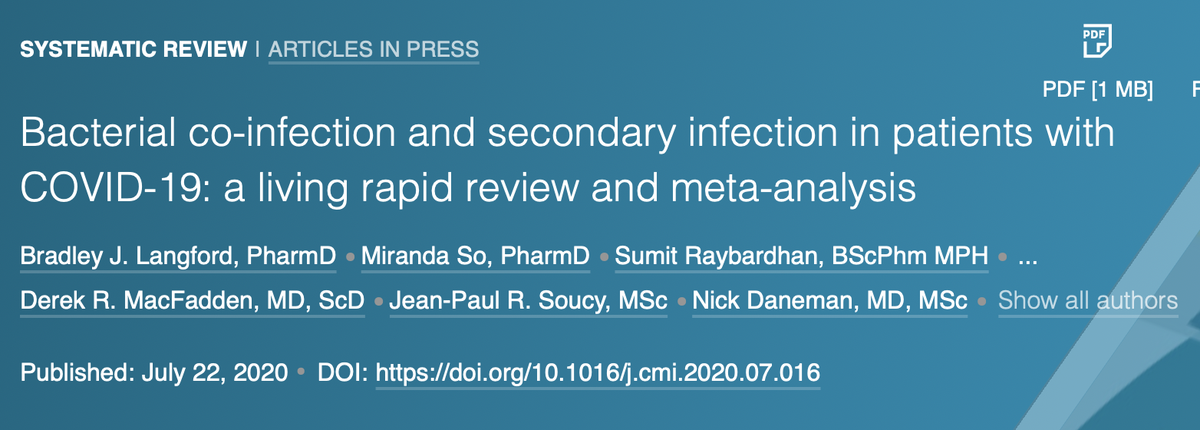
Bacterial co-infection was identified in 3.5% of patients with COVID19 and secondary bacterial infection in 15.5% of patients. The overall proportion of COVID-19 patients with bacterial infection was 7.1% (95%CI 4.6 to 9.6%). #IDTwitter
https://t.co/hLsg01Sswh
I think that schools should teach science up till year 12 like make it mandatory for everyone to learn it. That includes Tafes etc as if people knew science and biology we would not be in this mess. I think science is the most important subject schools should teach and push.
It so dishearting seeing the rise in cases like I want to be able to go back to WA by November after my oral defense. Being away from friends, your partner and family take a toll on you mentally and emotionally. I wish this would end like don't even know anymore.
Sorry for rant
After over 30 years with @ScienceUWA, Prof. Paul Attwood of @SMS_UWA is retiring. Colleagues and friends should save the date for his party, on his last day of work, Friday 31 July from 3pm in the Bayliss foyer. Meanwhile any photos like these blasts from the past, get in touch.
It always puzzles me is our immune system so outdated and weak or the virus so advanced and strong? Makes you stop and think is our immune system really that good??😂
Just read a paper on Human Coronavirus: Host-Pathogen Response and just strikes me do interferons actually protect cells? Like it seems most viruses can antagonize or shut the pathway down. It just seems innate viral defense is so outdated and redundant. Smh immune system.
@MarcelFrankFer1 So far it's just VBPs (peptides buried in and provicilin) & PDPs (peptide buried in proalbumin) that are the first interstitial peptides - but I suspect this is an under-appreciated form of de novo protein evolution ... and I'd like to find more examples. https://t.co/SzYG9YczwI
@MarcelFrankFer1 Some block enzymes and others are said to have drug potential so knowing how to dig for buried proteins in plants and other kingdoms of life will reveal natural products with potential benefits to biomedicine, plant biology and biotechnology (2/2) - text taken from my DP19 😀 OK?
@MarcelFrankFer1 This is a case where completely new proteins take an evolutionary shortcut and appear from within what then becomes a host. This and the other event that created these first examples of plant proteins hiding in unrelated hosts are small, ultra-stable and bioactive products (1/2)
@j_mylne I am curious hat is the importance of understanding this in plants? And what's the bigger goal in doing this research like what do you get out of knowing this? And how can it help us?