@DefensieMin@Defensie@Kon_Luchtmacht Nog minder bestuurlijke verantwoordelijkheid, nu zelfs bij het doden van mensen. Nog even en een bestuurder hoeft echt nooit meer verantwoordelijkheid te nemen voor gemaakte fouten.
@nicksortor Why don't they arrest all -including all journalists- forensic wipe everything fingerprint detailed to the button of their camp toilet and RICO the hell out of the situation?
@okdiario Dit is wel de domste Spaanse actie die je je maar kan voorstellen. Het raam eruit halen om het in één keer goed in gruzelementen te laten vallen. Professioneel in stukjes: het zogenaamde moralistische vingerwijzen.
@chgroenhuijsen Jawel, de EU totaal aan zet gezet en de media aan de kant gezet. De media roept wel, maar iedereen ziet dat wat zij roepen heel de tijd anders gaat en nu zo opvallend is als patroon onder er ineens twee werkelijkheden zijn. De echte en de verzonnen experts. De kapiteins aan wal.
Here’s Ben Stein in 1979 describing television as an engine of cultural demoralization. He argues that a small clique of producers and writers pushed a left-coded inversion of reality onto the public. They despised traditional power centers and hated figures like Buckley. They propagandized the nation into accepting a fake world where businessmen are villains, criminals are the good-guys, small towns are sinister, military officers are proto-fascists, and work barely exists.
@ministerBHOS Principles=zero, but hey your profession is lying, that we believe. I always wonder, what kind of people like these kind of people... with power of not having to take responsibility for their actions... how powerful. What ever turns you on baby.
@jeffreymlevy@RepMarkHarrisNC Now do the proof or you have no life at all so it seems. Just making noise with no constructive reason or outcome. And no I am not pro Trump. I am anti stupid. You are so locked in your echo that you spit poison to feel alive. How shameful and lonely that must be.
Everything you need to know about the Israeli "Giora Island" plan to settle Gaza residents in Sinai
The Israeli "Giora Island" plan is a controversial proposition rooted in the ever-evolving geopolitical landscape of the Middle East. Suggesting the resettlement of Gaza residents in parts of the Sinai Peninsula, the idea has oscillated between the realms of audacious speculation and potential policy over the years. This exposition seeks to provide a comprehensive understanding of the plan, its nuances, and its implications in the larger context of regional dynamics.
Historical Origins and Key Players
The Middle East, with its rich tapestry of interwoven narratives, is no stranger to bold and transformative proposals. Within this framework, the Giora Eiland plan emerges as an intriguing and potentially game-changing idea, especially in the context of the protracted Israel-Palestine impasse.
Giora Eiland, the chief proponent of this initiative, is a formidable figure within the Israeli defense and strategy establishment. His significant stints within the Israeli Defense Forces and the National Security Council between 1997 and 2006 have left an indelible mark on the country's strategic paradigm. The Giora Eiland plan, with its audacious and unorthodox approach, is a testament to his penchant for out-of-the-box thinking.
In a surprising turn of events in 2013, the scheme resurfaced when Palestinian President Mahmoud Abbas divulged his discussions about the proposal with Egypt's then-President, Mohamed Morsi. Beyond Abbas, Morsi was also believed to have approached Hamas's leadership about the plan. While the Palestinian Authority unequivocally rebuffed the proposal, murmurs about Hamas's possible receptivity to it added a layer of intrigue to an already complex situation.
Giora Eiland Plan: The Key Tenets
The inception of the plan can be traced back to the early 2000s, but it was in the aftermath of the Israeli military's 2005 retreat from the Gaza Strip that Eiland's idea began to gain more concrete shape.
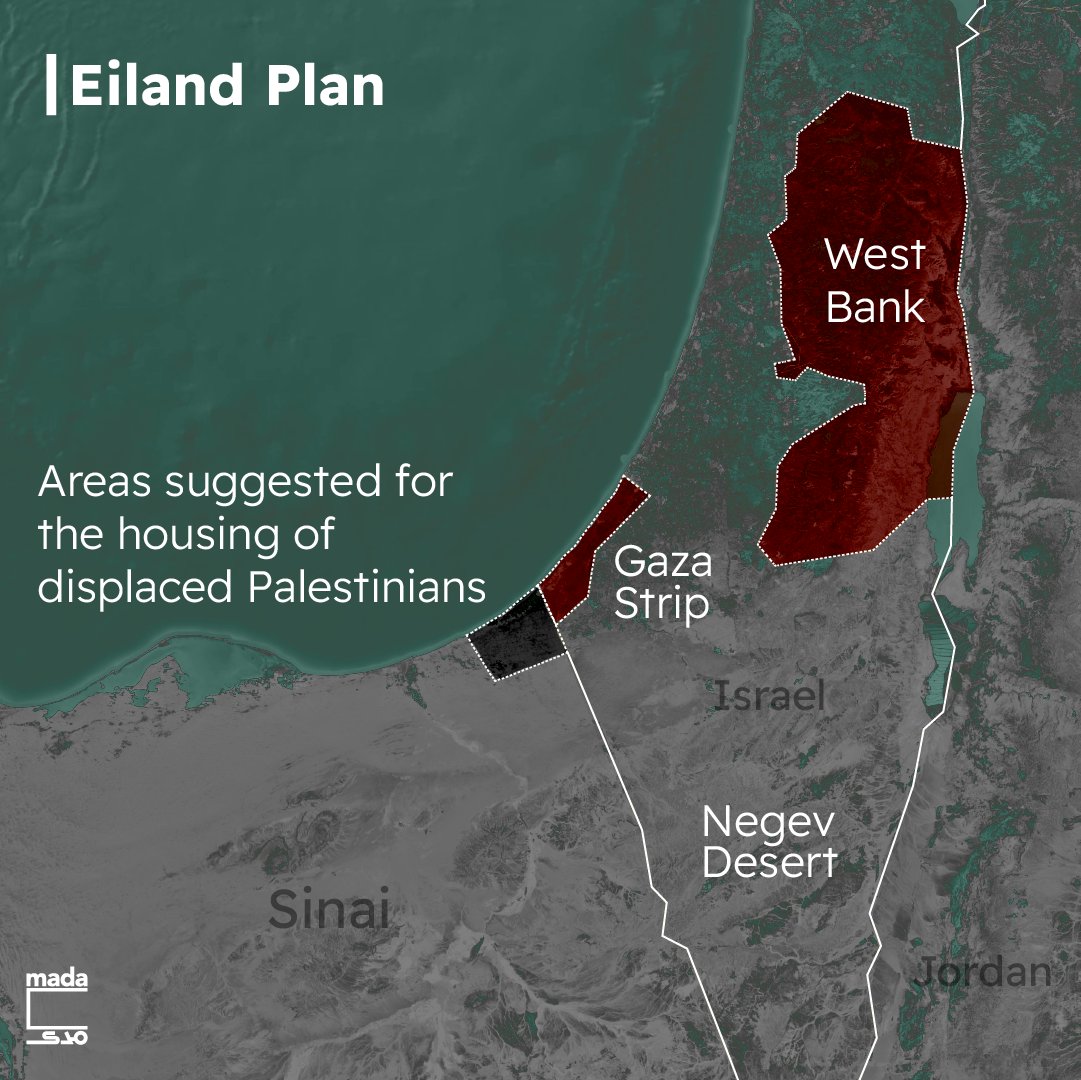
Land Reallocation: Central to Eiland's vision is the potential willingness of Egypt to relinquish a portion of its Sinai territory, approximately 720 https://t.co/iPapdv7eHE in size. Such a move would significantly expand the territorial boundaries of the Gaza Strip, transforming it from Rafah to Al-Arish along the Mediterranean coastline. This territorial augmentation holds promise for alleviating Gaza's dense population issues and laying the foundation for economic and infrastructural rejuvenation.
Exchange Concessions: Eiland's plan doesn't solely advocate territorial expansion for the Palestinians. It posits a certain reciprocity, wherein Palestinians would be expected to relinquish about 12% of the West Bank. This would facilitate Israel's annexation of vital territories, enveloping significant settlement zones and regions in proximity to Jerusalem.
Compensation to Egypt: The plan is anchored in a principle of mutual benefit. In exchange for the Sinai territory, Israel would transfer a comparable landmass from its southwestern Negev region to Egypt. A cornerstone of this arrangement would be the envisaged canal, which promises to usher in enhanced trade and connectivity avenues between Egypt and Jordan.
For Eiland, the success of this initiative wasn't just contingent upon regional consensus but required broader international acceptance. He imagined Europe taking the lead in championing the idea, with pivotal support from international powerhouses like the U.S., Egypt, and Jordan. Yet, the reticence of the Palestinian leadership meant that, for the most part, the plan's deliberations were confined to the Israeli-U.S. strategic dialogue.
Repercussions and Reiterations
The conversations between Abbas and Morsi in 2013 rejuvenated interest in the Eiland plan. Morsi's ambitious idea, proposing a sprawling extension of Gaza into Sinai by a staggering 1,600 km, met with staunch opposition from Abbas, who remained deeply committed to Egyptian territorial sovereignty and the overarching Palestinian objectives.
Fast forward to 2014, and the plan once again grabbed headlines. Speculations suggested that Egyptian President Abdel Fattah al-Sisi had broached the topic with Abbas. However, the Palestinian leadership's position was unyielding. They reiterated their long-held vision of a sovereign Palestinian state, demarcated by the 1967 boundaries, with East Jerusalem as its heartbeat and capital.
Nabil Abu Rudeina, then serving as the Palestinian presidential spokesperson, was vociferous in clarifying the Palestinian stance. He firmly dismissed any speculation of the Palestinian administration aligning with the Eiland plan. Rudeina further drew attention to the contrasting positions of the Palestinian leadership and the rumored inclinations of the Muslim Brotherhood during Morsi's rule. Through his statements, Rudeina not only clarified the Palestinian perspective but also illuminated the deep-seated political and ideological schisms in the region.
Conclusion
The Giora Island plan, while a dormant proposition, exemplifies the intricate complexities of Middle-Eastern geopolitics. Beyond the immediate concerns of land allocation and sovereignty, it underscores the larger themes of regional power dynamics, historical narratives, and the quest for lasting peace. Each resurgence of the plan underscores the evolving nature of diplomatic strategies, regional alliances, and nationalistic aspirations. While its feasibility remains contested, the very existence of the Giora Island plan showcases the lengths to which stakeholders might go in search of an elusive resolution to the Israel-Palestine conundrum.
Gamliel's Bizarre Brainchild: The Sinai Mirage and its Foreboding Shadows on Middle Eastern Peace
Amidst the rubbles of Zahra City in southern Gaza, which has borne the brunt of relentless animosities between Israel and Hamas, the most recent Israeli strikes stand as poignant markers of a conflict that has seemingly outlived its expiration date. A bitter history, deep-seated mistrust, and competing national narratives have forged an inferno of emotions and strategies in the heart of the Middle East.
Enter Intelligence Minister Gila Gamliel and her audacious, or should we say farcical, plan that's causing quite the sensation in diplomatic circles: the relocation of the beleaguered Palestinian population to Egypt’s Sinai Peninsula. Let's put this in stark terms; such a plan isn't merely controversial, it sounds almost like it's been pulled from the pages of an absurdist dystopian novel.
Gamliel’s memorandum, conveniently leaked to the public, conjures visions of tented communities within Sinai. These, alongside a proposed "humanitarian corridor", sound benevolent on paper, promising ease in the transfer of goods and people. However, scratching just below the surface reveals a deeper, more insidious agenda: permanent settlements in North Sinai and a protective buffer zone along the Egyptian-Israeli border, seemingly putting to bed any dreams of Palestinian repatriation.
But let’s dissect this for a moment. The historical precedent of uprooting and relocating entire populations is not just ethically questionable but replete with logistical nightmares. Where in the annals of history has such a move not been met with resistance, turmoil, or outright disaster? Add to that the volatile nature of the Sinai Peninsula, already a hotbed for insurgency, and you’re looking at a potential political Chernobyl.
Seasoned Middle East analyst, Daniel Levy, has lambasted the plan, and rightly so. Humanitarian aid for Gaza is a global rallying cry, but what Gamliel proposes walks a tightrope between genuine assistance and a Machiavellian strategy masked in the garb of benevolence.
But what of Egypt's role in this? President Abdel Fattah al-Sisi is already neck-deep in regional politics and now finds himself in an ever-tightening vice. Sinai, after all, isn't just any stretch of land; it’s woven into the fabric of Egypt's national identity. And al-Sisi isn't alone in his predicament; whispers of Israeli overreach echo in the halls of power throughout the Middle East.
We mustn't forget the notorious "Eiland Plan" which still haunts diplomatic discussions. A brainchild of retired Major General Giora Eiland, this once derided plan pushed for territorial swaps between Egypt and Israel. Egypt's vociferous rebuke back then should have served as a glaring warning sign for those now entertaining similar flights of fancy.
Israel's intense push, arguably influenced by the Dahiyeh doctrine, signals more than just a tactical shift. One can't help but wonder if there's an ulterior motive afoot: an ambition to alter Gaza's geopolitical status or, more cynically, to efface its historic identity altogether.
Hani al-Masry, a keen observer of the region, points to an almost comical paradigm shift: not too long ago, the focus was on boosting Gaza's economy and integrating it further into the Middle East. Now, it seems there are those in Israel who'd prefer a Middle East sans Gaza.
When evaluating the Gamliel proposal, skepticism should be our guiding light. On paper, relocation might seem like the answer to Israel's 'Gaza problem', but the pages of history are stained with the failures of such brazen endeavors. The real issue here is whether we are willing to gamble with the lives and futures of millions for a fleeting, and likely illusory, geopolitical edge.
Seeking peace in the Middle East isn’t a game of chess. It's a complex dance requiring understanding, patience, empathy, and above all, a profound commitment to the ideals of coexistence and mutual respect. The world watches, waits, and hopes for solutions that honor these principles, rather than undermining them.