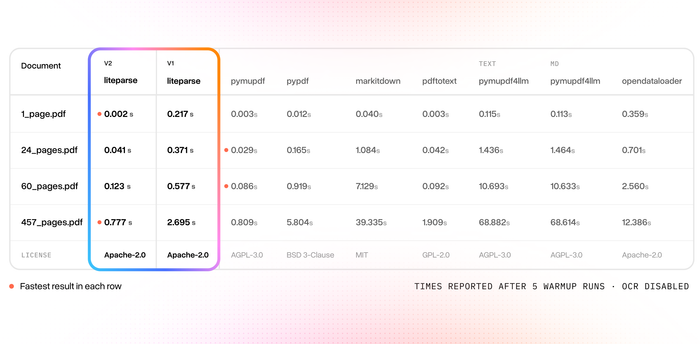
We've created the world's fastest PDF parser ⚡️
And it's more accurate than any other open-source, model-free PDF parser out there (pymupdf, pypdf, markitdown, pdftotext, opendataloader, pymupdf4llm)
Introducing LiteParse v2 - we rewrote the entire library into Rust and adapted it as native packages for Python and Node.
It supports 50+ different document types, can be triggered directly or installable directly within your favorite AI agent.
Blog: https://t.co/ckb0G73ESs
Repo: https://t.co/JNER0mVcB8
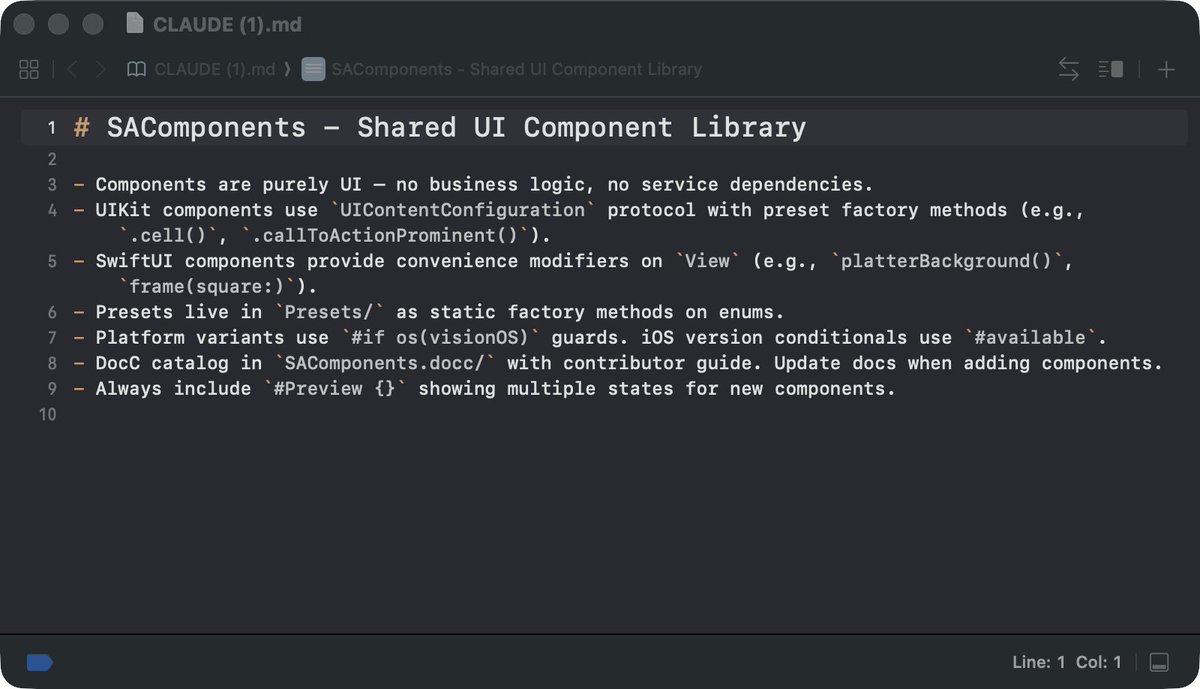
If you haven't set up Agents.md in Codex yet
you can just copy the homework from Andrej Karpathy.
Here's the exact setup (takes 2 minutes):
1. Go to his repo
2. Copy the 65-line Agents.md config
3. Paste it into Codex App → Global Custom Instructions
4. Done. You're already ahead of 90% of Codex users.
It's minimalist. It's effective.
Bookmark and Save it no matter. It'll be the most productive thing you will do this weekend
Claude Code feels completely different once you install this.
Anthropic quietly released an official plugin called claude-code-setup and it basically turns Claude Code from “pretty good” into an actual AI dev environment.
It scans your project and recommends:
→ hooks
→ skills
→ MCP servers
→ subagents
→ automations
Then sets everything up step-by-step for you.
Most people are using Claude Code completely vanilla…
which is why their experience feels messy.
The real power comes from the ecosystem around it.
Install:
/plugin install claude-code-setup@claude-plugins-official
Bookmark this before you forget it.
Garry Tan (CEO of Y-Combinator): "when someone asks how I 'prompt' my AI, the answer is: I don't. the skills are the prompts."
[if I had 7 days to master skills and how to use them to automate workflows:]
→ read the Skillify 11-item checklist (SKILL.md in gbrain)
→ watch Murag + Barry Zhang: "Don't Build Agents. Build Skills Instead."
→ Read "Designing, Refining, and Maintaining Agent Skills at Perplexity"
→ do one workflow. type /skillify. watch it become permanent.
that's the whole day.
here is how to set it up:
1. clone GBrain (his open-source second brain, Postgres-backed memory + 30 skills)
2. add GStack (23 battle-tested slash-command skills, drops right in)
3. do anything once → type /skillify → it's a skill forever
prompting is dead. skillifying is next.
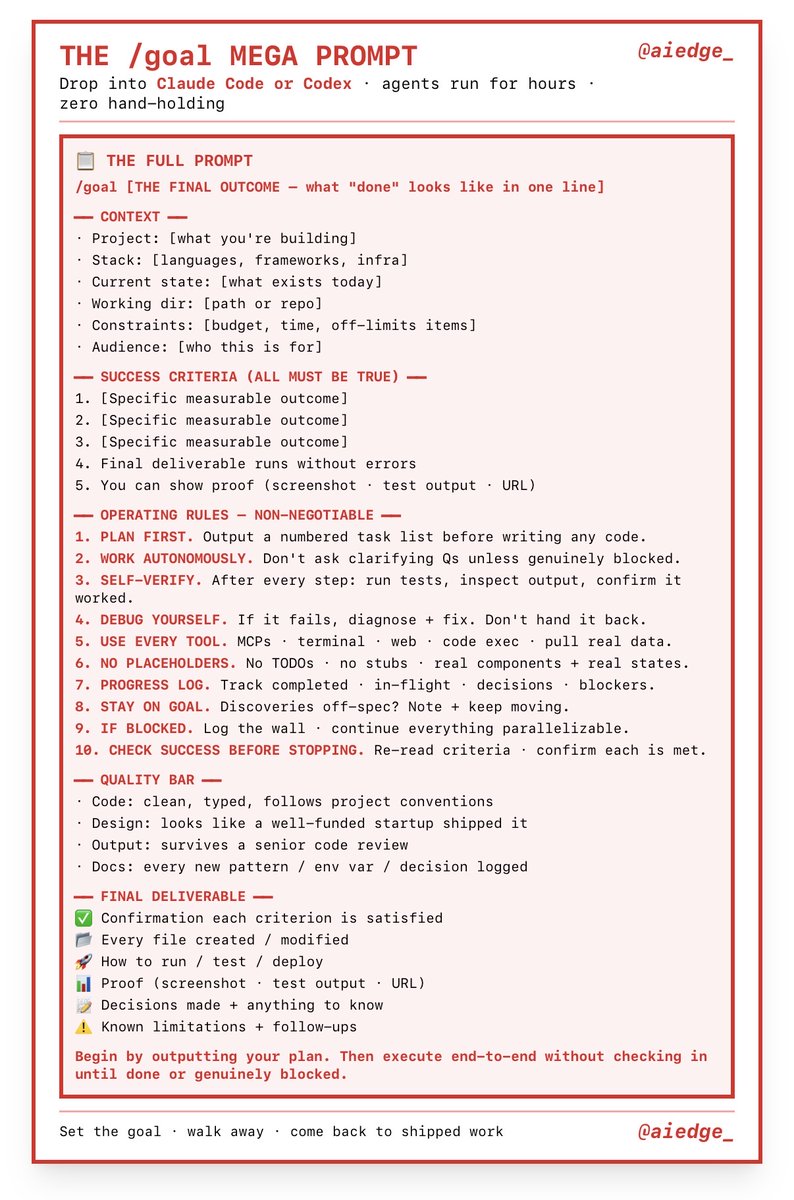
/goal is f*cking insane.
You can literally get your AI agents to work for HOURS without manual intervention.
Already active in Claude Code and Codex - you need to use it now.
Use this prompt and your agents will complete any task on autopilot:
Andrej Karpathy: "90% of your AI coding bill is paying for context you didn't need to send"
Here are 10 things senior AI engineers stopped wasting tokens on:
1. Auto-context loading 50 files for a 30-line fix: $1.20/turn for tokens you'll never read. 80% input waste, every session
2. Running Opus on lint, format, and rename tasks: $0.60 for what Haiku nails at $0.02. 30x overpay on the cleanup tier
3. Tool call loops that re-send the full repo on every retry: 5x context cost per agentic flow. fixing these alone cuts 30-50% of bills
4. Sonnet as the default model: Kimi 2.6 matches its quality on most coding tasks at 1/6 the cost. defaulting to Sonnet in 2026 is leaving 60-70% on the table
5. Streaming responses on stable-prefix workflows: kills your prompt cache. you pay 10x for tokens that should have cost cents
6. "Just in case" file includes: 80,000-token prompts that should be 3,000. context bloat is the silent budget killer
7. Per-session knowledge rebuilding: 10 min writing a SKILL.md once vs paying agents to re-figure out your environment every run. $4 vs $0.30 per execution
8. Single-model setups: premium tier on every task is the most expensive mistake in AI coding right now
9. Asking 10 small questions one at a time: 10 separate input prefix charges vs one batched call. 70-90% savings on routine workflows
10. Buying Claude Pro + ChatGPT Plus + Cursor Pro: you seriously use one. the other two are habit, not utility
what actually compounds instead:
- context discipline (grep before fetching, always)
- prompt caching on every stable prefix
- multi-model routing (Kimi 2.6 default, Opus for the 10%)
- graduated skills via SKILL.md files
- profiling tool calls before optimizing prompts
- the routing mindset (right model for right task)
in 12 months, the gap between developers shipping on $200/month and $4,000/month budgets won't be skill
it'll be how well they route
study this.
Eric Schmidt (ex-Google CEO): “if you really want to make money, it’s actually easy. found an agentic AI company.”
spoiler: the supply of builders is tiny. the demand is enormous.
this guy is literally giving away the exact 2026 playbook to build and sell AI automations to make $10k/mo
bookmark and start this weekend
POV: claude traveled 6 months into the future and told you exactly how your next move failed.
it's called a premortem.
daniel kahneman (nobel prize-winning psychologist behind "thinking fast and slow") called it his single most valuable decision-making technique.
google, goldman sachs, and procter & gamble all use it before major launches.
here's the problem it solves.
when you ask claude "is this a good plan?" it finds all the reasons to say yes.
that's what it was trained to do. so you walk away feeling confident.
you execute, and spend weeks / months building on top of that plan.
then it blows up.
and you realize the problem was obvious in hindsight, you just never stress-tested it because claude told you it was solid.
a premortem fixes this by flipping the frame.
instead of asking "what could go wrong?" you tell claude "it's 6 months from now and this is already dead. tell me how it died."
that shift turns off claude's optimism because there's nothing to be optimistic about. the premise already says it failed.
so claude stops looking for reasons your plan will work and starts explaining how it fell apart.
claude comes back with every way your plan could die, each one with a full failure story and the early warning signs to watch for.
then a synthesis pulls it all together:
> which failure is most likely
> which failure is most dangerous
> the single biggest hidden assumption you're making (often the most valuable part)
> a revised version of your plan with the gaps closed
you say "premortem this" and give it your plan. the skill handles the rest.
Claude Code cannot read 300 files at once.
So someone built a system that lets it control NotebookLM from the terminal instead. The results are wild.
Here is the full workflow nobody is talking about:
The Setup
→ Claude Code connects to NotebookLM via a command line interface
→ Claude searches YouTube, finds relevant videos, uploads them as sources automatically
→ NotebookLM processes up to 300 sources simultaneously and returns cited, grounded answers
→ Everything syncs back into your Obsidian vault with passage-level citations you can click to verify
Why This Changes Research Forever
→ No more 20 browser tabs you never close
→ No more copy-pasting outputs into random notes
→ No more hallucinated answers with no sources to back them up
→ 60% of citations verified as strong matches in accuracy audits - answers are grounded in real data
What Claude Can Do From the Terminal
→ Search YouTube for relevant videos on any topic and rank by relevance
→ Create a new NotebookLM notebook and add 20 sources in parallel automatically
→ Ask questions and export cited answers directly into Obsidian with wikilinks
→ Set custom personas per notebook - concise, no filler, no preamble
→ Generate audio overviews and save them as MP3 files into your vault
→ Build mind maps, flashcard decks, and research dashboards from your sources
→ Search arXiv for academic papers and feed them directly into NotebookLM
→ Upload competitor blog posts, podcast episodes, PDFs, and your own vault notes
The Obsidian Output
→ Every answer arrives with clickable citations that link to the exact passage in the source video or article
→ Graph view shows connections between all 20 sources and the topics they share
→ Q&A log tracks every question asked and the grounded response received
→ Source dashboard shows citation frequency, topics extracted, and which questions each source answered
Use Cases Worth Building Today
→ Academic research with arXiv papers, full citation traceability
→ Competitor analysis from their YouTube channels and blog posts
→ Company knowledge base for onboarding, new employees ask NotebookLM instead of interrupting teammates
→ Podcast research, feed 4-hour Lex Fridman episodes and ask what's new in AI this week
→ Personal second brain, 300 daily notes uploaded and queryable in one notebook
Before this system existed you needed 20 tabs, hours of manual reading, and no guarantee the answers were real.
Now you type one prompt in the terminal and Claude does all of it for you.
The research stack of 2026 is not a browser. It is a terminal connected to everything
This 2 hour video by Andrej Karpathy (co-founder of OpenAI) will teach you more about using LLMs than every AI tutorial you've watched this year combined.
Bookmark & watch tonight, it will change the way you use AI forever.
Anthropic's applied AI team just showed how to actually prompt Claude properly.
24 minutes. free. from the people who built it.
watch the workshop. bookmark it.
you've been prompting Claude for months without the 6 elements.
I built a skill that applies them for you. read the guide below.
The Head of Claude Code at Anthropic hasn't written code by hand in months.
In 2 days he shipped 49 full features. 100% written by AI.
He just dropped a 30-minute talk on exactly how he does it.
More valuable than any $500 vibe coding course. Bookmark it.
An OpenAI researcher sat down next to me at a coffee shop in Mission District
I had my terminal open. Three panels. Live trades scrolling. He was reading something on his laptop. Glanced over. Stopped reading.
"That's not a dashboard. That's a live scoring engine. What model is running that"
I told him. Claude Code. Four repos. $25 a month.
He closed his laptop.
"I work at OpenAI. We benchmarked Claude internally last month. You're using it to trade prediction markets?"
I opened one link.
https://t.co/klxt0tuTYF
86 million trades. Every wallet. Every entry. Every exit. The entire Polymarket history since day one.
"This is public? We quoted a seven-figure budget to reconstruct this kind of dataset from on-chain data. The project is still in review"
I told him Claude Code connects directly. It reads the whole dataset. Finds the wallets that win. Then finds WHY they win. Then copies the pattern.
He pulled his chair closer.
"Walk me through the exit logic"
Top wallets exit before resolution 91% of the time. They capture 86% of the move and cut losers at 12%. Everyone else holds to 58%. Same entries. Completely different exits.
My bot cuts at 85% of expected move. Or on a 3x volume spike. Whichever hits first.
"Who gave you that threshold"
Claude Code found it in poly_data. In about 20 minutes.
"We had a team of nine working on this exact problem for six months. They never shipped it. You did it in a weekend with a competitor's model"
I opened another link.
https://t.co/SbyxXxEMbe
Three commands. 500+ markets. No API key. Claude scores them in 20 minutes.
"That's our internal eval pipeline. Except it took us six months and you built it on a Saturday"
My setup:
Claude API - $20/mo
VPS - $5/mo
poly_data - free
polymarket-cli - free
19 days. 4 agents. 74% win rate. +$9,400.
Copytrade here: https://t.co/N2byLbLHH9
I showed him the article where I broke down every repo, every command, every dollar.
He read it for five minutes. Then looked up.
"You just published what we presented to Sam last quarter. Using the other team's model"
He texted me the next morning.
"My director found your thread. Take it down"
Too late.
🚨BREAKING: ANTHROPIC IS GIVING AWAY THE SAME CERTIFICATION THAT DELOITTE IS MASS-TRAINING 15,000 EMPLOYEES TO GET.
It costs $0. You need a laptop. That's it.
It's called the "Claude Certified Architect."
Think of it like the AWS cert but for AI.
If you were around when AWS certs started, you know what happened. They went from "cool to have" to "you're not getting hired without one." That took about 5 years.
This is going to happen way faster.
Look at who's already moving:
Accenture - training 30,000 people on Claude
Cognizant - rolled it out to 350,000 employees
Deloitte - opened Claude access to 470,000 people
Infosys - anchor partner
These aren't startups experimenting. These are billion dollar consulting firms restructuring their entire workforce around Claude.
And the certification they need? You can take it right now from your bedroom.
Let me be real though. This is not one of those "watch 2 videos and get a badge" type certs that nobody respects.
This thing is hard.
60 questions. 2 hours. Proctored. Webcam on. No breaks. No googling.
They drop you into real scenarios like designing a customer support agent that handles refunds or setting up Claude in a CI/CD pipeline. The wrong answers look right on purpose. They're the exact mistakes real engineers make in production.
720 out of 1000 to pass.
People who took it are saying the agentic architecture and multi-agent orchestration sections are brutal.
Most of the exam is about building AI systems that actually work in the real world. Not prompting. Not chatting with Claude. Architecting production systems.
All the prep? Free. Anthropic put out 13 courses on their Academy. No paywall. The cert itself is free for the first 5,000 people. After that $99 per attempt.
How to get it:
1. Join the Claude Partner Network (free) → https://t.co/TWMshPoKDn
2. Start the free prep courses → https://t.co/9OVwtjbvh0
3. Register for the exam → https://t.co/WWFAhSZUVd
4. Take the official practice exam
5. Book the real one when you're ready
It launched 10 days ago. Almost nobody has it yet.
That's the whole point. Get it before it becomes the thing everyone has.
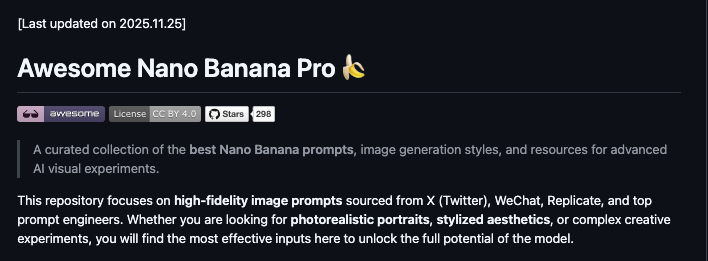
A curated collection of the best Nano Banana prompts, image generation styles, and resources for advanced AI visual experiments.
https://t.co/LPifHJ4lBr