In 1929, Victor Lustig, the smoothest con man of the early twentieth century and the man who would later sell the Eiffel Tower twice, took $50,000 of Al Capone's money promising to double it. He never invested a dime. He locked the cash in a safe, waited two weeks, handed it back with a story about deals that fell through, and Capone, moved by the honesty, gave him $5,000 for his trouble. The biographers call it the purest convincer ever recorded. Apparent honesty, invested at maximum stakes, collecting interest from the most dangerous man in America.
On October 19, Elon Musk announced he will give one SpaceX share to every child in America. Next year. "The first of many." The President confirmed the mechanism within hours. Trump Accounts, the same rails the Dell family used.
Take the headline at face value first, because the headline is doing the work. Seventy-three million kids at Friday's close of $146.03 comes to about $10.7 billion. Against his roughly 6.4 billion shares, that prices the gift at 1.1 percent of his stake. Sounds almost serious.
Now read the fine print, because the fine print is where the number actually lives. Nobody is handing stock to seventy-three million children. A parent has to opt in. An account has to be opened, a claim filed, a form signed. Programs of this shape never reach their ceiling; a strong result is a fraction of it. So the real cost is some unknown slice of $10.7 billion, plausibly a few billion dollars, well under half of one percent of his holdings, while the sentence everybody remembers says every child in America. Darrell Huff was not even a statistician. He was a magazine writer with a gift for spotting cooked numbers, and in 1954 he wrote the sharpest short course ever published on the subject, How to Lie with Statistics. One of his chapters covers the well-chosen average: one street, truthfully priced at ten thousand pounds by the mean and two thousand by the median, depending on which buyer the speaker wants to impress. A technically true number, selected for the size of its sound. "Every kid in America" is the mean. The opt-in registry is the median, and nobody is printing that one.
Watch what the sentence did anyway. Monday, the first trading day after he said it, SPCX closed at $147.96, up $1.93 a share. On his 6.4 billion shares, that single green candle added roughly $12.4 billion to his paper wealth. Even the ceiling version of the promise, the full $10.7 billion, was paid for before a single child was named. Daniel Simons and Christopher Chabris, the two psychologists who turned getting fooled into a laboratory science, call this the potency hook. We are suckers for big effects from small causes, and the bigger the magic, the less mechanism the mind demands. The sentence is the product. The shares are the coupon.
The route has been driven before, with the receipts public. The Dell family donated $6.25 billion of Dell stock into Trump Accounts. The President spent weeks telling Americans to buy Dell. The stock ran 14 percent. Then the disclosure: Trump himself had sold up to $1 million of Dell into the pump. SpaceX is only the second company to use the rule, and the first one's ledger is open. Doing it again, on camera, in front of everyone who watched the first time, is what an honest vocabulary calls a repeat con.
Earnings are after the close today. Announced Sunday, pumped Monday, earnings Tuesday. Same choreography as the Roadster barrel roll nine days earlier, the driverless flip that landed hours before Tesla's own earnings call.
The defenses arrived right on schedule, pre-cooked as always. "Liberals say the rich should share. A rich man shares. Liberals say it doesn't do anything." Nobody said it does nothing. The frame exists because the honest description cannot be memed: a fraction-of-one-percent marketing spend, self-funded in a day, routed through a government children's program, timed to an earnings call, on rails a documented pump already ran. Try drawing that as a crying cartoon. Daniel Kahneman, the psychologist who won a Nobel Prize for mapping how the mind actually decides, showed decades ago that belief comes first and reasons arrive afterward, hired as attorneys for the conclusion rather than judges of it. The meme does not answer the claim. It cross-examines the claimant.
Huff ended his book with five questions, and they still do the work. Who says so? How does he know? What's missing? Did somebody change the subject? Does it make sense? What is missing here is everything that would make the promise real: a date, a registry, a delivery mechanism for people who legally cannot hold stock. A man who has missed every production promise since 2017 is asking to be believed about a promise with no deadline at all.
Rolf Dobelli, a Swiss writer who cataloged ninety-nine thinking errors in his bestseller The Art of Thinking Clearly, has a chapter for exactly this maneuver. He calls it strategic misrepresentation, the planner's lie. The overpromise gets the project funded, and the truth gets it cancelled. "Next year" is not a date. "The first of many" is not a plan. It is the same lure re-cast, and re-casting the lure is the sport.
Then there is the part that outlasts the headlines. A child cannot touch that account for eighteen years. So the gift does not buy gratitude. It buys households. Every family holding one share becomes a family that hears skepticism as an attack on their kid's future. Benjamin Franklin worked this out with a borrowed book and a political enemy: do someone a favor, and the brain invents a reason to like him rather than admit the favor was a mistake. David McRaney, a journalist who spent two books cataloging self-delusion, wrote it up as the Benjamin Franklin effect. The trick now runs at population scale, through the federal government, on shares in a company where one man keeps about 82 percent of the votes. McRaney supplies a second entry too: the backfire effect, his name for what happens when a correction entrenches the belief it targets. Expect this piece to be screenshotted as proof of the obsession. That is the immune system doing its job.
The unpaid defense attorneys used to volunteer. Now they will be issued, at birth.
David Maurer was a linguist at the University of Louisville who spent years inside the confidence trade while it was still running, and he wrote its anatomy in 1940, The Big Con. He named the stages in the professionals' own argot, and one of them is the touch, the moment real money moves. If next year there is no share, there was never a date to miss. If there is a pilot, a program, a few thousand accounts, the headlines will have finished their work long before. Heads he wins, tails you were naive to count the children.
This is the touch, perfected for the index era. The money appears to move toward the mark. And the mark's own affection completes the circuit.
Ian Hislop reveals Lord Archer's true legacy | Private Eye https://t.co/X8VPM2ZYjS via @YouTube
An effective counterpoint to some of the utter guff spouted last week. A complete (and very successful) fraud.
Nearly 30 years as an orthopedic surgeon, and there are few phrases I wish I could remove from medicine more than "bone on bone."
Patients come into our office with an X-ray and those three words, and you can see what the phrase has already done to them. Some have stopped walking the dog the long way, stopped taking the stairs, and stopped playing pickleball, because they believe every step is grinding something away. They believe that “rest” and less activity will save the knee. It won’t. But it will affect your overall health tremendously.
X-rays and pain often don't align as much as people assume. The research is very clear: imaging findings don’t predict symptoms well.
Severe arthritis should be a clinical diagnosis... meaning that there are severe changes on X-ray and you have severe pain. If you don't have severe pain, the X-ray findings matter far less.
I see people with terrible-looking films who hike, and people with more moderate arthritis who can barely cross a parking lot. In general, the knees that do best are usually the ones that keep getting loaded, with stronger quads and hips, more walking, and a lot less fear.
Cartilage has no blood supply of its own and depends on movement and loading to stay nourished... so protecting a painful arthritic knee by resting it can quietly make things worse. Perhaps the most useful thing I can tell you is that your picture is not your prognosis.
Yes, many of you might have crippling pain, too. And that’s why we do knee replacement surgery on some of you.
But the picture does not tell us everything… and you shouldn’t fear trying to load a bone-on-bone knee if the knee tolerates it.tes it.
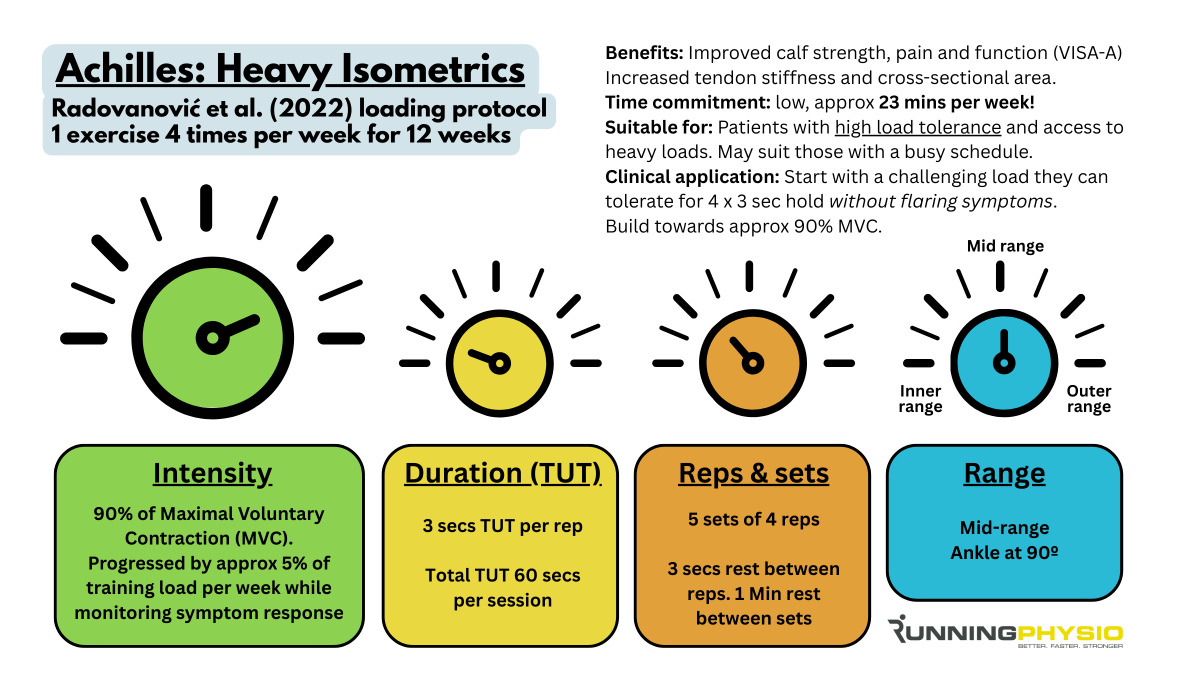
The heavy isometric programme for Achilles Tendinopathy from Radovanonić et al. (2022) has somewhat gone under the radar but has lots of potential benefits 💪
It’s just one exercise and takes less than 25 mins per week!
@theiaincameron Disgusting. People are so incredibly selfish. I drive over Pendle Hill every day to work and the amount of litter is a disgrace. #keepbritaintidy