Cuando Sting salió al escenario de Dire Straits en el concierto de Live Aid '85, muchos fans de la banda se dieron cuenta que el comienzo de Money For nothing estaba interpretado por él, algo que pasó desapercibido para muchos en la radiofórmula.
El riff ya es historia.
📢💣 Ojo al impresionante momento que se acaba de vivir durante la intervención arqueológica en un solar de La Albufereta (Alicante): el descubrimiento de una necrópolis ibérica (finales s. III a.C.) con un rico ajuar funerario que incluye un pebetero con la diosa Tanit 🧵👇
The Stunning Andromeda Galaxy captured above a mountain peak, glowing clearly in the night sky. This rare shot reveals our nearest major galaxy shining 2.5 million light-years away, perfectly aligned above the landscape — a breathtaking blend of Earth and the cosmos.😍
🐶🐂 Una amistad sin etiquetas que está conquistando el internet.
Dicen que los mejores amigos vienen en todas las formas y tamaños. 🐾🥹✨
Vía @infinitevideos2026
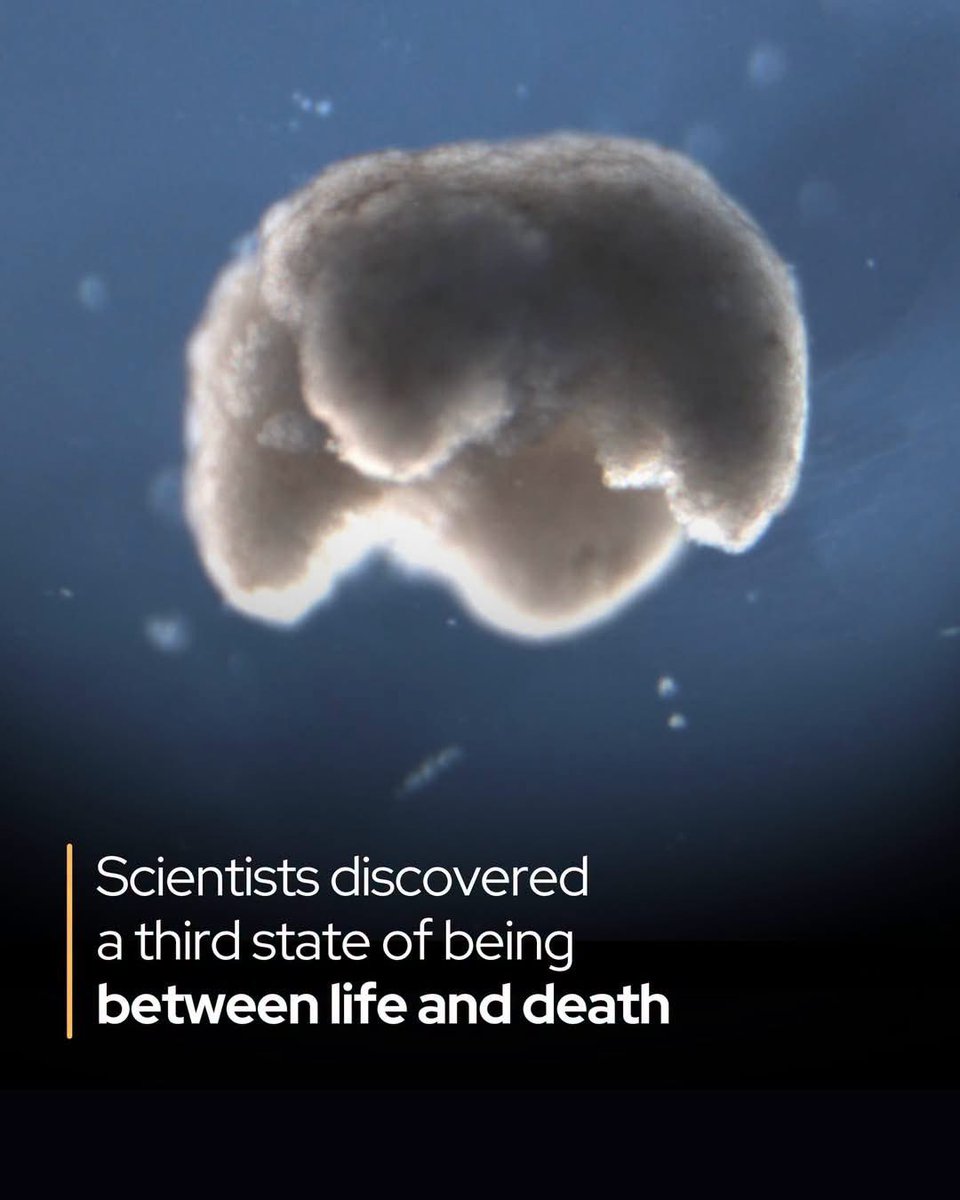
We’ve officially found a “third state” between life and death.
Some cells don’t die when we do. They adapt, reorganize, and sometimes rebuild.
Scientists have discovered that certain cells – when removed from a dead organism and given the right environment – can take on entirely new life. In some cases, they organize themselves into living, mobile structures with unique behaviors and functions. This state, researchers say, isn’t truly life or death. It’s something in between: a third state.
In one experiment, skin cells from a deceased frog embryo were placed in a petri dish. There, they spontaneously assembled into tiny organisms now called xenobots. Unlike ordinary cells, these structures could move on their own, heal damage, and even replicate – not through growth, but by shaping other cells into copies of themselves.
Later, scientists discovered similar behavior in human lung cells. These formed anthrobots – small blobs that navigated their surroundings and even helped repair nearby nerve cells.
This plasticity – the ability of cells to change identity and build new structures – suggests that even after organismal death, some cells retain not just function, but creative potential. And it’s raising new possibilities in regenerative medicine.
In the future, biobots could be designed to deliver drugs, clear arteries, or repair tissues – all built from a patient’s own cells. They degrade naturally within weeks and don't trigger immune rejection.
It’s a strange new frontier: one where death isn’t always the end and cells may still have more to do.
Learn more:
"Biobots arise from the cells of dead organisms − pushing the boundaries of life, death and medicine." The Conversation.
📸Credit: Douglas Blackiston
Una perra fue diagnosticada con depresión tras sufrir un aborto espontáneo, y los veterinarios decidieron que trabajar con niños en una escuela local le vendría bien. Nunca ha sido más feliz.
It's hard to imagine that the human body is made of nanotechnology, molecular robots, molecular computers, unpacking an adult from a grain of sand.
This is what technology a billion years beyond us looks like.