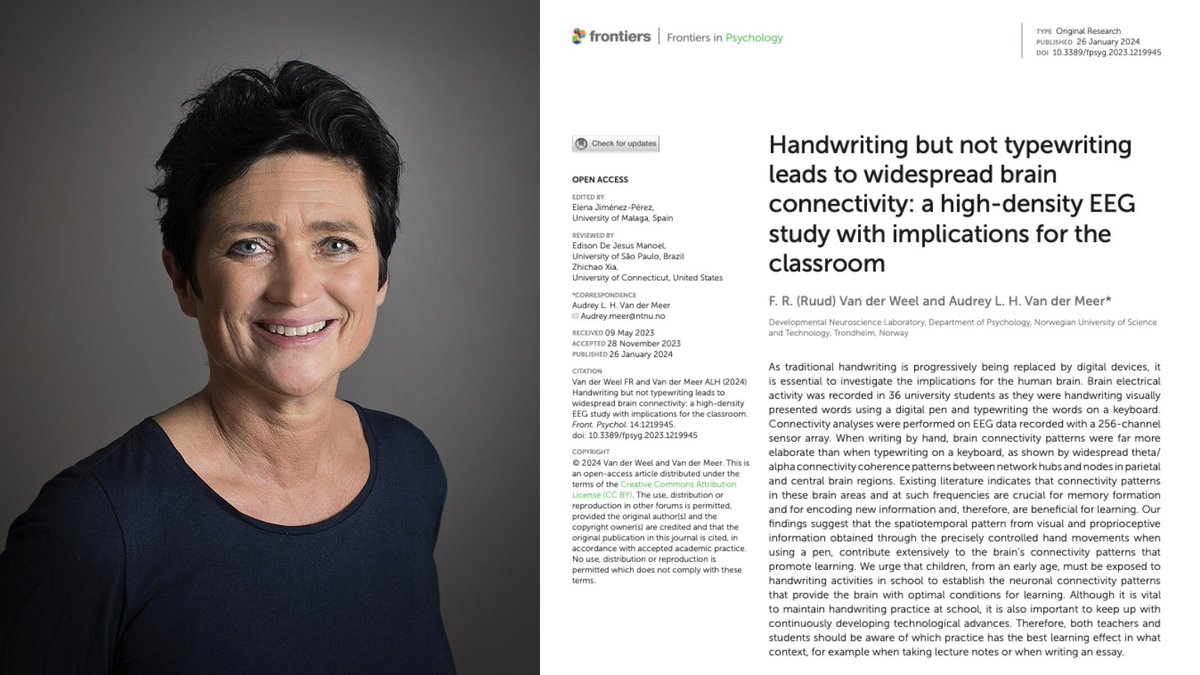
A Norwegian neuroscientist spent 20 years proving that the act of writing by hand changes the human brain in ways typing physically cannot, and almost nobody outside her field has read the paper.
Her name is Audrey van der Meer.
She runs a brain research lab in Trondheim, and the paper that closed the argument was published in 2024 in a journal called Frontiers in Psychology. The finding is brutal enough that it should have changed every classroom on Earth.
The experiment was simple. She recruited 36 university students and put each one in a cap with 256 sensors pressed against their scalp to record brain activity. Words flashed on a screen one at a time.
Sometimes the students wrote the word by hand on a touchscreen using a digital pen, and sometimes they typed the same word on a keyboard. Every neural response was recorded for the full five seconds the word stayed on screen.
Then her team looked at the part of the data most researchers had ignored for years, which is how different parts of the brain were communicating with each other during the task.
When the students wrote by hand, the brain lit up everywhere at once.
The regions responsible for memory, sensory integration, and the encoding of new information were all firing together in a coordinated pattern that spread across the entire cortex. The whole network was awake and connected.
When the same students typed the same word, that pattern collapsed almost completely.
Most of the brain went quiet, and the connections between regions that had been alive seconds earlier were nowhere to be found on the EEG.
Same word, same brain, same person, and two completely different neurological events.
The reason turned out to be something nobody had really paid attention to before her work. Writing by hand is not one motion but a sequence of thousands of tiny micro-movements coordinated with your eyes in real time, where each letter is a different shape that requires the brain to solve a slightly different spatial problem.
Your fingers, wrist, vision, and the parts of your brain that track position in space are all working together to produce one letter, then the next, then the next.
Typing throws all of that away. Every key on a keyboard requires the exact same finger motion regardless of which letter you are pressing, which means the brain has almost nothing to integrate and almost no problem to solve.
Van der Meer said it plainly in her interviews.
Pressing the same key with the same finger over and over does not stimulate the brain in any meaningful way, and she pointed out something that should scare every parent who handed their kid an iPad.
Children who learn to read and write on tablets often cannot tell letters like b and d apart, because they have never physically felt with their bodies what it takes to actually produce those letters on a page.
A decade before her, two researchers at Princeton ran the same fight using a completely different method and ended up at the same answer. Pam Mueller and Daniel Oppenheimer tested 327 students across three experiments, where half took notes on laptops with the internet disabled and half took notes by hand, before testing everyone on what they actually understood from the lectures they had watched.
The handwriting group won by a wide margin on every question that required real understanding rather than surface recall.
The reason was hiding in the transcripts of what the two groups had actually written down.
The laptop students typed almost word for word, capturing more total content but processing almost none of it as they went, while the handwriting students physically could not write fast enough to transcribe a lecture in real time, which forced them to listen carefully, decide what actually mattered, and put it in their own words on the page.
That single act of choosing what to keep was the learning itself, and the keyboard had quietly skipped the choosing and skipped the learning along with it.
Two studies. Two countries. Same answer.
Handwriting makes the brain work. Typing lets it coast.
Every note you have ever typed instead of written went into your brain through a thinner pipe. Every meeting, every book highlight, every idea you captured on your phone instead of on paper was processed at half depth.
You did not forget those things because your memory is bad. You forgot them because typing never woke the part of the brain that would have made them stick.
The fix is the thing your grandmother already knew.
Pick up a pen. Write the thing down. The slower road is the faster one.
Why does Mary look younger than Jesus in Michelangelo's Pietà?
The answer is one of the most beautiful in art history...
Mary is holding the body of her 33 year old son, but she looks 20. Critics noticed it the moment the sculpture was unveiled in 1499. The mother of a man who has just been crucified would have been in her late forties or early fifties. Michelangelo had carved her as a girl.
His own biographer, Ascanio Condivi, was the one who finally asked him why. The answer Michelangelo gave is preserved in Condivi's Life of Michelangelo and has been repeated for centuries: "Do you not know that chaste women stay fresh much more than those who are not chaste? How much more in the case of the Virgin, who had never experienced the least lascivious desire that might change her body?"
Most modern critics treat this answer as a half-serious deflection. Michelangelo was famous for his sharp tongue and refused to explain himself to people he considered beneath his intellect.
The deeper answer is older, and it lies inside one of the greatest poems ever written. In the final canto of Dante's Paradiso, Saint Bernard of Clairvaux begins his prayer to the Virgin with one of the most extraordinary lines in Italian literature:
"Vergine madre, figlia del tuo figlio."
"Virgin mother, daughter of your own son."
Michelangelo, who knew Dante by heart, was carving that line into stone. Mary is younger than Jesus because Jesus is older than the universe... because she gave birth to her own creator.
But there is another reading, simpler than either of those, and it is the one I find myself thinking of today. Every mother who has held her child has held them at every age at once. The infant is still inside the toddler. The toddler is still inside the teenager. The young man on her lap, even dead, is also the boy she nursed and the baby she first carried home.
And maybe that's why Michelangelo did not carve Mary as the years had aged her. He carved her as love had kept her: outside of time, outside of grief, holding her son the way she had always held him...
Happy Mother's Day.
-- -- --
If you enjoyed this, I write a weekly newsletter read by over 50,000 people who love rediscovering the beauty of the past. You can join us here:
https://t.co/hgJUdR0jlx
I write about beauty in all its forms. If you'd like to support my work, a paid subscription is what makes it possible.
With deep sadness, we share the passing of Michael Burawoy.
A towering figure in sociology, he shaped global debates & championed Public Sociology with passion.
His legacy lives on.
Read ESA’s full statement here: https://t.co/YjowFTE3Eo
In shock at the passing of Michael Burawoy. We owe him public sociology and a stronger global community of sociologists, for whom social inequalities are at the center of research and action. He will be greatly missed, but his memory will be eternal. ❤️ RIP
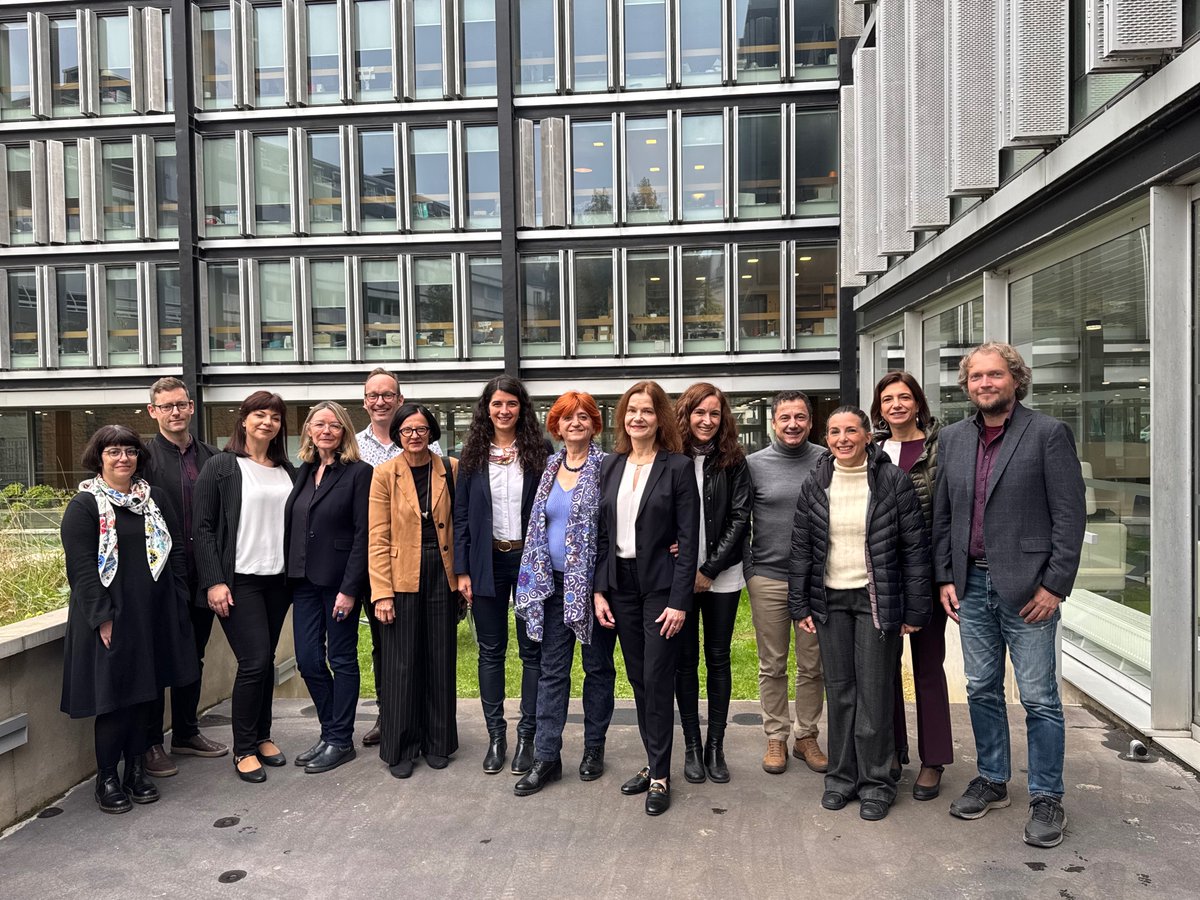
The newly elected Executive Committee of the @ESA_Sociology is currently convening in Paris.
With a commitment to innovation and collaboration, they are working to advance the association's initiatives and foster an inclusive, dynamic agenda for the future.
Did you know? 📺 The plenaries from the last ESA Conference
-12th Prague,
-13th Athens,
-14th Manchester,
-15th Barcelona,
-16th Porto
are now available on the ESA YouTube channel!
Watch them all here: https://t.co/xVFmaBraFF
#Sociology#Plenaries
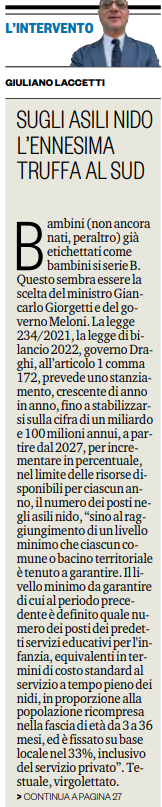
Il trucchetto di Giorgetti per togliere nidi al Sud. Per fortuna la notizia lanciata da @MeMeEsposito la stiamo rilanciando tutti.
Ne ho scritto qui: https://t.co/VqCwmY5AM1
Metto sotto anche un commento di Bruno Laccetti:
After a nursing home gets bought up by a private equity firm, the mortality rate for residents jumps up by 10% on average. Workers are laid off. Treatment and hygiene get worse.
Private equity kills. But it makes rich capitalist investors even richer.
https://t.co/64hpcdzCd5
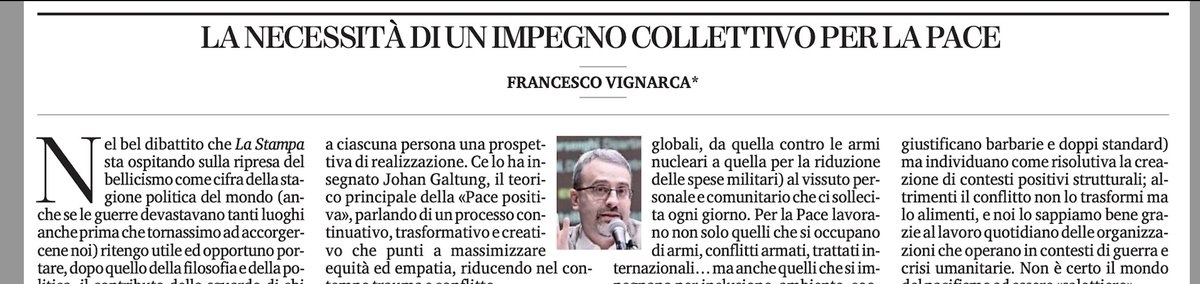
"Can science be a route to peace and common understanding? A glance at the history of one institution shows: only when scientists actively commit to it" by Roberto Lalli & Jaume Navarro
https://t.co/DyvNwpjXXy
📢 Announcing the newly elected ESA President and Executive Committee for 2024-26!
Congratulations to all the incoming leaders who will guide the European Sociological Association's future.
https://t.co/lq4Y2t3Wc1
It was a great day and evening for European Sociology. Full of emotions and memories, and moments to make new ones. Have a look at some pictures from the sessions, the social dinner, and party 29 Aug 24. #ESA2024#ESAPorto24"
🚨 The ESA 2024 Elections are open!
🗳️ Cast your vote by Thursday, August 29th, 2024, at 14:00 (CET).
View candidate details here: https://t.co/FjYLpMInx6
More information here: https://t.co/pw77cduFDl
The 16th ESA Porto Conference is approaching! Today the LOC was taking care of the last details. Very proud to join this great team of colleagues working for an exciting conference!
📢 The ESA Election is now open! 🗳️
Vote for your President and Executive Committee. Check your email for instructions and cast your vote anytime from now until August 29th at 14:00 CET.
🌟 #ESAElection2024#ESAPorto24
🚨 Final Programme for the 16th ESA Conference in Porto (Aug 27-30) is now available! Don't miss out on Plenaries, Semi-Plenaries, Research Sessions, and more. Check the full agenda here:
https://t.co/L2FoYXikhP
#ESA2024#ESAPorto24