Have you noticed that the system supposedly designed to serve the public often seems more interested in protecting itself?
My legal career has involved challenging governments, regulators, and powerful institutions. I can tell you firsthand: they do not like being challenged. The moment you question them, seek accountability, or expose failures, and are treated as an annoyance standing in the way of what they want to do.
I saw it representing landowners.
Now we have all seen it during and after the pandemic, where people harmed by government policies and C0ovid shots have often been abandoned, while those responsible continue to turn a blind eye.
For all the talk of compassion, transparency, and accountability, there seems to be very little interest in confronting uncomfortable truths or addressing the harms that occurred.
The pattern is always the same. Protect the institution. Protect the reputation. Protect the people in charge.
Meanwhile, politicians, bureaucrats, self-proclaimed experts, and publicly funded legacy media and advocacy groups all insist they are acting in the public interest.
Are they?
Just look around.
Public trust is collapsing. Services are declining. Costs keep rising. Accountability is nowhere to be found.
At some point, we have to stop judging people by what they say and start judging them by what they do.
So I’ll ask this:
Who do you actually trust? And what are you going to do about it?
When my husband died in late summer last year, my daughter and I didn't just lose him.
We lost more than half our household income overnight.
Suddenly, every dollar had a job. Every bill became a math problem.
Because my income dropped so dramatically, I became eligible for a GST rebate of about $435.
To some people, that might sound like a nice little bonus.
To people like me, trying to live on less than $27,000 a year, it's not spending money. It's survival money.
Where I live, water, garbage, and recycling cost me $520 every three months. Coincidentally, those bills arrive around the same time as the GST rebate.
So the GST cheque doesn't buy treats. It doesn't fund vacations. It doesn't even make life easier.
It mostly disappears into a utility bill before I can blink.
Today I'm sharing screenshots from my CRA account to demonstrate the federal government's latest affordability miracle with their renamed GST benefit masquerading as the Groceries and Essentials Benefit.
My GST rebate went up.
By six dollars.
Not sixty.
Not six hundred.
Six.
Apparently somewhere in Ottawa, somebody looked at the affordability crisis facing Canadians and thought:
"Hmm, needs more half sandwich."🤔
What makes this worse is knowing there are millions of Canadians out there who need help just as badly as I do, but don't qualify for a penny of it.
People working two jobs.
People trying to raise families.
Seniors watching every grocery bill climb higher.
People doing everything right and still falling behind.
So to @MarkJCarney, I have a simple question.
Why are you celebrating the existence of a Grocery and Essentials Benefit instead of asking why Canadians need one in the first place? How much did it cost taxpayers for the photo-op? Do you not see the hypocrisy in it?
Because that is the part I can't understand. A government should not be standing in a grocery store congratulating itself for handing back a few dollars of taxpayers' own money.
A government should be creating the conditions where people can afford groceries without government assistance.
The goal should be fewer Canadians needing benefits, not more!
I'm not proud to qualify for this.
👉🏻 I don't want to qualify for a government cheque.
👉🏻 I don't want to qualify for a renamed GST rebate.
👉🏻 I don't want my kid to qualify for a school lunch program because parents can no longer afford lunches.
I want an economy where ordinary Canadians can stand on their own feet and keep more of what they earn and be proud about it.
The fact that Ottawa felt the need to rename the GST rebate to include the words "Groceries and Essentials" should have set off alarm bells in every cabinet office in the country.
Because groceries and essentials are not luxuries. If Canadians need government assistance to afford the basics of life, that is not evidence of success.
It's evidence that something has gone very badly wrong.
What makes it even harder to stomach is watching a government talk about borrowing billions for new projects and sovereign wealth funds while ordinary Canadians are being told to celebrate an extra six dollars.
Six dollars!
That's not economic leadership.
That's a receipt. Perhaps the question Canadians should be asking is this:
If #MarkCarney's resume is as impressive as advertised, why do the results look like this?
At some point, Canadians stop listening to credentials and start looking at outcomes. And the outcomes are speaking for themselves!
So what exactly is the problem with letting citizens have a say?
Oh right.
Control. Power. Greed.
And it is no surprise who is paying for articles like these.
What I do not understand is how these people sleep at night. Is the money really worth it?
Is it worth undermining public debate?
Is it worth dismissing citizens?
Is it worth sacrificing the interests of future generations?
Is it worth trying to convince people that democratic participation is somehow dangerous?
Judging by the full-blown fear and disparagement campaign now underway, I think we are getting our answer.
So thank you for coming out and showing everyone exactly what you stand for.
BREAKING: a BC First Nation just put in writing, to the BC government, their threats:
✅ They will block the Island Highway
✅ They will block marine terminals
✅ They will block Seymour Narrows, the only cruise ship and shipping corridor through that section of coast
✅ They will block BC Hydro dams in the Campbell River watershed
They will do it all, unless the K’omoks treaty is paused.
In other words, infighting for a land claim.
As a reminder, the 2022 Convoy didn’t block hydro dams, critical infrastructure or shipping corridors.
Nor was a formal threat made to the government of civil disobedience.
The Emergencies Act was invoked anyway.
So which is it: Is the Emergencies Act a tool for actual blockades of critical infrastructure?
Or is it a tool for political enemies?
It is embarrassing that many of the so-called “leaders” in this country, including current and former elected officials, academics, and legacy media figures, have resorted to childish fearmongering and name-calling instead of engaging in serious discussions about serious issues.
What it really exposes is the remarkably unsophisticated level of public discourse coming from people who present themselves as informed, sophisticated, knowledgeable, or worthy of leadership.
I have said this many times before: I am tired of listening to those voices.
They are not sophisticated.
They are not knowledgeable.
And they are not leaders.
Just look at them. What have many of them actually built or accomplished outside of politics, public institutions, or media circles? Many obtained their positions through timing, connections, luck, political machinery, and with the public purse, only to turn around and disparage the very public that funded and elevated them. And now they expect ordinary citizens to treat them as intellectual or moral authorities while simultaneously being disrespected and disregarded.
No more.
I want to hear from people who actually matter.
From people who create.
From people who build.
From people who work hard in their communities without demanding attention or titles.
From people who solve problems instead of manufacturing fear.
From people grounded in reality, not ideology or self-preservation.
Because it is becoming increasingly obvious that the wisest and most thoughtful people are not the ones sitting behind podiums or television panels.
If they were, we would not be living through collapsing public trust, failing institutions, and levels of division between friends, families, and neighbours that many of us have never seen before.
Here is my response to a recent post claiming 5 reason why Alberta can’t be independent…
1. Landlocked. “Right now Canada guarantees pipelines”
I can’t believe after the last 20 year to you feel you can say that.
As an independent country, Alberta, through the UN law of the sea, is guaranteed access to tide water through negotiations with neighbouring countries. The US is no issue as 87%of Alberta’s trade goes south anyway, but yes we would have to negotiate with Canada. As in all negotiations a win win is the best outcome. If Canada does not want to allow our pipelines, you must remember that the port of Vancouver is connected to the rest of Canada by two rail lines and three major highways that now go through the independent Republic of Alberta. All of those pesky load permits, inspections, delays, quarantines, loss, theft etc would be a shame. Again, let’s ai m for a win win negotiation.
2. Economy, yes there would be a temporary downturn due to uncertainty but once we scrap the carbon pricing, do more to lower taxes for businesses and unleashed our innovation we will thrive.
3. Debt. Yes we will take on our portion of federal debt, about $120 billion depending on whose estimate we use, just as we will take our portion of the CPP. Currently Alberta sends $68 billion to Ottawa in the form of personal and corporate income taxes and GST. That is $68 billion we now get to put to work paying for the Federal services we have to backfill and go against the $120 billion Canadian debt. Realistically we could pay it off in ten years. When will your portion of Canada’s debt be paid for??
4. Oil harder to sell. As mentioned earlier about 87% of our trade goes north south and oil and gas only make up about 22% of Alberta’s GDP. Nations around the world negotiate trade deals every day. Alberta will not be breaking new ground by negotiating trade deals with whom we please.
5. Higher cost of services. Possibly a bit but our taxes would go down as we no longer send $68 billion to Ottawa. Alberta already has an attractive business environment and it will be even more so once independent because it is not only citizens that no longer have to pay Ottawa income taxes but business as well will no longer have to pay federal taxes. Ask any business if they would prefer not to collect GST for Ottawa.
6. A few bonus statistics for you…
If Alberta were an independent country, it would…
• have more land mass than 70% of all other nations.
• have more farmland than about 85% of all other nations.
• have a population larger than 45% of all other nations.
• have more resources than 95% of all other nations.
• have a nominal GDP larger than 82% of all other nations.
• have a larger GDP per capita than 90% of all other nations.
• have a lower crime rate than 70% of all other nations.
• have a higher education level than 85% of all other nations.
• be more diverse than 70% of all other nations.
We would be a powerhouse!
We are no longer content with being serfs in a system of systemic discrimination.
A judge ruled Alberta can't ask Albertans a question, not until First Nations are consulted on whether the question can even be asked.
A judge ruled Ontario can't clear a homeless encampment because homelessness is now a Charter protected characteristic, like race or sex.
Judges across Canada are reducing sentences for foreign criminals so they don't get deported.
The Alberta & Ontario judge: BOTH Liberal appointees under Justice Minister David Lametti.
CANADA IS BEING GOVERNED BY OUR COURTS.
By people no one elected.
"Did they vote for this in the last provincial election? No, they didn't."
That line from @MarkJCarney deserves to be framed and hung on a wall somewhere, preferably over the entrance to the "National Museum of Political Nerve & Hypocrisy."
Because now I have questions.
⁉️ Did Canadians vote for #Carney to pivot Canada toward a more European economic and defence model?
🙅🏼♀️ No, they did not.
⁉️ Did they vote for him to start loosening Canada from its most important trading relationship with the United States after campaigning as the only adult in the room who could handle Trump?
🙅🏼♀️ No, they did not!
⁉️ Did they vote for new strategic partnerships with China?
🙅🏼♀️ No, they did not!
⁉️ Did they vote for a revived industrial carbon pricing regime and carbon markets dressed up as competitiveness?
🙅🏼♀️ No, they did not!!
⁉️ Did they vote for "no Pathways, no pipeline" as national energy policy?
🙅🏼♀️ NO, THEY DID NOT!
Apparently #democracy only requires itemized voter consent when #Albertans want to ask an #Alberta question.
When #Ottawa changes the direction of the country after election day, they call it leadership.
When citizens want a direct say on the future of their own province, suddenly it is reckless, divisive and dangerous. Does this clown pretending to lead FOR Canadians even hear himself?
People asking people what people think.
Terrifying stuff.
#cdnpoli #CarneyIsALyingHypocrite #WesternAlienation
https://t.co/DN2vTrQnhL
Why dear Liza, I was locked up. I was also shackled, strip searched, spent time in solitary confinement, denied bail, and banned from social media, seeing my friends, and the entire province of Ontario. Following those adventures, I then endured the longest mischief trial of all time, and am now locked up again. If this is still unsatisfactory to you I am happy to go on. What I’ve described above is the tippy top of this Lawfare Iceberg.
Thanks so much for your engagement and for your follow! Money earned from this platform through monetization is going towards my legal fees and every cent helps. I appreciate you! 🙏🏼
Dear fellow Albertans.
The deadline to file your 2025 tax return was April 30, 2026, almost a month ago. By now you should have all received your Notice of Assessment from the CRA.
Go look at line 42000 "Net federal tax"
That the amount of taxes you paid to Ottawa in 2025. For most people, it's about twice as much as what they pay to the provincial government in Edmonton.
Now answer this question honestly.
What value did the CArney Liberals provide for your hard-earned tax dollars?
A proud Canadian military?
A secure border?
Efficient courts?
Low inflation?
A competent RCMP?
Safer streets?
Affordable food?
Watching the drama unfold around the referendum discussion is, to me, just so incredibly silly.
I cannot believe we are at a point where we are seriously entertaining theatrics about whether citizens should even be allowed to pose a question, instead of having mature discussions about what the question actually means, the potential consequences, the legal realities, the risks, the benefits, and the broader future of the province and country.
That is what democracy is supposed to be.
Not fear of discussion.
Not attempts to shut conversations down before they even happen.
Not treating citizens like they are incapable of hearing ideas, thinking critically, and making decisions for themselves.
A referendum question is not automatic implementation. It is a mechanism to gauge public support and force public discussion on an issue of significant importance. Democracies should not be afraid of asking questions. If anything, they should be afraid of preventing them.
If people believe an idea is flawed, unrealistic, harmful, or unsupported, then make the argument. Present the evidence. Debate the issue openly and honestly. Trust citizens enough to engage with the substance instead of trying to suppress the conversation itself.
Because once a society becomes more concerned with controlling what questions can be asked than debating the answers, we are moving in a very dangerous direction.
When will we turn things back right side up in this upside down world?
Let me read you something written in 1947.
Not as history. As a mirror.
The Nuremberg Code states that the person involved should have legal capacity to give consent and that consent must be given freely, without the intervention of any element of force, fraud, deceit, duress, overreaching, or other ulterior form of constraint or coercion.
Every single word of that sentence was violated during the COVID pandemic.
Force — lose your job if you refuse.
Fraud — safe and effective, fully tested, cannot spread it if you take it.
Deceit — emergency authorisation presented as full approval, risks buried, data suppressed.
Duress — no jab, no participation in society.
Overreaching — governments, employers, schools, airlines, hospitals all weaponised simultaneously.
Coercion — your children cannot attend school. Your elderly parent cannot receive visitors. Your career is over.
This was not a grey area.
This was not a difficult ethical question requiring careful nuance.
This was a textbook, point by point, systematic violation of the most fundamental informed consent framework the civilised world ever produced, written specifically to ensure that what was done to human beings by those in positions of power and authority would never happen again.
It happened again.
On a global scale. With the full participation of governments, medical institutions, media organisations, and technology platforms working in a coordination that the architects of the Nuremberg Code could not have imagined.
The code is not decorative. It is not a historical artefact to be cited in academic papers and then quietly set aside when inconvenient.
It is law. It is principle. It is the line that was drawn in the blood of those who suffered so that future generations would be protected.
That line was crossed.
And every person who crossed it, every official, every mandate writer, every doctor who coerced a patient, every employer who threatened a worker, every institution that made participation conditional on injection must be held to the standard of the code they violated.
Not eventually.
Now.
Not food-related post.
This is likely one of the most sickening things I’ve seen the CBC do. Read the story below. ⬇️
One of the RCMP officers pranked by the CBC is a personal friend.
I can’t believe a Crown corporation, funded by the Canadian public, would do something like this to people who served our country for decades, only to humiliate them.
It is profoundly disturbing to watch you and your party advocate for silencing citizens who participated in a lawful democratic process simply because you disagree with the issue being raised.
It is literally your job to listen to citizens, especially when they are using the very democratic processes established by law to have their voices heard.
This is not even about debating the pros and cons of independence. This is about an organized effort by elected officials to silence citizens from participating in a lawful democratic process, and that should concern everyone.
You do not have to support independence to recognize how dangerous that is. Once governments, political actors, and courts begin deciding which citizen-led issues are acceptable to discuss, democratic participation stops being a right and becomes a permission granted by those in power.
Today it is this petition. Tomorrow it could be any issue the political class finds inconvenient.
Citizens do not hold institutional power. Their voice is their power. And when lawful democratic processes are undermined to prevent citizens from even being heard, public trust in democracy itself begins to collapse.
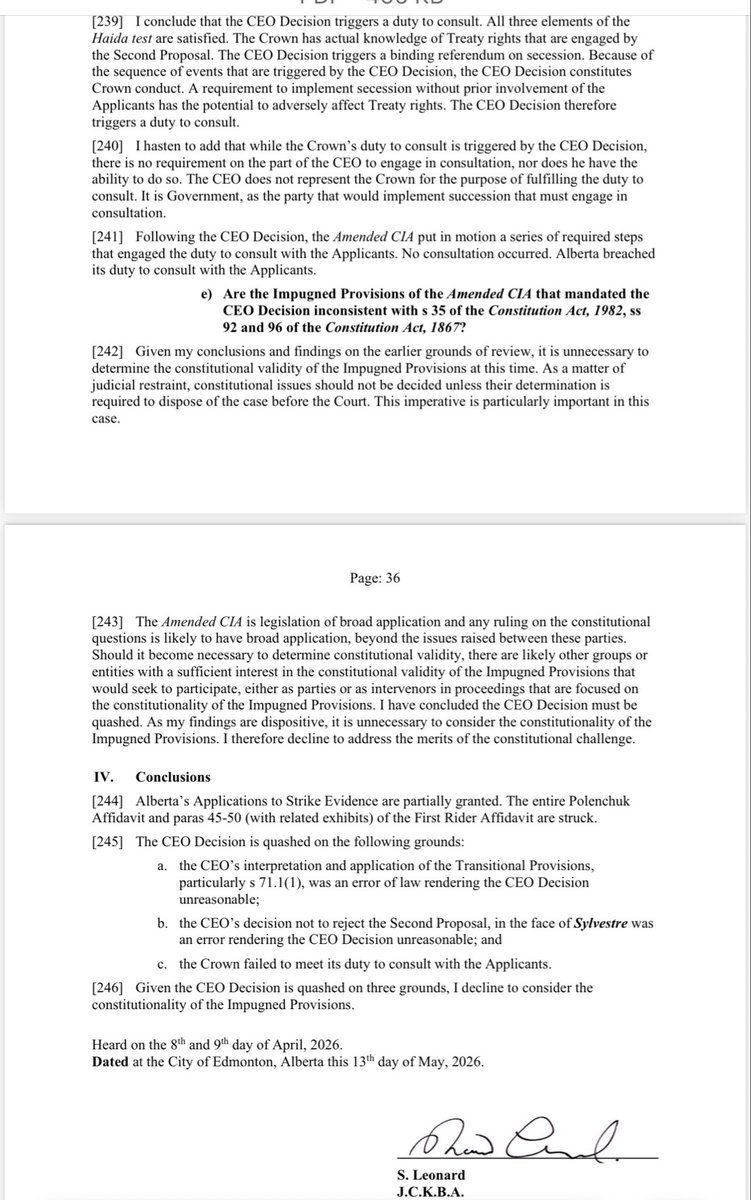
Today’s ruling by Justice Leonard essentially found that the citizen-led independence petition process cannot proceed because the government did not fulfill certain constitutional responsibilities owed to First Nations.
But here is the important point: the Alberta government did not initiate this petition process. Citizens did, through a lawful statutory mechanism created by the Legislature itself. So how does a court conclude that the government failed to fulfill duties that had not yet even arisen or been carried out, particularly when the government itself had not initiated the referendum process?
It is also important to understand that the Alberta government has always had the ability to call a referendum on independence at any time if it chose to do so. That is not in dispute, and it was not the legal question before the Court in this case. Nothing in today’s ruling prevents the Alberta government from calling the very same referendum itself tomorrow.
So think about that carefully.
A citizen-led democratic process established by law is effectively halted, not because citizens failed to follow the legislated process, but because of obligations assigned to government itself. Yet the government retains the full ability to ask the same question directly.
Courts and those in government must always have regard to the overall interests of justice, including democratic participation, the integrity of legislated statutory processes, and public confidence in lawful democratic frameworks established by the Legislature.
I figured it would be appropriate to reflect on a few words from the Supreme Court of Canada:
“…liberal democracy demands the free expression of political opinion” and political speech lies at the core of the Charter’s guarantee of freedom of expression. The Court further affirmed that freedom of expression includes “the right to attempt to persuade through peaceful interchange.” — Harper v. Canada
The Supreme Court of Canada has also held that:
“…the right of each citizen to participate in the political life of the country is one that is of fundamental importance in a free and democratic society.” — Figueroa v. Canada
And in the Reference re Secession of Quebec, the Supreme Court of Canada recognized that democracy is grounded in the participation and democratic will of the people, and that a clear expression of the will of citizens carries constitutional and political significance that cannot simply be ignored. Specifically, the Court confirmed:
“The democratic principle identified above would demand that considerable weight be given to a clear expression by the people of Quebec of their will to secede from Canada…” — Reference re Secession of Quebec
So how does any of this truly reconcile with a situation where government itself can ask citizens a question through a referendum process, but a group of citizens following a lawful statutory process established by the Legislature is not permitted to ask the question?
What message does that send when citizens engage in lawful democratic participation, comply with the very process created by government, and yet their voices are disregarded or treated as something to be feared?
Democracy is not strengthened when lawful citizen participation is restrained or silenced. In this case, it was not government stopping the process, but the Court. That reality raises profound questions about the role institutions play in democratic participation and how citizen engagement is treated when it touches controversial political issues.
After all, citizens do not hold institutional power. Their power is their voice. And if even that voice can be restrained after citizens lawfully engage in the exact democratic process created for them, what meaningful role are citizens truly left with in shaping the political future of their province and country?
What do you think? Should lawful citizen participation be encouraged, even when institutions disagree with the message?
Unemployment in today’s Canada.
My experience.
It’s a big read but please read it through.
For three years, I helped care for my father while continuing to work full-time.
I even moved next door to him so I could better support him as his health declined.
I cared for him until he died.
Later, while still employed, I went through six months of breast cancer treatment myself.
Pretending those experiences didn’t affect my career would be dishonest.
What nobody tells you about employment instability is how cumulative it becomes.
Caregiving impacts careers even when you stay employed.
Illness impacts careers even when you keep showing up.
You can still be working while slowly losing professional momentum underneath you.
During unemployment, I applied for 65 jobs.
Government. Communications. Non-profit. Administrative. Retail. Hospitality.
Not one offer.
At one point, after years in senior advisory and executive communications roles, I applied at Starbucks.
I didn’t get the job.
That experience stayed with me.
Not because service work is beneath me — some of the hardest jobs I ever had were in restaurants and hospitality when I was younger.
But because the economy had somehow decided I was simultaneously overqualified and unemployable.
At 44 years old, after years spent working in government and public affairs, there were moments I genuinely started wondering whether I had anything left to contribute professionally.
That’s what prolonged unemployment does to people psychologically.
The hardest part of unemployment wasn’t only financial.
It was psychological.
Watching previous accomplishments stop mattering.
Trying to explain résumé gaps without sounding damaged.
Feeling your professional identity slowly erode in real time.
In April 2026, Canada’s unemployment rate climbed to 6.9%.
Behind those numbers are people whose lives became complicated.
Caregivers.
People managing chronic illness.
Cancer survivors.
People navigating grief, burnout, disability, aging parents, or health crises while trying to maintain careers at the same time.
Governments still talk about unemployment mostly through statistics.
But people experience the economy emotionally.
Through rejection emails.
Through grocery bills.
Through rent increases.
Through the quiet panic of realizing there’s very little room left in modern life for interruption.
The labour market increasingly rewards uninterrupted stability.
Perfect timelines.
Continuous productivity.
No visible complications.
But real life does not work that way anymore.
Parents age.
People get sick.
Caregiving responsibilities consume years
.
Disabilities emerge.
Mental health deteriorates.
And increasingly Canadians are expected to absorb those pressures privately while continuing to perform professionally as though nothing has changed.
There’s a growing class of Canadians who did everything they were told to do. I certainly did.
Built careers
Paid taxes.
Earned degrees.
Contributed to institutions.
Then life interrupted the plan.
And the system suddenly became much less patient with them.
This is why affordability and unemployment cannot be separated politically.
When the cost of living keeps climbing, employment instability becomes terrifying.
One interruption can destabilize everything.
I have a job again now and I am grateful for that.
But the experience changed how I see work, government, and the economy.
A lot more Canadians are hanging on by a thread than our politics currently acknowledges.
Carbon pricing?
No venture which is premised on the anti-scientific myth of anthropogenic catastrophic climate change and carbon dioxide as a "pollutant" can ever hope to succeed.
Danielle, the only way forward for Alberta is to totally abjure the false pseudo-religion of "climate change" and embrace reality, logic, and good sense instead.