Absolutely masterful interview on Gaza of Dominique De Villepin, former Prime Minister of France, who famously led France's opposition to the Iraq war and who, IMHO is the best diplomat the West has produced in decades.
This is so important, so incredibly well argued, that I decided to translate it in full:
"Hamas has set a trap for us, and this trap is one of maximum horror, of maximum cruelty. And so there's a risk of an escalation in militarism, of more military interventions, as if we could with armies solve a problem as serious as the Palestinian question.
There's also a second major trap, which is that of Occidentalism. We find ourselves trapped, with Israel, in this western bloc which today is being challenged by most of the international community.
[Presenter: What is Occidentalism?]
Occidentalism is the idea that the West, which for 5 centuries managed the world's affairs, will be able to quietly continue to do so. And we can clearly see, even in the debates of the French political class, that there is the idea that, faced with what is currently happening in the Middle East, we must continue the fight even more, towards what might resemble a religious or a civilizational war. That is to say, to isolate ourselves even more on the international stage.
This is not the way, especially since there's a third trap, which is that of moralism. And here we have in a way the proof, through what is happening in Ukraine and what is happening in the Middle East, of this double standard that is denounced everywhere in the world, including in recent weeks when I travel to Africa, the Middle East, or Latin America. The criticism is always the same: look at how civilian populations are treated in Gaza, you denounce what happened in Ukraine, and you are very timid in the face of the tragedy unfolding in Gaza.
Consider international law, the second criticism that is made by the global south. We sanction Russia when it aggresses Ukraine, we sanction Russia when it doesn't respect the resolutions of the United Nations, and it's been 70 years that the resolutions of the United Nations have been voted in vain and that Israel doesn't respect them.
[Presenter: Do you believe that the Westerners are currently guilty of hubris?]
Westerners must open their eyes to the extent of the historical drama unfolding before us to find the right answers.
[Presenter: What is the historical drama? I mean, we're talking about the tragedy of October 7th first and foremost, right?]
Of course, there are these horrors happening, but the way to respond to them is crucial. Are we going to kill the future by finding the wrong answers...
[Presenter: Kill the future?]
Kill the future, yes! Why?
[Presenter: But who is killing whom?]
You are in a game of causes and effects. Faced with the tragedy of history, one cannot take this 'chain of causality' analytical grid, simply because if you do you can't escape from it. Once we understand that there is a trap, once we realize that behind this trap there has also been a change in the Middle East regarding the Palestinian issue... The situation today is profoundly different [from what it was in the past]. The Palestinian cause was a political and secular cause. Today we are faced with an Islamist cause, led by Hamas. Obviously, this kind of cause is absolute and allows no form of negotiation. On the Israeli side, there has also been a development. Zionism was secular and political, championed by Theodor Herzl in the late 19th century. It has largely become messianic, biblical today. This means that they too do not want to compromise, and everything that the far-right Israeli government does, continuing to encourage colonization, obviously makes things worse, including since October 7th. So in this context, understand that we are already in this region facing a problem that seems profoundly insoluble.
Added to this is the hardening of states. Diplomatically, look at the statements of the King of Jordan, they are not the same as six months ago. Look at the statements of Erdogan in Turkey.
[Presenter: Precisely, these are extremely harsh statements...]
Extremely worrying. Why? Because if the Palestinian cause, the Palestinian issue, hasn't been brought to the forefront, hasn't been put on stage [for a while], and if most of the youth today in Europe have often never even heard of it, it remains for the Arab peoples the mother of all battles. All the progress made towards an attempt to stabilize the Middle East, where one could believe...
[Presenter: Yes, but whose fault is it? I have a hard time following you, is it Hamas's fault?]
But Ms. Malherbe, I am trained as a diplomat. The question of fault will be addressed by historians and philosophers.
[Presenter: But you can't remain neutral, it's difficult, it's complicated, isn't it?]
I am not neutral, I am in action. I am simply telling you that every day that passes, we can ensure that this horrific cycle stops... that's why I speak of a trap and that's why it's so important to know what response we are going to give. We stand alone before history today. And we do not treat this new world the way we currently do, knowing that today we are no longer in a position of strength, we are not able to manage on our own, as the world's policemen.
[Presenter: So what do we do?]
Exactly, what should we do? This is where it is essential not to cut off anyone on the international stage.
[Presenter: Including the Russians?]
Everyone.
[Presenter: Everyone? Should we ask the Russians for help?]
I'm not saying we should ask the Russians for help. I'm saying: if the Russians can contribute by calming some factions in this region, then it will be a step in the right direction.
[Presenter: How can we proportionally respond to barbarism? It's no longer army against army.]
But listen, Appolline de Malherbe, the civilian populations that are dying in Gaza, don't they exist? So because horror was committed on one side, horror must be committed on the other?
[Presenter: Do we indeed need to equate the two?]
No, it's you who are doing that. I'm not saying I equate the faults. I try to take into account what a large part of humanity thinks. There is certainly a realistic objective to pursue, which is to eradicate the Hamas leaders who committed this horror. And not to confuse the Palestinians with Hamas, that's a realistic goal.
The second thing is a targeted response. Let's define realistic political objectives. And the third thing is a combined response. Because there is no effective use of force without a political strategy. We are not in 1973 or in 1967. There are things no army in the world knows how to do, which is to win in an asymmetrical battle against terrorists. The war on terror has never been won anywhere. And it instead triggers extremely dramatic misdeeds, cycles, and escalations. If America lost in Afghanistan, if America lost in Iraq, if we lost in the Sahel, it's because it's a battle that can't be won simply, it's not like you have a hammer that strikes a nail and the problem is solved. So we need to mobilize the international community, get out of this Western entrapment in which we are.
[Presenter: But when Emmanuel Macron talks about an international coalition…]
Yes, and what was the response?
[Presenter: None.]
Exactly. We need a political perspective, and this is challenging because the two-state solution has been removed from the Israeli political and diplomatic program. Israel needs to understand that for a country with a territory of 20,000 square kilometers, a population of 9 million inhabitants, facing 1.5 billion people... Peoples have never forgotten that the Palestinian cause and the injustice done to the Palestinians was a significant source of mobilization. We must consider this situation, and I believe it is essential to help Israel, to guide... some say impose, but I think it's better to convince, to move in this direction. The challenge is that there is no interlocutor today, neither on the Israeli side nor the Palestinian side. We need to bring out interlocutors.
[Presenter: It's not for us to choose who will be the leaders of Palestine.]
The Israeli policy over recent years did not necessarily want to cultivate a Palestinian leadership... Many are in prison, and Israel's interest - because I repeat: it was not in their program or in Israel's interest at the time, or so they thought - was instead to divide the Palestinians and ensure that the Palestinian question fades. This Palestinian question will not fade. And so we must address it and find an answer. This is where we need courage. The use of force is a dead end. The moral condemnation of what Hamas did - and there's no "but" in my words regarding the moral condemnation of this horror - must not prevent us from moving forward politically and diplomatically in an enlightened manner. The law of retaliation is a never-ending cycle.
[Presenter: The "eye for an eye, tooth for tooth".]
Yes. That's why the political response must be defended by us. Israel has a right to self-defense, but this right cannot be indiscriminate vengeance. And there cannot be collective responsibility of the Palestinian people for the actions of a terrorist minority from Hamas.
When you get into this cycle of finding faults, one side's memories clash with the other's. Some will juxtapose Israel's memories with the memories of the Nakba, the 1948 catastrophe, which is a disaster that the Palestinians still experience every day. So you can't break these cycles. We must have the strength, of course, to understand and denounce what happened, and from this standpoint, there's no doubt about our position. But we must also have the courage, and that's what diplomacy is... diplomacy is about being able to believe that there is light at the end of the tunnel. And that's the cunning of history; when you're at the bottom, something can happen that gives hope. After the 1973 war, who would have thought that before the end of the decade, Egypt would sign a peace treaty with Israel?
The debate shouldn't be about rhetoric or word choice. The debate today is about action; we must act. And when you think about action, there are two options. Either it's war, war, war. Or it's about trying to move towards peace, and I'll say it again, it's in Israel's interest. It's in Israel's interest!"
Terrorism and extremism do not help to reach a solution to the conflict between Israelis and Palestinians, but fuel hatred, violence, revenge, and only cause each to other suffer. The Middle East need a peace built on dialogue and the courage of fraternity.
Without forgiveness there is no hope; without forgiveness there is no peace. Forgiveness is the oxygen that purifies the air of hatred; it is the antidote to the poisons of resentment; it is the way to defuse anger and heal so many maladies of the heart. #GospelOfToday
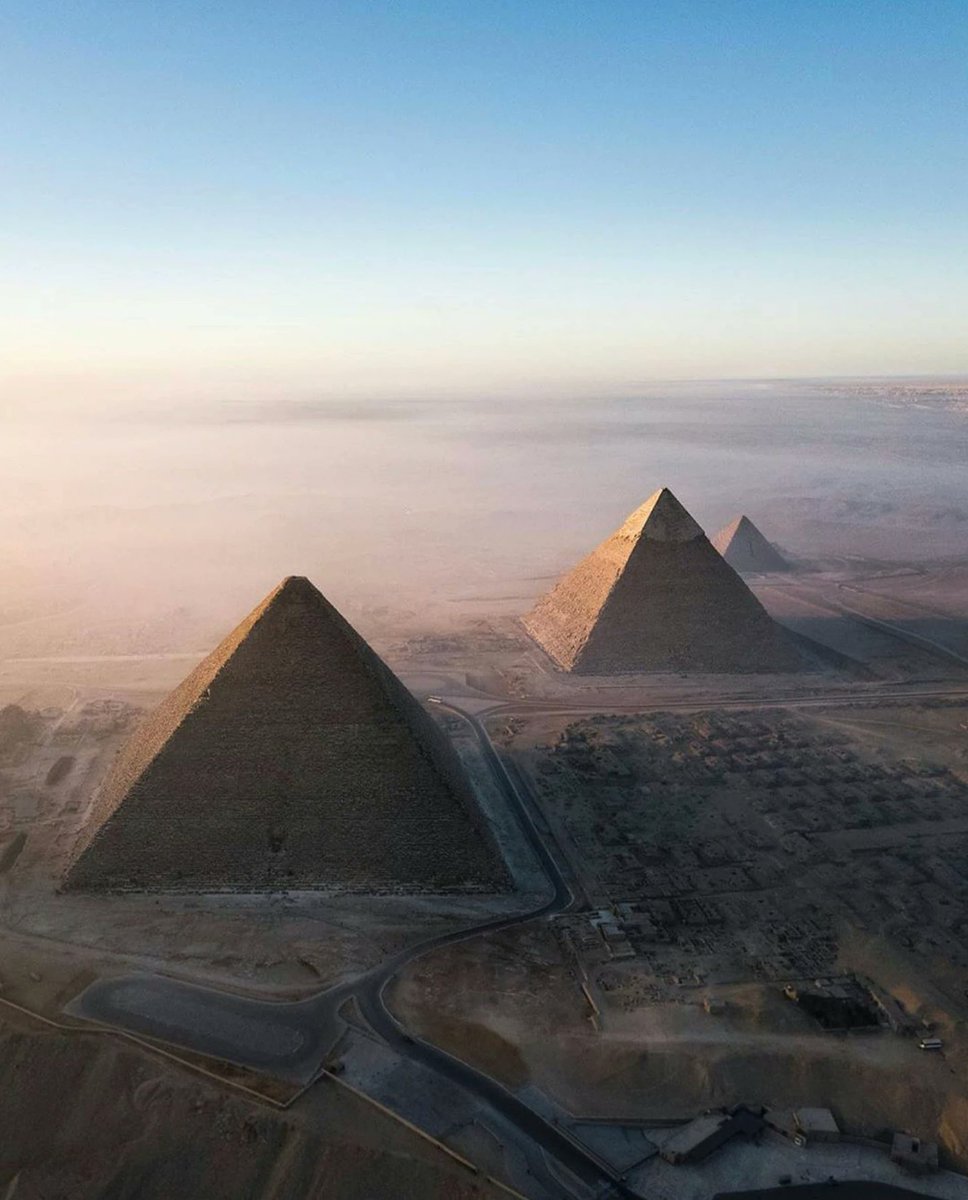
We're so used to seeing and hearing about the pyramids that it's easy to forget how strange and extraordinary they really are.
So, just to remind you:
When woolly mammoths went extinct the Pyramids of Giza were already more than 500 years old.
Cleopatra and Julius Caesar are closer in time to the present day — to the Burj Khalifa — than to the construction of the Pyramids of Giza.
Where are they and who built them?
There are three pyramids on the Giza Plateau, which is on the west bank of the River Nile, in northern Egypt. They aren't far from Memphis, which was the capital of Ancient Egypt when they were constructed.
The largest and oldest was built in less than thirty years around 2570 BC for the Pharaoh Khufu. The second was built for Khufu's son, Khafre, and is only a few metres shorter. The third and smallest was then built for Menkaure, Khafre's son. Three monumental tombs for three generations of the same family.
Nearby are many more tombs for various members of the royal court, the Sphinx, several more temples, and the remains of a sort of workers' town including houses, workshops, bakeries, kitchens, breweries, a hospital, and a necropolis.
Khufu's Pyramid, known as the Great Pyramid, was the tallest building in the world for over 3,800 years — that is, until the spire of Lincoln Cathedral in England was constructed in 1311.
And at more than 6 million tonnes it was the heaviest manmade structure ever built, and is still third behind only the Great Wall of China and the Three Gorges Dam.
The mortar used in constructing the Great Pyramid alone weighs over half a million tons, which is more than the total weight of the Burj Khalifa.
See, the Great Pyramid is almost entirely solid — there are only a few narrow shafts and three small chambers inside. It was largely built from huge blocks of local Giza limestone, although its exterior was once covered in polished white limestone transported there from nearby Tura, and its interior includes blocks of granite weighing up to 80 tonnes transported from Aswan, over 500 miles away.
The *precision* of the pyramids is also remarkable. On a technical level their masonry is astonishingly accurate, but even more amazing is that the four sides of the Great Pyramid are all almost exactly the same length — they have a variation of no more than 60 millimetres.
Not to forget that all three pyramids are aligned according to the points of the compass — within one tenth of a degree of perfect geographical accuracy.
And if these facts weren't impressive enough, the actual construction of the pyramids — the specifics of how the blocks were quarried, transported, and lifted into place — remains a marvel we have yet to fully understand.
But those are merely the facts of the Pyramids of Giza; perhaps more interesting is what they really mean.
After all, you can learn a lot about any society from its architecture. What we say about ourselves can rarely be trusted — but what we do and what we leave behind is always truthful. In other words, that which we build expresses our priorities, how our society works, and who has the most power.
Think of it this way: what are the biggest buildings in the modern world?
By volume it is factories (the Boeing Everett Factory is number one right now) and distribution centres.
By total floor space it is airports and malls.
By height it is mixed-used skyscrapers, though they are usually dominated by offices, especially relating to finance. The Pentagon was the world's largest office building until this year; it has been overtaken by the Surat Diamond Bourse in India.
By capacity? Well, there are sports stadiums, the biggest of which is the Narendra Modi Stadium in India, with an official capacity of 132,000. That being said, no single complex can hold a greater number of people than the Masjid al-Haram in Mecca, which has a capacity of 4 million.
So the largest buildings in the 21st century are almost all related to industry, finance, retail, transport, and leisure — with religious worship something of an outlier. This is a technologically advanced, industrial, highly consumerist society in which businesses hold a great deal of power, and in which the wants and demands of the public are very important.
For comparison, during the Middle Ages nothing came remotely close to cathedrals in size or complexity, though castles and fortresses were also far bigger than everything else. We can draw the basic conclusion that religion was of immense and central importance, that the church as an institution was very wealthy, and that power was actually spread out among the hereditary nobility rather than being entirely concentrated in the monarch alone, not to mention the political and spiritual power also held by the church.
So, what about the Pyramids?
The Ancient Greek historian Herodotus remarked that the Pyramids of Giza were proof of how tyrannical a ruler Khufu — or Cheops, as the Greeks called him — must have been. In his native Greece the largest buildings were temples for public worship; the Great Pyramid was a monument to but one man alone, and this shocked Herodotus.
The biggest buildings of the 21st century are all useful. They have a clear and immediate purpose, and usually one which benefits — in some sense — lots of people. A factory produces things we all use, a distribution centre organises our online shopping, an office is a place of work, and a stadium is where we go for entertainment. Our largest buildings are intimately and inseparably related to employment and consumption.
What about the Pyramids? They were tombs for the Pharaohs and they were supposed to last forever. In other words, they had no immediate use or purpose, at least for the living. They served only one person: the Pharaoh — plus his family and closest supporters, though they were buried nearby rather than inside — in his journey through the Afterlife.
So this is not the same as a large and lavish royal or presidential palace; such buildings are designed to be used as a seat of power and administration — by several succeeding generations or leaders.
Meanwhile, all the resources and labour that went into building the Pyramids, which were literally manmade mountains, were for the benefit of one Pharaoh alone, after his life had ended — and, to a lesser extent, those lucky enough to have been buried nearby at the time.
Does that mean Khufu and his descendants were tyrants? In some sense, yes. But there is evidence that those who built the Pyramids were not, as Herodotus thought, slaves, and were instead closer to conscripted workers and freely employed craftsmen who were fairly remunerated for their labour.
See, it wasn't just that Khufu held total political power; he was also the spiritual leader of his subjects, such that their work was fundamentally religious in nature — it might have even helped them achieve a better afterlife.
There was nobody who could refuse Khufu's desire to build the largest tomb in human history, because he was a divinely appointed intermediary between gods and humans; no regulation to stop him, because his will was the law; no limits to his expenditure, because he collected the taxes and owned all the land in the kingdom.
However powerful the world's richest and most influential people might now seem, none of it compares to the power wielded by Pharaohs like Khufu; a power that was political, financial, legal, military, and spiritual — absolute.
And so the Pyramids are a glimpse into a society fundamentally and almost irreconcilably different from that in which we now live, to the earliest epochs of human civilisation, long before democracy and the rule of law, when one man could rule as a god and have mountains built to serve as his personal, eternal monument on earth.
@ayagica Kalagot. If only naay daghan campaign against human trafficking mo tuo pa ko pero kung sa immigration lang pirmi mag dakop that’s not a very productive way pa hassle lang
🤡😡🤮. Reminds me also of something I read recently of a person who missed their flight because the immigration line was moving slow and the commenters were saying that you should be in airport 6hrs before your flight. Wake up Pinoys that’s not normal. You deserve better.
Mabuti kinuha ng state of the nation GMA 7 ang story ni Ms.Cham tungkol dun sa immigration experience niya which i posted also here on twitter. Okay na yang mabigyan sila ng paalala para aware sila dyan sa immigration.
In the #GospelOfToday (Mt 5:38-48), the Lord invites us not to respond to evil with evil, but to dare to do good, even if we receive little or nothing in return. For it is this love that slowly transforms conflicts, overcomes enmities and heals the wounds of hatred.
"That's what Australia means to me."
@steftsitsipas admits he would love to win the #AusOpen and build a school in Victoria with the prize money. 👏
#AO2023
I've always thought there should be more transparency about the substances players take, particularly during matches, but I've also rarely thought anything was likely amiss. But golly, the body language in this video is bizarre. What does the Djokovic team think needs hiding?
Iga Swiatek and Ons Jabeur will be #1 and #2 on Monday.
Carlos Alcaraz and Casper Ruud will be #1 and #2 on Monday.
Those are the two Finals at the US Open.