Robin Williams’ emotional tribute to the American Flag leaves an entire stadium speechless — then in tears.
Is there a single Hollywood star who would give this performance today?
Total Patriot.
RIP Legend 🇺🇸
**Yes, it's for real.** This is a legitimate recent video from the Astrum YouTube channel (a solid, well-regarded science communicator focused on astronomy) about a genuine astronomical discovery.
### What the video covers
It discusses a **runaway supermassive black hole** (nicknamed something like RBH-1) that's been observed streaking through space at high speed (~1,000 km/s or over 2 million mph), leaving a long trail of newborn stars in its wake.
- **Initial discovery**: In 2023, Hubble images (led by Yale astronomer Pieter van Dokkum and team) revealed an unusual straight line of young stars and shocked gas extending ~200,000 light-years from a distant galaxy (in a system nicknamed the "Cosmic Owl" — colliding ring galaxies).
- **Confirmation**: Follow-up with Keck Observatory and especially **JWST** (James Webb Space Telescope) in 2025 provided stronger evidence, including a clear bow shock (supersonic shockwave) at the leading edge and kinematic data showing it's moving through the circumgalactic medium while triggering star formation.
This matches long-standing theoretical predictions: when galaxies (and their central supermassive black holes) merge, the black holes can interact violently (via gravitational waves or multi-body slingshot effects), kicking one out at high speed.
### Why it seems wild (but checks out)
Black holes are usually thought of as destroyers, not star creators—but here, the black hole is plowing through gas at high speed, compressing it and triggering collapse into stars (like a cosmic snowplow). It's an extremely rare, serendipitous find, and the science is published in peer-reviewed journals (e.g., Astrophysical Journal Letters) with arXiv preprints available.
Astrum's video is well-sourced (they link the papers in the description) and explains the evidence step-by-step without hype. No signs of misinformation or AI slop—it's based on real observations from Hubble, JWST, etc.
If you watch it and have questions about specific parts (e.g., the "how did it escape?" or star formation mechanism), feel free to share timestamps! This kind of discovery is exactly why telescopes like JWST are exciting. 🚀
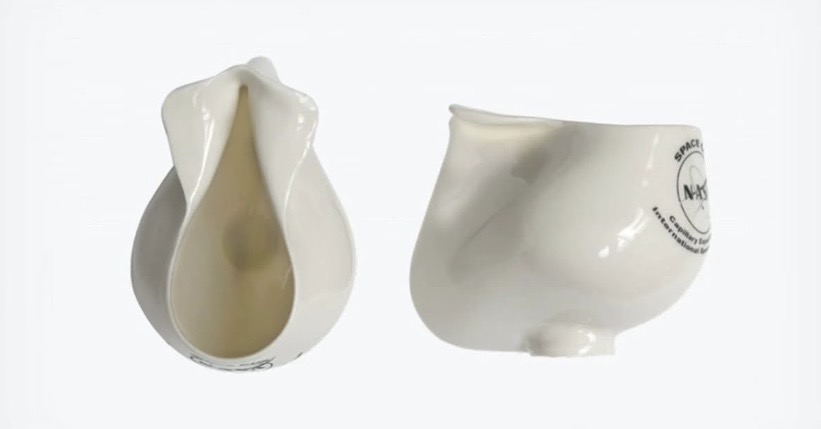
NASA created a coffee cup engineered to prevent spills in the weightless environment of space.
NASA developed the Capillary Beverage Cup to solve a challenge unique to spaceflight. In microgravity, liquids do not settle at the bottom of a cup because gravity is largely absent. Instead, they cling to surfaces and gather into floating droplets, making a traditional mug impractical.
For decades, astronauts drank coffee and other beverages from sealed plastic pouches fitted with straws. Although effective, those containers prevented researchers from observing how liquids naturally behave in weightlessness.
In the early 2000s, a NASA team led by Mark Weislogel began designing an open cup that used surface tension and capillary action instead of gravity to move liquid. The finished Capillary Beverage Cup was successfully tested aboard the International Space Station in 2015.
Its distinctive teardrop-shaped design and narrow channel naturally direct liquid toward the rim, allowing astronauts to drink from an open cup without pumps or straws. Beyond making a cup of coffee feel more familiar, the technology has important engineering applications. Research into capillary flow is helping improve fuel storage systems, water recycling technology, and life-support equipment for future missions to the Moon and Mars, where controlling liquids in low-gravity environments remains a major challenge.