Tweets from @LSU #OCS4012 The Biology of Marine Vertebrates: Student led discussion of scientific literature focused on marine fishes, reptiles, birds & mammals
@LSU#OCS4012 The Biology of Marine Vertebrates course will return in the 2023-24 academic year! Check back then for student led discussions of scientific literature focused on marine fishes, reptiles, birds & mammals! 🐠🐢🐧🦭
@LSU#OCS4012 The Biology of Marine Vertebrates course will return in the 2023-24 academic year! Check back then for student led discussions of scientific literature focused on marine fishes, reptiles, birds & mammals! 🐠🐢🐧🦭
Info session tomorrow! All majors welcome on a 25-day program in the Galapagos this May! Connect with us Wed. 2/05/20 at 6:00 PM in the 1st floor Exhibit Hall of Foster or email [email protected]. This includes Ecology of the Galapagos Islands (OCS 4007) & Evolution (BIOL 3040).
#Question: What are the cause and consequences of Harmful Algal Blooms (HABs) in coastal California. How do HABs influence neurological disease in Sea otters? #Nicholson2018#OCS4012 https://t.co/SpEx77qUrR
#Question: #Allen2018 used stomach contents to study the diets of manatees. What other methods have studied used to estimate manatee diets and what are the pluses and minuses of each method? #OC4012 https://t.co/fcmlxQtHBd
#Question: Prior studies have proposed polygyny, polyandry, female defense polygyny, serial monogamy, serial female-defense polygyny, and promiscuity as possible mating systems for polar bears. How do these systems differ? #OCS4012#Biddlecombe2019 https://t.co/z8oPUSI51V
Question: How does the structure and function of the retia mirabilia differ (or not) among Bottle-nose dolphin, Bluefin tuna, and Opah? #OCS4012#Bonato2019 https://t.co/lYDIU65QrQ
#TigersVote! 🐅 It's Election Day in Louisiana and the polls are open til 8pm! As long as you're in line, you'll be able to vote. Don't forget that your tigercard is a valid form of ID! Get out and #geauxvote! 🌟
#Question: How do modern Kogiid sperm whales forage and what do they eat? How might this be similar or different than the fossil Kogiids studied by #VelezJuarbe2015? #OCS4012 https://t.co/Kf0YfkYxj0
#Question: How does eradication vs. control of Yellow crazy ants compare as a seabird conservation strategy? Why has has eradication been more elusive in past studies? #OCS4012#Plentovich2018
Unlike the males, female frigatebirds feed chicks more frequently than males during periods of biparental care. As a result, they tend to perform shorter, coastal commutes (smaller homing range) as opposed to long, pelagic trips like the males. #Austin2019#OCS4012
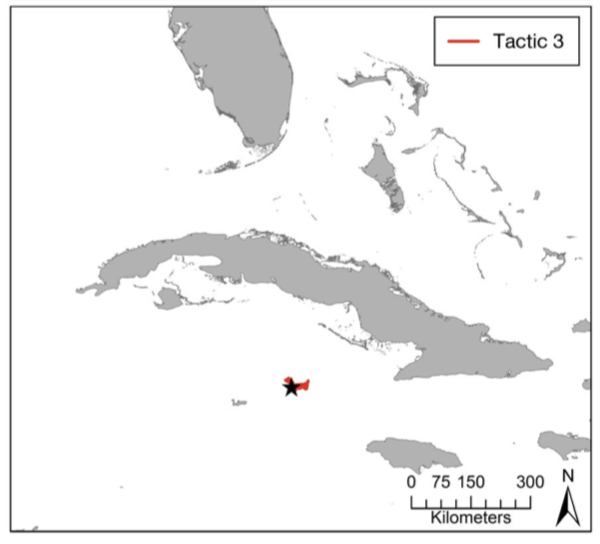
It was revealed that the frigatebird has 3 tactics for foraging trips: commuting flights with coastal foraging, pelagic trips of variable duration, and highly localised coastal foraging trips. The males were usually the ones making the longer distance trips. #Austin2019#OCS4012
In order to track the foraging behaviors of chick-rearing frigatebirds in the Cayman Islands, #Austin2019 used GPS, GPS-GSM loggers (attached to their #contour feathers), bird-borne cameras and dietary data. Data was collected and multiple statistical analyses were run. #OCS4012
#Austin2019 aims to examine the foraging behaviors of the frigatebird by quantifying the number of coastal/pelagic foraging trips, investigating the impacts of the organism's sex on foraging; as well as explore the factors that drive variability in foraging strategies. #OCS4012
As central place foragers, the magnificent frigatebird (Fregata magnificens), must balance self-maintenance with chick-provisioning. In order to achieve this, they have adapted a flexible foraging ecology that displays unequal levels of parental involvement. #Austin2019#OCS4012
#Question: What might the adaptive benefits of male and female frigatebirds having differing foraging strategies? #Austin2019#OCS4012 https://t.co/zjXhmHY3BF