Far out in the frigid fringes of our solar system, where sunlight is a faint whisper, Pluto is revealing secrets that are rewriting what we thought we knew about distant worlds.Once dismissed as a cold, dead relic, NASA’s New Horizons spacecraft — which swooped past in July 2015 — captured stunning high-resolution images showing a surface marked by expansion, not compression. These clues point to something astonishing: a vast subsurface ocean of liquid water, possibly hidden beneath an icy shell for nearly the entire 4.5-billion-year history of the dwarf planet.Led by researchers like Carver Bierson of UC Santa Cruz, scientists analyzed Pluto’s geology and found evidence of an early “hot start.” Instead of beginning as a fully frozen ball that slowly melted, Pluto likely formed with enough internal heat — from accretion and radioactive decay — to create a liquid water layer early on. That ocean has been slowly freezing ever since, but may still exist today.The star of the show is Sputnik Planitia, the vast, smooth nitrogen-ice plain that forms the left lobe of Pluto’s iconic heart-shaped feature. Its position, the surrounding fractures on the opposite side of the planet, and the way the crust has stretched all suggest a massive hidden water ocean — perhaps up to 150 kilometers (about 93 miles) deep — sloshing beneath the surface. This buried sea has gently influenced Pluto’s rotation, surface evolution, and that famous heart-shaped terrain for billions of years.What makes this truly mind-blowing is the implication: icy worlds far from the Sun’s warmth don’t have to be geologically dead. If Pluto can maintain a subsurface ocean through nothing more than leftover formation heat and radioactive elements, then many other Kuiper Belt objects could be doing the same. Hidden oceans may be far more common in the outer solar system than anyone imagined.Pluto is no longer just a frozen outpost at the edge of our cosmic neighborhood. It’s a quiet, ancient world wearing a thick icy armor — while deep below, in eternal darkness, liquid water may still stir, preserving a spark of planetary youth that time has never fully extinguished.
One frame to the next: I shot out of my north-facing window in Indian Harbour Beach, FL with empty hopes of capturing some #aurora not visible to the naked eye. A few minutes later, I tried again and was amazed at the image on the back of the camera. ISO1600 f2.8 4.0sec #flwx
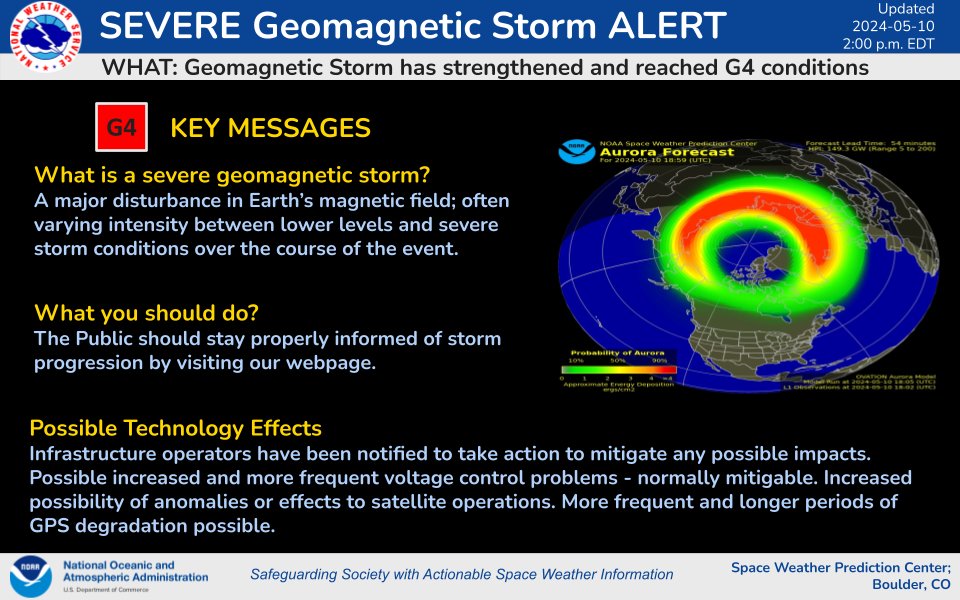
JUST IN: The ongoing geomagnetic storm has been upgraded to level 5 out of 5, or "extreme," making it the first G5-level storm since 2003.
Scientists are warning of potential disruptions to communications over the weekend.
GPS, spacecraft and satellite navigation may also be impacted. U.S. utility companies are monitoring the potential threat to the power grid as well according to CNN.
The video below was posted by BBC Meteorologist @MetMattTaylor.
"This is the astounding view as far south as Switzerland a short while ago… on top of Jungfraujoch," he posted.
@mjaydenmullins@UtahWildfire I just heard on KPCW that its 0% contained, but 3/4 a mile from any Summit County structure. Heard like 10 minutes ago. It’s possible that was dated news, but it came from a Summit County Public Information Officer.
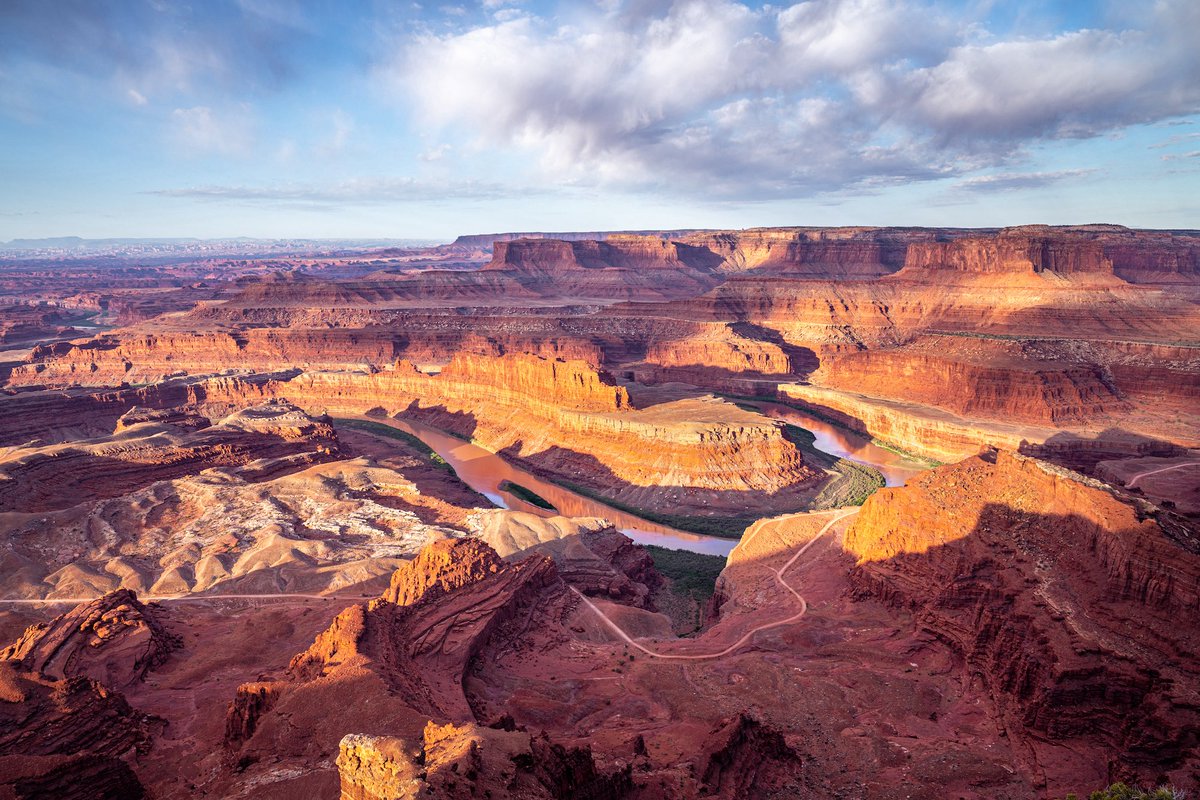
📸 I love places where you can stare right at time. Dead Horse Point State Park is one of those places where we get to see time all at once, not needing to wait for things to evolve in pieces. 🗺️
#phototour#photoworkshop#utah#visitutah#moab#archesnationalpark
☄️ Look up! Tonight after sunset, for the 3-mile wide Comet Neowise, around Earth every 6,800 years ☄️ Or you can check just before sunrise. Sunset: NW sky, sunrise: NE sky.
.
.
.
Shot on A7riii, 600mm, 9 images… https://t.co/idcgnNJasE
🧊 The solitude of Siberia is healing. Take a look around today, see if you can find the same kind of solitude, the same kind of space, in your surroundings. 🧊
#furtherphotoexpeditions#siberia#lakebaikal#phototour… https://t.co/K0EyoysPYU
Antelope Canyon miraculously displays over 10 levels of light at a time ✨ (The human 👁 can only see 10 at a time!). With tripods now banned from the canyon, photographers will have to handhold high quality cameras (like I did here) to capture them. 📸 #furtherphotoexpeditions
🎶👂💕 The sound of sand falling at the depths of a 120-foot slot canyon. Still, the light finds its way... 📸 😍 Handheld on a Sony, ISO 3200 #furtherphotoexpeditions#sonyalpha