Friend of mine just told me that in addition to making a GLP-1 gene therapy and a myostatin gene therapy, he's also making a testosterone gene therapy.
And he got the cost down to a tenth of the already low price he was working with.
2026 is the year of hot Americans.
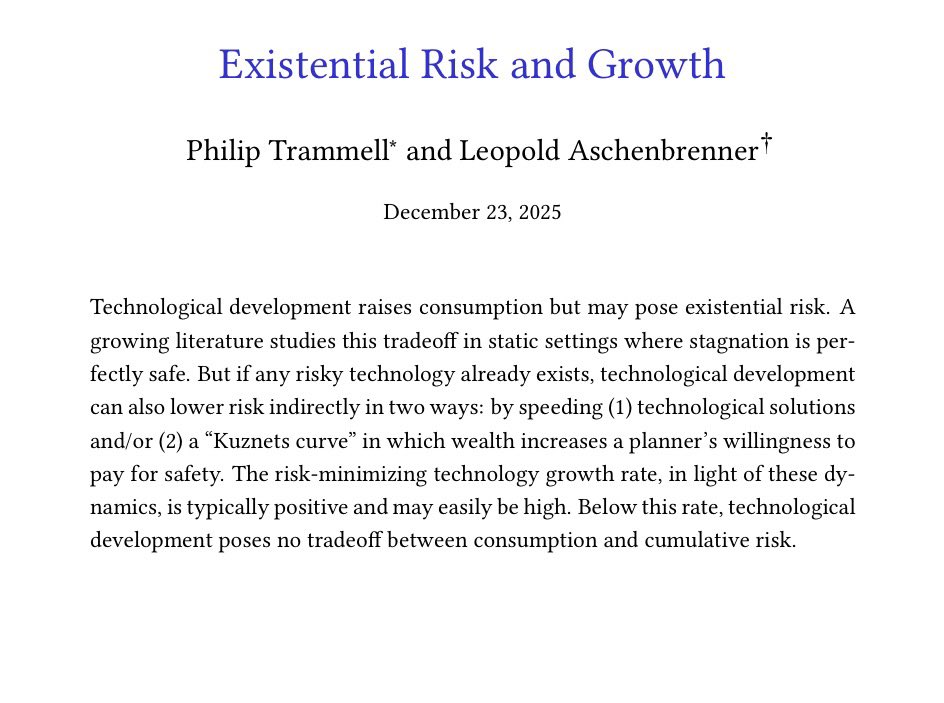
The guy whose hedge fund returned 47% in H1 2025 just dropped one of the most important AI papers I've read.
Leopold Aschenbrenner's Situational Awareness LP returned 47% net of fees in H1. The S&P returned 6%. He bet his entire net worth on AI infrastructure and outperformed Wall Street by 8x.
When someone with that track record publishes a formal economics paper on existential risk, I read it.
The paper mathematically inverts the core assumption driving AI regulation: that slowing down reduces existential risk.
He and coauthor Philip Trammell from Stanford show the opposite can be true.
The setup is elegant.
If any dangerous technology already exists, stagnation doesn't eliminate risk. It guarantees catastrophe. You're stuck running the same gauntlet forever. Nuclear weapons don't disappear. Bioweapons don't disappear. Current AI systems don't disappear. Every year you remain in a dangerous state, you roll the dice again.
Enough rolls and you lose.
They split existential risk into two components the policy debate has been conflating. "State risk" is the ongoing hazard from technologies that already exist. "Transition risk" is the danger from developing new technologies. The experiments. The scaling runs. The novel deployments.
Unless transition risk scales super-linearly with speed, faster growth is always weakly safer. You endure less cumulative state risk by escaping dangerous states more quickly.
The integral under the hazard curve shrinks.
The Kuznets curve dynamics strengthen the case. As societies get richer, safety becomes a luxury good. The marginal utility of consumption falls while the value of civilization rises. Optimal policy shifts toward more safety spending. Faster growth accelerates this dynamic.
There's a second-order effect most people miss. When the future is more valuable because growth will be faster, it becomes worth sacrificing more today to protect it. Anticipated acceleration motivates stricter current policy.
The paper acknowledges limits. If policy frictions are severe enough, speed becomes genuinely risky. If transition risk compounds super-linearly with deployment velocity, slower wins on some margins.
These are empirical questions.
But the burden of proof shifts. Anyone advocating slowdown needs to demonstrate that transition risk dominates state risk. That we're not already in a "time of perils" where the safest path is pushing through as quickly as possible.
The real insight is structural. Permanent deceleration locks you into whatever hazard rate you currently face. If that rate is positive, survival probability goes to zero. Only acceleration or surgical regulation can minimize cumulative risk.
The pause advocates have it backwards. Slowing down extends your exposure to current dangers.
Speed is the escape route.
Everyone in AI policy should read this paper.
How is $350b in T bills a “free call option”
You are missing out on the opportunity to own equities and dealing with inflation
A “free call” would be if you ended up getting that optionality on a mkt crash without paying these opportunity costs for it.
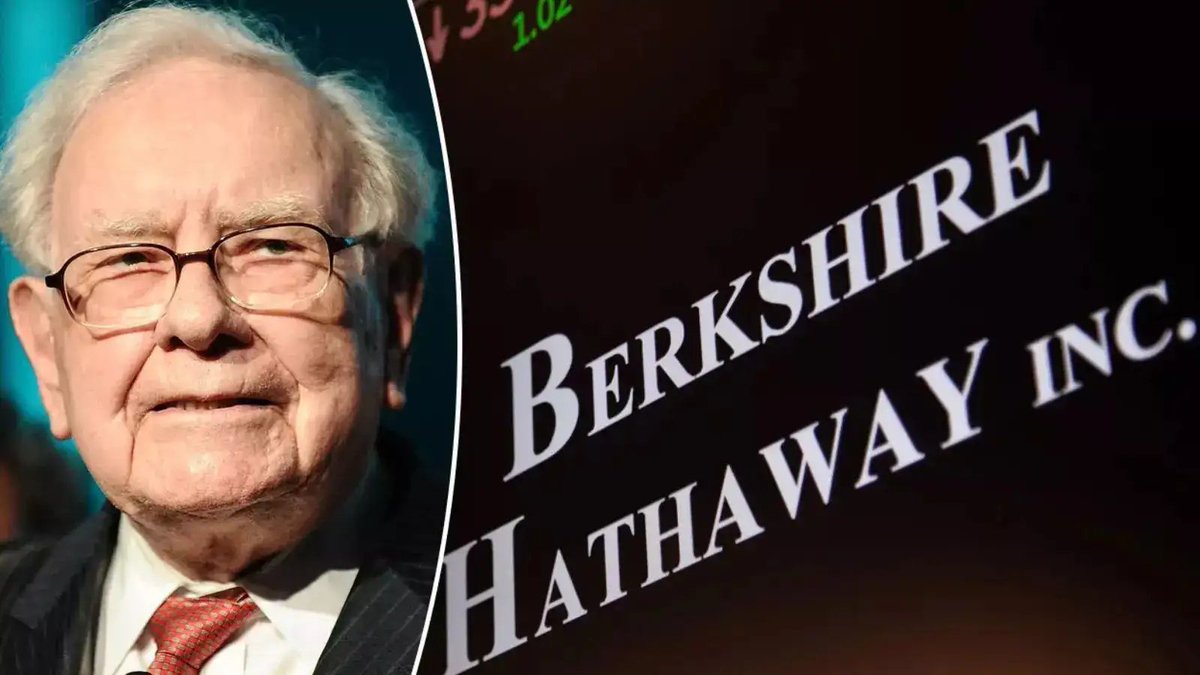
Buffett didn't retire.
He spent two years demolishing and rebuilding Berkshire from scratch.
Wall Street completely missed it:
74% of Apple. Sold.
677 million shares. Liquidated.
$130 billion. Converted to T-bills.
Tomorrow Greg Abel inherits:
$381.7 billion cash fortress (That's 5% of ALL U.S. Treasury bills)
$15 billion per year in risk-free income (More than BNSF Railway earns)
Zero concentration risk (The hardest decision already made for him)
But here's what nobody is talking about:
The Japanese carry trade.
Buffett borrowed ¥1.3 TRILLION at 1.6%.
Bought $31 billion in trading houses yielding 4%+. Currency-hedged. Self-funding.
Net profit: $677 million per year.
For doing absolutely nothing.
This is the most sophisticated financial engineering of his 60-year career.
Then on December 8th, the real signal dropped.
Todd Combs left for JPMorgan.
23 days before the handover.
After 15 years.
The stock-picking era at Berkshire is over.
What Abel actually inherits:
An operating company, not an investment fund.
A $50B+ deployment capacity per opportunity.
A free call option on market collapse.
A Japanese income machine running on autopilot.
Sum-of-parts: $1.05-1.15 trillion intrinsic.
Market cap: $1.08 trillion.
Fair value with embedded optionality.
PREDICTION:
By February 2026, the 10-K will confirm:
Japanese dividends exceeded $800M.
No Apple rebuy occurred.
Abel's first acquisition target is identified.
The Oracle didn't step down.
He rebuilt the entire machine for a world without him.
And handed his successor the most deliberately engineered corporate handover in history.
The fortress is complete.
Tomorrow we find out if it holds.
Read the full deep dive story about Oracle of Omaha here! - https://t.co/Tmz84k3je6
Libertarians have pointed out for years that you can’t have both mass immigration and a welfare state. Of course, they say this because they want to keep immigration high and eliminate welfare, but the basic point is sound. It’s just an absurdity that we bring new people to the country and then tax natives to give them welfare. There’s really no way to justify it. It’s an absurdity.
Claude Code makes crazy ambitious projects suddenly (seem) within reach.
Out: "What if I made a neat to-do list app"
In: "What if we built a new operating system from scratch"