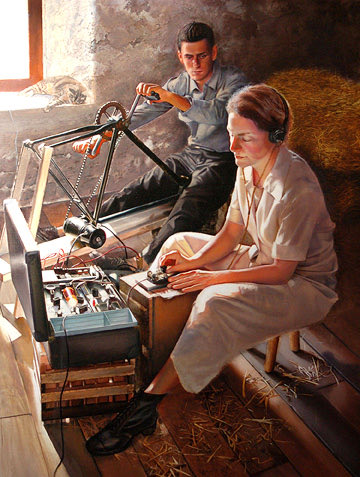
In 1942, the Gestapo was hunting a woman they described as one of the most dangerous Allied agents in France.
They didn't know her name. They had one clue.
She walked with a limp.
Her name was Virginia Hall, and she was from Baltimore. She had a wooden leg. She named it Cuthbert.
In the 1930s she dreamed of becoming an American diplomat. While working at a US consulate in Turkey, she went bird hunting, tripped climbing over a fence, and accidentally shot herself in the foot. Gangrene set in. Doctors amputated her left leg below the knee.
When she applied to become a diplomat, the State Department turned her down. Partly because of the leg.
So she found another way to serve.
When the war began, she was living in Europe and drove ambulances in France. When France fell, she made her way to Britain and was recruited by the Special Operations Executive, the British secret service that sent agents behind enemy lines.
In 1941, she went back into France undercover, posing as a reporter for an American newspaper. She was the first female agent SOE sent into France.
She set up her base in Lyon. She recruited contacts everywhere. Doctors, nuns, police officers, farmers, brothel owners. She found safe houses, arranged supply drops, and helped downed Allied airmen escape. She helped break a group of captured agents out of a French prison.
The Germans figured out someone was running a network. They figured out it was a woman. They figured out she limped.
In November 1942, the Germans took over all of France. Her network was compromised. She had to get out.
The only escape route was over the Pyrenees mountains into Spain. In winter. On foot.
With a wooden leg.
She made the crossing. Before she left, she sent a radio message to London saying that Cuthbert was giving her trouble. London, not realizing Cuthbert was her leg, reportedly replied that if Cuthbert was giving her trouble, she should have him eliminated.
She made it to Spain, was arrested for crossing illegally, spent weeks in jail, and eventually got out.
Most people would have stayed safe after that. She asked to go back.
The British said no. She was too well known. So she joined the Americans instead, in the OSS, the forerunner of the CIA.
In 1944 she went back into France. She dyed her hair gray, wore baggy clothes, and changed the way she walked to hide the limp. She posed as an old peasant woman herding goats and selling cheese.
She was actually a radio operator, organizing resistance fighters. She arranged weapons drops, trained fighters, and helped sabotage German forces in the run up to and after D-Day.
In 1945, she was awarded the Distinguished Service Cross. She was the only civilian woman in World War Two to receive it. President Truman wanted a public ceremony. She declined, saying she was still working undercover.
After the war, she joined the CIA, where she worked for years and was often overlooked by the men around her.
She died in 1982. For decades almost nobody outside the intelligence world knew who she was.
The State Department said a woman with a wooden leg couldn't be a diplomat. She became a spy instead.
One of the sweetest 80s intros...
Street Hawk (1985)
What's sad is that it only ran for one season. Hell, Christopher Lloyd was in the pilot! Too many great shows cancelled too soon.
Suppose we will always have this...Tangerine Dream intro.
The youth of today will never understand how hard 80s intros went.
Airwolf is one of the best.
Can you honestly name one bad 80s intro compared to today, you can't.
The REAL British Redcoats of the Zulu War (1879)
British soldiers of the 24th Regiment of Foot, photographed during the era of the Anglo-Zulu War of 1879. Armed with Martini-Henry rifles.
#OnThisDay 11 November 1985
The first of 33 episodes of JONNY BRIGGS was broadcast on Children's BBC. The series followed the exploits of a young boy, his pet dog Razzle, and his eccentric family members played by #SueDevaney, #LeslieSchofield and #JaneLowe.
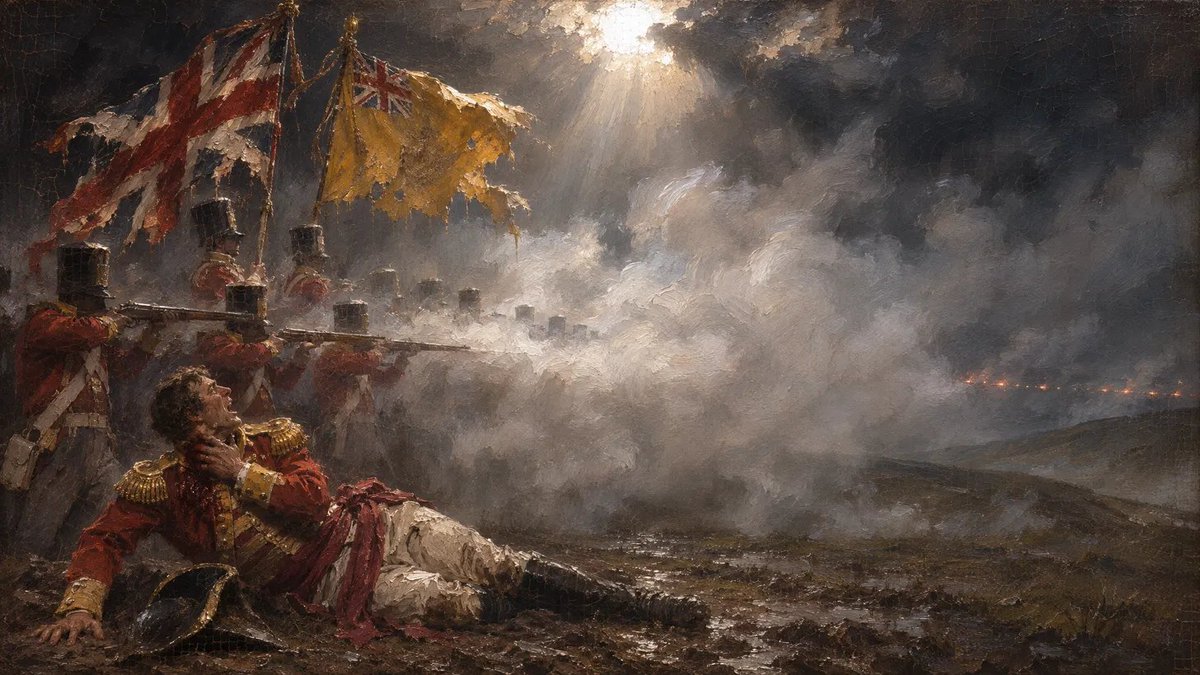
A French canister ball tore into Lieutenant-Colonel William Inglis near the neck and lodged in his back. His men moved to carry him to the rear. He refused. He refused the surgeon too. He had them lay him down beneath the colours of the 57th Foot, in the open, facing a French column some 8,000 strong — and from there he gave his regiment one order, over and over again.
16 May 1811. Albuera, Spain. Marshal Beresford's British, Portuguese and Spanish army is covering the siege of Badajoz, and Marshal Soult has come to break it. He swings round the Allied right. Then a hailstorm hides Polish lancers until they are inside a British brigade, and three of its battalions are gone in minutes. That leaves a hole in the line, and one brigade to fill it.
Major-General Hoghton's brigade — the 29th, the 48th and the 57th West Middlesex, 1,651 men — halts in line against a French column of 8,000, with guns firing grape and canister into the ranks at 300 yards. No cover. No manoeuvre. Only the line.
Hoghton is killed. Inglis has his horse shot from under him. Then the canister finds him. He lies beneath the colours, bleeding, and as the files are shot away the men hear him above the guns: "Die hard, 57th! Die hard!"
They do. The King's colour is hit seventeen times, the Regimental colour twenty-one, its staff broken. The line does not go back — and it holds until the Fusiliers come up and break the French.
The 57th went up the ridge 647 strong. 428 were killed or wounded — two men in every three. Beresford wrote that their dead lay "as they fought in the ranks, every wound in front."
Inglis lived, and was back in the field by 1813. His regiment were the Die Hards for the rest of their history, and every 16 May Albuhera Day is still kept.
Two men in three fell on that ridge. The line never went back. That is what the name means.
The 57th held that ridge with two men in three down. Stories like theirs only survive if someone keeps telling them, properly and without apology. That’s what Guardians make possible. Hold the line with me: https://t.co/qC8TTIpcH2