Canada built bridges for bears, and the bears used them.
So did wolves, cougars, elk, moose, lynx, wolverines, bighorn sheep, black bears, deer, and almost everything else trying to cross one of the busiest highways in the Rockies.
The Trans-Canada Highway cuts through Banff National Park for 82 km. For decades, it did what highways do: split habitat in half, severed migration routes, isolated populations, and turned animal movement into roadkill.
So Parks Canada tried something that sounded ridiculous to a lot of people at the time: they built wildlife bridges and tunnels.
They look nice, but they're far from a decoration. Forested overpasses wide enough for grizzlies and elk. Dark underpasses for cougars and black bears. Fencing along the highway to keep animals off the pavement and guide them toward safe crossings.
At the time, critics called it a waste of money and editorials opined that animals would never use them.
Fortunately, animals don't read opinion pieces. Since monitoring began, wildlife have used Banff’s crossings more than 250,000 documented times.
Grizzlies took years to trust them. Elk started testing them while they were still under construction. Different species chose different designs: grizzlies and elk tended to prefer wide, open overpasses, while cougars and black bears often used narrower underpasses.
The results were not subtle. Wildlife-vehicle collisions dropped by more than 80% overall. For elk and deer, they dropped by more than 96%.
Banff now has one of the most studied wildlife crossing systems on Earth, and countries around the world have looked to it as a model.
JUST IN: A Trump judicial nominee was asked point blank: is Trump eligible to run for a third term?
Their answer: “I would have to review the actual wording…”
Sen. Chris Coons then asked every nominee in the room to confirm the Constitution bars a third term.
Silence.
Every single one of them refused to say it.
Trump is appointing judges who won’t affirm the 22nd Amendment to his face.
Never stop connecting the dots.
The national debt crossed $39 trillion for the first time last month. That's another trillion added in five months. Interest alone is running $88 billion a month. Cut six cents out of every projected dollar for five years and the budget balances. It isn't radical. It's basic math.
This is the interview Donald Trump didn’t want you to see.
His FCC refused to air my interview with Stephen Colbert.
Trump is worried we’re about to flip Texas.
Atmospheric scientist here. Let me tell you what was actually "slashed" today.
Slashed: The Endangerment Finding — a 200-page scientific review upheld by the Supreme Court, the D.C. Circuit Court of Appeals, and reaffirmed by the National Academies of Sciences in 2025.
Slashed: The legal authority to regulate carbon from cars, power plants, and factories. All of it. Gone in one afternoon.
Now here's what you're "saving":
Yesterday Trump ordered the Pentagon — the largest energy consumer on Earth — to buy coal electricity.
Coal costs $69–$169/MWh.
Wind costs $27–$53/MWh.
Solar costs $38–$78/MWh.
99% of U.S. coal plants cost more to run than replacing them with brand-new solar or wind.
That's your tax dollars buying the most expensive electricity on the market. By executive order. While the Peabody Energy CEO stood in the room.
And the human cost of what you're "saving"?
460,000 American deaths linked to coal pollution in 20 years. Coal PM2.5 is 2.1x deadlier than other air pollution. (Henneman et al., Science, 2023)
All to protect an industry that employs 44,000 people total. Clean energy employs 3.5 million.
Marco Rubio in March 2016:
“For years to come, there are many people on the right, in the media and voters at large, that are going to be having to explain and justify how they fell into this trap of supporting Donald Trump.”
At the moment, mansion-sized Asteroid 2024-YR4 has a one-in-fifty chance of hitting Earth in the next eight years.
Now might be a bad time to reduce spending on Science. Just sayin’.
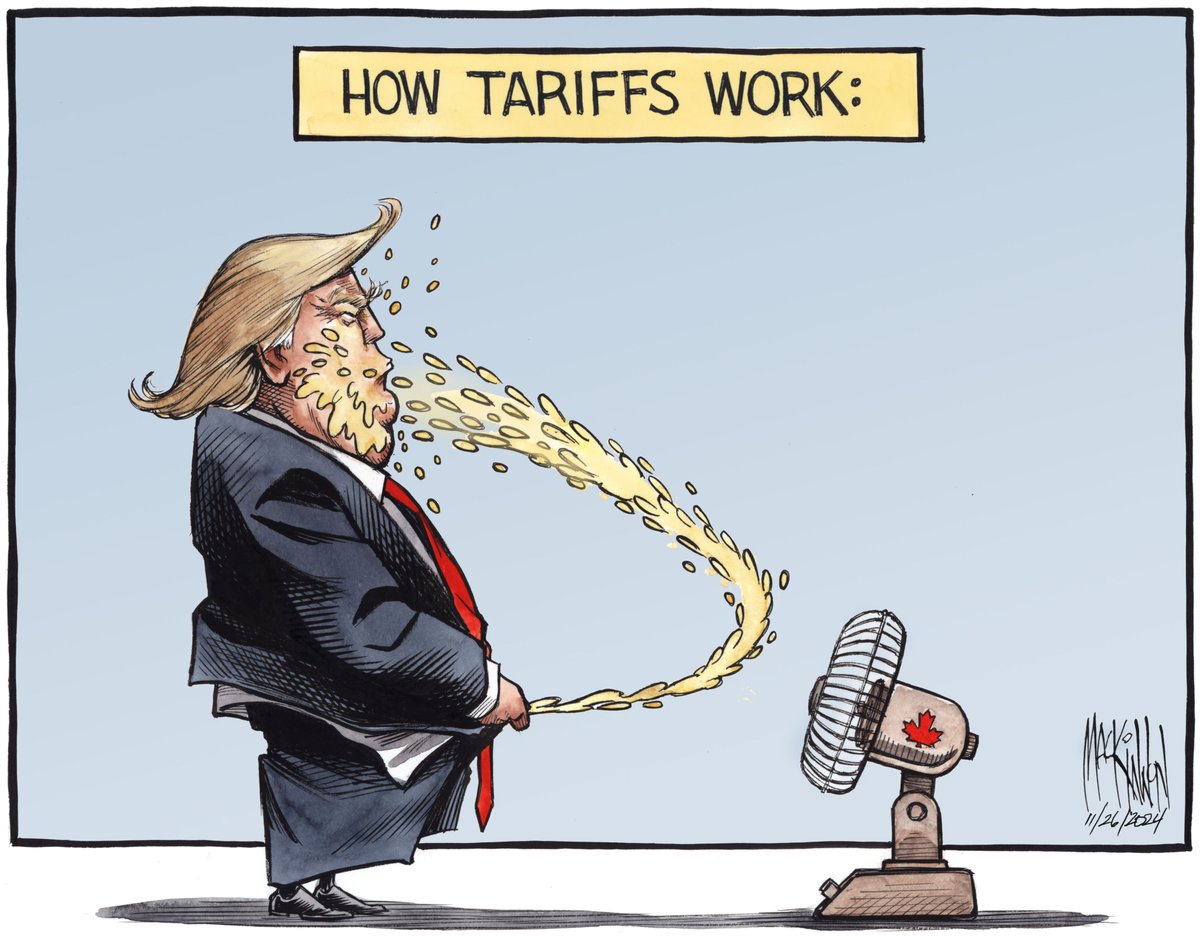
I drew this last November 26th knowing full well no self-respecting family newspaper in the country would be likely to print it. I was right. But given the events of this weekend, I’m gonna to let ‘er rip anyway.
#USA#Canada#tariffs@realDonaldTrump
"We have to tell them over and over again, 'Voter suppression's fake. Voter fraud is fake. It's used to raise money and get you angry,'" says Gabriel Sterling, Georgia’s chief operating officer for the secretary of state. https://t.co/ANZeYURopL
If you haven't voted yet, now is the time to fill out and return your mail-in or drop-off ballot. If you've already voted, consider volunteering to assist others in doing the same.
We must elect leaders we can push to act on the climate crisis. Vote and sign-up to volunteer at https://t.co/OBzMJucI1D
The last time Americans voted for president, US democracy faced a close call. We might be about to embark upon an experiment to see whether our institutions, checks and balances can hold, even when leaders try their best to bend them.
My take:
Why are we endorsing Kamala Harris? She has run an impressive campaign and seems to appreciate the need for centrist politics in America today. But, more importantly, a second Trump term comes with unacceptable risks. We explain why she gets our vote https://t.co/knlJOa1BHF
No matter who wins the 2024 election, a new landscape—in which cultural identity takes precedence over economics—will define US politics for decades to come.
My take:
World leaders agreed to transition away from fossil fuels at the COP28 climate negotiations last year and President Biden’s decision today to pause new permits for LNG exports shows that he is taking that pledge seriously. If we want to enhance energy security, create jobs, and prevent environmental injustice, we should be making investments in cheaper, readily available renewable energy, not dirty and damaging fossil fuels.
The decision at #COP28 to finally recognize that the climate crisis is, at its heart, a fossil fuel crisis is an important milestone. But it is also the bare minimum we need and is long overdue. The influence of petrostates is still evident in the half measures and loopholes included in the final agreement.
Fossil fuel interests went all out to control the outcome, but the passionate work of millions of climate activists around the world inspired and motivated delegates from many nations to loosen the industry’s grip.
Whether this is a turning point that truly marks the beginning of the end of the fossil fuel era depends on the actions that come next and the mobilization of finance required to achieve them.
We must ask ourselves how much longer will the world have wait before all nations summon the political will to overcome these narrow special interests and act on behalf of the future of humanity. It is up to all of us to hold our leaders accountable to their promise to transition away from fossil fuels once and for all.
The fossil fuel industry has started to say the quiet part out loud a little more often: they want to continue pumping fossil fuels forever.
And, of course, they are still pushing phony ‘solutions’ intended to delay real climate action. I explain in my latest from @TEDTalks.
https://t.co/cPnAH8SBFD