First they stole Germany!With #Adidas's stranglehold due to expire, can #Nike get that swoosh printed on #Fifa's #WorldCup ball in 2034?
Share price: 76% below August 2021's ATH.
#RipTheScript
#Inelastic demand is an economic term referring to the static quantity of a good or service when its price changes. When the price goes up, consumers’ buying habits stay about the same & when the price goes down, consumers’ buying habits remain unchanged. https://t.co/2EDSlsGF2L
US #oil giant #ExxonMobil tells Donald Trump #Venezuela is ‘uninvestable’.
Meanwhile, #Chevron said it could boost production by 50 per cent within 18 to 24 months by expanding its existing operations, which pumps about 240,000 barrels per day. https://t.co/ut3rOJHIkq
The #KardashevScale is a method proposed by Soviet astronomer #NikolaiKardashev in 1964 to classify a civilization's technological advancement based on the amount of energy it can harness and use. Type 1: planetary
Type 2: stellar
Type 3: galactic
https://t.co/sl0GKvNqQi
$TSLA CEO Elon Musk and $NVDA CEO Jensen Huang discussed the profound potential of AI IN SPACE, particularly in the context of achieving a Kardashev Scale civilization, at the 2025 Saudi-US Investment Forum.
Musk argues compellingly that for civilization to sustain its upward trajectory and reach a meaningful fraction of a Kardashev Type II civilization—one that harnesses a significant portion of its star's total energy—the deployment of solar-powered AI satellites in deep space is absolutely essential.
The transition to space-based AI is overwhelmingly critical due to Earth's fundamental energy limitation: our planet receives only about one two-billionth of the sun's total energy output. To attain an energy capacity a million times greater than the maximum Earth could ever produce, humanity has no choice but to expand into space.
Moving AI computation to orbit presents a series of overwhelming practical and economic advantages:
✅ Musk predicts that the cost-effectiveness of AI in space will soon eclipse terrestrial systems. He estimates that the lowest-cost method for performing large-scale AI compute will involve solar-powered AI satellites in as little as four or five years.
✅ Since space is a vacuum, cooling is achieved purely through radiative means, eliminating the need for water. Jensen Huang highlights this advantage by pointing out that a substantial majority of a terrestrial supercomputer rack's weight—1.95 tons out of a 2-ton total—is dedicated to cooling infrastructure. This illustrates just how compact a space-based supercomputer could be.
✅ The vastness of space offers uninterrupted solar power, completely eliminating the need for heavy, complex battery storage. Furthermore, solar panels can be manufactured more affordably as they do not require protective glass or heavy framing materials.
✅ It is exceedingly difficult, if not utterly impossible, to scale AI computation to the massive levels required on Earth. For instance, producing 300 gigawatts per year of new AI compute would consume two-thirds of the United States' total annual electricity usage. Scaling to a terawatt per year is simply infeasible within Earth's constraints. Achieving this order of magnitude of compute demands the full utilization of the solar energy available in space.
In short, AI in space is inevitable if civilization is to continue its progression.
#Netflix Inc. has told management of #WarnerBros#Discovery Inc. that it will keep releasing the studio’s films in theaters if it’s successful in buying the company.
#WarnerBrosDiscovery
https://t.co/nebvyZCF6I
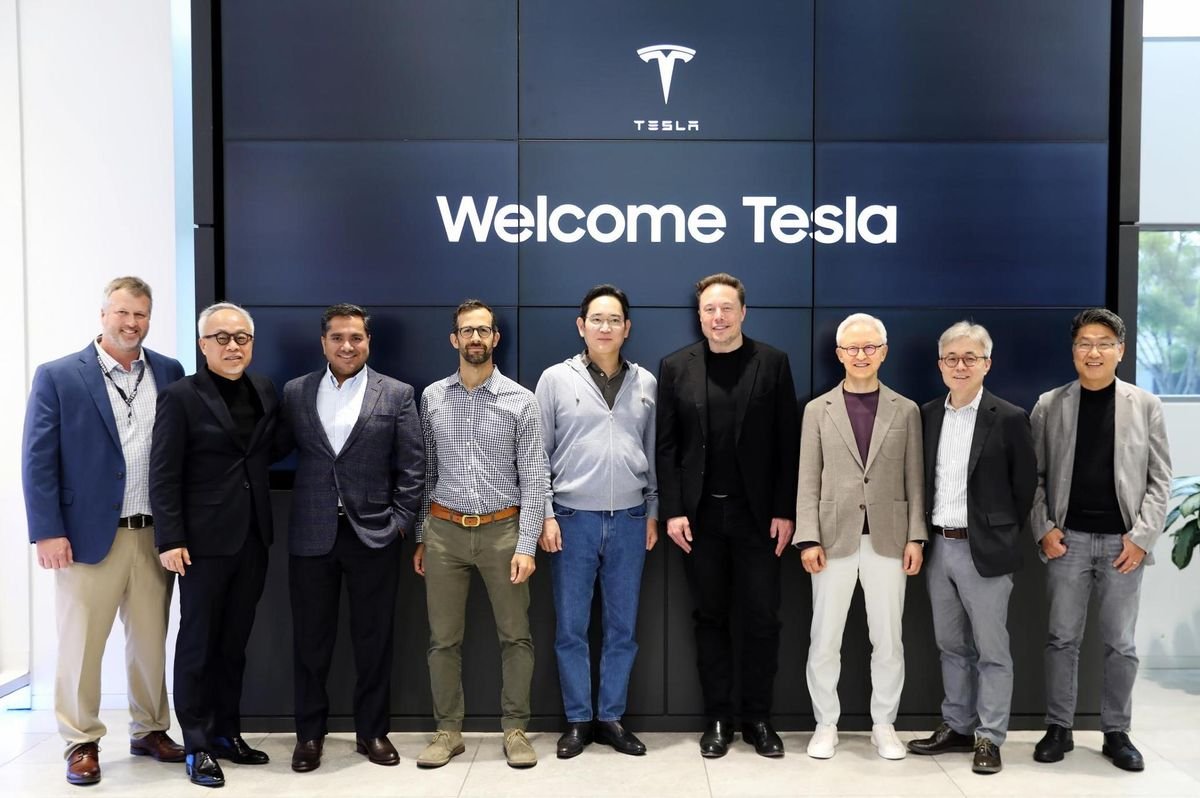
Tesla and Samsung just signed a $16.5B AI pact.
It’s not about chips or cash.
It’s about the ONE move that will decide which AI companies survive the next decade, and which disappear.
Here’s what the next 10 years of AI will really look like: ⬇️