Everything you need to know on investing on glass substrates and advanced packaging.
6 parts - 2 hours total read time.
Part 1 live on substack now. (Free)(Link in bio)
This research sets out our base scenario for that investing timing and a quarterly signal framework for monitoring whether that scenario is unfolding on schedule.
Glass enters advanced packaging in two distinct layers: on the interposer layer that connects die to die, and the substrate layer that supports the entire package.
Research by @GyujinAAIG ✍️✍️
$LPKF $SEMCO $AEHR $NVDA
Got a sneak peak of what is coming and @GyujinAAIG really created a masterpiece here. So much info and insights, a must read. First piece coming out on our Substack tomorrow, link in bio
Our Korean team member @GyujinAAIG has emerged from hyperfocus mode and wrote up a deep-dive sector overview on glass substrates, advanced packaging, and everything you need to know about this upcoming technology.
The first part of the series was one of our most-read pieces on Substack (see comments)
Part 1 goes live tomorrow and will be free, just like the next three parts in this six-part series. Cadence will be a part every 3 days so you have time to digest.
Over two hours of reading time.
And everything you need to understand this sector, from the basics to the key investment angles.
All to find on our Substack
$INTC
$LPK
$3037 unimicron
$7911 Toppan
$2802 ajimoto
So. A couple months back @citrini sent Analyst #3 behind the lines into the Strait of Hormuz. Cuban cigar in the water, Shahed drones overhead, IRGC patrol boats running circles eighteen miles off the Iranian coast. One of the best pieces anyone published all year.
We agree with the ethos completely. We just took the part about staying alive a little more seriously.
So our AAIG HR department (which we don’t have) decided it’d be slightly smarter to send @SimeonResearch_ behind the guns instead of in front of them.
Badge is in hand. We’re going to Eurosatory, Paris, June 15–19 the second largest defense expo on earth. 120,000+ people, 60+ countries, every major prime and a full hall of disruptors under one roof.
And no, what you just watched isn’t AI. That’s a real autonomous swarm by @swarm_defense_
Counter-drone is the single hottest fight on that floor right now the radars, the jammers, the lasers and the interceptors built to put swarms exactly like that back on the ground. That’s where we start with @aussie_eos remote weapon systems, High Energy Laser Weapons (HELW) and much more. Loitering munitions and autonomous strike following the story.
From AI-enabled command and control, space-based ISR and secure comms to soldier man-to-man protection and optics. We are going to look at it all.
But the bigger question we’re flying to Paris to answer is the money one: Europe is committing well over a trillion to defense this decade and we’re there to see where it actually goes.
We’re sitting down with industry experts and management teams across the space.
This is the open of a proper deep dive into the defense sector. Not from a desk. From the floor. what’s actually being ordered, and where the money flows next.
Follow along trough our Substack.
$THEON.AS $EOS.AX $RHM.NE $RENK
So. A couple months back @citrini sent Analyst #3 behind the lines into the Strait of Hormuz. Cuban cigar in the water, Shahed drones overhead, IRGC patrol boats running circles eighteen miles off the Iranian coast. One of the best pieces anyone published all year.
We agree with the ethos completely. We just took the part about staying alive a little more seriously.
So our AAIG HR department (which we don’t have) decided it’d be slightly smarter to send @SimeonResearch_ behind the guns instead of in front of them.
Badge is in hand. We’re going to Eurosatory, Paris, June 15–19 the second largest defense expo on earth. 120,000+ people, 60+ countries, every major prime and a full hall of disruptors under one roof.
And no, what you just watched isn’t AI. That’s a real autonomous swarm by @swarm_defense_
Counter-drone is the single hottest fight on that floor right now the radars, the jammers, the lasers and the interceptors built to put swarms exactly like that back on the ground. That’s where we start with @aussie_eos remote weapon systems, High Energy Laser Weapons (HELW) and much more. Loitering munitions and autonomous strike following the story.
From AI-enabled command and control, space-based ISR and secure comms to soldier man-to-man protection and optics. We are going to look at it all.
But the bigger question we’re flying to Paris to answer is the money one: Europe is committing well over a trillion to defense this decade and we’re there to see where it actually goes.
We’re sitting down with industry experts and management teams across the space.
This is the open of a proper deep dive into the defense sector. Not from a desk. From the floor. what’s actually being ordered, and where the money flows next.
Follow along trough our Substack.
$THEON.AS $EOS.AX $RHM.NE $RENK
It very depends per site. Modular pods are quite standard already these days, the ehouses I named in the article are also called pods, epods, modular pods. It’s all the same. Everyone looks at the most optimized schedule and building and testing stuff offsite in a factory helps a lot
WhiteFiber posted a video about their NC-1 campus showing the progress in their construction development. In this free Substack article I describe what I saw in the video and what I think is needed to complete the data center fit out, with the time involved. This article will also describe the data center design in general and the function of each component sitting within. Read it for free, link in the comments ⤵️ $WYFI $NBIS $CRWV $NUAI $IREN $AMD $NVDA #Datacenter
The team at NC-1 is nearing the finish line. We remain on-track to deliver on-schedule, but a lot of work remains.
Billy is back in Madison to walk us through what has been completed since his last update and explain what remains before the site is commissioned.
$WYFI
It depends per neocloud, for WhiteFiber, very little of the physical buildout is probably self-performed. Usually there is an AE doing the design, a GC that delivers the civil, shell, and MEP install. And then it depends on the contract with the end customer who delivers the racks.
@braden_tewinkel@jiahanjimliu@MarkosAAIG I agree on your points, however without the DarkNX order I don’t expect them to hit their guidance this year which also will put pressure on their balance sheet. This is the main reason I have sold until I know exactly what is going on with the 300MW project.
Well, i'm literally writing that I'm making assumptions because I don't follow the company closely and I'm giving my view on this single video without further background on the project. I have written "assumptions, speculation" etc multiple times throughout the article to make this clear. There are multiple ways to deliver a project which most of the time aligns with contractual obligations and/or client coordination. My intention of the article was to give an objective view of what I see in the video, what remains to be done and also to describe the components we're seeing in the video and the function of each.
It’s hard to say from the information I could see on the video. 600 people on site shows they’re pushing to finish on time. However the missing E-Houses and Gens raises the question if they’re going to be on time. As a PM I would not be comfortable looking at the amount of work, but there are always weekends and night shifts to speed things up.
I see a lot of people starting coverage on $INV in the last couple of weeks. I like it. I saw some good deep dives. It’s good to see that the market is catching on to this opportunity.
But I believe we wrote the most conclusive deep dive on $INV you can currently find on any platform. It has been read by a lot of high level investors and analysts.
What makes it different is that it wasn’t built purely from “desk research” but It was backed by @mvanbeijeren his 15 years of operational data center experience, his conversations with engineers across the ecosystem, and his boots-on-the-ground understanding of what is actually happening within both Inventure and the liquid cooling space as a whole.
That type of edge is incredibly difficult to replicate and we hold that as AAIG.
The real differentiation comes from understanding:how deployments actually happen,where current architectures begin to fail,how hyperscaler decision-making works,and how next-generation compute density changes the thermal stack entirely. On our platform you can ask those questions also to @mvanbeijeren because we also give live thesis support with everything we bring out.
That whole approach differentiates us.
Link in bio.
$INV
$VRT
$IREN
$IRM
$NBIS
$NVDA
Having run development and pilot programs at Google, I can add some direct context to the Google section.
What Google engineers do exceptionally well is systems integration. Together with AE firms they defining the boundaries and the specifications that vendors then build to. That is genuinely skilled engineering work at a incredible pace. But it is specification-driven procurement and integration, not component manufacturing. The cold plates, CDUs, manifolds, and sensors in a Google facility carry vendor part numbers, not Google part numbers.
When a hyperscaler says “we designed our cooling system,” the components inside that system still come from somewhere. Vertiv, CoolIT, and Boyd revenue opportunities don’t disappear because Google wrote the spec, they exist precisely because Google wrote the spec and then someone had to build it. The IP could be narrowed on a integrated product spec but not at a component level.
The opportunity for component-level cooling vendors is structural and durable precisely because hyperscalers will never build their own CDUs, that’s not their business. Designing around vendor components is a feature, not a weakness.
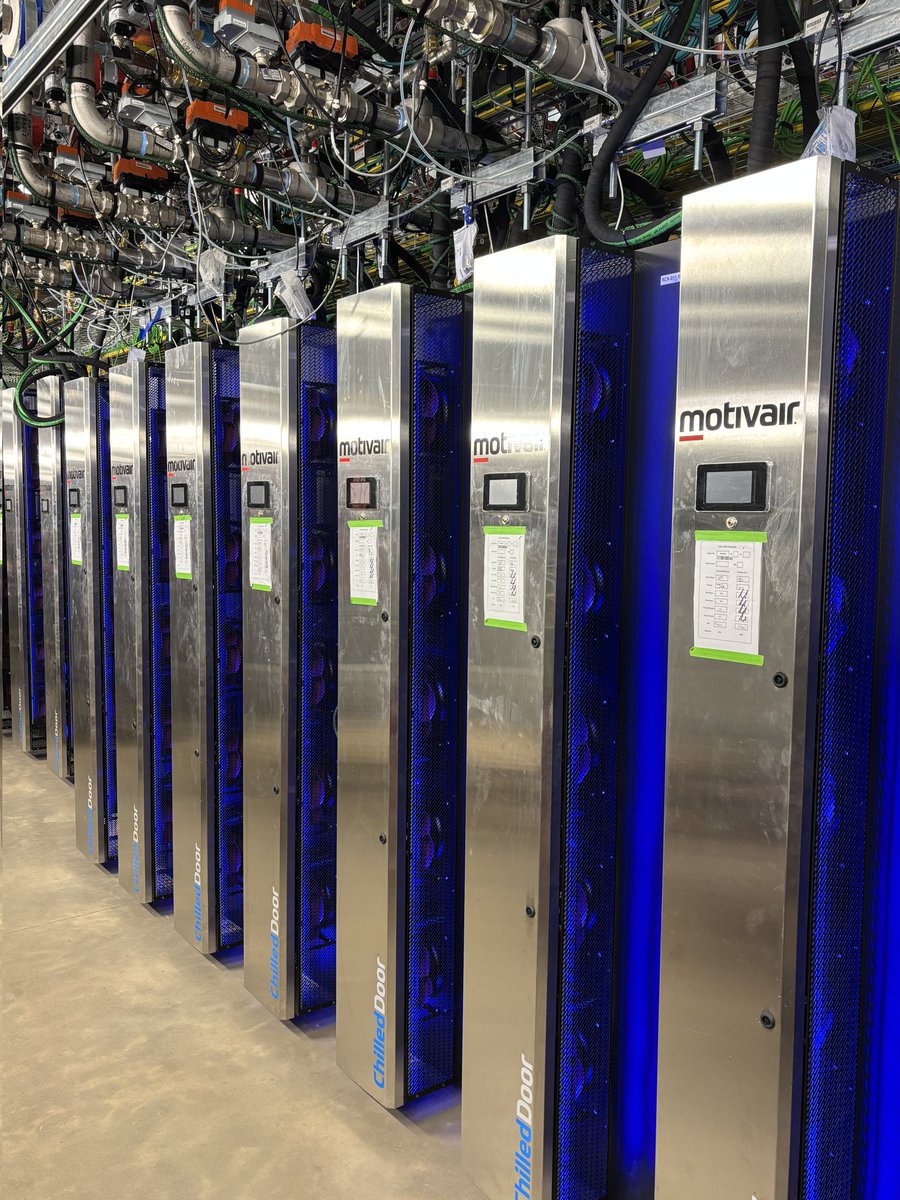
@Lazarus_Capital This is referring to direct-to-chip cooling, which is different than the moltivair solution on the picture. I guess they have 2 different solutions at the Horizon 1 site
High tech datacenters always impress me, manifolds, valves, cabling, each with its own dedicated function.
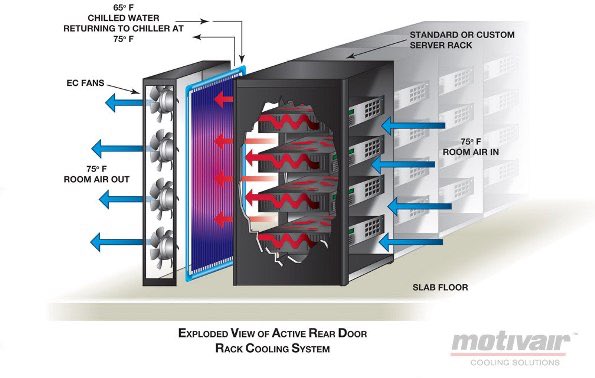
This Motivair solution is actually a hybrid air cooled / liquid cooled solution since the servers inside are still air cooled. The liquid cooling intercepts the hot exhaust air at the back of the rack. It’s a meaningful upgrade from pure air cooling.
Rear-door heat exchangers work well up to ~20–30 kW per rack. NVIDIA GB300 runs at 100–120 kW. Rubin Ultra will hit 600 kW. It will be interesting to see how the 5GW NVIDIA partnership will take shape and if two-phase direct to chip cooling will be part of it, reducing PUE and WUE. #datacenter $INV $IREN
$WYFI executed. They had clear catalysts which where very underlooked by the market. Great job @WhiteFiber_
Wrote down the opportunity at 18th of april.
Revised upgrade after earnings.
AI infrastructure names will see so much demand in the next coming years. $NBIS $IREN All of them.
Data center solutions in cold environments keep fascinating me. I’m currently in Norway working on a large data center project, and the creativity here about heat displacement is impressive. Every AI cluster and every data center generates enormous amounts of thermal energy that has to go somewhere. Globally, the industry spends billions on cooling infrastructure. Some operators re-use the heat to warm homes, swimming pools, or nearby facilities.
But what I saw in Norway takes it a step further. A Norwegian data center operator built its facility close to the coast. Instead of relying on traditional mechanical chillers, it draws in seawater from a nearby shore at roughly 8°C through a gravity-fed cooling system. After cooling the servers, the water exits at around 20°C, about 12 degrees warmer and no longer useful for the data center itself.
But for a lobster farm built directly next door, that temperature is perfect. The warmed water flows straight into the lobster tanks, effectively turning excess thermal output into a competitive advantage. And because data centers are designed with full redundancy and near-constant uptime requirements, the farm benefits from a heat source that is structurally reliable. As the farm CEO put it: ‘If the water stops flowing, the data center operators have much bigger problems than we do.’
Even Norway’s Minister of Digitalization highlighted it as the kind of symbiotic partnership they want to encourage more broadly between digital infrastructure and new industry.
Norway keeps finding ways to impress me, and honestly, I don’t think anyone can blame me 🇳🇴
#DataCenter #CircularEconomy
A BlueBird convoy is officially underway.
Two BlueBirds are already making their way to Cape Canaveral, with the third close behind.
Next stop: the launch pad. 🚀 🚀 🚀 🚀 🚀 🚀 🚀 🚀 🚀 🚀
Built in Texas. Broadband from space. Designed to connect directly to everyday smartphones.🌎📶📱
#ASTSpaceMobile #Broadband #ConnectingtheUnconnected #BlueBirds