Tesla Crashes Into Portland Dealership, Sending Three People to Hospital.
A Tesla vehicle crashed at high speed into a Tesla dealership in Portland, Oregon, sending three people to the hospital. Portland Fire & Rescue responded shortly after 10:30 a.m. on September 7 to the Tesla location at 4330 S Macadam Ave.
Authorities have not yet disclosed the severity of the injuries or whether the injured people were inside the vehicle or the dealership. The cause of the crash also remains unknown, and there is currently no evidence linking the incident to FSD or Autopilot.
Tesla Cybercab Demand Surges in Austin, Pushing Fares Above Model Y Robotaxi and Uber.
Early demand for Tesla’s Cybercab in Austin appears to be significantly outpacing available supply, with newly reported rider data showing sharply higher fares and wait times. On the same roughly 1.3-mile trip, the Cybercab was quoted at $15.24, compared with $12.04 for a Model Y Robotaxi. Uber showed $6.41 for Wait & Save and $7.95 for UberX on the same route.
On launch day, the same rider had seen roughly $6 for a Cybercab versus $12 for a Model Y, but that relationship reversed as weekend demand increased. Another app comparison showed a Cybercab wait exceeding one hour, versus roughly 14 minutes for a Model Y Robotaxi. These are individual rider observations rather than Tesla-reported network averages, and unusually strong launch-period curiosity may be contributing to demand.
Tesla China Offers ¥10,000 Cash Incentive on Model Y and ¥5,000 on Model 3 — Tesla China
Tesla has introduced new cash incentives for inventory Model 3 and Model Y vehicles in China. Customers who order and take delivery by September 30 can receive ¥10,000 ($1,475) off all Model Y inventory variants and ¥5,000 off all Model 3 inventory variants.
Selected Model 3 variants can also receive an ¥8,000 insurance subsidy. After applicable incentives, prices start at ¥222,500 for Model 3, ¥253,500 for Model Y and ¥329,000 for Model Y L. The new cash incentive applies specifically to inventory vehicles rather than custom-production orders.
The promotion comes after Tesla’s China-made wholesale sales reached 86,166 vehicles in August, up 3.6% YoY but down 7.9% MoM, while China retail deliveries during January–July were 266,204, down 12.4% YoY.
Tesla Robotaxi Could Begin 24/7 Operations as Soon as Next Month.
Tesla AI chief Ashok Elluswamy says the company’s Robotaxi service could move to round-the-clock operations as soon as next month. The service currently operates seven days a week but is limited to approximately 6 a.m. to 10 p.m.
Responding to a request for all-night Cybercab availability, Elluswamy said “next month or so,” adding that the next technology scheduled to merge into the FSD v15 plan should enable 24/7 service.
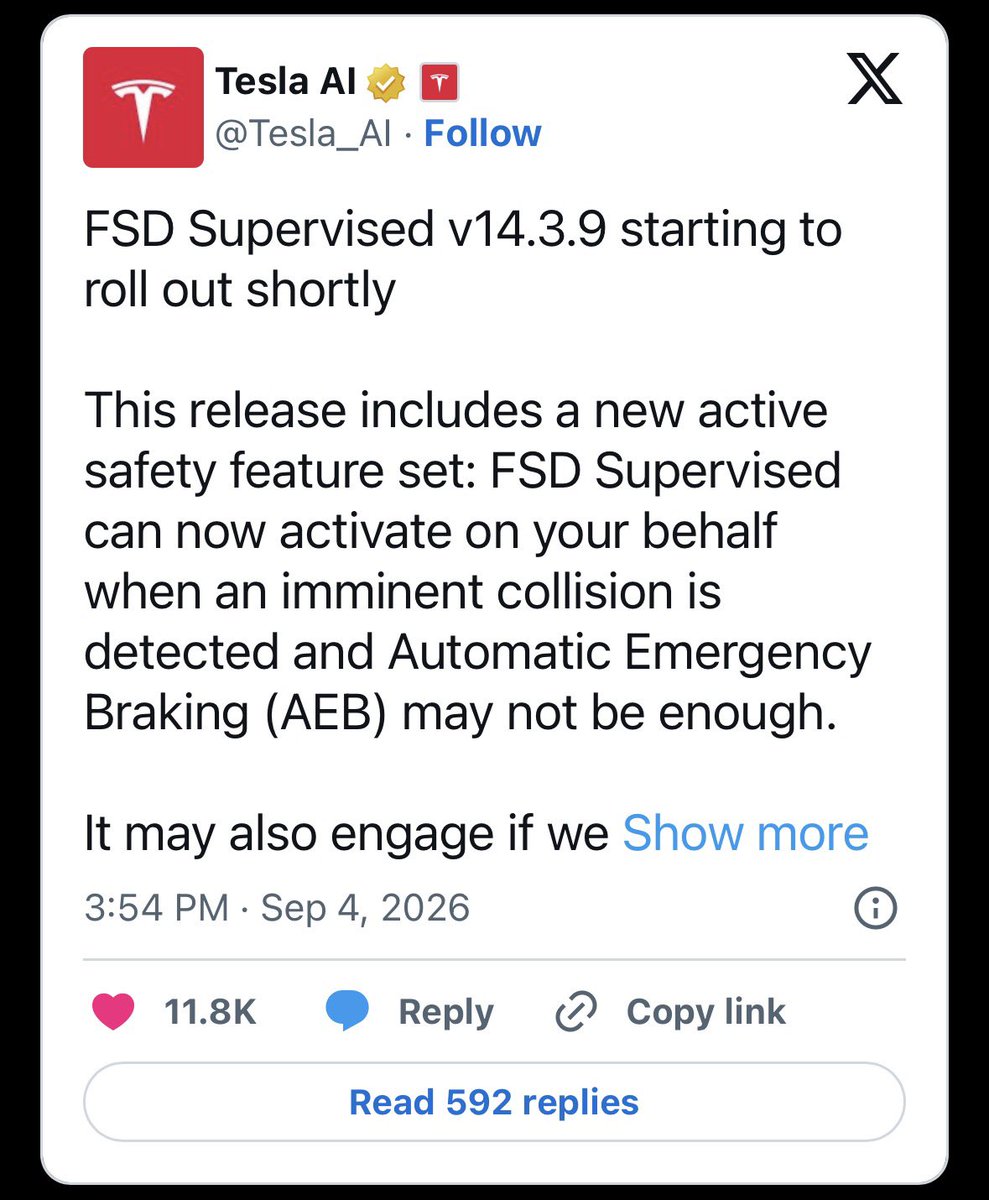
Tesla FSD v14.3.9 Coming Soon, Can Automatically Take Control During Manual Driving to Avoid a Crash.
Tesla says FSD (Supervised) v14.3.9 will begin rolling out shortly, introducing a new active-safety feature called Automatic Collision Evasion.
The major change is that FSD can activate even when the driver is manually controlling the vehicle. If Tesla detects an imminent collision and determines that Automatic Emergency Braking alone may not be enough, FSD can take control of steering, braking and acceleration to perform an evasive maneuver. It may also intervene when severe driver distraction is detected or when FSD appears to have been unintentionally disengaged.
Tesla employees are currently testing v14.3.9, with broader early-access deployment expected next.
Wells Fargo Says Tesla’s Cybercab Launch Likely Fell Short of Investor Expectations as $TSLA Slides 6% — Wells Fargo
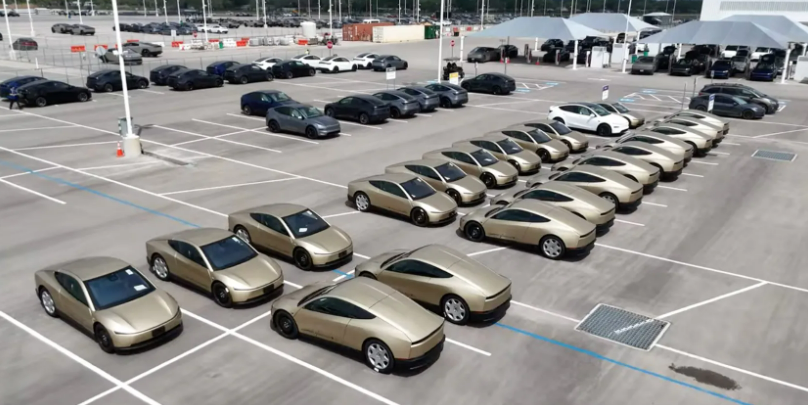
Wells Fargo said Tesla’s Cybercab launch likely fell short of investor expectations, highlighting that only about 45 Cybercabs were registered in Texas around the launch.
GLJ Research also reiterated its Sell rating on TSLA, describing the Cybercab event as a classic “sell-the-news” moment. Tesla shares fell roughly 6.4% intraday, wiping out the previous session’s 5.4% Cybercab-driven gain.
Tesla Could Use Regulatory Gray Areas to Expand Cybercab, With Any Clash Potentially Heading to Court
A new Reuters analysis says Tesla may have room to push ahead with Cybercab deployment because the U.S. regulatory system allows automakers to self-certify compliance with federal vehicle-safety standards, rather than requiring government approval before a new vehicle reaches public roads. Industry experts say regulatory gray areas could give Tesla an opening to broaden Cybercab use.
NHTSA has opened an audit covering roughly 1,000 Cybercabs, examining the technical process Tesla used to determine that vehicles without steering wheels, pedals or mirrors comply with federal safety standards. Experts cited by Reuters said that if regulators challenge Tesla’s interpretation, the dispute could ultimately move into the courts rather than automatically stopping deployment.
TSLA Slides About 2% Premarket as Cybercab Scale and Regulatory Questions Come Into Focus.
Tesla shares are down roughly 2% in Friday premarket trading after gaining more than 5% ahead of the Cybercab launch on Thursday. Investors are now focusing on the limited scale of the initial rollout and regulatory uncertainty surrounding the steering-wheel-free vehicle.
Only 45 Cybercabs are currently registered in Texas, versus 420 total Tesla Robotaxi vehicles in the state, and service remains limited to parts of Austin. NHTSA has also confirmed that it is in contact with Tesla and evaluating the Cybercab rollout.
U.S. Auto Safety Regulator Begins Reviewing Tesla’s Cybercab Rollout
The National Highway Traffic Safety Administration (NHTSA) says it is in contact with Tesla and evaluating the company’s rollout of the Cybercab, following the deployment of the purpose-built autonomous vehicle in Austin. The Cybercab has no steering wheel, pedals or side mirrors, equipment normally addressed by federal motor-vehicle safety standards.
Tesla has already placed Cybercabs into its Austin Robotaxi service, while NHTSA is assessing the regulatory situation surrounding vehicles that lack conventional controls. The agency has not yet disclosed the details of its review or indicated what action, if any, it may take.
Tesla Cybercab Goes Live in Austin Robotaxi Service With 45 Vehicles.
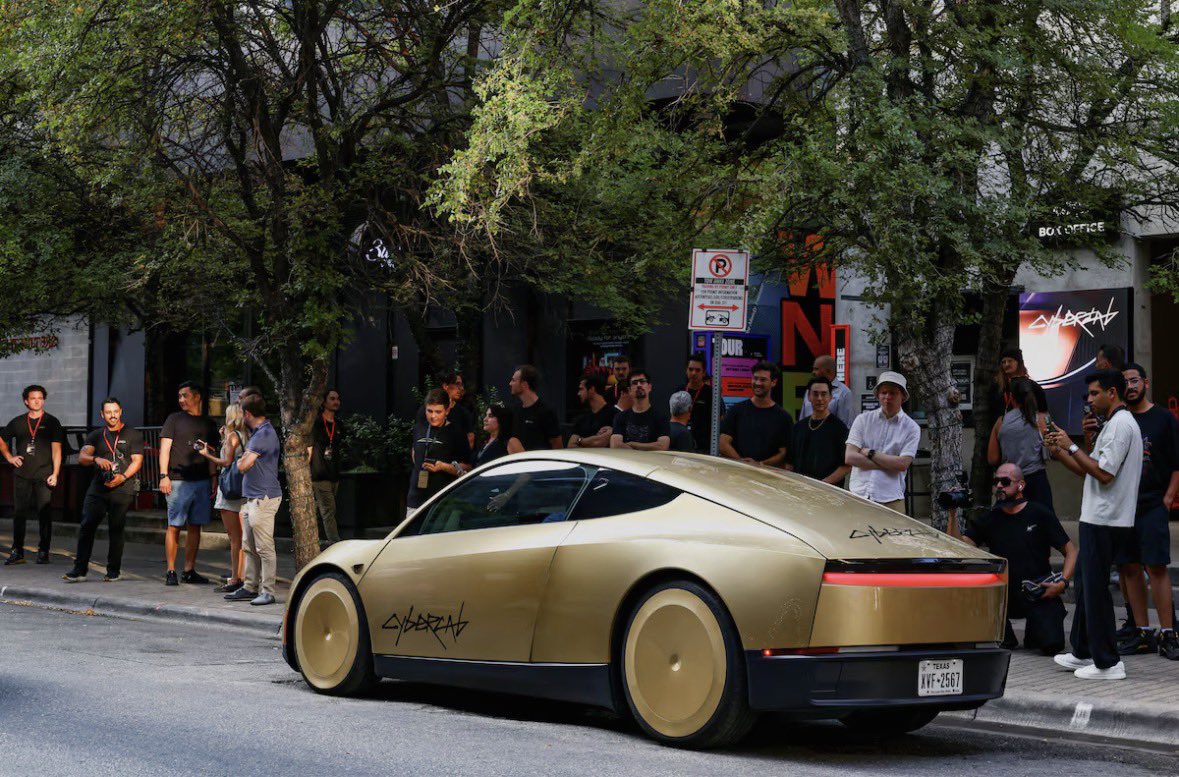
Tesla’s steering-wheel- and pedal-free Cybercab has entered real-world Robotaxi service in Austin. Riders can now select a Cybercab directly through Tesla’s Robotaxi app, with 45 Cybercabs currently operating in Austin. Tesla’s total registered Robotaxi fleet in Texas, including Model Ys, now stands at 420 vehicles.
The future of transport is safer, more enjoyable & gives you more time back
With theater, music & gaming apps on a 22" touchscreen, Cybercab offers you a space to be productive or unwind
Soon to be equipped with V5 Starlink hardware, too, for complete connectivity
Tesla Opens the Door to Third-Party Cybercab Fleet Purchases.
Tesla is beginning to formally explore selling Cybercabs to outside operators rather than relying exclusively on company-owned vehicles. A newly published Help Us Build Our Robotaxi Network form allows businesses to express interest in Cybercab fleet vehicle purchasing, mobility hubs and infrastructure, event collaboration and other Robotaxi opportunities.
This appears to be Tesla's first official public channel for prospective commercial Cybercab fleet purchases. Tesla has not yet disclosed fleet pricing or delivery timing, and submitting the form does not constitute a confirmed vehicle order.
Tesla Officially Launches Steering-Wheel-Free Cybercab Service in Austin.
Tesla has officially deployed its purpose-built Cybercab with no steering wheel or brake pedals into its Robotaxi service in Austin. Unlike Tesla’s existing Model Y-based robotaxis, passengers have no physical driving controls, marking the transition of Tesla’s dedicated autonomous vehicle into real-world service.
Cybercab operates using Tesla’s camera-based autonomous-driving system, and Tesla plans to expand the service beyond Austin. Tesla currently operates more than 200 unsupervised robotaxis across several cities, while Waymo operates roughly 4,000 vehicles across 14 cities.
Musk Highlights Cybercab’s Cost Advantage Hours Before Launch.
Elon Musk responded to a comparison suggesting that $1 million could buy roughly eight Waymo Ojai robotaxis versus about 40 Tesla Cybercabs, effectively reinforcing Tesla’s argument that Cybercab can deliver a dramatically lower vehicle-level capital cost.