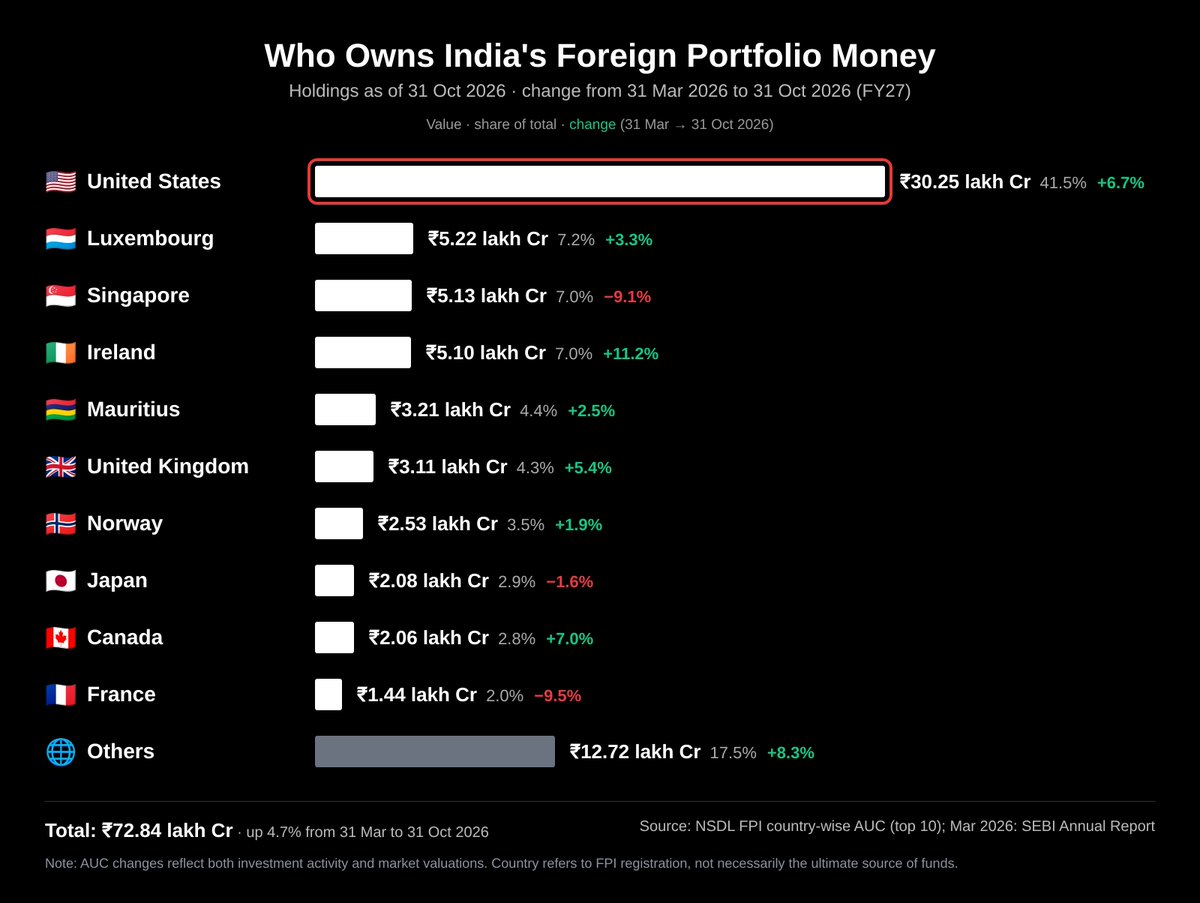
Foreign portfolio money in India (NSDL, Oct 2026)
🇺🇸 US: ₹30.25 lakh Cr
🇱🇺 Luxembourg: ₹5.22 lakh Cr
🇸🇬 Singapore: ₹5.13 lakh Cr
🇮🇪 Ireland: ₹5.10 lakh Cr
🇲🇺 Mauritius: ₹3.21 lakh Cr
🇬🇧 UK: ₹3.11 lakh Cr
The US alone holds more than the next 7 countries combined.
SEBI doesn't want IPO GMP to be published by market players. The intention is right but we believe it is not in the best interest of retail investors.
IPO GMP, whether it is published or not, will still exist. Retailers won't be able to access it but insiders will continue to have that information.
Level playing field will be lost.
Such is the impact that Nasdaq has halted futures trading after rising +7% today.
Jensen Huang is the father of the AI revolution. You can't fire him. He is back with a bang.
Something interesting in the order filings this week.
Three different wagon makers announced orders from the same customer, JSW, within four days.
Jupiter Wagons got a ₹128 crore repeat order on 20 November. Texmaco Rail got ₹230.58 crore for 553 wagons the next day. And today, Titagarh Rail got ₹77.09 crore for 184 wagons.
Put together, that's roughly ₹436 crore of wagons from one group.
What is JSW planning to move and why they split the orders across three companies?
Same morning, same sector, opposite days.
Korean media called it “Black Monday”. The AI selloff hit Seoul again, and the Kospi fell around 4%, a day after a 5.2% drop.
Korean tech took the worst of it. Samsung SDS −14%, LG CNS −13%, Naver −7%, Kakao −6%.
In India, IT was green. TCS +4.4%, Tech Mahindra +3.1%, Infosys +1.6%.
Two AI selloffs in two sessions, and India has gone the other way both times. How long that lasts is anyone’s guess.
Something interesting is happening with FIIs.
They haven’t sold a single day in the last two weeks. That’s 9 sessions of buying in a row.
On November 11, they bought ₹12,560 crore. Friday saw another ₹10,310 crore of buying. This was happening even as Taiwan and Korea were down 5-6%.
So far, that’s roughly ₹66,000 crore in buying.
But look at the bigger picture. FIIs are still net sellers by around ₹2.1 lakh crore in 2026.
They were selling heavily when the market was falling. Now that markets have recovered, they’re back on the buying side.
DIIs have gone the other way, selling around ₹55,000 crore this month.
Week Ahead | 23–27 Nov
A fairly packed week coming up.
On Monday, Mahanadi Coalfields' ₹8,981 crore IPO closes. Midway through, institutions had bid for more than their share, while retail was still well short. It will be interesting to see if that changes on the last day. The RBI is also reportedly meeting NBFC heads, with gold-loan bad debts on the agenda.
Tuesday is the monthly F&O expiry, so expect some extra movement.
On Wednesday, Mahanadi shares get allotted, and Foodlink F&B's IPO opens on the 26th.
US markets are shut on Thursday for Thanksgiving, which usually means quieter global trading.
Mahanadi lists on Friday.
Right after that comes October industrial output on the 28th, Q2 GDP on 30 November, and the RBI policy on 4 December.
The one thing worth watching through all of it is whether foreign investors keep buying.
Stock in Focus: NSE
When NSE listed in September, it was the world’s 8th most valuable exchange company. This week, it moved up to 5th, just past Hong Kong’s exchange and Nasdaq.
Its market value is now about ₹5.56 lakh crore, or roughly $60 billion. At the IPO price, it was valued at about ₹4.4 lakh crore. That’s around 26% added in two months.
The business itself is easy to understand. An exchange earns a small fee every time someone trades, and India has become one of the busiest trading markets in the world.
The gap with Hong Kong and Nasdaq is only a couple of billion dollars, so the ranking could flip any day. Still, it’s a decent measure of how much India’s markets have grown.
Sector of the Week: Banks
If one sector carried the market this week, it was banks.
Nifty Bank hit a record high on four of the five days. On Friday, it rose 2.5% and closed at a record 64,635, while most of Asia was falling. Axis Bank and HDFC Bank were among the day's biggest gainers.
Part of the reason is simple. Banks make up a big share of the index, so when foreign investors come back to India, banks are usually where a lot of that money goes first.
Prices are only half the picture, though. What decides how banks do over the next year is whether loans keep growing and borrowers keep repaying. Those numbers show up in quarterly results, not in a week of rallies.
GTA VI release date was 19 November 2026.
That night, Wall Street fell for the sixth day in a row. Next morning, Taiwan dropped 6.2%, Korea 5.2% and Japan 5.1% in the AI selloff.
GTA (1997): Asian financial crisis
GTA III (2001): the dot-com bust
GTA IV (2008): the global financial crisis
GTA V (2013): the rupee hit a record low weeks before launch
GTA VI (2026): AI selloff ?
Mere coincidence ?
Week Summary | 16–20 Nov
It was an odd week to be watching markets. Most of Asia had a rough time, and Indian markets still ended up higher.
The Nifty rose about 2.6% for the week to 25,800.60, its highest close in nine months. The Sensex rose about 2.9% to 83,919.71. That's four weekly gains in a row.
Friday showed the contrast best. Taiwan fell 6.2%, Korea 5.2% and Japan 5.1% as the AI selloff spread. India was the only major Asian market that closed higher.
The rupee gained for five straight days, from 94.19 to the dollar last Friday to 92.67 this Friday. That's its strongest close in about seven months. Gold went the other way, hitting a 14-month low after five straight days of losses.
A lot of this comes back to foreign investors, who kept buying through the week.
Money that comes in this fast can also leave fast. Next week should tell us a little more.
When NSE listed in September, it was the world’s 8th most valuable exchange company. As of today, it’s 5th, just ahead of Hong Kong’s exchange and Nasdaq.
Its market value is now about ₹5.56 lakh crore, or roughly $60 billion. At the IPO price, it was valued at about ₹4.4 lakh crore. That’s around 26% added in two months.
The reason isn’t complicated. An exchange earns a small fee every time someone trades, and India has become one of the busiest trading markets in the world. More investors, more trades, more fees.
The four ahead of it are CME, the NYSE’s owner, Deutsche Boerse and the London Stock Exchange. All of them have been around far longer as listed companies.
Whether NSE holds this spot is hard to say. The gap with Hong Kong and Nasdaq is only a couple of billion dollars, and it can flip in a day. Still, it’s a good measure of how much India’s markets have grown.
Silver has fallen about 28% in 30 days.
₹1 lakh of silver bought a month ago is worth roughly ₹72,000 today.
Gold isn't far behind. MCX gold fell about 4% today to near ₹1.22 lakh per 10 grams. That's a 14-month low, and its fifth straight day of losses. Silver fell close to 6% today alone.
Most of the reasons are outside India: a strong US dollar, and growing expectations that the US Fed will raise rates next month. When interest rates go up, metals that pay no interest start to look less attractive.
There is one small cushion for Indian buyers. The rupee crossed 93 this week, its strongest since April, so imported gold costs a little less in rupee terms.
The wedding season is close. Whether lower prices bring buyers back is the thing to watch.
13 major Asian markets. 12 of them closed in the red today.
The only one in green was India, up 1.1%.
Taiwan fell 6.2%, Korea 5.2%, Japan 5.1%. These markets are full of chipmakers and AI suppliers. When AI stocks crack, they crack with them.
For most of the last two years, India was the market people said had missed the AI boom. No Nvidia, no TSMC, no big chipmakers. Foreign investors kept selling Indian shares while AI stocks elsewhere kept rising.
Today, that gap worked the other way. There wasn't much AI in India to fall.
Foreign investors have also bought over ₹1 lakh crore of Indian shares so far in November. It's hard to say how much of that came straight out of Korea or Taiwan. Some of it probably did.
One day doesn't change a two-year story. If AI stocks bounce back next week, the money could move again just as quickly. But today was a good reminder that what a market doesn't own can matter as much as what it does.
Indian stocks have added about ₹34 lakh crore in value this month.
Only one month this year added more. April, with ₹50.88 lakh crore.
The Nifty is up about 2,250 points in November and is at a 10-month high.
Picture someone who looked at their portfolio at the end of October, didn't like the number, and stopped checking.
Three weeks later, it's a different number.
Foreign investors have been a big part of it. Between 2 and 18 November, they bought a net ₹94,229 crore of Indian shares.
When people talk about who benefits from new refineries or the data centre boom, pumps rarely come up.
But almost every big facility needs them, to move crude, cooling water and much more.
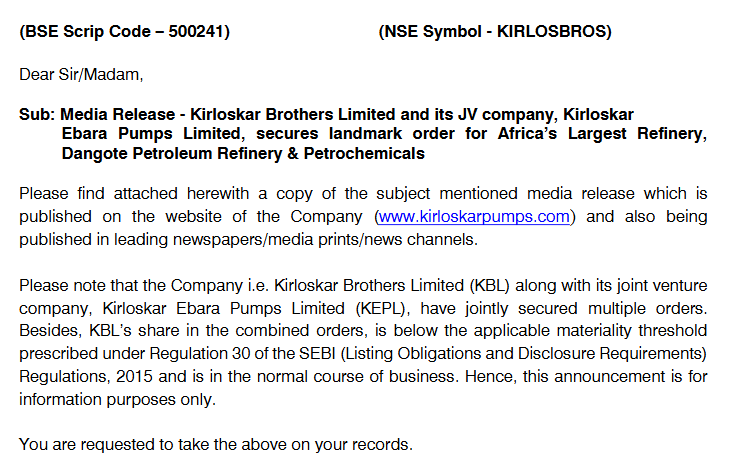
Today Kirloskar Brothers said it has won an order, along with its JV, for Dangote, Africa’s largest refinery. Its share is ₹165 crore. It also said it is “very close” to a large framework contract with US data centre operators.
The second one isn’t signed yet. If it happens, it says something about where Indian engineering companies are finding demand.
What a way to close the week for Indian markets.
The day started badly. The global AI selloff hit Asia, and the Sensex opened sharply lower.
It closed at 83,919, up 898 points. From the morning low, that's a swing of well over 1,000 points in a single session.
For the week, the Nifty rose about 2.6% and the Sensex about 2.9%. That's four weekly gains in a row.
Banks did most of the work. Nifty Bank crossed 64,000 for the first time, its fourth record in five sessions. Axis Bank and HDFC Bank were among today's top gainers, with Apollo Hospitals, Max Healthcare and Maruti. Titan, Tata Steel, NTPC, Eternal and Dr Reddy's ended lower.
The Nifty closed at 25,800.60, a 10-month high.
A lot of this has been foreign money. FIIs had bought for 14 straight sessions through yesterday, and their November buying has crossed ₹1 lakh crore. The rupee moved past 93 this week for the first time since April.
How long that continues is anyone's guess. For this week, India held up through a shaky start.
SEBI is testing an AI tool to flag early signs that a company may default on its debt.
It sounds technical. The reason behind it is simple.
In August 2018, IL&FS had the highest credit rating possible. AAA. Six weeks later, it missed a payment. For people holding its bonds, that was roughly all the warning they got.
The new tool will watch disclosures from rating agencies, debenture trustees, exchanges and depositories. In most of these cases, the clues are public. Nobody can read all of them, for every company, every day.
Whether it works will only be clear after the next stress event. Even turning six weeks of warning into six months would change a lot for bondholders.
Finally, a red candle Indians will be happy to see.
This is the dollar-rupee chart. Every red candle means one dollar buys fewer rupees. Today it crossed below 93, the strongest the rupee has been since April. A month ago, it was around 95.80.
Indian travellers heading abroad this winter will be happy too. A $2,000 trip budget now costs about ₹5,600 less than it would have a month ago. The same goes for parents paying fees for children studying overseas.
Part of the reason is foreign money. Between 2 and 18 November, foreign investors bought a net ₹94,229 crore of Indian shares, and to do that they first had to buy rupees.
It shows up in gold too. India buys almost all its gold in dollars, so the stronger rupee is partly why gold fell about 4.5% on MCX today, against roughly 3.3% globally.
Sometimes the most useful chart to watch is the one that's falling.