Indian markets & options, decoded. OI • price action • risk • psychology. I share my trading process, not promises. Educational only. Not SEBI registered.
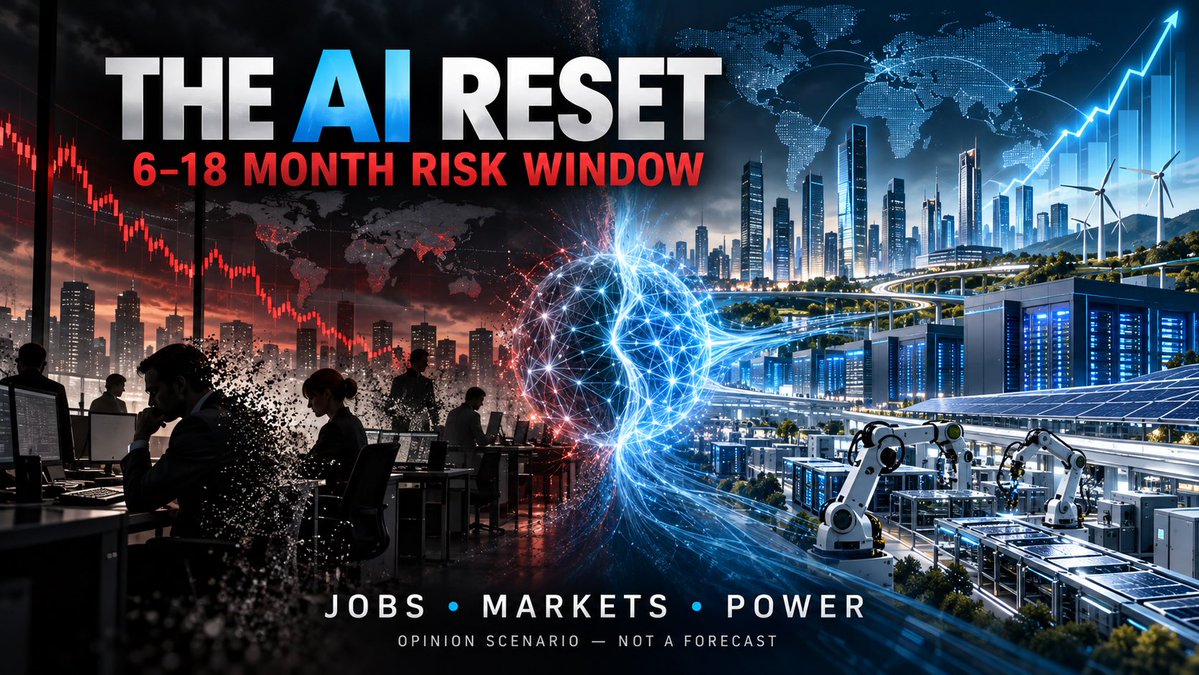
‼️🚨THE AI RESET MAY BE CLOSER THAN WE THINK🚨‼️
The concern is no longer whether AI will affect employment. It is how quickly companies will discover that one AI-enabled employee can perform work previously requiring an entire team.
Anthropic’s latest economic research presents an extreme 2030 scenario in which AI performs nearly one-third of economic work, white-collar employment falls by more than 20%, and labour’s share of income drops from 60% to 45%.
The ILO also identifies business, finance, computing and education among the most AI-exposed fields.
My concern is that we may have only 6–18 months before the employment model begins changing radically—not that every job disappears overnight, but that mass hiring starts breaking.
Entry-level developers, analysts, writers, customer support, administration, operations and routine finance or legal work could be compressed first. Physical, regulated and accountability-heavy roles may survive longer—but far fewer people may be needed across the wider economy.
My market thesis is even darker:
A transition this large rarely happens peacefully. War, recession, an American debt or dollar crisis, de-dollarisation, or an AI-investment collapse could become the trigger—or the public explanation—for a global economic reset.
That does not mean someone has deliberately planned a “scapegoat.” It means an already fragile financial system may use the next major shock as its reset button.
If that happens, almost every stock market could reprice violently. Even today’s fashionable AI stocks may crash first if their valuations and spending cannot produce real returns.
The eventual winners will not be companies merely adding “AI” to their names. They will be businesses with real revenue, proprietary technology or data, access to compute and energy, strong distribution, and AI-native operations requiring a minimal human workforce.
AI may make the economy dramatically more productive while transferring income and power from workers to owners of capital.
The technology is arriving faster than governments, education systems and society can adapt.
This is not a guaranteed prediction. It is my six-to-eighteen-month risk thesis—and I believe the preparation window is closing.
Research:
https://t.co/U7oFmPK42P
https://t.co/3aJiozqn1J
https://t.co/W4txNBClgq
Not financial advice.
Satyagraha went live 9 hours ago. Since then, more than 10,000 people and groups have come forward.
That's how many struggles Indians are already fighting - quietly, convinced no one was listening.
We are listening. Every submission will be read. Already, we see stories in the topics of education, corruption, social justice, farmers, labour, health, women’s safety, land and environment.
Our team will go through each one, work out how we can help, and reach out where more details are needed. Where any genuine struggle needs to be amplified to be resolved, we will do it.
This is only the beginning. Satyagraha isn't a one-day campaign. It will run for years, and it will stand with every andolan, big or small.
Thank you for speaking up and for standing up for the Constitution.
If you haven't yet, tell me your story 👉 https://t.co/hJ8iARr5La
Mr Soni, if your post was 1-2 years ago, I would have agreed. But today, after all that @realDonaldTrump has done for America since returning to office, America is still, and will remain, a superpower for at least a couple of decades or even more.
Governments normally refinance maturing debt. The realistic goal is to reduce or stabilize the debt-to-GDP ratio, not eliminate every dollar of debt.
As someone with an MBA in economics, my short reply is:
Your claim that $100 will be worth only $0.10 is extreme. It would require nearly 26% annual inflation for 30 years. At 2–3% inflation, $100 retains roughly $55–$41 in purchasing power after 30 years, while 2–2.5% real GDP growth makes the economy around 1.8–2.1× larger.
That’s a gradual erosion of the debt’s real value, not a formal default. At most, it could be described as a gradual “soft default” through inflation.
The $40T US government debt won't be paid off
The US government will default by debasing the dollar
By the time the debts mature, the dollar will be worth nearly nothing, and youll still get whatever the face value is on the debt
Eg. You gave the US $100 today, you'll get back $100 in 30 years but that $100 will be worth $0.10.
And if you’re talking about a software for tracking transfers and transactions using blockchain, I can make that in 6 hours. You don’t need any high tech sh*t.
I just need 3 cups of coffee for every 2 hours and an Apple laptop/iphone 1TB. 🤓
Sab Jumle hai Tax payers ka paisa thikane lagane k liye.
Madam. Learn about Blockchain technology first cause whatever high tech development you’re BSing about is already there for the world to use and its called “Blockchain Technology” 😄
You can track each and every transfer/transaction on Blockchain.
Trust me “Ache Din” for America is near.
Every Citizen of America will be blessed with “Universal High Income” as @elonmusk says.
It’s the only option left for government to keep the economy functioning.
It’s Inevitable !!!
https://t.co/Lrog0MC4O8
This is my long-term vision—not a prediction tied to any particular date.
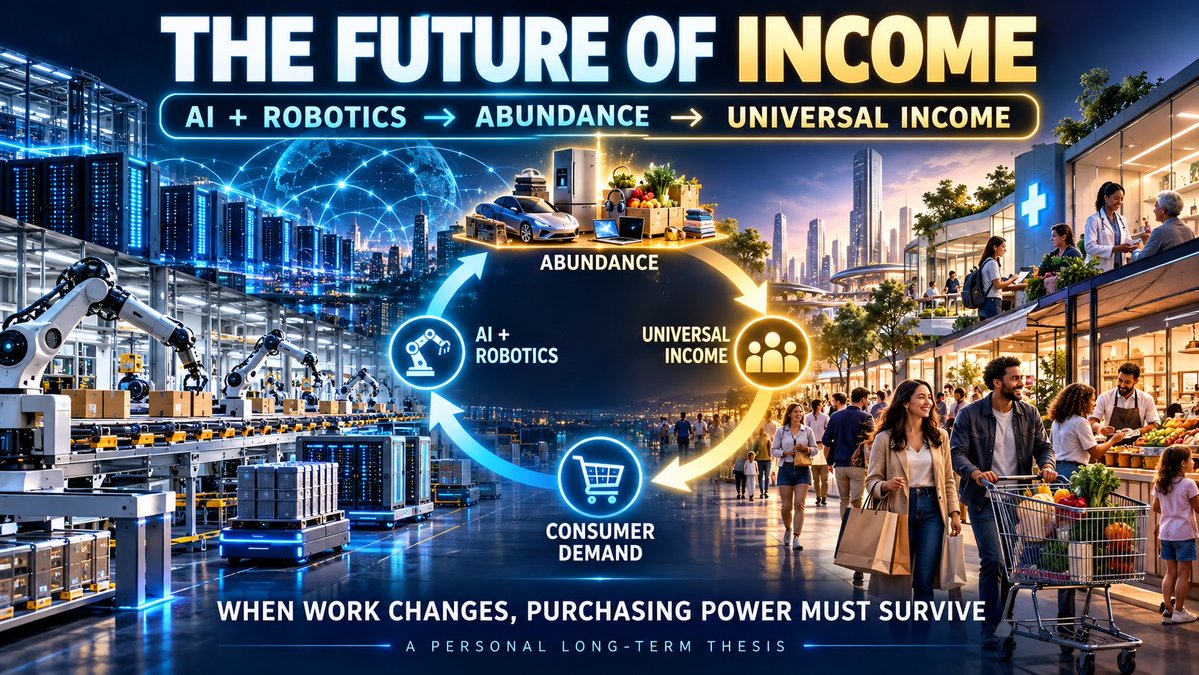
It could take 5, 10, 20 or even 30 years, but I believe AI and robotics will eventually automate such a large share of human work that governments will have to provide people with a universal income.
Why? Because an economy cannot survive without consumers.
Companies may produce more with fewer employees, but if millions lose their wage-based purchasing power, who will buy those goods and services? To preserve demand and keep the economy functioning, governments may have to distribute part of AI-generated prosperity through UBI, a social dividend or what Elon Musk calls “universal high income.”
This is not an entirely untested concept. Unconditional-cash experiments have already been conducted in India, the United States, Finland and elsewhere.
The findings are mixed and don’t prove that nationwide UBI would be simple. But they show that people frequently spend this money on necessities—and receiving cash doesn’t automatically make everyone stop working.
My conviction is that money may not disappear, but it will gradually lose its present importance to basic survival. A traditional job may no longer remain the only route to having an income.
AI is unstoppable. The challenge is ensuring that the enormous wealth it creates reaches ordinary people—because without mass purchasing power, even the most productive economy cannot sustain itself.
If managed properly, this could become an age of abundance instead of an age of unemployment.
The timeline is uncertain. The direction, in my opinion, is not.
Research:
India/UNICEF basic-income pilots:
https://t.co/dg0L5Uswip
U.S. unconditional-cash study:
https://t.co/3SmJ1gnWxA
Finland basic-income experiment:
https://t.co/w80MmZvxxD
Elon Musk on “universal high income”:
https://t.co/8SOCH5D115
A suggestion for @XDevelopers from my side:
Please don’t let one recent search dominate the entire timeline. For example: If I explore AI or coding today, it doesn’t mean I want every post to be about developers.
Consider users’ weekly or monthly interests and create a balanced content mix instead of overreacting to their latest activity.
‼️🚨THE AI RESET MAY BE CLOSER THAN WE THINK🚨‼️
The concern is no longer whether AI will affect employment. It is how quickly companies will discover that one AI-enabled employee can perform work previously requiring an entire team.
Anthropic’s latest economic research presents an extreme 2030 scenario in which AI performs nearly one-third of economic work, white-collar employment falls by more than 20%, and labour’s share of income drops from 60% to 45%.
The ILO also identifies business, finance, computing and education among the most AI-exposed fields.
My concern is that we may have only 6–18 months before the employment model begins changing radically—not that every job disappears overnight, but that mass hiring starts breaking.
Entry-level developers, analysts, writers, customer support, administration, operations and routine finance or legal work could be compressed first. Physical, regulated and accountability-heavy roles may survive longer—but far fewer people may be needed across the wider economy.
My market thesis is even darker:
A transition this large rarely happens peacefully. War, recession, an American debt or dollar crisis, de-dollarisation, or an AI-investment collapse could become the trigger—or the public explanation—for a global economic reset.
That does not mean someone has deliberately planned a “scapegoat.” It means an already fragile financial system may use the next major shock as its reset button.
If that happens, almost every stock market could reprice violently. Even today’s fashionable AI stocks may crash first if their valuations and spending cannot produce real returns.
The eventual winners will not be companies merely adding “AI” to their names. They will be businesses with real revenue, proprietary technology or data, access to compute and energy, strong distribution, and AI-native operations requiring a minimal human workforce.
AI may make the economy dramatically more productive while transferring income and power from workers to owners of capital.
The technology is arriving faster than governments, education systems and society can adapt.
This is not a guaranteed prediction. It is my six-to-eighteen-month risk thesis—and I believe the preparation window is closing.
Research:
https://t.co/U7oFmPK42P
https://t.co/3aJiozqn1J
https://t.co/W4txNBClgq
Not financial advice.