"You only find out who is swimming naked when the tide goes out." Warren Buffett, 2001 Berkshire letter.
Cochin Shipyard's revenue rose 11.7% last quarter. Its net profit fell 49.8%. The segment table shows where.
Cochin Shipyard Q2 FY27 (consolidated, year on year, results filed with NSE on 10 Nov):
- Revenue from operations: +11.7% (₹1,249.19 cr vs ₹1,118.59 cr)
- Ship repair revenue: +29.6% (₹466.05 cr vs ₹359.60 cr)
- Shipbuilding revenue: +3.2% (₹783.14 cr vs ₹758.98 cr)
- EBITDA: −30.7% (₹51 cr vs ₹73.6 cr), margin 4.1% vs 6.6% (CNBC-TV18)
- Net profit: −49.8% (₹54 cr vs ₹108 cr)
- Shipbuilding segment profit before interest and tax: −₹6.08 cr vs +₹149.71 cr
- Ship repair segment profit before interest and tax: +₹143.34 cr vs +₹67.20 cr
- H1 operating cash flow: −₹635.37 cr
- Exceptional items: nil, so this is not a one-off line
How the filing explains it:
1. The repair yard carried the quarter. Ship repair made ₹143.34 cr of segment profit on ₹466.05 cr of revenue. Shipbuilding made a loss of ₹6.08 cr on ₹783.14 cr.
2. Shipbuilding was profitable earlier this year. Its six-month segment profit is ₹57.81 cr, so the July to September quarter alone turned negative.
3. Costs ran ahead of sales. Total expenses were ₹1,256.72 cr, larger than revenue from operations of ₹1,249.19 cr. Cost of materials consumed was ₹682.78 cr and subcontract and other direct expenses ₹275.80 cr.
4. Other income kept profit positive. The filing shows other income of ₹82.62 cr and profit before tax of ₹75.10 cr.
5. Cash went the other way. H1 operating cash flow was −₹635.37 cr, and CNBC-TV18 reports borrowings up 62% from a year ago.
What the company had promised, as reported by CNBC-TV18: "Earlier, Cochin Shipyard had guided for revenue growth of 12% with a potential to reach 15% on the upside, along with EBITDA margin of 14%." At the end of H1, the same report puts revenue growth at 7% and margin at 9%.
The same season, other listed defence shipyards (Q2 FY27, year on year):
- Mazagon Dock: revenue −16.5% (₹2,446.09 cr), net profit −54.1% (₹344.12 cr vs ₹749.48 cr) (ETInfra)
- GRSE: revenue +9% (₹1,827 cr), PAT +12% (₹172 cr vs ₹154 cr) (press release, 11 Nov)
GRSE's CMD, in that press release: "The Q2 & H1 FY27 results have been encouraging, with GRSE once again delivering a strong financial performance."
What to watch next quarter (from the filings, not a call):
1. Shipbuilding segment profit before interest and tax: back above zero or not
2. Ship repair revenue and segment profit, the part that held up
3. Operating cash flow and borrowings in the H2 numbers
4. Revenue growth and EBITDA margin against the 12% and 14% guidance
What the data can't tell us: which ships or contracts caused the shipbuilding loss. The segment table gives one line for all of shipbuilding, not a project split.
Our read: one yard, two businesses. Repair doubled its profit. Shipbuilding, the bigger business, made a segment loss this quarter. The headline revenue number hid both.
Revenue tells you how busy a company was. The segment table tells you what it earned.
Cochin Shipyard (NSE: COCHINSHIP) fell as much as 8% to ₹1,186.50 on 11 Nov after the results (ET) and last traded at ₹1,202 (Yahoo Finance, 11 Nov).
Not investment advice. Do your own research.
When a company reports two segments, do you check the segment profit table or stop at total revenue?
3.66%. Nifty IT jumped that much on Thursday. By 9:34 am today, TCS, Infosys and HCLTech were each down about 2%.
Nifty 50 opened at 25,839.25 against Thursday's close of 25,884.50, 45.25 points lower (our calculation, −0.17%). Sensex opened at 84,093.24 against 84,328.59 (NDTV Profit, Times Now).
Early trade, Strota live data, 9:34 am:
• TCS: −2.13%
• HCLTech: −1.89%
• Infosys: −1.88%
• Titan: +2.77%, top Nifty 50 gainer
• Tata Steel: +1.60%
• Nifty 50: 22 stocks up, 27 down
Why it matters: the index is nearly flat because IT is giving back part of Thursday's jump (3.7% per Axis Direct) while Titan and metals rise. Midcap 100 and Smallcap 100 are up about 0.4% to 0.6% (NDTV Profit, DSIJ). Brent is near $96-97 after Gulf supply attacks (Times Now, NDTV Profit).
The limit: these are first-25-minute moves and can change in minutes. We found no two-source reason for Titan's move today.
Keep this: a flat index can hide a big IT drop and a broad rise elsewhere. Check the sectors before the headline.
After a 3.66% one-day IT jump, do you read a 2% pullback as profit-booking or a change of mood?
Stocks named only for data. Not a recommendation. DYOR.
$96.57. Brent rose on both days of this week's Gulf attacks. Yet gold, the metal many of us buy for bad times, hit a 15-month low.
US markets were shut on Thursday for Thanksgiving, so there is no fresh US close. The last one is Wednesday's: Dow +0.33%, S&P 500 −0.25%, Nasdaq −0.62%.
The oil side:
• Brent rose 3.51% to $94.61 on Wednesday, then $1.96 more to $96.57 on Thursday
• That is $5.17 a barrel in two sessions, up 5.66% (our calculation from the settles)
• Yemen's Houthis said they hit Saudi Arabia's Ras Tanura refinery, and Iran said two tankers struck mines near the Strait of Hormuz
The gold side:
• Spot gold slipped below $3,500 an ounce on Wednesday, for the first time since September 2025
• It was near $3,565 on Thursday
• The reason given: bets that the US Fed raises rates again. Gold pays no interest, so higher rates make it costlier to hold
What it means in plain words:
• Costlier crude raises input costs for fuel retailers, paint makers, tyre makers and airlines. Oil producers get more per barrel.
• Cheaper gold lets jewellers buy new stock for less. For gold loan lenders, each gram pledged now backs a smaller amount.
Before 9:15 am:
• GIFT Nifty was at 25,967 at 7:55 am, 28.50 points below its previous settlement (NSE IX). That is a futures price, not the opening level.
• Asia opened mostly higher: Nikkei +1.02%, Kospi +1.81% at 7:54 am (Yahoo Finance data).
A war does not lift every safe asset. This week, oil priced the supply risk and gold priced the Fed.
Which shows up first in your portfolio: costlier crude or cheaper gold?
₹370 cr. That is how much Cipla's India sales added in the September quarter. North America took away ₹396 cr.
If an inhaler at home says Cipla, this is the company. Its Q2 FY27 headline said sales fell 2%. The business table shows a swap.
The swap:
• India (Rx, generics, consumer): ₹3,516 cr vs ₹3,146 cr, +12%, its highest quarterly sales
• North America: ₹1,643 cr vs ₹2,039 cr, −19%
• API and others: ₹107 cr vs ₹259 cr
• India is now 47.5% of sales, from 41.5% (our calc)
What it cost:
• EBITDA margin 18.7% vs 25.0%
• Profit after tax ₹878 cr vs ₹1,351 cr, −35% (our calc)
Why: last year's US base had big gRevlimid sales, and lanreotide supplies are halted by regulatory issues at partner Pharmathen's plant. Management said on the call it does not expect lanreotide back this financial year.
What looks better:
• US sales $172 mn, +$10 mn on the June quarter
• Margin up 200 bps on the June quarter
• Net cash ₹9,823 cr
Management kept its guidance: a $1 bn yearly US run rate by the end of FY27 and full-year EBITDA margin of 18.5% to 20%. Those are its targets, not ours.
Caveats: one quarter only. Cipla does not report profit by business, so we can't say how much of the profit India now makes. R&D was 5.7% of sales, below its own 6% to 7% guide, which also helped this quarter's margin.
Keep this: a falling total can hide a growing core. Read the business table before the headline.
Which matters more to you in a pharma result: India growth or the US recovery?
Cipla numbers from its 27 Oct filing and call. Not a buy or sell call.
₹5,843.33 crore. Foreign funds bought more today than on Monday or Wednesday, yet the Nifty rose only 0.25%.
NSE's provisional cash-market data for 26 Nov:
• FIIs bought ₹17,879.74 cr, sold ₹12,036.41 cr. Net: +₹5,843.33 cr
• DIIs bought ₹24,352.87 cr, sold ₹18,722.15 cr. Net: +₹5,630.72 cr
Put the last three sessions side by side:
• Mon 23 Nov: FIIs +₹5,672.99 cr, Nifty −1.75%
• Wed 25 Nov: FIIs +₹4,479.08 cr, Nifty +1.85%
• Thu 26 Nov: FIIs +₹5,843.33 cr, Nifty +0.25%
Foreign buying was big on all three days. The index went down, up and barely up. This extends the FII buying run CNBC-TV18 counted at 17 sessions on Wednesday. Today DIIs bought too, so institutions together net bought ₹11,474.05 cr (our sum).
November so far:
• FIIs: +₹1,27,945 cr (our sum of NSE's daily figures; some outlets quote about ₹1.31 lakh crore, so counts differ)
2026 to date, FIIs are still net sellers of about ₹3.20 lakh crore (our sum of NSE's daily figures).
Why the Nifty barely moved: the gain came from one corner. Nifty IT rose 3.66%, while Nifty Bank fell 0.26% and Nifty FMCG and auto also ended lower (NSE).
What the data can't tell us: these are provisional institutional figures. They don't show retail or prop desks, and NSDL's final FPI numbers can differ.
Keep this: a big FII buy tells you who bought. It does not tell you how far the Nifty moves.
Which do you trust more on a day like this, the flow number or the index?
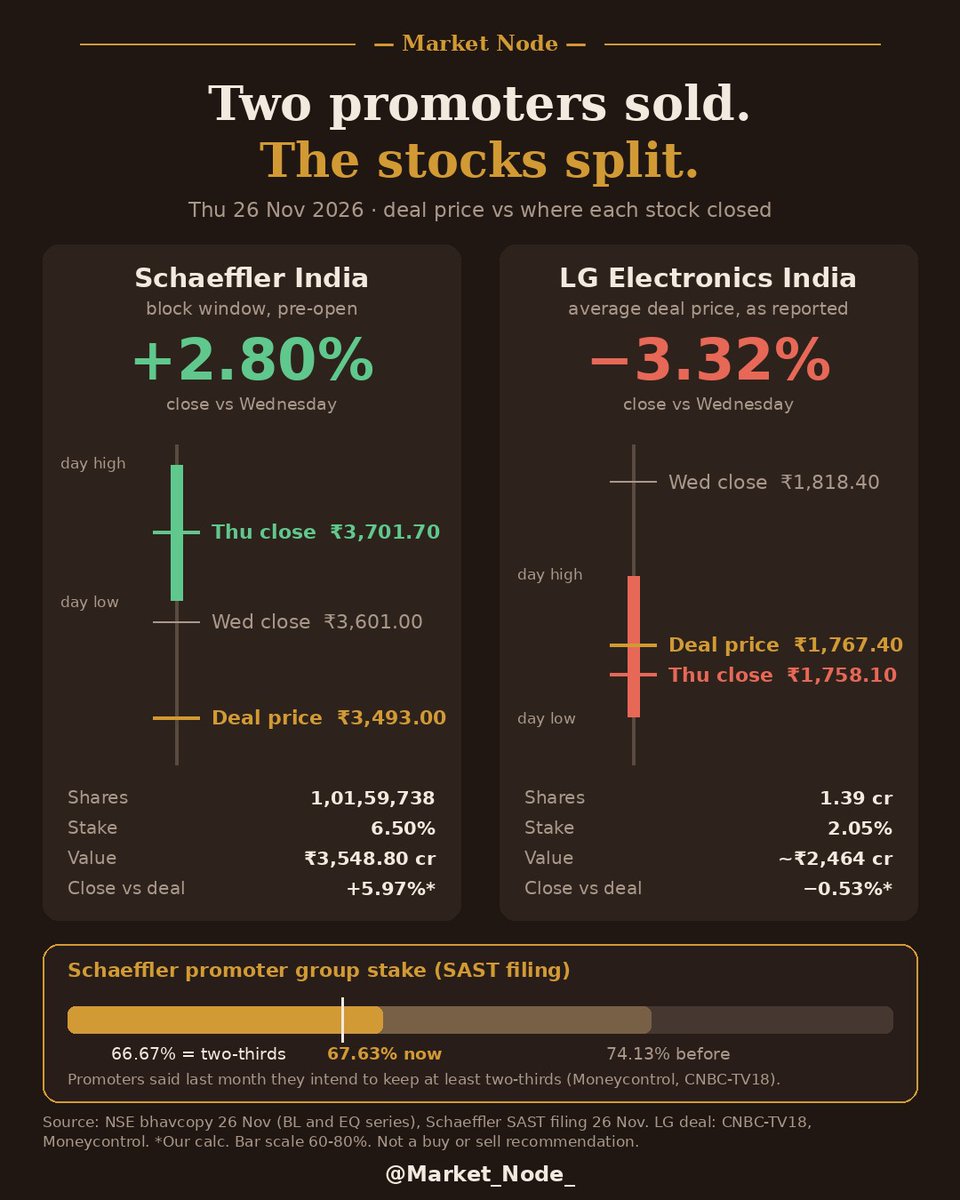
₹3,548.80 cr. That is how much stock Schaeffler India's own promoter sold today. Most of us would expect a fall. It closed up 2.80%.
Same day, the opposite move: LG Electronics India saw a big block a day after its promoter said it would sell, and that stock fell 3.32% (NSE).
Schaeffler India:
• Seller: Schaeffler Schweinfurt Beteiligungs GmbH, a promoter group firm (its SAST filing)
• 1,01,59,738 shares, 6.50% of the company, at ₹3,493 in the pre-open block window
• 3% below Wednesday's close of ₹3,601
• Close ₹3,701.70, 5.97% above the deal price (NSE, our calc)
LG Electronics India:
• 1.39 crore shares, 2.05% of the company, at an average ₹1,767.40, about ₹2,464 cr (CNBC-TV18, Moneycontrol)
• On 25 Nov its Korean parent said it would sell up to 2% by 31 Dec, to meet the minimum public shareholding rule (BusinessLine, Moneycontrol)
• Close ₹1,758.10, below the deal price (NSE)
The detail to note in Schaeffler: its promoters said last month they intend to keep at least two-thirds of the company (Moneycontrol, CNBC-TV18). After today the group holds 67.63% (filing). Two-thirds is 66.67%, a gap of under 1 point (our calc).
Also in today's block window (NSE): Amagi Media, 47,37,204 shares at ₹554, ₹262.44 cr, and Alkem Labs, 3,58,695 shares at ₹5,075, ₹182.04 cr.
What the data can't tell us: why the two moved apart. One day's move is one day.
Keep this: a promoter sale is not one signal. The price, the size and the stake left each tell part of the story.
When a promoter sells, what do you check first: the price, the size or the stake left?
Not a buy or sell recommendation.
3.66%. If you hold an IT fund, you'd expect a US tariff threat to hurt it. Today, the morning after one, Nifty IT led all 15 sectors.
The US plan: tariffs of up to 25% on Indian goods. The Nifty rose just 0.25%. 8 of 10 IT stocks closed up (NSE).
Why IT, on a tariff day:
• The plan targets goods. Experts quoted by Mint see software services as less exposed.
• Global money is leaving crowded AI trades in South Korea and Taiwan, said Geojit's V K Vijayakumar. FIIs have bought about ₹1.31 lakh cr of Indian shares in November (Moneycontrol).
• Wipro rose about 4% after a deal to take over BP finance work involving about 3,000 staff (Moneycontrol, CNBC-TV18).
HCL Tech +6.28%, TCS +4.97% and Infosys +4.70% topped the Sensex (Zee Business).
The catch: even after today, Nifty IT is 10.65% below its level a year ago (NSE).
Second on the board:
• Realty: +3.27%, a 52-week high, up 23.19% in a month (NSE). Moneycontrol linked it to IBBI's project-wise insolvency rules for builders, notified on 30 Oct.
The bottom:
• Consumer Durables: −1.33%, worst of 15.
• FMCG: −0.94%, a day after it led at +3.79%.
• Auto −0.69%, PSU Bank −0.68%.
Every sector's close is on the card.
Keep this: a tariff on goods is not a tariff on services, and today the IT board traded that gap.
When a tariff headline hits, do you check what it actually covers before you react?
Not a buy or sell recommendation.
6,01,580 put contracts were added to Nifty's 1 Dec weeklies by 1:16 pm. Calls added 3,04,079. The Nifty itself moved 0.15%.
That is the rise in open interest since Wednesday's close (NSE option chain, our sums).
So the put-call ratio by open interest went from 0.91 to 1.06 (our calc). More puts than calls are now open.
Yet India VIX, the fear gauge, fell 2.26% to 17.27. The Nifty was at 25,859.25, after a range of 25,733.50 to 25,974.95. It stopped 25 points short of 26,000 again.
Where the new contracts went (1 Dec expiry, contracts):
• Biggest put additions: 25,600 (+64,144), 25,900 (+50,915), 25,800 (+46,291)
• Biggest call additions: 25,900 (+37,145), 25,950 (+34,464), 26,000 (+28,931)
• Most call open interest: 26,000 (1,60,760), then 27,000 and 26,500
• Most put open interest: 25,000 (1,30,839), then 25,500 and 25,600
• Max pain: 25,800, up from 25,700 at Wednesday's close (our calc)
December Nifty futures were at 25,953.70, up 0.06%. Open interest rose 5.4% to 1,94,757 contracts (our calc vs NSE's Wednesday bhavcopy). New positions came in, but with the price flat it is not a clear long or short build-up.
How can puts pile up while VIX falls? Every new put has a buyer and a seller. A higher count says more contracts are open, not who is scared. VIX is built from option prices, and today they priced in smaller moves.
Open interest is a snapshot. It can shift a lot by the close.
Keep this: a put-call ratio above 1 counts contracts. It does not tell you which side is right.
When put open interest jumps but VIX falls, which one do you give more weight?
Data, not a trade call.
−16.6%. If you bought Asian Paints five years ago, that's your price change. Its profit rose 37.8% from FY21 to FY26.
The share price: ₹3,143.10 on 26 Nov 2021, ₹2,621.20 at Wednesday's close (NSE closes via Yahoo Finance, our calc, before dividends).
Five years of filings, FY21 to FY26 (consolidated):
• Revenue: ₹21,712.79 cr to ₹35,584 cr. 10.4% a year (our calc)
• Profit after minority interest: ₹3,139.29 cr to ₹4,325.4 cr. 6.6% a year (our calc)
• Latest quarter, Q2 FY27: net sales ₹9,953.9 cr, +16.9%. Operating profit only +3.6%, margin 15.6% from 17.7%
Quality and debt (Screener):
• Return on capital employed: 34% in FY21, 26% in FY26
• Fixed assets: ₹5,859 cr to ₹9,640 cr. New plants came first, returns lag
• Borrowings: ₹1,093 cr to ₹3,929 cr, against reserves of ₹21,276 cr
Cash (Screener):
• FY26 cash from operations ₹7,088 cr, free cash flow ₹5,604 cr
So why did the price fall? Not the profit. The price paid for it.
P/E against its own past (Screener):
• Dec 2021: 92.6. Jan 2022 peak: 106.5
• Today, about 11:15 am: 50.8. 30 Oct 2026: 45.6, the five-year low
• 5-year median: 62.8. 10-year median: 64.4
The caveats. FY21 was not a weak base: sales still grew 7.4% that Covid year. Profit peaked in FY24 at ₹5,558 cr (Screener, before minority interest), and FY26 is still below it. Excluding exceptional items, the company puts FY26 profit growth (before minority interest) at 11.8%.
Keep this: profit grew for five years, but a starting P/E of 92.6 left little room for the stock.
When you study a quality company, which do you check first: profit growth, or the P/E you pay?
Not a buy or sell recommendation.
53.95 points. The Nifty 50 opened that far above Wednesday's close, then sank 47.75 points below it by 9:25 am.
Nifty 50 opened at 25,873.20 against Wednesday's close of 25,819.25 (BusinessLine, India Today). At 9:25 am it was at 25,771.50 (India Today). Sensex opened at 84,301.40 against 83,938.28, up 363.12 points (our calculation), but by 9:23 am it was up only 42.63 points.
Sector moves, India Today, about 9:25 am:
• IT: +1.74%
• Metal: +0.85%
• Auto: −0.72%
• FMCG: −0.82%
• Media: −0.57%
Stocks in early trade (India Today, about 9:23 am):
• Infosys: +2.63%
• TCS: +1.87%
• Bajaj Finance: −2.40%, the biggest Sensex laggard
Why a green open faded:
• Wednesday's base: the Nifty rose 1.85% (469.60 points), winning back most of Monday's 1.75% fall in one session (BusinessLine).
• Who led then: FMCG +2.6% and private banks +2.2%. This morning FMCG is down 0.82%.
• Our reading: the sectors that led Wednesday paused, and IT carried the index at the open.
The limit: these are first-25-minute moves. They can change within minutes.
Keep this: an index can open green and turn red in minutes. The sector split shows who is carrying it.
If the Nifty opens green after a 1.85% jump, do you trust the open or wait for the first hour?
Stocks named only for data. Not a recommendation. DYOR.
25%. That is the US tariff proposed on Indian goods last night, second highest of 14 countries. Yet medicines and smartphones are on its exempt list.
Indian markets had closed before the notice came out. Today is the first session to trade it.
What the US trade office (USTR) proposed on Wednesday:
• Vietnam: up to 35%
• India: up to 25%, or 17% with a trade deal
• China, Singapore: up to 20%
• Bangladesh, Cambodia, Indonesia, Malaysia, Thailand: up to 18%
• Japan, Korea, Taiwan, EU, Switzerland: up to 15%
It is a proposal, not a tax in force. Comments close on 5 Jan 2027 and hearings start on 25 Jan.
What the notice leaves out (our reading of its exempt list):
• Medicines in dosage form, generics included
• Smartphones
• Steel, aluminium, copper, cars and car parts, which already pay separate US tariffs
What it does not leave out: clothes and jewellery do not appear on that list. Garment and jewellery exporters are among those the 25% headline does reach.
Two other cues before 9:15 am:
• Brent crude rose 3.51% to $94.61 a barrel on Wednesday, its biggest one-day gain since 5 Nov (Dow Jones Market Data), after Yemen's Houthis said they hit a Saudi refinery. Costlier crude raises costs for oil marketers, paint makers and airlines.
• GIFT Nifty was at 26,061 at 8:00 am, 241.75 points above Wednesday's Nifty close of 25,819.25. That is a futures price, not the opening level.
US markets are shut today for Thanksgiving, so tomorrow morning brings no fresh US close.
A tariff headline gives you a rate. The exempt list tells you who pays it.
If you track one export sector, which one is it, and is it on the exempt list?
−9.3%. That is how much HUL cut its ad spend in the September quarter. Its sales grew 14.5% in the same three months.
If Surf, Dove or Horlicks is in your home, this is the company behind them. Its Q2 FY27 headline looked clean. The cost lines tell a second story.
What grew:
• Revenue: ₹18,226 cr vs ₹15,919 cr
• Volume growth 7%, sales growth 15%, its best in 14 quarters
• Profit before one-offs: ₹2,795 cr, +9%
What got squeezed:
• Materials and bought-in goods took 52.4% of revenue, from 48.5% (our calc)
• So gross margin fell from 51.5% to 47.6% (our calc)
• Yet EBITDA margin fell only 140 bps, to 22.6%
What filled the gap:
• Ads and promotion: ₹1,481 cr vs ₹1,632 cr
• That is 8.1% of revenue, from 10.3% (our calc)
HUL itself lists "A&P spends productivity" as one of three levers this half, next to pricing and savings. Its outlook says commodity inflation is expected to continue in the short term. EBITDA margin is guided at 22-24%.
Caveats: this is one quarter. Ad spend can swing with launch timing. Reported profit was flat at ₹2,796 cr because last year's quarter had ₹273 cr of one-off tax gains.
Keep this: when input costs jump and margin barely moves, the ad line is often where the cushion came from.
Which line do you check first in a results table: sales, margin or ad spend?
HUL numbers from its 28 Oct filing. Not a buy or sell call.
If you think FII buying moves the Nifty, compare two days. Monday: FIIs bought ₹5,672.99 crore, Nifty fell 1.75%. Today: ₹4,479.08 crore, Nifty rose 1.85%.
NSE's provisional cash-market data for 25 Nov:
• FIIs bought ₹24,309.87 cr, sold ₹19,830.79 cr. Net: +₹4,479.08 cr
• DIIs bought ₹22,379.82 cr, sold ₹18,361.10 cr. Net: +₹4,018.72 cr
That is the 17th straight session of net FII buying (CNBC-TV18). Monday, DIIs were net sellers of ₹2,760.12 cr. Today both sides bought.
The Nifty closed at 25,819, up 470 points, a nine-month closing high (CNBC-TV18).
November so far:
• FIIs: +₹1,22,101 cr (sum of NSE's daily figures; MarketCalls and Tapetide show the same)
• DIIs: net sellers for the month
2026 to date, FIIs are still net sellers of about ₹3.26 lakh crore (our sum of NSE's daily figures; MarketCalls shows the same).
Why flows and the index move apart: the cash number is one buyer's net. A 1.85% day can come from heavy buying in a few large stocks. Today private banks led, and the advance-decline ratio was 3:4, so more stocks fell than rose (CNBC-TV18).
What the data can't tell us: these are provisional institutional figures. They don't show retail or prop desks, and NSDL's final FPI numbers can differ.
Keep this: a day's FII number tells you who bought. It does not tell you which way the Nifty closed.
Which do you watch more, FII flows or the index itself?
On Monday the Nifty fell 1.75%, and 71 NSE stocks hit a 52-week low. Today it rose 1.85%, and 86 did.
That is our count from NSE's own files. Only 38 stocks hit a 52-week high. More than two new lows for every new high, on a rally day.
The rise-and-fall count says the same (NSE):
• 1,799 rose
• 2,159 fell
• 106 unchanged
The rally sat at the top. 42 of the Nifty's 50 stocks rose. The Smallcap 100 fell 0.44% and the Microcap 250 fell 0.65% (NSE).
The most surprising name: APL Apollo.
• 16 Nov: a 52-week high of ₹2,312.30
• Today: a 52-week low of ₹1,342.20, then a close of ₹1,476, down 11.62%
• That is six sessions, and a close 36% below the high (our calc)
• It was NSE's top stock by traded value today, ₹6,638 cr, ahead of HDFC Bank's ₹4,068 cr
The trigger is the Tata Steel deal. APL Apollo is to buy Tata Steel's tubes and coated steel units for up to ₹28,000 cr, and analysts flagged the debt it brings (Moneycontrol, Mint). Tata Steel hit a 52-week low today too.
The other side of the list: Coforge hit a 52-week high of ₹2,185.60, then closed down 3.84%. 11 of the 38 new highs closed red (our count).
What the data can't tell us: one day of breadth is one day. It shows how many stocks joined the move, not what comes next.
Keep this: an index can rise while new lows pile up. Count the highs and lows, not just the Nifty points.
Do you track 52-week highs and lows, or only the index level?
Not a buy or sell recommendation.
Most people think FMCG is where money hides on bad days. Today the Nifty rose 1.85%, and FMCG led it: +3.79%, with all 15 stocks up.
That is more than double the Nifty's gain (our calc). No sector on NSE's main board did better.
Why FMCG, on a risk-on day:
• Crude. Brent was down nearly 23% in November as of this morning (Moneycontrol). Crude-linked inputs and palm oil had squeezed FMCG costs in Q2 (Business Standard).
• Flows. FIIs have been net buyers for 10 sessions in a row, over ₹71,662 cr (Moneycontrol). The rupee firmed to about 92.43 from 92.85 (Capital Market).
• Bounce. The index had slipped 0.52% in the two sessions before today (Capital Market).
HUL and Tata Consumer were among the top Nifty gainers (Moneycontrol, Business Standard).
The bottom of the board:
• Media: −4.44%. Zee traded ex-record date for its ₹600 cr buyback. Sun TV and Nazara led the fall. The index had gained 11.88% in the month before (Moneycontrol).
• Metal: −2.04%, with 0 of 15 stocks up (NSE). Copper hit a 13-month low on the LME (Moneycontrol).
Under the surface, 2,052 NSE stocks fell and only 1,571 rose (BusinessLine). The Smallcap 100 lost 0.44% (NSE).
Every sector's close is on the card.
Keep this: today's rally ran on big, steady names, not on the broad market.
When the Nifty jumps, do you check which sectors carried it, or just the headline number?
Not a buy or sell recommendation.
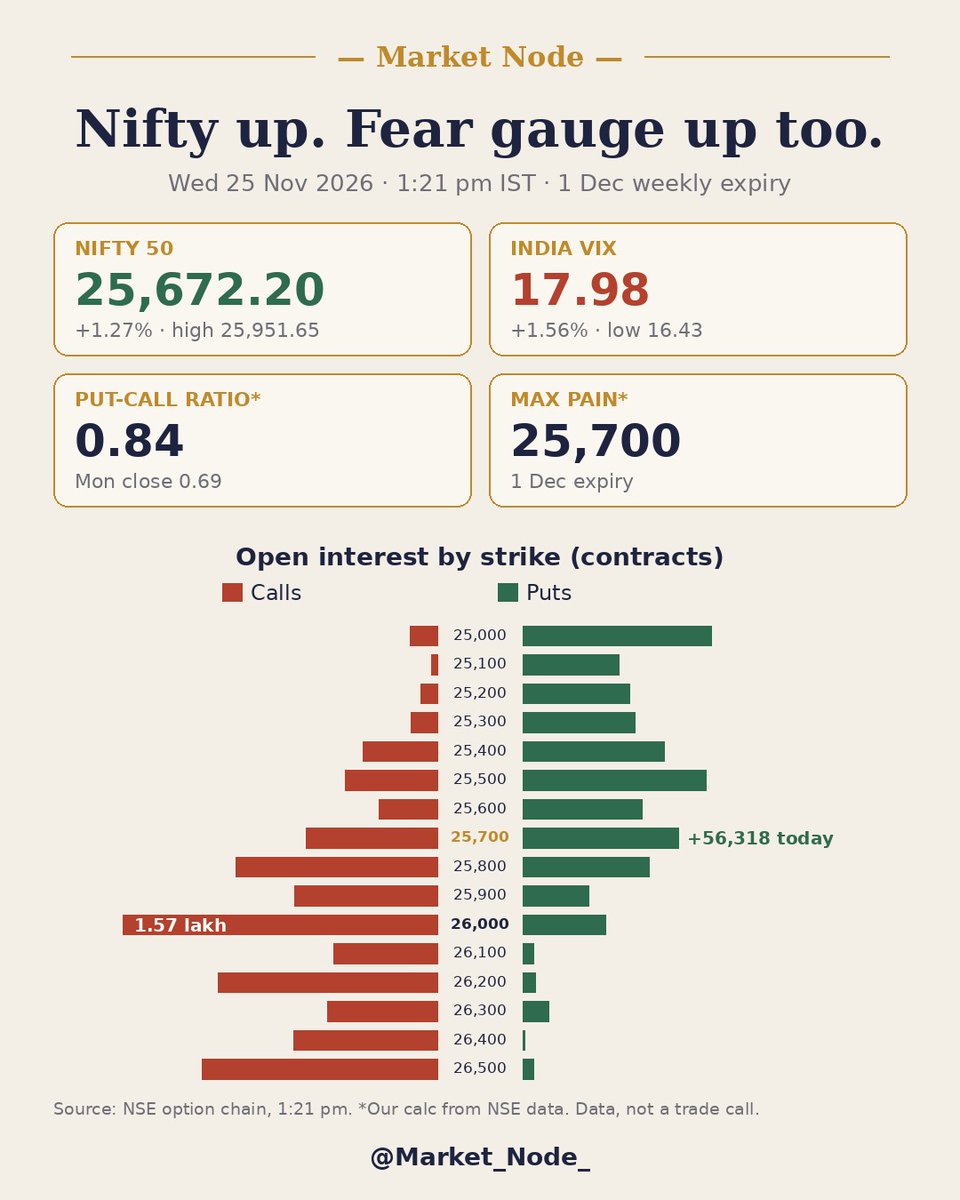
Most people think the fear gauge falls when the Nifty rises. At 1:21 pm today, both were up: Nifty 1.27%, India VIX 1.56%.
The Nifty touched 25,951.65 this morning, 48 points short of 26,000. At 1:21 pm it was at 25,672.20, about 279 points off the high.
India VIX dipped to 16.43 early, then climbed to 17.98.
What the 1 Dec weekly Nifty options show (NSE option chain, 1:21 pm, in contracts):
• Most call open interest: 26,000 (1.57 lakh), then 26,500 and 27,000
• Most put open interest: 25,000 (94,329), then 24,500 and 25,500
• Biggest put addition today: 25,700 (+56,318), right where the Nifty trades
• Biggest call addition: 26,200 (+52,496). Call writers cut positions at 25,500 and 25,600
• Put-call ratio by open interest: 0.84, up from 0.69 at Monday's close (our calc)
• Max pain: 25,700 (our calc)
December Nifty futures were up 1.27% at 25,827.70. Open interest rose about 1.2% from Monday (our calc). Price up with open interest up is what traders call long build-up. Today's addition is small.
Why can VIX rise on a green day? India VIX is built from Nifty option prices. When traders pay more for options, in either direction, it goes up.
Open interest is a snapshot. It can shift a lot by the close.
Keep this: a rising Nifty with a rising VIX means options got pricier. It does not mean traders turned calm.
When the Nifty and VIX rise together, do you read it as caution or just a big move?
Data, not a trade call.
RMC Switchgears got an order worth 3 times its market value. Its stock had still fallen about 70% in a year.
On 23 Nov, RMC told NSE and BSE it had received Letters of Award worth ₹521.84 crore for power distribution work in Maharashtra: new substations, upgraded substations, power transformers and HT lines. The filing gives 24 months to finish. The customer is not named.
The numbers:
• Order: ₹521.84 crore, about 3 times the ₹173 crore market value on Monday (Mint)
• Order book before it: about ₹1,188 crore, as the company said in September
• Q2 FY27 revenue ₹88.81 crore, down 35.2%. Profit ₹8.32 crore, down 47.9%
• H1 FY27 revenue: ₹126.05 crore, from ₹221.61 crore. The order is 4.1 times that (our calc)
• Price: closed ₹163.61 on Monday (NSE was shut on Tuesday). About ₹196 at 11:10 am today, up about 20% (Yahoo Finance; Capital Market had ₹197.45 at 10:16)
Mint, citing Trendlyne, had the stock down about 70% over one year to Monday.
The limits: the filing says Letters of Award, but the company's press release calls it a Letter of Intent with an "estimated basic order cost". An order is not revenue or profit. The company itself said in September that "billing follows commissioning, not award". Over 24 months, even a signed order lands in slices.
What to watch:
• Whether the letter becomes a signed contract
• How fast the Gujarat awards from August turn into billing
• Working capital, which the company calls its clearest priority
Keep this: for a small company, an order bigger than its market value starts a long wait before it shows up in the results.
When a small company wins an order bigger than its whole market value, what do you check first: the customer, or how fast it gets paid?
Not a buy or sell recommendation.
South Korea's market fell as much as 5.3% this morning. India's Nifty 50 still opened 1.22% higher.
Nifty 50 opened at 25,658.35 against Monday's close of 25,349.65. The change is our calculation. Sensex opened at 83,436.89 against 82,435.99 (Times Now, Zeebiz).
Sector moves at the open (Zeebiz, as of about 9:18 am):
• Private banks: +2.40%
• Financial services: +2.30%
• IT: +1.85%
• Metal: −1.53%
• Media: −1.54%
Why India opened up while Asia fell:
• Money: foreign investors bought ₹5,673 crore of Indian shares on Monday (provisional, Reuters). They have put a record $14.28 billion into Indian equities in November.
• Oil: Brent crude was near $90.8 a barrel, down about 23% this month (Reuters).
• Rebound: the Nifty fell 1.75% on Monday, led by banks. Banks led the bounce too.
Asia fell on US tariff threats and a fading tech rally. Korea and Taiwan are heavy in chip makers; India is not (Reuters, BusinessLine).
The limit: these are opening moves. They can change within minutes.
Keep this: on a day Asia's chip markets fell, Indian banks did the lifting.
When Asia is red at your open, do you wait for India to show its hand, or does the Asian screen decide your morning?
If your feed says US tech fell last night, that's half the story. Since Indian markets closed on Monday, the Nasdaq is up 4.93%.
India was shut on Tuesday for Guru Nanak Jayanti. So today is the first Indian session to see two US sessions, not one.
What happened after India's Monday close:
• Nasdaq, Monday: +6.51%, its best day since April 2025
• Nasdaq, Tuesday: −1.48%, to 23,733.54
• US chip index (SOX), Monday: +14.03%
• US chip index, Tuesday: −7.88%
Net from Friday's US close to Tuesday's (our calculation): Nasdaq +4.93%, chip index +5.04%.
Asia already traded Monday's rally on Tuesday. This morning it is trading Tuesday's fall. At 7:52 am, Taiwan's Taiex was down 6.62% and Korea's Kospi 5.05%. Both markets are heavy in chip makers.
India saw neither session. GIFT Nifty, the Nifty futures traded in GIFT City, was at 25,749.50 at 7:52 am, 399.85 points above Monday's Nifty close of 25,349.65. That is a futures price, not the opening level.
What it means, in plain words:
• IT services: Indian IT sells software and services, not chips, but it trades on the US tech mood. On Monday, Nifty IT rose 1.69% while the Nifty fell 1.75%.
• Oil users: Brent crude rose 2.27% to $91.40 a barrel on Tuesday after attacks on ships near the Strait of Hormuz. Oil marketers, paint makers and airlines pay more when crude rises. Oil producers earn more per barrel.
The limit: these cues show the mood, not where any stock opens.
After a holiday, the overnight cue is every session India missed, added up, not just last night's.
When India reopens after a holiday, do you check only last night's US close, or every session it missed?
Triveni Turbine's Q2 revenue fell just 3%. Its profit fell 41.7%. The gap is WHO it sold to:
Same company, same turbines. Exports went from 55% of revenue to 30% in one year.
Triveni Turbine, Q2 FY27 vs a year ago, as stated by Vice Chairman and MD Nikhil Sawhney on the call (12 Nov 2026):
- Revenue: ₹491 cr, −3%
- Domestic revenue: ₹340 cr, +51.8%
- Export revenue: ₹151 cr, −46.6%
- Product revenue: ₹343 cr, +4.4%
- Aftermarket revenue: ₹148 cr, −16.7%
- EBITDA margin: 17.5%, vs 26.3%
- Profit before tax: ₹75.7 cr, −39.2%
- Profit after tax: ₹53.3 cr, −41.7%
- Order booking: ₹764 cr, +17.2%, a quarterly record
- Export order booking: +49%
- Closing order book: ₹2,453 cr, +10.5%
How a 3% sales dip became a 41.7% profit fall:
1. Domestic sales grew 51.8%. Exports fell 46.6%. Exports dropped to 30% of revenue from 55%.
2. Domestic work earns less. The MD said domestic orders sit in a margin range "significantly lower" than exports.
3. One large domestic order, the strategic NTPC order, was "at a low to negative margin," he said. It was part of domestic product billing this quarter.
4. Aftermarket revenue fell 16.7%. He named both mixes, domestic vs export and product vs aftermarket, as the reason margins fell.
The orders tell a different story. Export order booking grew 49% and was 48% of Q2 order booking, vs 38%. Exports are 59.2% of the closing order book, vs 50%. The aftermarket order book more than doubled, +105.4%, to ₹639 cr.
From the call, Nikhil Sawhney:
"Apart from that, domestic orders typically tend to be around the same margin range, which is significantly lower than our export margin."
What to watch in the next filings (education, not a call):
1. Export share of revenue, against 30%
2. EBITDA margin, against 17.5%
3. Aftermarket revenue, against ₹148 cr
4. Closing order book, against ₹2,453 cr
What the data can't tell us: the call gives no margin for each segment, so the exact share of the fall from each mix is not public. The figures here are management's, as stated on the call.
Our read: Triveni did not stop selling. It sold more to lower-margin domestic buyers and less to higher-margin export ones, while its orders tilted back toward exports.
Sales tell you how much a company billed. Mix tells you how much it kept.
When a company's profit falls far more than its sales, do you check who it sold to before anything else?
Not a buy or sell recommendation.
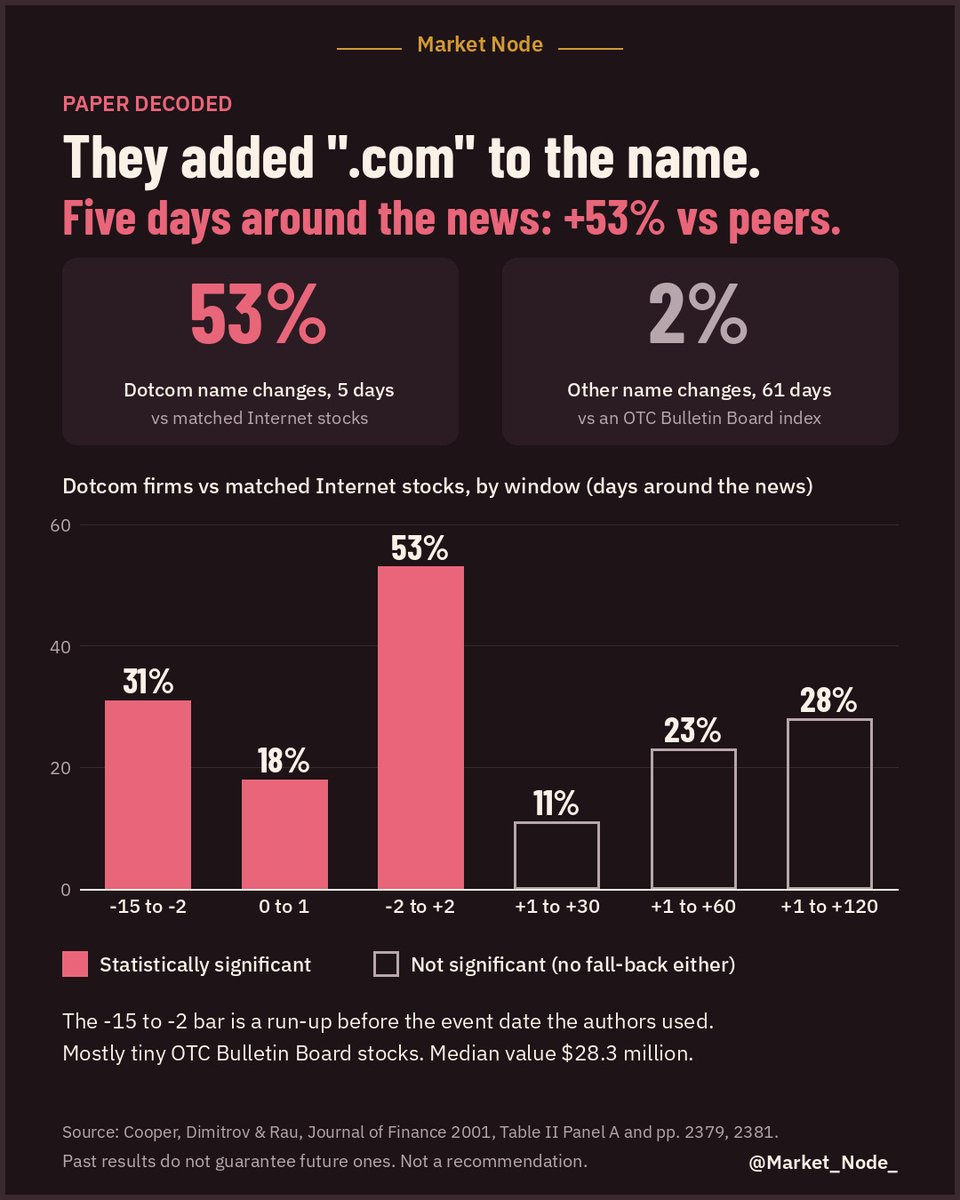
If you think a new company name can't move a stock, a 1994 study agreed: 0.4%. Then 95 small US firms added ".com" to theirs.
That's "A https://t.co/TL2GhNoqEL by Any Other Name" by Michael J. Cooper, Orlin Dimitrov and P. Raghavendra Rau (Purdue University), Journal of Finance, 2001. The question: what happens to a stock when a company only adds .com, .net or "Internet" to its name?
Method: an event study of 95 US firms that did this between June 1998 and July 1999, mostly tiny OTC Bulletin Board stocks, measured against price-matched Internet stocks.
What the paper reports:
• The 0.4% was Karpoff and Rankine's figure for ordinary name changes, over two days.
• In the five days around the news, these stocks beat the matched group by 53%. Over 10 days, on the order of 74%.
• A control group of 95 non-Internet name changes earned an insignificant 2% over 61 days.
• On the news day and the next, firms in all four Internet-involvement groups gained 9% to 30%, including 30% for the 10 firms whose core business was not Internet-related.
• Across all 95, no fall-back showed up in the 120 days after.
In the authors' words: "A mere association with the Internet seems enough to provide a firm with a large and permanent value increase."
Limits: tiny stocks (median value $28.3 million for the 66 firms with data), one hot market, unknown trading costs, and a window ending 120 days after. The authors "cannot know with any degree of certainty" if the jump was rational or a bubble.
Why it matters for Indian retail investors: the buzzword changes each cycle. A name change at a listed company comes with exchange filings, and the quarterly numbers show whether the business changed too.
The name can change in a day. The revenue behind it does not have to.
Have you ever bought a stock because of a buzzword in its name or story?
Images: page 2371 and Table II of the paper (highlight ours), plus our card.
Past results don't guarantee future ones. Not a recommendation. Do your own research.