BREAKING: Authorities have stopped an alleged ISIS-inspired mass shooting plot targeting the Mall of America before it could be carried out.
Federal prosecutors say 18-year-old Sheikhdoon Abdullahi Mohamud pledged allegiance to ISIS and initially wanted to travel overseas to fight for the terrorist group before allegedly turning his attention to Minnesota.
Court documents allege Mohamud planned to attack an Oct. 24 event at the mall, hoping to kill 30 to 60 people.
The FBI arrested him after he allegedly bought an AK-47 and 200 rounds of ammunition from an undercover agent. | @AmericaRpts@Garrett_FoxNews
JUST IN: Scientists sequence the genome of Jonathan, the world’s oldest known land animal at 194, uncovering potential clues to slowing aging in humans.
IRAN TO REPLY TO U.S. PROPOSALS THROUGH MEDIATORS
Iranian Foreign Ministry spokesman Esmaeil Baghaei says Tehran will send its response through intermediaries. He also says Iran and Oman have agreed on safe shipping routes through the Strait of Hormuz.
MARKET PULSE VIEW: The diplomatic channel remains active, but an announced route agreement does not establish that commercial shipping is operating safely.
WATCH NEXT: The U.S. response and independently verified vessel movements.
Source: Baha, citing IRIB. https://t.co/vFmXyGP6TM
Photo: EPA/Abedin Taherkenareh via Baha. #Iran #Oil
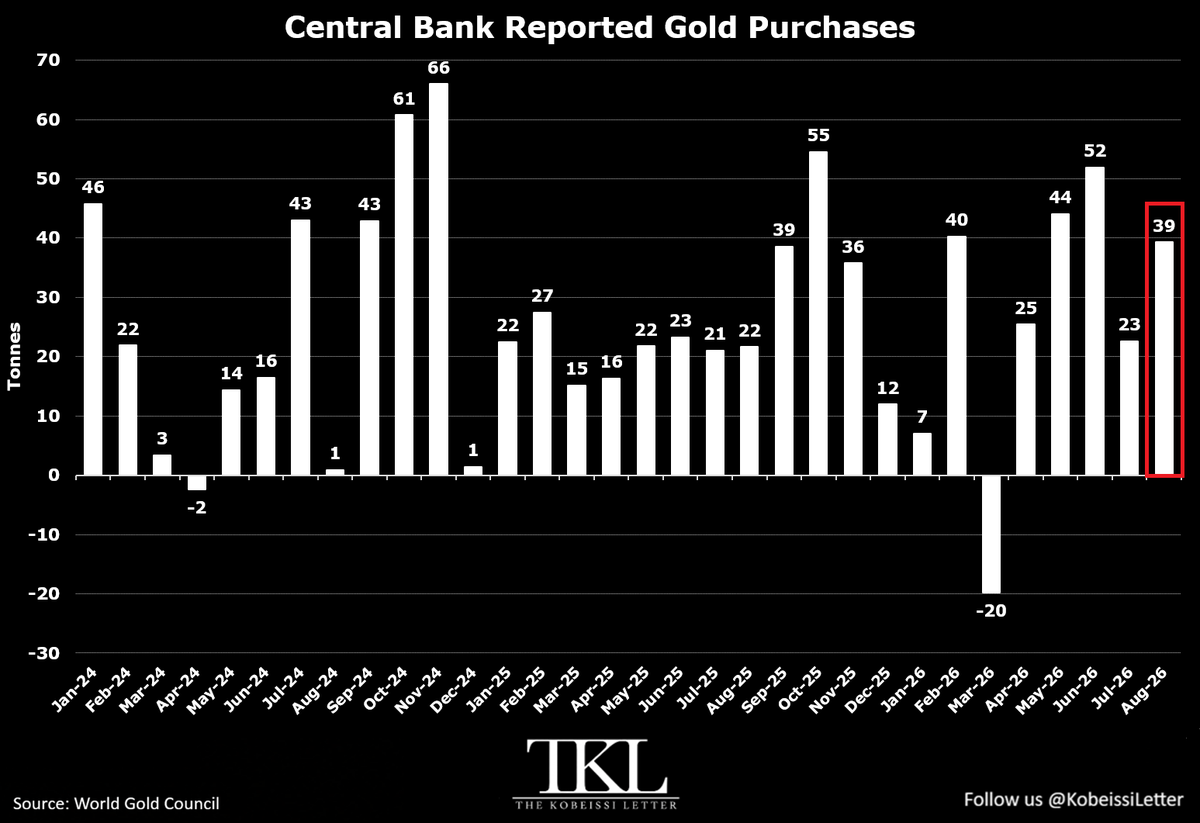
BREAKING: Global central banks acquired +39 tonnes of gold in August, marking their 5th consecutive monthly purchase.
This follows +23 tonnes in July and +52 tonnes in June.
China again led demand, adding +20 tonnes and bringing its year-to-date purchases to +80 tonnes.
China’s official gold reserves have now risen to a record 2,387 tonnes, or 9% of its total FX reserves.
Furthermore, Poland bought +8 tonnes, lifting its year-to-date purchases to +98 tonnes and total gold reserves to a record 648 tonnes.
So far in 2026, central banks have acquired +170 tonnes of gold.
Central banks continue to aggressively accumulate gold.
U.S. GRANTS AURORA FIVE-YEAR EXEMPTION FOR DRIVERLESS-TRUCK WARNING SYSTEMS
The U.S. Transportation Department said late Wednesday it approved a five-year exemption for Aurora and other qualifying self-driving trucking companies from rules requiring drivers to place warning devices around a stopped truck. Covered Level 4 trucks may use cab-mounted warning beacons instead, removing the need for a human solely to deploy reflective triangles or flares.
The decision follows an exemption application from Aurora and Alphabet’s Waymo. It concerns warning-device requirements; it is not blanket approval of every autonomous-trucking operation.
MARKET PULSE VIEW: The exemption removes a concrete regulatory and operating obstacle to broader driverless-freight deployment. Commercial impact will still depend on the final safety conditions, carrier eligibility, route expansion and fleet scale.
WATCH NEXT: FMCSA’s full conditions and which carriers opt into the exemption.
Sources: Reuters; U.S. DOT/FMCSA. https://t.co/twAyxDoDUs
Photo: Aurora official media kit, 2025 file photo. $AUR #AutonomousTrucks
🚨 MARKETPULSE ALERT | TANKER ATTACKS REACH RECORD LEVELS AS VESSEL STRUCK OFF QATAR
October 8, 2026 | HIGH PRIORITY — Escalating maritime supply risk
THE FACT
A tanker was struck by multiple projectiles approximately 94 km north of Qatar on October 7, with casualties reported by UK Maritime Trade Operations. The attackers have not been identified.
Reuters also reports that maritime security sources recorded at least 12 attacks, attempted attacks and harassment incidents involving energy tankers between September 28 and October 5, the highest weekly total since the Iran war began. The International Maritime Organization separately recorded nine incidents during that period.
WHY IT MATTERS FOR WTI
The latest attack occurred beyond the immediate Strait of Hormuz approaches, demonstrating that shipping risks extend into the wider Persian Gulf.
This development threatens the sustainability of recovering Middle Eastern oil exports. Higher insurance premiums, transportation costs and operational disruptions could reinforce the geopolitical risk premium in crude prices.
At 01:16 GMT on October 8, Reuters reported:
WTI: $89.39/barrel, up 1.26%.
Brent: $101.53/barrel, up 1.33%.
These are timestamped futures quotes, not closing prices.
BEST MARKETPULSE ANGLE
“THE GULF SHIPPING CRISIS: OIL EXPORTS ARE RECOVERING, BUT TANKER ATTACKS HAVE REACHED A NEW HIGH”
Investigate whether the increase in maritime attacks could reverse the recent recovery in Gulf oil shipments despite government efforts to stabilize supply.
WATCH NEXT: Tanker damage and cargo status, maritime insurance premiums, shipping diversions, Gulf export volumes and any confirmed interruption to loading operations.
MarketPulse assessment: HIGH — Publication-worthy.
This is a distinct escalation from previous alerts about strategic reserves, refinery margins and U.S. hurricane-related production shutdowns.
If these reports are accurate, this could trigger another major escalation in the Middle East. But the idea that striking Iran’s energy infrastructure would lower oil prices is highly questionable. Disrupting supply and threatening the Strait of Hormuz could send prices sharply higher instead.
BREAKING: US military ordered to conclude preparations for resuming major combat operations in Iran, including against Iran's energy facilities, infrastructure and nuclear sites, with US and Israeli sources saying it could happen before the US midterms and even before the Israeli elections a week earlier, per Axios.
US officials add that if major combat operations resume, the US and Israel would act in tandem with the Israeli military participating for the first time in months.
Trump spoke with Netanyahu today about Iran, their second call in days after barely speaking for weeks.
Meanwhile, White House officials and aides to Trump claim that resuming major combat operations, including strikes on Iran's energy facilities, would lower gas prices ahead of the midterms.
If these reports are accurate, this could trigger another major escalation in the Middle East. But the idea that striking Iran’s energy infrastructure would lower oil prices is highly questionable. Disrupting supply and threatening the Strait of Hormuz could send prices sharply higher instead.
🚨 MARKETPULSE ALERT | IRAQ DEVALUES CURRENCY AS OIL EXPORT CRISIS DEEPENS
October 8, 2026 | HIGH PRIORITY — Economic impact of oil supply disruptions
THE FACT
Iraq has approved a 14.5% devaluation of its currency, setting a new exchange-rate structure as the war involving Iran continues to disrupt Iraqi oil exports.
Reuters reported on October 7 that:
The new headline exchange rate is 1,520 Iraqi dinars per US dollar.
Iraqi crude exports fell to approximately 2.34 million barrels per day in August, compared with more than 3.6 million bpd before the war.
The government’s draft budget assumes exports of approximately 4 million bpd, substantially above August’s actual level.
The devaluation is intended to generate more dinars from each dollar of oil revenue, but it also increases import costs and inflationary pressure.
WHY IT MATTERS FOR WTI
Iraq is one of OPEC’s largest oil producers. Its currency decision reveals the financial consequences of prolonged export disruptions, even with Brent trading around $100.
However, the devaluation itself does not remove additional barrels from the market. The critical issue for WTI remains whether Iraqi exports recover or face further logistical disruptions.
BEST MARKETPULSE ANGLE
“THE OIL WAR IS BECOMING A CURRENCY CRISIS: WHY IRAQ’S DEVALUATION EXPOSES THE HIDDEN COST OF DISRUPTED ENERGY TRADE”
Investigate how prolonged oil-export disruptions are affecting Iraq’s public finances, the sustainability of alternative export routes and future OPEC supply availability.
WATCH NEXT
Iraqi export volumes for September and October, Basra loading activity, alternative shipping routes, budget revisions and potential changes to Iraqi production policy.
MarketPulse assessment: Publication-worthy. This is a distinct economic development, rather than another report about emergency oil reserves, refining margins or Gulf storm shutdowns.
Source: Reuters — Iraq Devalues Dinar, October 7
🚨 MARKETPULSE ALERT | SHELL AND CHEVRON SHUT DOWN U.S. GULF OIL PRODUCTION AHEAD OF HURRICANE
October 8, 2026 | HIGH PRIORITY — Confirmed supply disruption
THE FACT
Reuters confirms that Shell and Chevron have begun shutting down offshore production in the Gulf of Mexico as Tropical Storm Isaias approaches.
Shell is stopping production at five installations: Mars, Olympus, Ursa, Vito and Appomattox.
Chevron has initiated production shutdown procedures at four offshore facilities. Five other Chevron-operated facilities remain operational.
Isaias is forecast to strengthen into a hurricane before reaching the U.S. Gulf Coast early Saturday, October 10.
WHY IT MATTERS FOR WTI
This marks a material escalation from a forecast weather threat to confirmed precautionary production shutdowns.
The implications depend on how much production is interrupted and how quickly operators can restart.
A prolonged shutdown could tighten U.S. crude availability. Damage to refineries or export infrastructure could further disrupt fuel markets.
However, Reuters has not yet provided a verified aggregate volume of production affected.
BEST MARKETPULSE ANGLE
“U.S. OIL SUPPLY UNDER PRESSURE: SHELL AND CHEVRON HALT GULF PRODUCTION AS HURRICANE THREAT INTENSIFIES”
Investigate whether Isaias could turn temporary precautionary shutdowns into a sustained disruption of U.S. crude production and fuel infrastructure.
WATCH NEXT: Official Gulf production shut-in volumes, hurricane trajectory, refinery operations, offshore platform damage and restart schedules.
MarketPulse assessment: Publication-worthy because actual offshore shutdown procedures are now confirmed. This is a concrete escalation beyond earlier warnings about possible storm-related disruptions.
Source: Reuters — Shell and Chevron Cut Gulf of Mexico Output, October 8
Cenovus acquiring Athabasca Oil for C$5.7 billion, adding 45,000 barrels of oil equivalent per day to its production base. The deal brings the Leismer and Corner oil sands assets into Cenovus's portfolio, expanding its footprint in one of Canada's largest crude reserves.
Athabasca Oil has faced pressure as a smaller independent operator in a consolidating sector. Cenovus, already a major oil sands player, gains immediate production scale and proven reserves without the exploration risk. The transaction values Athabasca at roughly C$127 per flowing barrel of production, in line with recent M&A multiples in Canadian heavy oil.
For Cenovus, the deal reduces per-barrel finding and development costs by adding lower-risk, producing assets. Athabasca shareholders get certainty in a volatile commodity market. The combined entity strengthens its position against larger peers like Canadian Natural and Suncor.
MARKET PULSE VIEW
Canadian heavy crude producers benefit when consolidation reduces overhead and improves cash returns. Cenovus's cost structure matters more than size; if integration costs are manageable, the 45,000 boed addition could improve free cash flow per share at current WTI levels around $75, 80. The key risk: oil sands projects are capital-intensive, and any slowdown in crude demand could pressure returns on this enlarged base. Watch whether Cenovus commits to maintaining total capex or signals production growth expectations to the market.
WATCH NEXT
Cenovus guidance on combined capex and production targets post-close. Regulatory approval timing in Canada. WTI crude direction, deals like this improve returns most when oil sustains above $70.
Source: Cenovus Energy announcement
@BernieSanders There’s something fundamentally wrong when billionaires can accumulate enormous wealth while ordinary workers struggle with taxes and living costs. Fair taxation matters, but so does closing loopholes and making sure the rules apply equally to everyone.
@AccessTheWatch@IMAX@usairforce@AFGlobalStrike@USNavy This looks fascinating. Real footage, no CGI, no AI, and unprecedented access to America’s nuclear forces. Definitely a documentary worth watching, especially at a time when nuclear security is back at the center of global tensions.
@BoLoudon That’s a sharp line, but the situation in the Middle East is far too serious to celebrate military confrontation. Strength matters, but preventing further escalation and protecting lives should always come first.
@teslaeurope Impressive technology, especially on snowy roads. But winter driving is unpredictable, and real safety goes beyond a successful demonstration. I’d love to see how FSD performs on icy Alpine roads in Switzerland!
@dwannadi It’s heartbreaking to see barriers like these in a school. If they’re there to prevent suicides, we need to ask what kind of pressure these students are facing. Education should inspire young people, not push them to their breaking point.
@cz_binance Couldn’t agree more. Money and success mean very little without good health and family. That’s a message worth sharing, especially in a world obsessed with wealth and status. Respect, CZ!
@RadioGenoa If these individuals are engaging in violence or intimidation, they should face the law. But judging an entire generation or community based on a video isn’t fair either. France needs security, accountability and opportunities for its young people, not more division.