‘The hard power that this ship represents needs to be melded with the diplomatic effort.’
@EdLlewellynFCDO , Political Director at the @FCDOGovUK, on why the Atlantic Future Forum takes place on board @HMSPWLS .
The Arctic is warming 4x faster than the global average.
It's opening up new sea routes and triggering competition for resources. Between 2023 and 2025 Chinese operators doubled the number of container voyages crossing the Arctic. And Putin is now probing more, testing western defences to see how quickly Moscow could assert itself.
The most vital contribution we in Britain can make to European security over the next decade is deterring Russia in the high north. It's in our national interest and is what our allies, in Europe and in Washington, want us to do.
That means showing the Russians that in the event of a war we could put their bases on the Kola peninsula at risk. If Russia knows we could threaten its military infrastructure there, it is far less likely to escalate any conflict. As the former cabinet secretary and national security adviser @marksedwill argued on a British aircraft carrier in Norway just days ago, effective deterrence requires Moscow to feel some jeopardy.
The North Atlantic has always been the key to our defence. But now there can be no control of the Atlantic without security in the Arctic.
https://t.co/1DegTBH5T4
Opening @FutureAtlantic aboard HMS Prince of Wales in Oslo 👇
NATO is a defensive alliance, but effective deterrence means presenting adversaries with dilemmas, not just defending against them.
🚨 The UK and its NATO allies should consider going “on the offensive” to defend against Russia - put pressure on the Kremlin, cause them a dilemma and create jeopardy - rather than leaving the initiative with Moscow and defending against whatever Russia does, Lord Mark Sedwill, a former Cabinet Secretary and long-serving UK National Security Adviser, has said.
He said this could be done by using conventional or hybrid defences.
Lord Sedwill, a highly regarded and leading voice in the security community, was speaking on the Royal Navy’s flagship aircraft carrier in Norway at the opening of a conference attended by serving military chiefs and ministers as well as members of the defence industry from across Europe and beyond.
Lord Sedwill posed three questions for the attendees.
Firstly, how can the UK and its allies defend effectively the North Sea and the North Atlantic - Britain’s “frontline” with Russia?
Secondly, how can allies defend against Russian, Iranian and other hostile grey zone attacks such as cyber hacks, assassinations and hoax bomb threats?
But his third point was the most strident.
Here is what Lord Sedwill said at the Atlantic Future Forum:
“This is something I really do want to emphasise. It is not just about defence.
“NATO is a defensive alliance but the most effective form of defence is often to cause a dilemma, it is often to go on the offensive against our adversaries.
“So how can we present our Russian adversaries in particular with a set of strategic dilemmas?
“How do we make them feel they are under threat? Not simply leave the initiative to them and defend against it.
“That is true whether we are talking about land, sea and air but it is also true if we are talking about the hybrid space, space, cyber space and indeed in the information space as well.
“I hope we can think that through as well.
“How - whether it is in conventional defence or in hybrid defence - can we put some pressure on the Russians?
“Because deterrence requires not just effective defence, it does require there to be some jeopardy to our adversaries in continuing to probe us.”
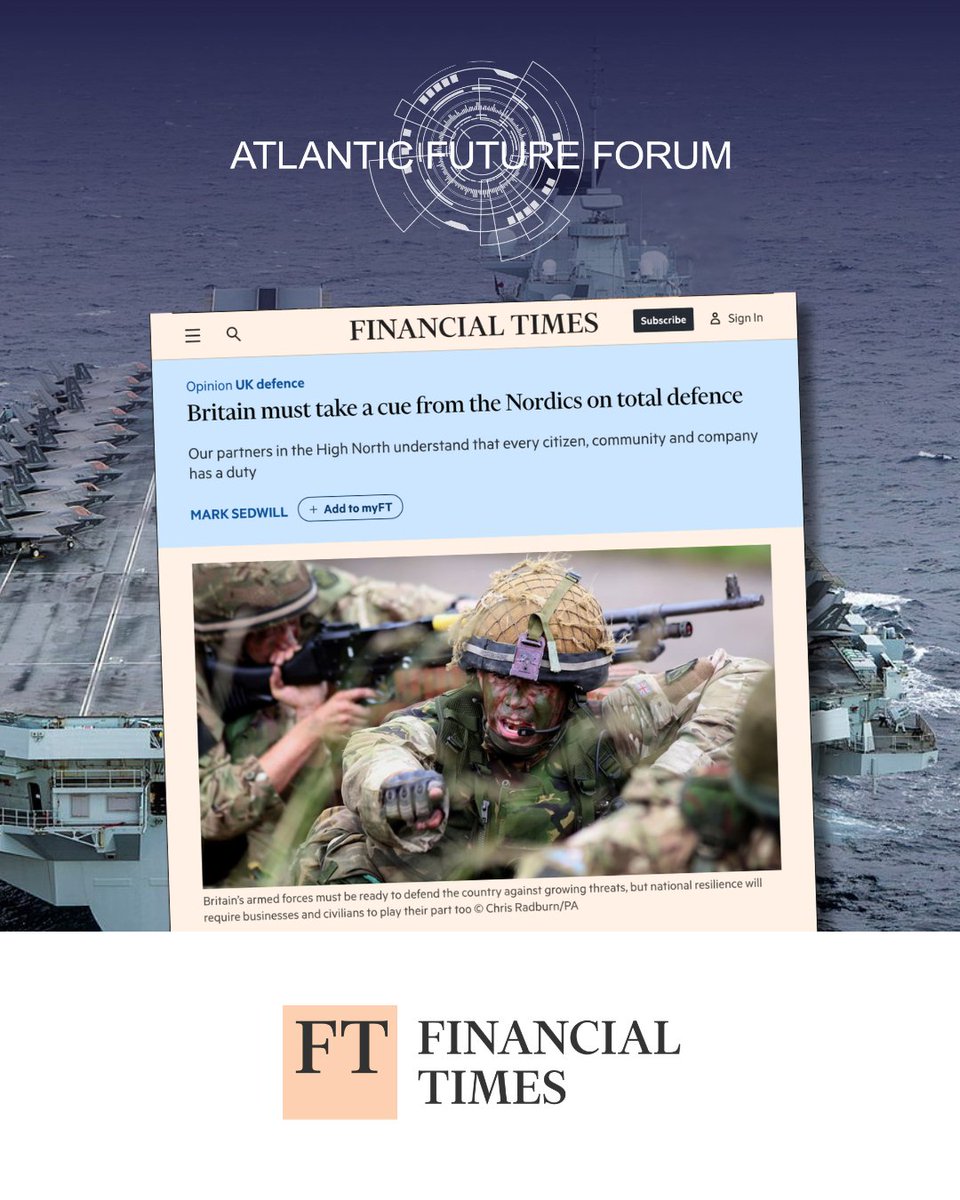
Writing in the @FinancialTimes, AFF Chair @marksedwill sets out why Britain must take a cue from its Nordic partners on the concept of total defence.
This week, HMS Prince of Wales is in Oslo to host AFF26, after exercising with allied forces in the High North
America’s voters have passed judgement on Trump’s second term. What does it mean for Britain and our allies?
Much of the America First agenda will outlast Trump. We'll still see a shift towards the Pacific, wariness of foreign wars, an economic model built on protectionism and deficits. But some of it won’t, starting with his approach to Russia.
For allies, I’d suggest three things. Hold your nerve, reach beyond the Oval Office to the rest of the American system, and become collectively more self-reliant. Mark Carney is right that if middle powers aren’t at the table, they’re on the menu, but he left out three words: “as American allies."
More from me in @politicshome today 👇
https://t.co/OC5oIiSd1G
We cannot let these attacks wipe out Ukraine's educational resources. That is why The Sunday Times is incredibly proud to partner with @Book_Aid for the our Get Ukraine Reading appeal.
They are working on the ground to get brand-new books back into the hands of students and restock the libraries whose shelves were destroyed.
Every £2 donated sends another brand-new book to a Ukrainian child or library.
Please consider supporting the appeal and sharing this thread to help us rebuild what has been lost:
https://t.co/d7066m9ruj
Could Taiwan be a flash point for future tension between the US and China?
Xi Jinping has urged President Trump to take the "correct position" on the self-governing island which Beijing claims as its own.
But the US is bound by law to provide Taiwan with the means to defend itself.
Mark Sedwill, former National Security Adviser, tells #R4Today that China is likely to continue to exert pressure.
We’re delighted to welcome the @FinancialTimes as our Media Partner for AFF26.
The FT will help shape and amplify the Forum’s content programme, with a special edition of the Political Fix podcast, hosted by @LOS_Fisher, also to be recorded on board HMS Prince of Wales.
Whether Europe can turn the money it has now promised into forces was the question that hung over Prague last week at the @IISS_org Defence Summit.
The money argument is settled. European defence spending has nearly doubled in recent years, and the procurement mix has improved - up from a quarter to 36% of budgets. Several nations now outpace Britain.
The real problem is fragmentation. Europe deploys roughly 5x as many military systems as the United States. Without proper integration - in command, industry and doctrine - we get less bang for every taxpayer buck or euro or pound.
There's also a political task. The relationship between citizen and state is shifting back toward shared resilience and defence responsibility. Most Europeans haven't caught up, because most politicians haven't made the case. In a democracy, you win that argument only by making it.
The IISS Strategic Dossier released for the summit measures the gap between current capability and what's required. It's substantial 👇
https://t.co/xnJH8UBkAv
A pleasure for me to introduce Gen David Petraeus to deliver the @LordSpeaker's lecture.
At this critical time in our history, the future isn't something that simply happens to us; it's shaped by choices, alliances, leadership. David understands that very well.
My thoughts:
Former @CIA director and 4-star US Army General David Petraeus delivered a compelling @LordSpeaker's lecture @UKHouseofLords on defence & national security.
His military leadership & experience at the very highest levels of 🇺🇸 intelligence offer important lessons for us all.
🗣️The extraordinary relationship between the @CIA, @NSAGov, MI5, #MI6 and @GCHQ is one of the West's greatest enduring strategic advantages.
Former @USArmy General and ex-CIA director David Petraeus speaking @UKHouseofLords
Britain’s next leader is right that much of Labour’s agenda can be driven “more agile governance closer to communities”, writes Mark Sedwill, a former cabinet secretary. “But conventional devolution of powers and budgets will not cut it” https://t.co/nc84bY7OaK
Illustration: Dan Williams
I've written in @TheEconomist on why Andy Burnham's first 24 hours will define his premiership.
No10 North may as well be called Manc-a-Lago unless he's serious about real decentralisation 👇
https://t.co/6yaEcRi0Uo
I see the current defence investment plans "falling well short of what is required", former defence secretary John Healey tells the Commons
https://t.co/jMqtSoaL42
John Healey’s resignation spotlights the gap between Britain’s defence ambitions and the budget. We can’t do everything everywhere. General Sir Nick Carter and I explain why Dan Jarvis must make hard choices: redesign the force to mobilise via reserves, focus on the northern flank through JEF leadership and protect our global interests.
https://t.co/gqeL0aG5uo
#UKDefence #NATO