Teaching is about making students reach the same level of understanding as the teacher—but with less mental effort.
This allows students to put their mental efforts into growing beyond their teachers.
https://t.co/iE9jhXKD0r
"Rewrite multi-join SQL into faster plans. Analyze query shape and workload overlap to find reusable intermediates."
Maybe worth a try if you have aggregating queries with many joins.
€10 for a frontier AI subscription are gone in one workday
€10 for my book SQL Performance Explained has a lasting impact on you*
https://t.co/uCueteZdDz
Learning timeless fundamentals always has a lasting effect
* you also need to read it, which takes about 1 day ;)
There's much more to defining primary keys than using surrogate id columns
@MarkusWinand introduces
Structured Primary Keys
These are based on foreign keys plus the columns needed for uniqueness
Using these can give performance & functional benefits
https://t.co/inQlvPwAHW
The SQL/JSON Path item-method .keyvalue() has an interesting history in the Oracle Database.
https://t.co/udThDNrJS2
In 23.26.2 it works, but not in ?( filter ) context.
MariaDB 12.3.2 was released last week.
It's the first "stable" version of the long-term supported (LTS = 3 years) 12.3 branch.
An SQL dialect enhancement is the IS JSON predicate. Also: a bug I reported is fixed (MDEV-38835).
All charts on https://t.co/DbUylcUDcg are updated.
MariaDB 12.3.2 was released last week.
It's the first "stable" version of the long-term supported (LTS = 3 years) 12.3 branch.
An SQL dialect enhancement is the IS JSON predicate. Also: a bug I reported is fixed (MDEV-38835).
All charts on https://t.co/DbUylcUDcg are updated.
ORDER BY Has Come a Long Way
https://t.co/rtU5aLUN6X
The ORDER BY clause is one of the best-known SQL clauses. Yet there are a number of common misunderstandings that are worth clearing up. The article walks you through the evolution of the ORDER BY clause in the SQL standard.
Should these functions return the same value?
SELECT
ROW_NUMBER() OVER (ORDER BY x),
ROW_NUMBER() OVER (ORDER BY x)
FROM ...
What about when many rows have the same value for X?
According to the #SQL standard: yes
@MarkusWinand investigates https://t.co/x5AFtRWGhp
Order-equivalent OVER clauses
https://t.co/CeM9z60F1e
About an important but rarely appreciated aspect when using multiple OVER clauses in a single query.
SQL Comments, Please!
https://t.co/Vgk1CunCGk
Standard SQL offers two flairs of comments: one starts by two dashes (--) and goes to the end of the line. The other starts with slash-asterisk (/*) and ends with asterisk-slash (*/).
#SQL#DuckDB#PostgreSQL#MSSQL
Infinite Recursion Guards
https://t.co/V3bLm5gWKh
With recursive is the only SQL construct that is not guaranteed to terminate, eventually. As the DBMS is typically a very crucial system, infinite loops must be prevented at all times. See how various SQL systems help you.
I’m a simple man.
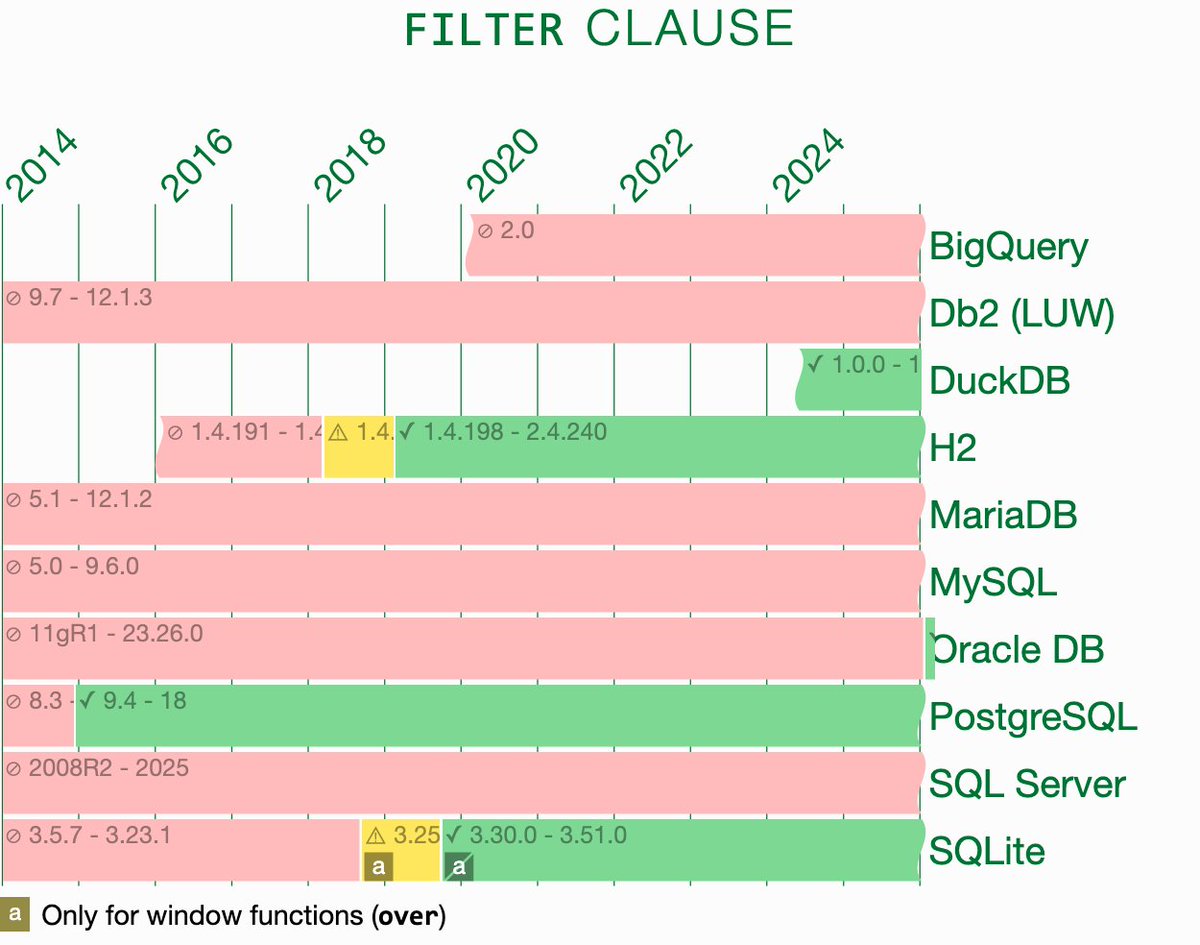
While Oracle people are ecstatic about ASSERTION in the just released version 23.26.1 of the Oracle Database, I’m happy to see something as simple as FILTER :)
🧵
I’m a simple man.
While Oracle people are ecstatic about ASSERTION in the just released version 23.26.1 of the Oracle Database, I’m happy to see something as simple as FILTER :)
🧵
FILTER was the first feature I covered on https://t.co/DbUylcUDcg, only supported by PostgreSQL at the time. Today, half the system I cover support FILTER. I cannot understand why there are still systems not support such a simple, easy to understand and useful feature.