What happens to your API uptime when a data center goes down?
If you're on a centralized provider, you wait. If you're on Chutes, traffic routes to another miner and you don't notice.
We run on Bittensor's Subnet 64. GPU operators around the world register their hardware, and our validator scores them on speed and output quality. When you send a request, we route it to the best available miner. If that miner drops, the next one picks it up.
No single data center. No single point of failure. 100% uptime over the last 90 days.
That decentralized compute is also why we can price models like this:
MiniMax M2.5 (TEE): $0.12/$0.99 vs Sonnet 4.6: $3.00/$15.00
Kimi K2.5 (TEE): $0.38/$1.90 vs GPT-5: $1.25/$10.00
GLM 5 (TEE): $0.95/$3.15 vs GPT-5.4: $2.50/$15.00
100B+ tokens per day. Production scale, not a demo.
What would you build if your inference cost dropped massively overnight?
That is why we need $TAO.
Every closed AI company eventually reveals the same truth:
you are not the customer.
You are the dependent.
They own the model.
They own the rules.
They own the distribution.
They own the upside.
You just rent access until they change the terms.
Bittensor
• open code
• open ownership
• open incentives
• open competition
The future of intelligence should not belong to a handful of companies.
It should belong to the people building, validating, and using it.
Subnet 78 is entering its next phase: Evolution.
It’s been just over two months since launching on Bittensor and we’ve learned a lot. This initial phase taught us about the constraints of the agent framework as well as its weaknesses, bottlenecks, and where it breaks. It’s also shown us where to go next.
We’re leveling up, starting today.
What’s changing:
-Focus on EEG and emotional inference research
-Design a Subnet 9-style pretraining competition
-Introduce multi-round training cycles, with emissions allocated based on validated marginal improvement against benchmark
In parallel:
-We’re exploring the use of zk proofs for inference validation
--Validators confirm inference ran on the specified model
--Moves toward a compute-based reward system, not just challenge-response
-If viable, both tracks will run in parallel.
-If not, we will prioritize pretraining.
Incentives update:
-90% miner emissions burn introduced
-Challenges continue, at reduced frequency
This adjusts rewards to reflect the current quality of outputs, while protecting long-term subnet health.
Why this matters:
We are shifting from early-stage experimentation to measurable, compounding model improvement. This creates:
-Stronger incentives for meaningful progress
-Clearer signal in miner performance
-A more stable path toward production systems
Timeline:
-30 days → inference track (research → rollout)
-49 days → pretraining track (research → deployment prep)
-60 days → full subnet upgrade (with testing)
This is a big shift, and a necessary one.
It brings us closer to building the cognition layer for real-world robotics.
That's the challenge. That’s the direction.
Subnet 78
For anyone looking to understand Bittensor from the ground up, this lecture is a great place to start in the $TAO ecosystem.
Presented by Bittensor co-founder @const_reborn at the National University of Singapore.
How do you price an AI app when your heaviest user costs you 4x what they pay?
You charge $15/mo. Your power user burns $12 in tokens. Your margin: $3.
Cap usage and power users leave. Raise prices and casual users bounce.
Third option? Let users bring their own compute.
Sign in with Chutes. Your users authenticate with their Chutes account, your app calls models, their account pays for the tokens.
Your inference cost per user drops to $0. You price based on what your product is worth.
SDK + setup wizard: https://t.co/BhrIR50GrY
If you're building an AI app right now, how are you handling inference costs? Subscription? Per-token? Something else?
https://t.co/Vflm555o5U
First NOVA Blueprint bounty paid out since upgrade
New winner:
1. Learned which reactants actually produce signal
2. Biased generation toward what works
3. Increased memory (150 → 500)
4. Coordinated global search (DJA) with local search (tabu)
5. Added anti-plateau dynamics
Net result:
A more adaptive, memory-rich, and directed search process.
Blueprint is working as intended:
Optimizers themselves are evolving under competition
🔗 https://t.co/EevQyfZEDZ
#Bittensor #SN68 #DrugDiscovery
Hippius Desktop v2 is out.
New sync engine built on Arion, our own erasure coding layer. Multi-folder sync. Conflict-free. Distributed across miners on Hippius.
Files are encrypted client-side before leaving your machine. We can't see them. Miners can't see them. Nobody can.
Download at https://t.co/FYA1Lq8Eo1
#Hippius #SN75 $TAO
OpenRouter has updated our provider status after verifying our privacy policy thanks to our recent updates
Chutes is in their default routing now!
https://t.co/WQ0CqJLCza
One thing I love about 404 (17) is that you can viscerally SEE miner progress.
Day by day, bringing people around the world to generate beautiful 3d generations.
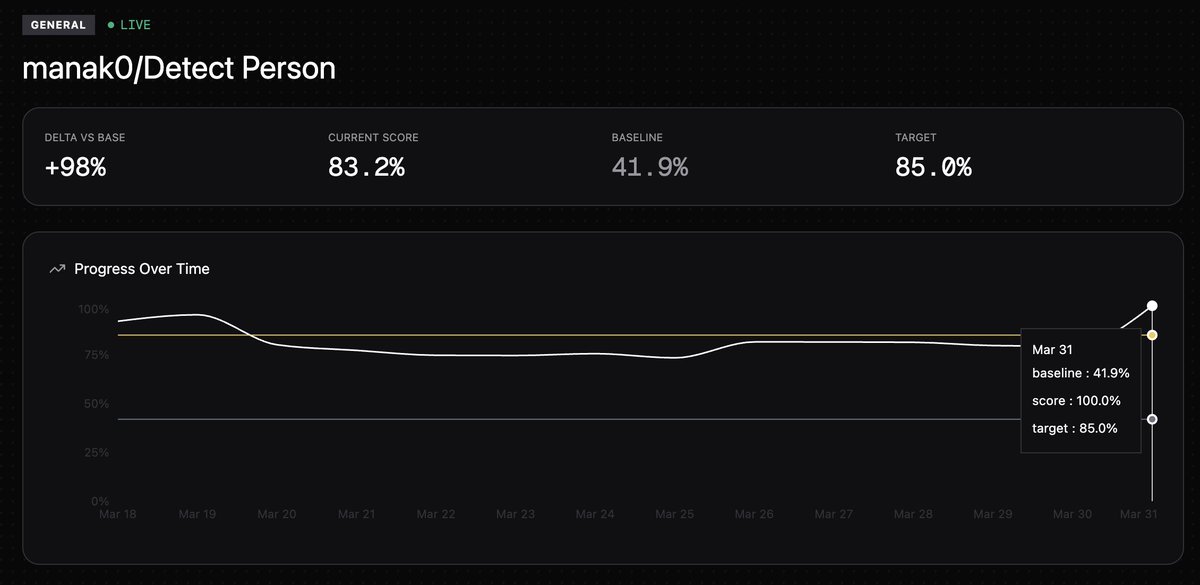
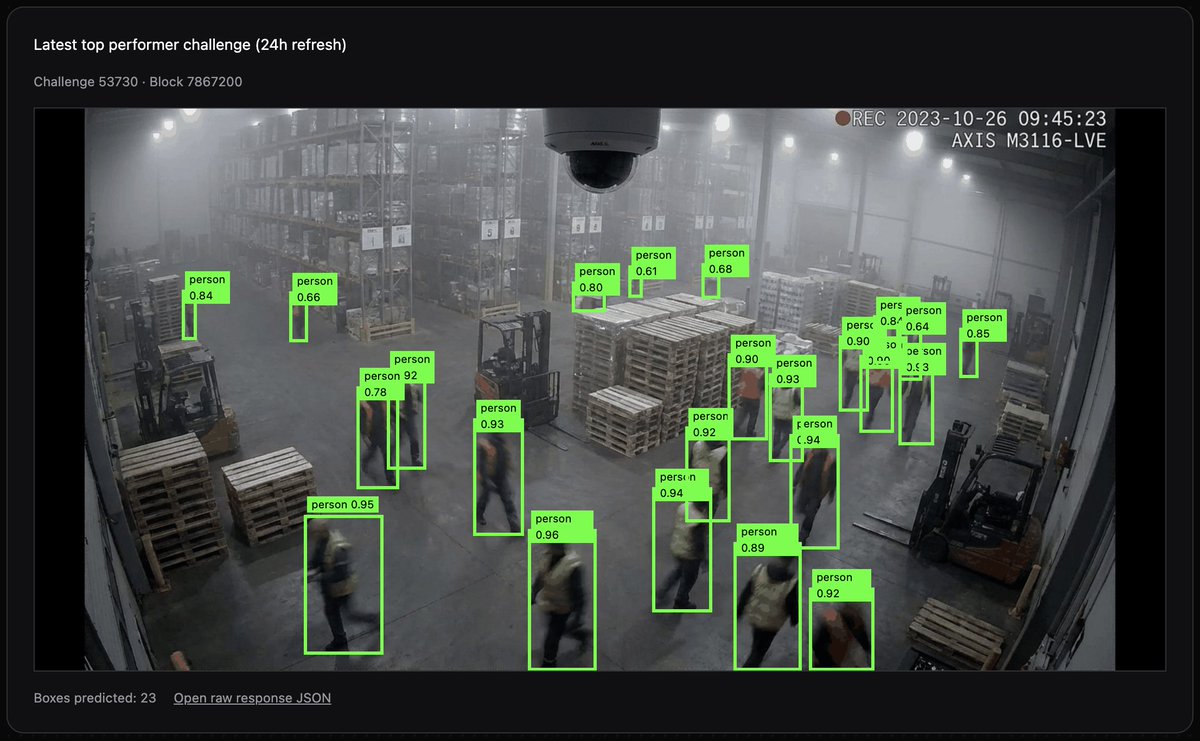
85% target accuracy on person detection on @webuildscore sn44.
today, someone just hit 100%.
this is what a decentralised vision ai network looks like when it's working.
and it's open source.