Loop V — New Car with New Coordinates. 🎬
A new vehicle. Coordinates not yet named. Connection becoming departure.
The Rider, all AI-made.
🎞 https://t.co/qg7ZB9Y6aB #AIcinema
Two travelers pass through a colour singularity.
A 19-second window into the Berlin School cosmic relay.
Full 4-minute transmission on YouTube.
Built on sovereign infrastructure — live bass coming next.
🎵 https://t.co/eFArQ44uT8
🌐 https://t.co/qg7ZB9Y6aB
The Rider · Episode I — The Rider Arrives 🎬
A lone figure crosses the threshold.
The first of an ongoing AI-cinematic series.
Aievoma Studio · AI cinematics from Slovakia 🇸🇰
Watch in 4K: https://t.co/qg7ZB9Y6aB
#AIcinematics#AIfilm
PFRC Hybrid Fusion Vehicle — Planetary Departure Study
Why does every rocket launch straight up? Because it has no choice.
Chemical rockets have no wings, no lift, no air-breathing engines. Vertical is the only option. But vertical is also the most wasteful:
90° vertical launch: 45% of thrust fights gravity, not acceleration. 35° angled STOL: only 26% — saving 43% in gravity losses.
57 years after Saturn V, we still launch the same way. Artemis SLS, SpaceX Starship — different economics, same physics. Brute force vertical. 2,600 tons of fuel to fight gravity head-on.
A hybrid fusion vehicle with wings changes this:
Earth: STOL 250m runway → Turbojet → Scramjet → Fusion. 5,102 kg total.
Moon: Pure fusion VTOL (no atmosphere). 781 kg.
Mars: Pure fusion VTOL. 1,589 kg.
Titan: Carry LOX + burn atmospheric methane → Fusion. 1,066 kg.
One ship. Four worlds. Universal design.
Wings use atmosphere instead of fighting it. Angled ascent reduces gravity losses by 43%. Fusion needs no oxidizer — works in any environment.
Falcon 9 needs 454,000 kg to orbit. This concept: 5,102 kg. That's 89× less.
The physics has always been there. We just kept building better hammers instead of inventing the scalpel.
How hybrid air-breathing fusion solves HTS magnet cooling — naturally. On the ground: 6 kW active cryocooling. In orbit: 0 kW. Vacuum eliminates convection, cosmic 3K background radiates heat away. The higher you go, the easier the engineering gets. PFRC D-He³ concept study.
Conceptual study: Hybrid air-breathing + D-He³ fusion ascent to LEO. 139× less propellant than Falcon 9. Air-breathing phases use atmospheric O₂ — no oxidizer carried. DFD nozzle Isp: 164,700 s. PIC simulation validated against PFRC-2 published data
@X Moon to Mars in days, not months.
Two Starships. One tether. He-3 fusion drive.
Spin at ~2 RPM = ~1g artificial gravity.
Lunar He-3 fuel = no Earth dependency.
99% energy to thrust = near-zero radiation.
Full redundancy = if one ship fails, crew survives.
The simplest interplanetary transport is two ships and a cable.
#Starship #Mars #FusionEnergy #SpaceX
Just posted a thread about escaping future energy crises like the one in the Strait of Hormuz right now.
Lunar He-3 mining → Cycler transport → Aneutronic fusion → Rotating O’Neill Cylinder habitats as a real multiplanetary insurance policy.
Would love to hear your thoughts – which part sounds most realistic or exciting to you?
@X Energy rules the world. Right now, the blockade of the Strait of Hormuz is pushing oil above $100–110/bbl and LNG prices sharply higher.
What if we could permanently escape geopolitical energy shocks?
Imagine this vision: Lunar He-3 mining → clean fusion → rotating space habitats as humanity’s ultimate insurance policy.
Thread below. 🚀 #SpaceEconomy #NuclearFusion
@X This is not science fiction.
With lunar cycler + Starship-class launchers + He-3 fusion, we can build it in the 2030–2040s.
A true insurance policy against energy crises, climate risks, and surface colony failures.
Humanity becomes truly multiplanetary and energy-independent.
What do you think? RT if you agree that cyclers + rotating habitats are the smart path forward.
#Multiplanetary #SpaceColony #Helium3 #ONeillCylinder
@X O’Neill Cylinder vs Stanford Torus?
Cylinder wins for a large interplanetary cycler: • Much larger living area (10–20 km²) • Slower rotation → lower Coriolis forces • More efficient magnetic shielding • Easier to scale
Stanford Torus is excellent as a smaller first module.
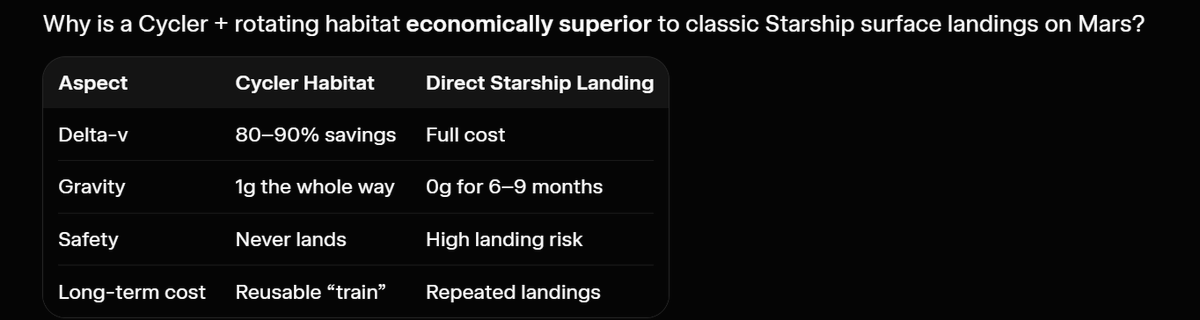
@X The centerpiece: A rotating O’Neill Cylinder as an Earth-Mars Cycler.
For 1,000–5,000 people: • Radius 500 m → 1.34 rpm = full 1g artificial gravity • Active magnetic shielding (5–20 T·m, only 100–500 kW) • 1g + radiation protection for the entire journey to Mars
No zero-g. No high radiation risk.
@X In parallel, build orbital solar power stations + data centers.
In space: 24/7 sunlight, no clouds, free radiative cooling. SpaceX is already applying for up to 1 million satellites for AI compute.
Result: cheap, scalable AI without terrestrial energy bottlenecks.
@X With lunar He-3 we enable aneutronic fusion (D-³He).
Key advantages over classic D-T fusion: • Almost no neutrons → minimal radioactive waste • Direct energy conversion → 70–90% efficiency • Fuel from the Moon = unlimited and geopolitically independent
The current Gulf crisis is accelerating investment into this “holy grail” of energy.
@X The Cycler — a repeating orbital transport system using gravity assists.
No more expensive one-way Starship flights for everything. A cycler regularly carries He-3, regolith, and materials from the Moon at a fraction of the cost.
Robotic harvesters + humanoid robots make raw materials cheap.
This drives the price of He-3 down from millions to thousands of dollars per kg.