To show the DHK perp to BJ, we just need to show that the angles beta and gamma are equal, so K is on the circle with diameters JD and AG. But beta and gamma are the small angles for the right triangles in purple, and they can be shown to be similar because the yellow right triangles are similar.
Not the easiest proof, but at least I got something a little different, and I did not resort to coordinates and algebra and SageMath...
As an additional fact, the base of the perpendicular AH, a point P on BC is also on the circle. (I had a more complicated proof, earlier, using that fact plus some dilation rotation by 90 degrees about P. But I think the purple triangle proof is simpler.)
Thanks for keeping me busy most of the weekend! 🙂
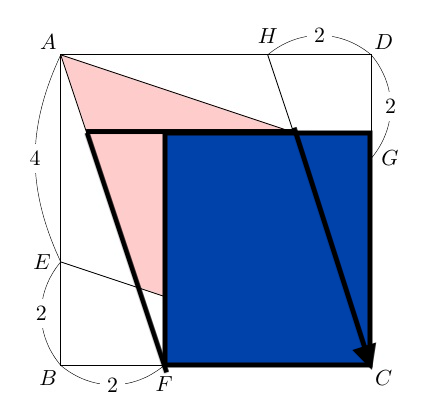
@MatildaSpicer First slide pink to make the dark bordered parallelogram, then slide horizontally to get the dark blue rectangle, with width 4 and height 6 - 3/2.
@MatildaSpicer Easy to see that the bottom left corner of the pink area has coordinates (3/2,3/2), if B = (0,0).
Then two slides turn the pink into a rectangle with sides 4 and 6-3/2, with area 18, half the area of the square ABCD.
Here is a proof via barycentric coordinates. The red line points, like D have the form (t : Sc : Sb) unnormalized, with Sc = (a^2+b^2-c^2), etc.
hen E = (0 : t+Sc : Sb), H = (0 : Sc : t+Sb), and we are off and running. Finally, we check that J = H+G-E is on the green line (Sc : * : Sa).
Slow going on Step 1. It does appear that the crossing altitudes property does not depend on the point D choice along the red altitude from A. (Does not have to be on the circumcircle.) Just connect D to E by line parallel to AC, and connect D to H by a line parallel to AB. Make EG antinparallel to AB, then find the 4th corner J of the parallelogram HEGJ. Then we need to show that J is on the green altitude from B towards AC.
There are now too many "safety lines" for me to process. I have to call in the assistance of @ohmohm
@Eduard16180 (Part of Step 2) For any triangle with orthocenter Q, we have BQ= AM iff angle C = 2 angle B. So we need to check that
cosC = 2 cos^B -1. We use the law of cosines to express the cosines , then use sagemath to factor the condition and see that c^2 = b*(a+b):
@MatildaSpicer Set AE=1, BE=x. Then big square area is (x+1)^2 and little square area is x^2+1. Results in quadratic equation 3x^2-10x+3=0. Roots 3 and 1/3.
Here is the barycentric approach. When I write (x,y,z) for b. coordinates, expect x+y+z=1, and x,y,z are the area fractions of the whole triangle obtained when the point (x,y,z) splits the triangle into 3 sections. When I write (x:y:z) that is the unnormalized b. coordinates, so the we convert to normalized by dividing each coordiante by the sum x+y+z. We start with A=(1,0,0), B=(0,1,0), C= (0,0,1), and midpoint M of BC is M= (0:1:1) = (0,1/2,1/2).
D is on the angle bisector, so D= (0: b : c) and E=(0: c: b).
ME/MC = MD/MB = (b-c)/(b+c) [ when we use the original diagram with b>c. Signs will take care of themselves when we switch to b<c later, we hope ].
The condition PE || AC means the P splits AM the same way that E splits MC, so we get P = ( b-c : c : c).
The ray BP consists of points (b-c : * : c). The line AE consists of points (* : c : b). The intersection Q=AE^BP= (b-c : c^2/b : c). The line DQ connects D=(0:b:c) and Q=(b-c : c^2/b :c), so we need to find a linear combination with second coordinate 0. Take b^2*Q- c^2*D = (b^2(b-c) : 0 : c*(b^2-c^2)) = (b^2 : 0 : c*(b+c)), giving us
c*(b+c)/b^2 = AN/NC = (c/b)*(1 + c/b)
When AN/NC = 6, we get c/b = 2.
@MatildaSpicer I found the point G ( C' in my diagram) and checked that the coordinates (11/5,7/5) worked. Then I broke the quadrilateral into two triangles, one with base 1 and one with base 2, with altitudes 8/5 and 11/5 respectively, given an area total of 22/10 + 8/10 = 3
The quadrilaterals ABA'C and ABCB' are harmonic, so the line AA' is the A-symmedian for ABC, and BB' is the B-symmedian for ABC, and D must be the symmedian point K, with unnormalized barycentric coordinates (a^2 : b^2 : c^2). Then if h is the altitude from C to AB, the blue area is (1/2) h c. Also DC'/h = (c^2/(a^2+b^2+c^2)) and we are given DC' = (1/4) c.
Thus (a^2+b^2+c^2)/area =
2(a^2+b^2+c^2)/hc=2(a^2+b^2+c^2)* 4/(a^2+b^2+c^2) = 8.
@MatildaSpicer By similarity, we have DH = (4/5) BH = 12. Then, the triangle CDE is 1/2 size of HGE, so CE = (1/2) HE and DF = (1/2) FH. Thus, x= DF = (1/3) DH = 4.