What if AI could invent enzymes that nature hasn’t seen? 👩🔬🧑🔬
Introducing 🪩 DISCO: Diffusion for Sequence-structure CO-design
14 rounds of directed evolution and over a year of wet lab work. That's what it took to engineer an enzyme for selective C(sp³)–H insertion, one of the most challenging transformations in organic chemistry.
DISCO surpasses this with a single plate. No pre-specified catalytic residues, no template, no theozyme, no inverse folding, just joint diffusion over protein sequence and structure.
📝 Blog: https://t.co/j9Za0JigfO
📄 Paper: https://t.co/ficrYNBBrM
💻 Code: https://t.co/p81sSwoaPH
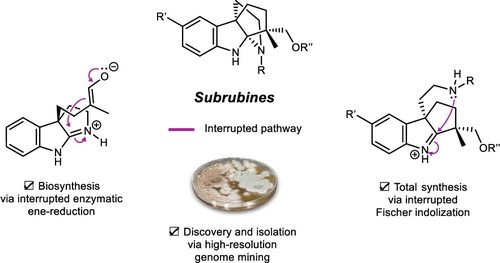
A decade-long passion project led by John Billingsley and made possible by uninterrupted collaboration with the great team at @GargLab. Propellane alkaloid discovery, biosynthesis and total synthesis. @UclaCBE@uclachem@eXoZymes
https://t.co/ULuJNgMYbd
🚨 New paper in Angewandte Chemie Novit! 🚨
Metal-free active template synthesis of catenanes — no strong binding or added templates needed!🧪
Huge thanks to Jiankang, Patrick, @enzoolivieri4, and Prof. @ProfDaveLeigh for the supervision!
👉 https://t.co/21qzFE3UKN
#Enzymatic Stereodivergent Synthesis of Azaspiro[2.y]alkanes by Jennifer L. Kennemur, Yueming Long, Catherine J. Ko, Anuvab Das, and @francesarnold at @CaltechCCE in @J_A_C_S https://t.co/exw8bND4qJ
Fully funded PhD opportunity in the design, synthesis and characterisation of artificial molecular machines - 2 years at the University of Manchester; 1-2 years at Peking University. Open only to non-Chinese nationals. If interested, please email me asap. https://t.co/jzXqwxu4Me
PhD positions (SNSF) available at the University of Basel (Switzerland🇨🇭)! Join a new research group working on innovative catalytic pathways to produce endergonic/endothermic molecules🔥.
For more details: https://t.co/4JALiJcMMY & [email protected]
@Ella_Maru Thank you Ella, reversing the fuel chirality doesn’t 100% restore the original state as not all of the polymer chains will unravel at the same time. However, the gel does re-expand and reaches 80% of its original volume before contracting again.
Out now in Nature (https://t.co/OeF5SGyEAH)! Very happy to have been a part of this journey. We have integrated a catalysis-driven molecular motor into a polymer gel network to better understand the molecular-level transduction of chemical energy to mechanical force. (1/5)
A big thank you to our excellent first author Peng-Lai, @StefanBorsley, @ProfDaveLeigh, and our collaborators Alessandro and @GiusepponeLab in Strasbourg for making this happen. (5/5)
The direction of motor rotation and therefore polymer entanglement can be changed by switching the chirality of the chemical fuel, enabling a powered expansion and re-contraction of the gel. (4/5)
Budding molecular magicians are invited to apply for a 4-year PhD studentship on catalysis-driven molecular machinery (e.g. https://t.co/qWudTDBfUo; https://t.co/Ndx2Xj9UBO; etc) available in my group, autumn 2025 start: https://t.co/azgS1NNh9z. Position open until filled😃




![EnzymeChemistry's tweet photo. #Enzymatic Stereodivergent Synthesis of Azaspiro[2.y]alkanes by Jennifer L. Kennemur, Yueming Long, Catherine J. Ko, Anuvab Das, and @francesarnold at @CaltechCCE in @J_A_C_S https://t.co/exw8bND4qJ https://t.co/E1davVfdGE](https://pbs.twimg.com/media/GwexOMnXUAMZNYb.jpg)


