On the Krugman/DeLong/Aghion/Garicano/Bergeaud/et al debate on the central issue of pty US/EU.
Let me admit my total confusion (am I the only one?). There seems to be at least three relevant measurement dimensions: PPP prices versus national prices. Quality adjustments for each. Current versus constant prices. The discussions seem to mix them in various ways. And different concepts: productivity growth, standard of living, consumer surplus.
My plan is to sit down and understand it all. But I am not there.
That pretty much all countries in the world now have a stock market, and that most of them acknowledge the critical importance of international commerce, a Weberian state, and scientific/technological advancement means that rather than declining, the West has actually triumphed.
It has become received wisdom in Brussels and Washington that there is a new “euro-sclerosis”: that the EU economy is lagging the US
This view is wrong
A little primer on the measurement of productivity – and why reports of the economic death of Europe are greatly exaggerated🧵
To a worrying extent, the US stock market is driven by a group of huge global tech players, whose revenues are 40 percent global. Economic indicators that are closer to home tell a more modest story.
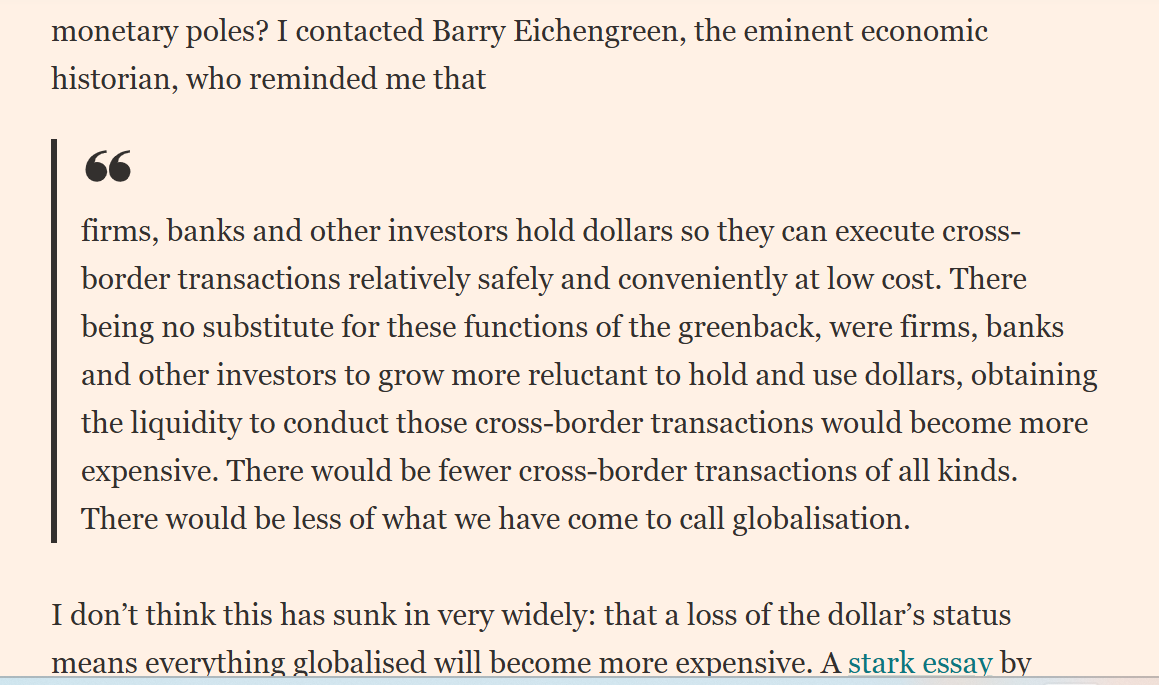
I generally agree with the distinguished economic historian Barry Eichengreen. But I think he is a bit too pessimistic here -- the euro has its limits, but I suspect it would work reasonably well as a vehicle currency that lubricates global trade and finance
1/
Ein paar Gedanken zum Manifest der 'SPD-Friedenskreise'. Die Einleitung beginnt mit einer pflichtschuldig anmutenden Verurteilung des russischen Angriffskrieges. Die Verletzung der Menschenrechte im Gaza wird angemahnt, wobei weder die Hamas noch Israel erwähnt werden, wer diese
1. Trump's tax cuts overwhelmingly help the rich
2. His spending cuts are targeted at the poor
3. Tariffs cost the poor a larger share of their income
Roll these three regressive policies together and you get the largest redistribution from poor to rich in American history.
I have a piece in @Intereconomics_ on what Donald Trump wants from Europe on trade--and what Europe's response should be. My opening here and my closing plus a link in the next post.
At a time when people are understandably focused on the daily chaos in Washington, these articles describe the rapidly accelerating impact that AI is going to have on jobs, the economy, and how we live. https://t.co/RSbMkhz3Xm
I could have never conceived that the U.S. President would be far more aggressive against a great university than he would be against a Russian dictator engaged in invading a U.S. ally. Why is it smart to starve cancer research, students on financial aid, innovation in public education and brilliant young people whose dream was to come to America while holding out the prospect of business deals to Vladimir Putin? I cannot imagine.
Lots of signs that the trade negotiations with US allies aren't going especially smoothly (the Japanese signaled through the FT that any deal was unlikely before their elections).
This shouldn't be a surprise -- the Trump "offer" isn't particularly appealing
1/
A few reactions to a thought provoking post from my friend @adam_tooze over the weekend. Some rather technical reactions, but also some big think reactions --
1/
https://t.co/ewFcIJ50tM
The pink paper isn't cheap, but it is a bargain --
Absolutely superb reporting on the biggest story around (other than the tariffs)
https://t.co/MjK3fumoeh