New newsletter: AMERICA, 1926. WHAT LIFE WAS LIKE 100 YEARS AGO ON AMERICA’s 150th BDAY
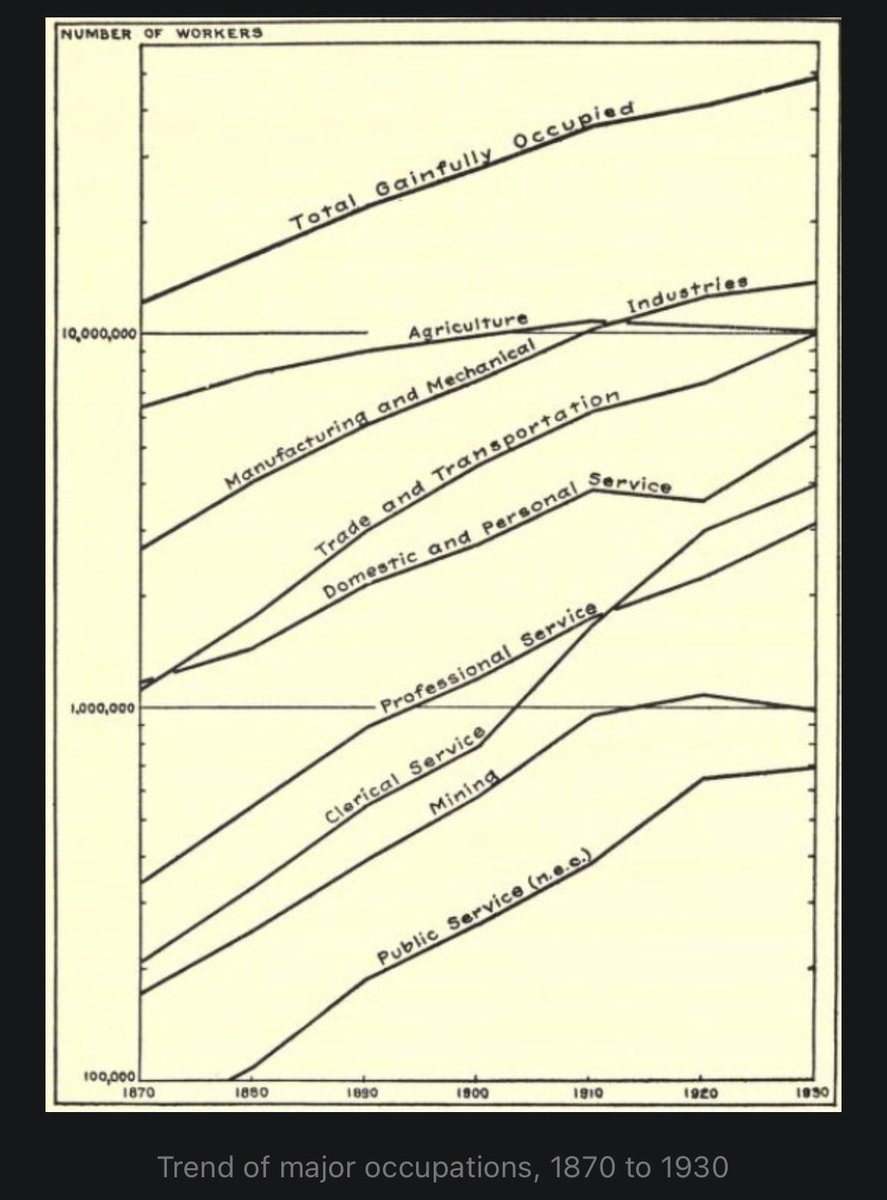
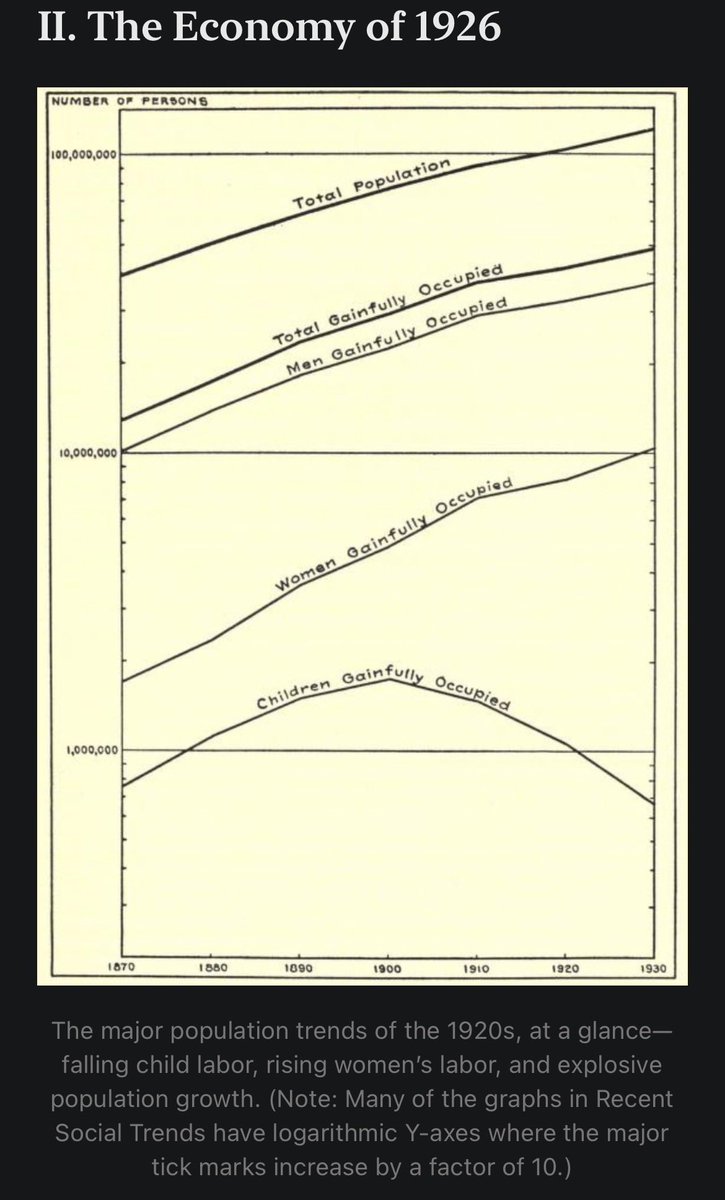
Hands down, the most fun I had writing a historical essay this year. I went through a widely forgotten, chart-filled 1,500 page report on life in the 1920s commissioned by Hoover just before the depression, to paint a picture of how much and how little has changed in the last century. Feat.:
- the booming auto and radio industries
- the rise of early female empowerment and decline of child labor
- familiar fears of technological disemployment alongside unprecedented growth
- rapid urbanization, horrific agrarian deflation, and the demise of America’s farming identity
- manufacturing is booming but nothing is growing faster than wholesale transportation and retail sales jobs
- a golden age for print
- familiar anxieties about declining birthrates and too much immigration
- and half the country still has no electricity or indoor plumbing
… all illustrated with gorgeous 100-year old graphs on yellowed paper.
https://t.co/mHvm0NxglC
“The surest way to work up a crusade in favour of some good cause is to promise people that they will have a chance of maltreating someone. Men must be bribed to build up and do good by the offer of an opportunity to hurt and pull down. To be able to destroy with a good conscience, to be able to behave badly and call your bad behavior ‘righteous indignation’—this is the height of psychological luxury, the most delicious of moral treats.”
Aldous Huxley. Introduction to Erewhon, by Samuel Butler, 1934
@Super70sSports These were the keys I used the first time my Mom allowed me to back the car down the driveway so I could shoot hoops on my 8 foot rim. It was a dunk fest.
Anthropic co-founder Dario Amodei has been saying this for over a year now. And he keeps saying it. Louder each time.
In May 2025, he told Axios that AI could eliminate 50% of all entry-level white-collar jobs within five years and push unemployment to 10-20%. In January 2026, he published a 20,000-word essay calling AI “a general labor substitute for humans” that will cause “unusually painful” disruption.
At Davos, he warned of a “zeroth world country” forming in Silicon Valley, decoupled from the rest of society, running at 50% GDP growth while everyone else faces mass joblessness. In his own words: “We, as the producers of this technology, have a duty and an obligation to be honest about what is coming.”
And the data is starting to back him up. Tech entry-level hiring dropped 30-50% in 2025. Wall Street banks are cutting ~200,000 roles concentrated at the junior level. S&P 500 companies shed employees in net terms for the first time since 2016. Anthropic’s own labor market research confirmed that 77% of businesses use Claude to automate tasks, not to augment workers.
Now another Anthropic co-founder is echoing the same message:
“There is a real possibility that AI will displace human labor at a very large scale. Supporting those people will be a moral imperative of historic proportions.”
This is no longer a warning from the sidelines. This is the company building the technology telling you, repeatedly, that the disruption is real, it’s fast, and society is not ready for it.
@creepydotorg The weak minded are easily influenced to believe those they deem to be authorities, instead of thinking for themselves. Unfortunately, the weak minded outnumber critical thinkers by a wide majority. History makes this clear, and it’s clear today.
Favorites went 16-0 yesterday.
This year's first round had 13 of 32 games decided by 20+ points.
High Point only true mid-major still alive, and its NIL is probably most of any team in 1-bid league.
I hate to admit it, but due to NIL & transfer portal, Cinderellas may be dead.
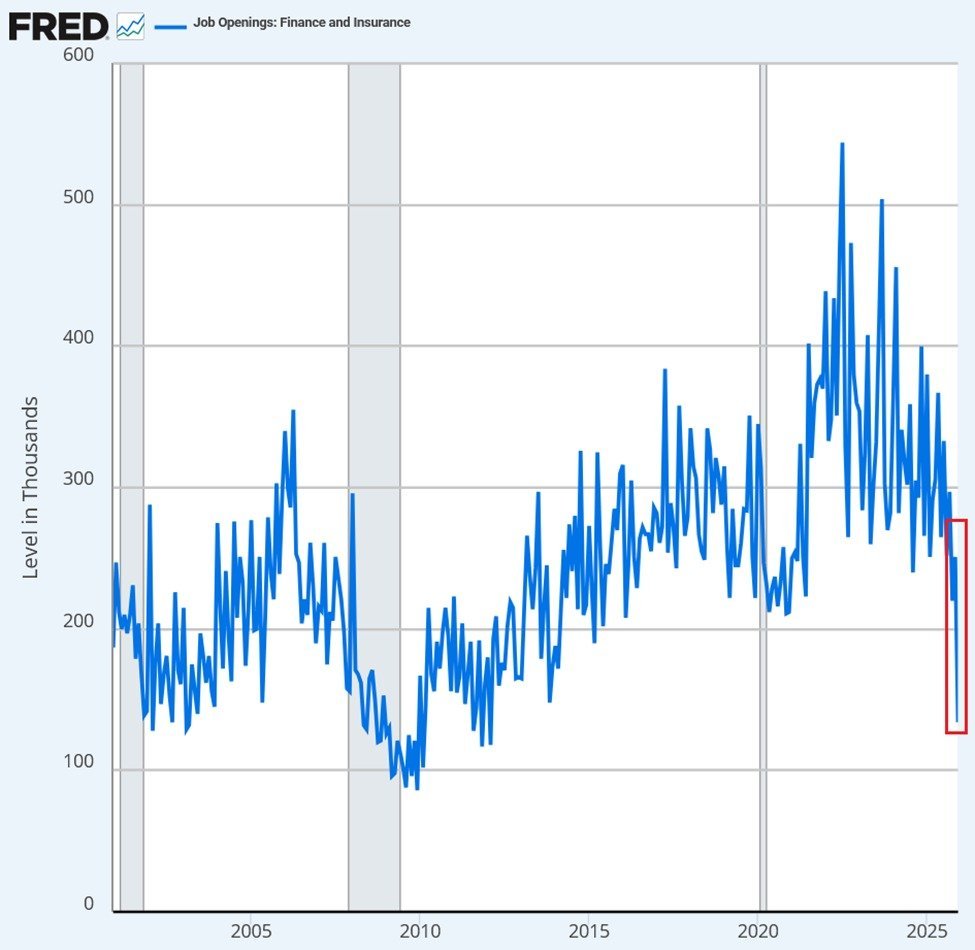
AI is coming for the desk jobs, and finance and insurance are right at the top of the menu.
Finance and insurance job vacancies saw a massive collapse, dropping by 117,000 to reach a historic low of 134,000, which is the lowest level since February 2012.
This brings available roles down by 75%, erasing 410,000 open positions since the 2022 peak.
These availability numbers are now worse than the lowest point of the 2001 recession.
For context, the biggest monthly drop during the 2008 financial crisis was 125,000. And now we're nearly there in one month, without a crisis.
---
Some recent numbers
- Morgan Stanley just announced in Mar-26 that they are firing 2,500 workers across their global operations despite having record revenue.
This huge cut represents about 3% of their entire workforce and impacts their investment banking, wealth management, and trading divisions.
- Citigroup is axing 1,000 employees in early 2026 as part of an ongoing corporate overhaul.
This specific round of firing is a major step in their long-term plan to eliminate 20,000 roles by the end of the year to modernize their aging technology and lower operating costs.
- TD Bank recently slashed around 2,000 roles, which makes up about 2% of their total global staff.
These cuts started hitting hard in Oct-25 and continued into early 2026 as the bank tries to pay for massive regulatory fines related to their recent money-laundering scandals.
- Block, the major financial technology company that runs Square and Cash App, fired more than 4,000 people in Feb-26. This brutal cut wiped out nearly half of their entire workforce as the company pivots to using AI for their daily operations.
- JPMorgan Chase has been conducting silent, rolling batch cuts into early 2026 to systematically boost their profit margins.
Instead of announcing one giant layoff, they are slowly locking employees out of the system department by department to avoid negative press while maximizing their efficiency ratios.
Big Ten players
Purdue (3)
- Braden Smith
- Fletcher Loyer
- TKR
Michigan St. (2)
- Jaxon Kohler
- Carson Cooper
Michigan (1)
- Will Tschetter
Nebraska (1)
- Sam Hoiberg
Northwestern (1)
- Nick Martinelli
Ohio State (1)
- Bruce Thornton
Oregon (1)
- Nate Bittle
The arguments about Iran are so polarised that no one wants to admit that several things are true at once:
You'd be a fool not to have serious reservations about the idea of a regime change war, especially in the Middle East.
You'd also be a fool to allow terrorist-funding lunatics to develop nuclear weapons.
Neither the people condemning these strikes, nor the people cheering them on know how this is going to work out.
So far, Trump Administration interventions have been extraordinarily successful in achieving valid objectives within a highly limited scope.
The strikes on Iran during the 12 day war achieved destruction of several nuclear facilities.
The Venezuela operation decapitated the hostile regime and replaced Maduro with a non-hostile leader.
Both also achieved significant "don't fuck with us" deterrence globally.
However, it is not remotely clear at this moment in time whether something similar can be achieved in Iran.
I understand and fully empathise with the people who think regime change is not going to work in Iran and you'll end up with the same as what you had or worse.
And I understand just as much the people who celebrate an evil dictator being killed and Iran's nuclear and military assets being degraded further.
The thing we do not know, and the thing that will determine whether this has all been worth it, is what the future leadership of Iran will look like. This seems to me to be the biggest risk Donald Trump has taken at any time in his first or second term. If it pays off, the reward both domestically and globally will be huge. If it doesn't and things go south, it could derail his Presidency and define his legacy like Iraq did for Blair and Bush.
Very few people have any idea which of these scenarios is more likely and one thing is for sure: none of them are talking about it on social media because they're all sitting in command bunkers, not on X.
I hope the people of Iran are released from living under tyranny. I hope the peoples of the Middle East can live in peace.
I hope the takeaway for any would-be terrorist is the realisation that October 7 might not have been such a good idea.
I hope that with the Middle East stabilised, the US can turn its attentions to the theatres that really matters to the security of the West: Russia and China.
Whether any of that happens remains to be seen and it seems the hardest thing for anyone to do is to not express an opinion before the smoke has cleared.
@kimmonismus The correct move is to keep moving forward while proactively discussing governance and safety. Can’t afford to fall behind other companies/countries so it’s not feasible to slow down. But planning safeguards also doesn’t have to wait.
Dario Amoudei - The public is not aware of what’s about to happen.
„there doesn’t seem to be a wider recognition of society of what’s about to happen; it’s as if this tsunami is coming at us and it’s so close, we can see it at the horizon.“
The solution for our democracy is more democracy.
It’s not enough to let people vote against one of two uninspiring general election candidates.
All voters should get to vote FOR who those candidates even are in the first place.