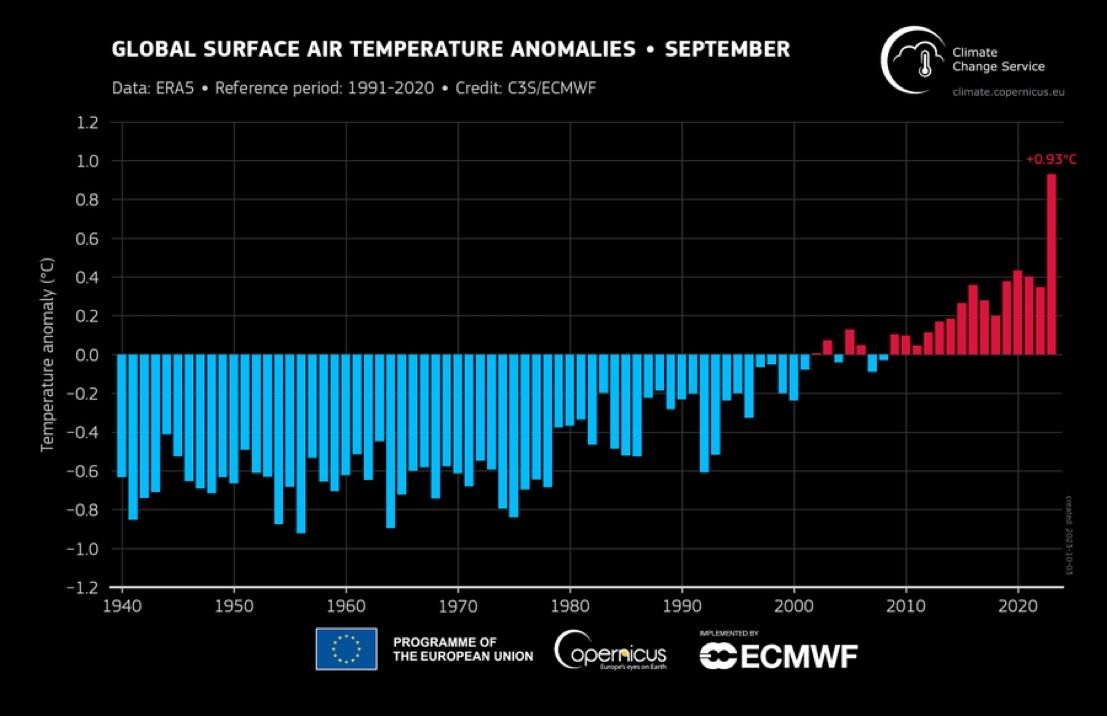
We do understand the #globalwarming caused by fossil fuels - for four decades it’s been going as predicted.
But we don’t understand the surprise upward leap that is happening now.
And that worries me.
I'm extremely grateful for the dedication and hard work of @danielapai , @tim_lichtenberg , @stellar_cyan , Arnaud Salvador, and @kevinkhu , without whom we couldn't have pulled this off!
You know you are being paid to find aliens when your paper ends with "extraterrestrial life in the Universe". I'm thrilled to share our new paper about testing the habitable zone hypothesis by studying its demographic imprint on the exoplanet population: https://t.co/bb3vMdqkKH
Overall, the Habitable Zone Inner Edge Discontinuity is a robust prediction of planetary climate models and provides near-future exoplanet missions with a unique observational test of the habitable zone hypothesis.
Amazing interdiscplinary research from departments in @UArizonaCALS @azengineering@UAZScience, testing & scaling the ability of algae to remove carbon from the atmosphere, a potential tool to help ward off the worst impacts of climate change. (1/2) https://t.co/CsgM9Rtx0M
There is also a striking dearth of very short-period planets around more massive M dwarfs. We hypothesize that planets might be trapped at the inner edge of a magnetic "dead zone" in the disk.
The punchline is: M dwarf stars are not just small Suns.
Do planets around very low-mass stars form in the same way as those around stars similar to the Sun?
Our just released comparison between discovered planets around M dwarfs and state-of-the-art planet formation models suggests otherwise. https://t.co/bBmXjSwL3a
1/
Even the smallest stars seem to host giant planets, which current theories fail to reproduce. We find that suppressing planet migration, e.g., through structured protoplanetary disks, would resolve the dilemma.
2/
@arXiver@CARMENES_exopl oh, the conversion from PDF didn't go that well for our 2D histogram plot here 😬
I recommend checking it out in the paper ;) https://t.co/bBmXjSwL3a
It was fun to speak with Ryan Fish from @kgun9 about our CO2 removal project - great summary of our project in the 5pm news: https://t.co/NUBag5n6q9 @TheAtmospherica
Atmospherica in the news: Read about how we combine astrobiology, biotechnology, and ecology to remove carbon dioxide from the air:
https://t.co/GsfweXKcfB @UArizonaLPL @azstewobs
Honored to share with you this very exciting project at @uazresearch!
Past failures in reducing GHG emissions make it necessary to remove CO2 from the atmosphere. Our approach involves a special algae species and a novel type of bioreactor. https://t.co/jx6ItRS7TW